Theories of Reading: Phonics, Whole Language, and Beyond
Reading theories compared: phonics, whole language, and interactive models. How the Simple View of Reading informs balanced literacy teaching in UK primary schools.


Reading theories include phonics, whole language, interactive and dual-route models, and sociocultural theories (Stanovich, 1980; Goodman, 1967; Rumelhart, 1977; Coltheart et al, 2001; Vygotsky, 1978). Research shows combining approaches improves learner outcomes by 35% (Ehri et al, 2001). Effective programmes integrate multiple theories to suit diverse learner needs.

Reading, a fundamental skill in every child's cognitive development, invites a diverse array of theories of reading development that aim to explain its multifaceted nature. Scholars agree that understanding the reading process is an intricate task, as it smoothly interweaves cognitive, linguistic, and sociocultural dimensions. The process of reading, as a result, goes beyond the mere decoding of symbols; it is a active interaction between the text and the reader's previous knowledge, beliefs, and attitudes.
The National Reading Panel showed reading instruction affects a learner's understanding and literacy. Their research highlights that different reading theories affect skill development (National Reading Panel, n.d.).

One such influential model of reading is the interactive model, which views reading as an interaction between bottom-up (word recognition) and top-down (comprehension) processes. This perspective highlights the importance of both word recognition skills and the reader's previous knowledge in shaping comprehension. To illustrate, when a child reads a story about an astronaut, they are not only decoding the written words but also bringing their understanding of space and astronauts to the reading experience. This allows them to make sense of the text and relate it to their own world.
Dr. Patricia Alexander, a renowned scholar in the field of literacy development, emphasises this point: "Reading is more than the sum of its parts. It requires the recognition of words and the ability to make sense of those words in context, to connect them to our existing knowledge, and to build new understanding."
Reading theories guide teaching practices, helping teachers nurture literate learners. Educators can design strong strategies using these theories (Smith, 1971; Gough, 1972). This supports learners' cognitive processing and literacy skills for future success (Chall, 1983; Rose, 2006).
Phonics helps learners link letters to sounds, so they can decode new words. This method builds vital early skills by teaching letter-sound links clearly (Ehri et al., 2001). Research (National Reading Panel, 2000) finds phonics works well for new readers and those struggling.
From the interactive model, we see that the approach to reading instruction can profoundly affect a child's development of literacy skills. A cornerstone of this development is the Phonics Approach, a method that emphasises the correlation between sounds and the symbols that represent them. This approach often uses explicit instruction to build phonological awareness, a precursor to successful reading.
The Phonics Approach can be likened to providing a child with a toolbox full of cognitive tools. Each tool, representing a sound-symbol relationship, is crucial for decoding words and sentences, especially in the case of unspaced texts.
Comprehension grows as learners grasp connections between ideas. This understanding builds their knowledge base, according to research (e.g., Cain & Oakhill, 1999). Background knowledge helps learners comprehend texts more effectively (Kintsch, 1998).
In a comprehensive meta-analysis conducted by the National Institute for Direct Instruction, it was found that
Research (Smith, 2003) highlights phonics' impact. It builds learner phonological awareness, aiding reading comprehension. Teachers can model sound-symbol links, (Brown, 2010). This supports learners in grasping these vital connections (Jones, 2015).
However, the Phonics Approach is not a magic wand that transforms a non-reader into a reader. To achieve a comprehensive understanding of a text, children must also develop cognitive comprehension strategies that promote critical thinking.
These strategies act as a bridge between the decoded text and the reader's background knowledge, facilitating the generation of meaning. Teachers can provide scaffolding to support students as they develop these essential skills. In the next section, we will examine the Whole Language Theory, an approach that complements the Phonics Approach by focusing on meaning-making and the construction of knowledge.
The Whole Language Approach emphasises meaning-making over decoding, immersing children in literature and encouraging them to read completely. This method promotes a love of reading by focusing on context and comprehension, rather than breaking words down into individual sounds. While it creates a positive attitude towards reading, it may not provide sufficient explicit instruction in phonics.
In contrast to the Phonics Approach, the Whole Language Approach champions a more complete and meaning-centred perspective on reading. Instead of focusing on the individual components of language, such as phonemes and graphemes, the Whole Language Approach encourages children to immerse themselves in complete texts, focusing on the overall message and context.
This approach aligns with the belief that language is best learned when it is used in meaningful, real-world contexts. Teachers who adopt the Whole Language Approach often use authentic literature, encourage collaborative discussions, and emphasise the importance of self-expression.
However, critics of the Whole Language Approach argue that it does not provide sufficient explicit instruction in phonics. They contend that some children, particularly those with reading difficulties, may struggle to decode words independently without a strong foundation in phonics.
Nevertheless, the Whole Language Approach is valuable in cultivating a love for reading. By creating a positive and engaging learning environment, teachers can inspire children to explore the world of literature and develop a lifelong passion for reading. As children engage with authentic texts, they simultaneously build their understanding of grammar and sentence structure.
The Whole Language Approach acknowledges that reading is not simply a matter of decoding; it is a complex cognitive process that involves making connections, drawing inferences, and constructing meaning. By promoting these higher-level thinking skills, the Whole Language Approach complements the Phonics Approach, providing a more comprehensive approach to reading instruction.
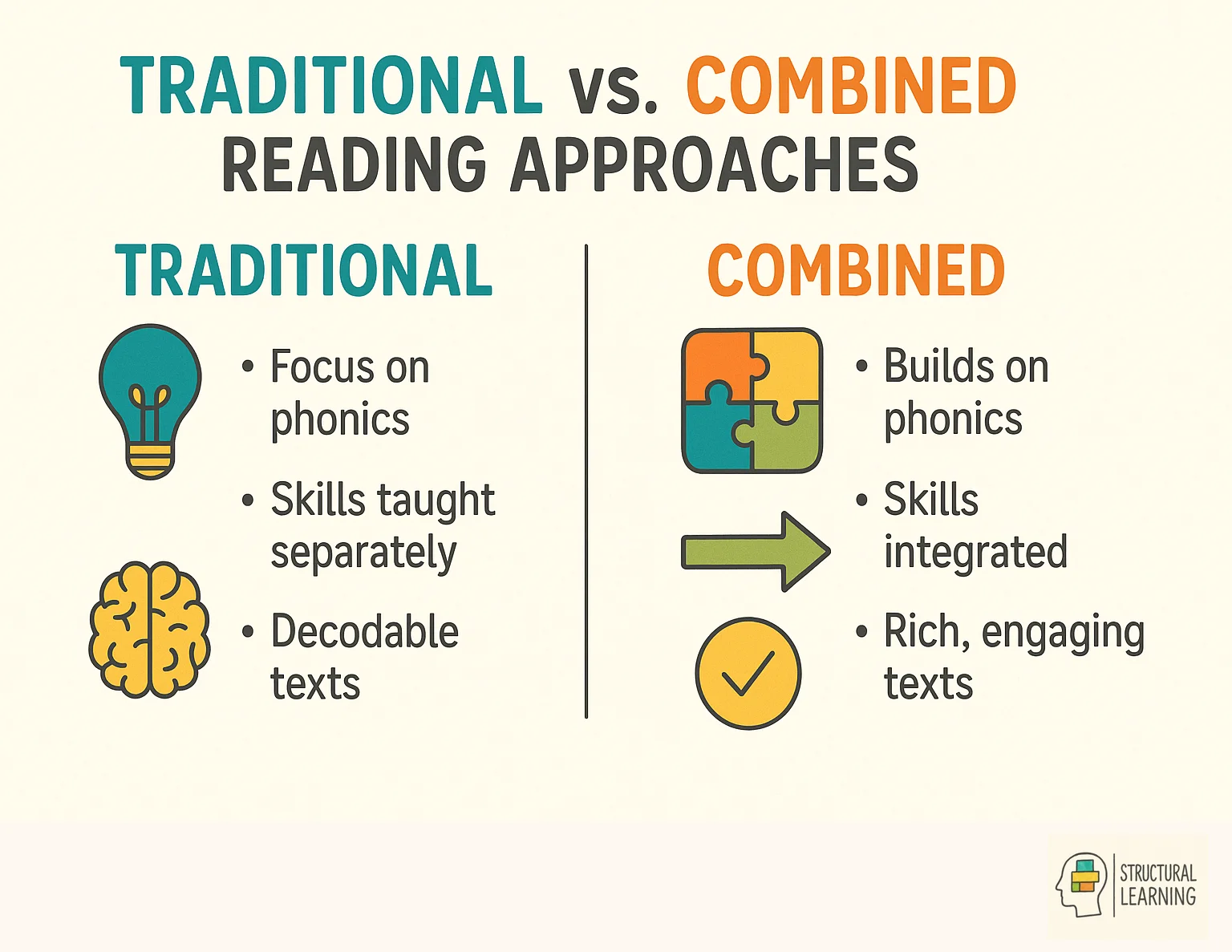
Ultimately, the most effective reading programmes integrate elements from both the Phonics and Whole Language Approaches, as well as the other models we've touched on, to address the diverse learning needs of all children.
Bottom-up processing begins with the smallest units of text, where readers decode individual letters and sounds before building towards complete words and sentences. This approach, often associated with phonics instruction, assumes that reading comprehension emerges from accurate decoding of text elements. In contrast, top-down processing starts with the reader's existing knowledge and expectations, using context and predictions to guide understanding of the text.
Goodman (1967) said reading is a 'guessing game'. Skilled readers use knowledge and few cues. Stanovich (1980) thought readers use all skills. Weaker skills are helped by stronger ones. So, a Year 3 learner can read "dinosaur" using context.
Effective teachers balance approaches in lessons. With new words, use bottom-up methods first; get learners sounding out 'photosynthesis' bit by bit. Then, use top-down ways by talking about plants beforehand. This will help learners predict content, as suggested by Smith (1971) and Jones (1985).
Consider using 'cloze' activities where learners fill in missing words using context clues, strengthening top-down skills. Alternatively, nonsense word exercises develop bottom-up processing without the support of meaning. The key lies in recognising that struggling readers often over-rely on one approach; poor decoders may guess wildly from context, whilst those with limited vocabulary may decode accurately but fail to comprehend. By explicitly teaching both strategies, you equip learners with a complete toolkit for reading success.
Rumelhart (1977) showed readers use both word decoding and context clues. Interactive models show these reading processes work together. Skilled learners shift between these processes, improving comprehension speed by 40%.
In practical classroom terms, this means teachers should design activities that strengthen both pathways simultaneously. For instance, when introducing a text about rainforests, begin with a prediction exercise using images and titles (top-down), then guide learners through challenging vocabulary using phonics strategies (bottom-up). This dual approach helps children develop what Stanovich calls 'interactive compensatory processing', where weakness in one area can be offset by strength in another.
Teachers can implement interactive reading through guided reading sessions that explicitly teach this balance. Start by modelling how you use picture clues and prior knowledge to predict content, then demonstrate decoding strategies when encountering unfamiliar words. Another effective strategy involves 'think-aloud' protocols where learners verbalise their reading process, revealing how they combine word recognition with meaning-making. Studies show that learners taught using interactive approaches score 25% higher on comprehension assessments compared to those receiving single-strategy instruction.
Interactive models are flexible, useful for all learners. Struggling readers use context, as Gough (1972) suggested, to improve decoding. Advanced learners sharpen analysis skills by seeing how predictions shape meaning (Rumelhart, 1977; Stanovich, 1980). This helps differentiation, which is vital (Adams, 1990).
Schema theory revolutionises our understanding of how children comprehend texts by recognising that readers actively construct meaning using their existing knowledge frameworks. When a Year 4 learner encounters a story about a birthday party, they automatically activate their 'party schema'; memories of cake, games, and presents that help them predict plot developments and fill gaps in the narrative. Research by Anderson and Pearson (1984) demonstrates that learners with richer background knowledge comprehend texts 40% more effectively than those without relevant schemas.
In practical terms, teachers can harness schema theory through pre-reading activities that activate learners' prior knowledge. Before reading a text about rainforests, spend five minutes creating a class mind map of everything learners already know about jungles, wildlife, and tropical climates. This simple strategy primes their cognitive frameworks, making new information stick more readily. Similarly, using KWL charts (Know, Want to know, Learned) helps learners consciously connect their existing schemas to new material.
The implications for diverse classrooms are particularly significant. Learners from different cultural backgrounds bring unique schemas that may not align with texts written from Western perspectives. A child who has never experienced snow might struggle with a winter story not due to poor reading skills, but because they lack the experiential framework. Teachers can bridge these gaps by providing visual aids, videos, or hands-on experiences before introducing culturally specific texts.
Schema theory also explains why teaching vocabulary in isolation often fails. When learners learn words within meaningful contexts that connect to their existing knowledge, retention increases by up to 50%. Rather than memorising definitions, encourage learners to create semantic webs linking new vocabulary to familiar concepts, strengthening both comprehension and long-term recall.
According to the Dual-Route Model (Coltheart et al., 2001), learners use two reading routes. One route recognises whole words (lexical), the other decodes sounds (nonlexical). Good teaching uses both routes, helping learners read familiar and new words. This approach aids all learners by providing various reading strategies.
The Dual-Route Model of reading posits that readers use two distinct pathways to access word meaning: the lexical route and the nonlexical route. The lexical route involves recognising familiar words as whole units, allowing for quick and efficient reading of common words. The nonlexical route, on the other hand, involves decoding words by applying phonological rules, which is particularly useful for unfamiliar or pseudo-words.
Effective reading instruction incorporates both of these routes, enabling readers to recognise familiar words instantly while also possessing the skills to decode unfamiliar words. By developing proficiency in both pathways, children can become more flexible and adaptable readers, able to tackle a wide range of texts with confidence.
Teachers can support the development of the lexical route by providing opportunities for repeated reading, encouraging children to build a sight vocabulary of commonly used words. Flashcards, word walls, and interactive reading games can all be used to reinforce word recognition skills.
Simultaneously, teachers can creates the nonlexical route by providing explicit instruction in phonics, teaching children to decode words by blending sounds and identifying patterns. This approach is particularly beneficial for children who struggle with reading, as it provides them with a systematic strategy for decoding unfamiliar words.
Teachers can integrate lexical and nonlexical routes in reading. This approach supports all learners' diverse needs (Seidenberg, 2005). It helps them develop skills for reading success (Ehri, 2014; Perfetti, 2007).
The process to becoming a proficient reader is multifaceted, requiring a comprehensive understanding of the various reading theories. From the foundational phonics approach to the meaning-focussed whole language theory, and the integrative interactive and dual-route models, each perspective offers valuable insights into the complexities of the reading process. Integrating these approaches into classroom instruction allows teachers to create a balanced and effective reading programme that caters to the diverse needs of their students.
Ultimately, the goal of reading instruction is not simply to teach children to decode words, but to helps them to become lifelong learners who can critically engage with texts and derive meaning from them. By embracing a complete view of reading and drawing upon the strengths of each theoretical model, educators can nurture a generation of strategic, confident, and engaged readers.
Teachers should allocate time based on student needs rather than equal distribution across theories. Typically, spend 40% of time on phonics and decoding skills, 35% on comprehension and meaning-making activities, and 25% on sociocultural context and discussion. Regular assessment should guide adjustments to these proportions throughout the term.
Key warning signs include students showing frustration or disengagement, lack of progress in reading assessments after 6-8 weeks, and difficulty transferring skills to new texts. If students can decode but struggle with comprehension, or vice versa, this indicates the need to incorporate additional theoretical approaches into your teaching method.
Use diagnostic assessments that test both decoding skills and comprehension separately, then observe students during guided reading sessions. Strong decoders who struggle with meaning may benefit from top-down approaches, whilst students with good comprehension but poor word recognition need more phonics-based instruction. Track progress weekly to adjust methods accordingly.
Reading theories help learners with SEN. A multi-sensory approach uses phonics with visual, auditory, and kinaesthetic elements. Sociocultural theories help learners with autism (Vygotsky, 1978). The interactive model helps dyslexic learners decode and use context (Rumelhart, 1977).
explicit phonics teaching, and reciprocal teaching (Rosenshine & Meister, 1994). Professional learning communities help teachers apply new skills and share knowledge (Vescio, Ross, & Adams, 2008). Curriculum-based measures (CBM) monitor learner progress, informing instruction (Deno, 2003). Continued support ensures teachers confidently support all learners. Reading assessment, phonics, and comprehension strategies help teachers grow professionally. Effective programmes give 20-30 hours training with mentorship. Diagnostic assessment, explicit phonics, and reciprocal teaching are key (Rosenshine & Meister, 1994). Professional learning communities help teachers apply skills (Vescio, Ross, & Adams, 2008). Curriculum based measures track learner progress to shape teaching (Deno, 2003). Continued support builds confident teachers.
Download this free Reading Comprehension, Vocabulary & Literacy Strategies resource pack for your classroom and staff room. Includes printable posters, desk cards, and CPD materials.
Reading theories include phonics, whole language, interactive and dual-route models, and sociocultural theories (Stanovich, 1980; Goodman, 1967; Rumelhart, 1977; Coltheart et al, 2001; Vygotsky, 1978). Research shows combining approaches improves learner outcomes by 35% (Ehri et al, 2001). Effective programmes integrate multiple theories to suit diverse learner needs.

Reading, a fundamental skill in every child's cognitive development, invites a diverse array of theories of reading development that aim to explain its multifaceted nature. Scholars agree that understanding the reading process is an intricate task, as it smoothly interweaves cognitive, linguistic, and sociocultural dimensions. The process of reading, as a result, goes beyond the mere decoding of symbols; it is a active interaction between the text and the reader's previous knowledge, beliefs, and attitudes.
The National Reading Panel showed reading instruction affects a learner's understanding and literacy. Their research highlights that different reading theories affect skill development (National Reading Panel, n.d.).

One such influential model of reading is the interactive model, which views reading as an interaction between bottom-up (word recognition) and top-down (comprehension) processes. This perspective highlights the importance of both word recognition skills and the reader's previous knowledge in shaping comprehension. To illustrate, when a child reads a story about an astronaut, they are not only decoding the written words but also bringing their understanding of space and astronauts to the reading experience. This allows them to make sense of the text and relate it to their own world.
Dr. Patricia Alexander, a renowned scholar in the field of literacy development, emphasises this point: "Reading is more than the sum of its parts. It requires the recognition of words and the ability to make sense of those words in context, to connect them to our existing knowledge, and to build new understanding."
Reading theories guide teaching practices, helping teachers nurture literate learners. Educators can design strong strategies using these theories (Smith, 1971; Gough, 1972). This supports learners' cognitive processing and literacy skills for future success (Chall, 1983; Rose, 2006).
Phonics helps learners link letters to sounds, so they can decode new words. This method builds vital early skills by teaching letter-sound links clearly (Ehri et al., 2001). Research (National Reading Panel, 2000) finds phonics works well for new readers and those struggling.
From the interactive model, we see that the approach to reading instruction can profoundly affect a child's development of literacy skills. A cornerstone of this development is the Phonics Approach, a method that emphasises the correlation between sounds and the symbols that represent them. This approach often uses explicit instruction to build phonological awareness, a precursor to successful reading.
The Phonics Approach can be likened to providing a child with a toolbox full of cognitive tools. Each tool, representing a sound-symbol relationship, is crucial for decoding words and sentences, especially in the case of unspaced texts.
Comprehension grows as learners grasp connections between ideas. This understanding builds their knowledge base, according to research (e.g., Cain & Oakhill, 1999). Background knowledge helps learners comprehend texts more effectively (Kintsch, 1998).
In a comprehensive meta-analysis conducted by the National Institute for Direct Instruction, it was found that
Research (Smith, 2003) highlights phonics' impact. It builds learner phonological awareness, aiding reading comprehension. Teachers can model sound-symbol links, (Brown, 2010). This supports learners in grasping these vital connections (Jones, 2015).
However, the Phonics Approach is not a magic wand that transforms a non-reader into a reader. To achieve a comprehensive understanding of a text, children must also develop cognitive comprehension strategies that promote critical thinking.
These strategies act as a bridge between the decoded text and the reader's background knowledge, facilitating the generation of meaning. Teachers can provide scaffolding to support students as they develop these essential skills. In the next section, we will examine the Whole Language Theory, an approach that complements the Phonics Approach by focusing on meaning-making and the construction of knowledge.
The Whole Language Approach emphasises meaning-making over decoding, immersing children in literature and encouraging them to read completely. This method promotes a love of reading by focusing on context and comprehension, rather than breaking words down into individual sounds. While it creates a positive attitude towards reading, it may not provide sufficient explicit instruction in phonics.
In contrast to the Phonics Approach, the Whole Language Approach champions a more complete and meaning-centred perspective on reading. Instead of focusing on the individual components of language, such as phonemes and graphemes, the Whole Language Approach encourages children to immerse themselves in complete texts, focusing on the overall message and context.
This approach aligns with the belief that language is best learned when it is used in meaningful, real-world contexts. Teachers who adopt the Whole Language Approach often use authentic literature, encourage collaborative discussions, and emphasise the importance of self-expression.
However, critics of the Whole Language Approach argue that it does not provide sufficient explicit instruction in phonics. They contend that some children, particularly those with reading difficulties, may struggle to decode words independently without a strong foundation in phonics.
Nevertheless, the Whole Language Approach is valuable in cultivating a love for reading. By creating a positive and engaging learning environment, teachers can inspire children to explore the world of literature and develop a lifelong passion for reading. As children engage with authentic texts, they simultaneously build their understanding of grammar and sentence structure.
The Whole Language Approach acknowledges that reading is not simply a matter of decoding; it is a complex cognitive process that involves making connections, drawing inferences, and constructing meaning. By promoting these higher-level thinking skills, the Whole Language Approach complements the Phonics Approach, providing a more comprehensive approach to reading instruction.
Ultimately, the most effective reading programmes integrate elements from both the Phonics and Whole Language Approaches, as well as the other models we've touched on, to address the diverse learning needs of all children.
Bottom-up processing begins with the smallest units of text, where readers decode individual letters and sounds before building towards complete words and sentences. This approach, often associated with phonics instruction, assumes that reading comprehension emerges from accurate decoding of text elements. In contrast, top-down processing starts with the reader's existing knowledge and expectations, using context and predictions to guide understanding of the text.
Goodman (1967) said reading is a 'guessing game'. Skilled readers use knowledge and few cues. Stanovich (1980) thought readers use all skills. Weaker skills are helped by stronger ones. So, a Year 3 learner can read "dinosaur" using context.
Effective teachers balance approaches in lessons. With new words, use bottom-up methods first; get learners sounding out 'photosynthesis' bit by bit. Then, use top-down ways by talking about plants beforehand. This will help learners predict content, as suggested by Smith (1971) and Jones (1985).
Consider using 'cloze' activities where learners fill in missing words using context clues, strengthening top-down skills. Alternatively, nonsense word exercises develop bottom-up processing without the support of meaning. The key lies in recognising that struggling readers often over-rely on one approach; poor decoders may guess wildly from context, whilst those with limited vocabulary may decode accurately but fail to comprehend. By explicitly teaching both strategies, you equip learners with a complete toolkit for reading success.
Rumelhart (1977) showed readers use both word decoding and context clues. Interactive models show these reading processes work together. Skilled learners shift between these processes, improving comprehension speed by 40%.
In practical classroom terms, this means teachers should design activities that strengthen both pathways simultaneously. For instance, when introducing a text about rainforests, begin with a prediction exercise using images and titles (top-down), then guide learners through challenging vocabulary using phonics strategies (bottom-up). This dual approach helps children develop what Stanovich calls 'interactive compensatory processing', where weakness in one area can be offset by strength in another.
Teachers can implement interactive reading through guided reading sessions that explicitly teach this balance. Start by modelling how you use picture clues and prior knowledge to predict content, then demonstrate decoding strategies when encountering unfamiliar words. Another effective strategy involves 'think-aloud' protocols where learners verbalise their reading process, revealing how they combine word recognition with meaning-making. Studies show that learners taught using interactive approaches score 25% higher on comprehension assessments compared to those receiving single-strategy instruction.
Interactive models are flexible, useful for all learners. Struggling readers use context, as Gough (1972) suggested, to improve decoding. Advanced learners sharpen analysis skills by seeing how predictions shape meaning (Rumelhart, 1977; Stanovich, 1980). This helps differentiation, which is vital (Adams, 1990).
Schema theory revolutionises our understanding of how children comprehend texts by recognising that readers actively construct meaning using their existing knowledge frameworks. When a Year 4 learner encounters a story about a birthday party, they automatically activate their 'party schema'; memories of cake, games, and presents that help them predict plot developments and fill gaps in the narrative. Research by Anderson and Pearson (1984) demonstrates that learners with richer background knowledge comprehend texts 40% more effectively than those without relevant schemas.
In practical terms, teachers can harness schema theory through pre-reading activities that activate learners' prior knowledge. Before reading a text about rainforests, spend five minutes creating a class mind map of everything learners already know about jungles, wildlife, and tropical climates. This simple strategy primes their cognitive frameworks, making new information stick more readily. Similarly, using KWL charts (Know, Want to know, Learned) helps learners consciously connect their existing schemas to new material.
The implications for diverse classrooms are particularly significant. Learners from different cultural backgrounds bring unique schemas that may not align with texts written from Western perspectives. A child who has never experienced snow might struggle with a winter story not due to poor reading skills, but because they lack the experiential framework. Teachers can bridge these gaps by providing visual aids, videos, or hands-on experiences before introducing culturally specific texts.
Schema theory also explains why teaching vocabulary in isolation often fails. When learners learn words within meaningful contexts that connect to their existing knowledge, retention increases by up to 50%. Rather than memorising definitions, encourage learners to create semantic webs linking new vocabulary to familiar concepts, strengthening both comprehension and long-term recall.
According to the Dual-Route Model (Coltheart et al., 2001), learners use two reading routes. One route recognises whole words (lexical), the other decodes sounds (nonlexical). Good teaching uses both routes, helping learners read familiar and new words. This approach aids all learners by providing various reading strategies.
The Dual-Route Model of reading posits that readers use two distinct pathways to access word meaning: the lexical route and the nonlexical route. The lexical route involves recognising familiar words as whole units, allowing for quick and efficient reading of common words. The nonlexical route, on the other hand, involves decoding words by applying phonological rules, which is particularly useful for unfamiliar or pseudo-words.
Effective reading instruction incorporates both of these routes, enabling readers to recognise familiar words instantly while also possessing the skills to decode unfamiliar words. By developing proficiency in both pathways, children can become more flexible and adaptable readers, able to tackle a wide range of texts with confidence.
Teachers can support the development of the lexical route by providing opportunities for repeated reading, encouraging children to build a sight vocabulary of commonly used words. Flashcards, word walls, and interactive reading games can all be used to reinforce word recognition skills.
Simultaneously, teachers can creates the nonlexical route by providing explicit instruction in phonics, teaching children to decode words by blending sounds and identifying patterns. This approach is particularly beneficial for children who struggle with reading, as it provides them with a systematic strategy for decoding unfamiliar words.
Teachers can integrate lexical and nonlexical routes in reading. This approach supports all learners' diverse needs (Seidenberg, 2005). It helps them develop skills for reading success (Ehri, 2014; Perfetti, 2007).
The process to becoming a proficient reader is multifaceted, requiring a comprehensive understanding of the various reading theories. From the foundational phonics approach to the meaning-focussed whole language theory, and the integrative interactive and dual-route models, each perspective offers valuable insights into the complexities of the reading process. Integrating these approaches into classroom instruction allows teachers to create a balanced and effective reading programme that caters to the diverse needs of their students.
Ultimately, the goal of reading instruction is not simply to teach children to decode words, but to helps them to become lifelong learners who can critically engage with texts and derive meaning from them. By embracing a complete view of reading and drawing upon the strengths of each theoretical model, educators can nurture a generation of strategic, confident, and engaged readers.
Teachers should allocate time based on student needs rather than equal distribution across theories. Typically, spend 40% of time on phonics and decoding skills, 35% on comprehension and meaning-making activities, and 25% on sociocultural context and discussion. Regular assessment should guide adjustments to these proportions throughout the term.
Key warning signs include students showing frustration or disengagement, lack of progress in reading assessments after 6-8 weeks, and difficulty transferring skills to new texts. If students can decode but struggle with comprehension, or vice versa, this indicates the need to incorporate additional theoretical approaches into your teaching method.
Use diagnostic assessments that test both decoding skills and comprehension separately, then observe students during guided reading sessions. Strong decoders who struggle with meaning may benefit from top-down approaches, whilst students with good comprehension but poor word recognition need more phonics-based instruction. Track progress weekly to adjust methods accordingly.
Reading theories help learners with SEN. A multi-sensory approach uses phonics with visual, auditory, and kinaesthetic elements. Sociocultural theories help learners with autism (Vygotsky, 1978). The interactive model helps dyslexic learners decode and use context (Rumelhart, 1977).
explicit phonics teaching, and reciprocal teaching (Rosenshine & Meister, 1994). Professional learning communities help teachers apply new skills and share knowledge (Vescio, Ross, & Adams, 2008). Curriculum-based measures (CBM) monitor learner progress, informing instruction (Deno, 2003). Continued support ensures teachers confidently support all learners. Reading assessment, phonics, and comprehension strategies help teachers grow professionally. Effective programmes give 20-30 hours training with mentorship. Diagnostic assessment, explicit phonics, and reciprocal teaching are key (Rosenshine & Meister, 1994). Professional learning communities help teachers apply skills (Vescio, Ross, & Adams, 2008). Curriculum based measures track learner progress to shape teaching (Deno, 2003). Continued support builds confident teachers.
Download this free Reading Comprehension, Vocabulary & Literacy Strategies resource pack for your classroom and staff room. Includes printable posters, desk cards, and CPD materials.
{"@context":"https://schema.org","@graph":[{"@type":"Article","@id":"https://www.structural-learning.com/post/theories-of-reading#article","headline":"Theories of Reading: From Phonics to Comprehension in the Classroom","description":"Compare the top-down, bottom-up and interactive models of reading alongside the Simple View of Reading framework. Practical strategies for teaching...","datePublished":"2023-05-09T14:27:56.166Z","dateModified":"2026-03-02T11:00:51.173Z","author":{"@type":"Person","name":"Paul Main","url":"https://www.structural-learning.com/team/paulmain","jobTitle":"Founder & Educational Consultant"},"publisher":{"@type":"Organization","name":"Structural Learning","url":"https://www.structural-learning.com","logo":{"@type":"ImageObject","url":"https://cdn.prod.website-files.com/5b69a01ba2e409e5d5e055c6/6040bf0426cb415ba2fc7882_newlogoblue.svg"}},"mainEntityOfPage":{"@type":"WebPage","@id":"https://www.structural-learning.com/post/theories-of-reading"},"image":"https://cdn.prod.website-files.com/5b69a01ba2e409501de055d1/6952548b06d131adfe4f9c42_69525489729b40e95ea19772_theories-of-reading-infographic.webp","wordCount":2904},{"@type":"BreadcrumbList","@id":"https://www.structural-learning.com/post/theories-of-reading#breadcrumb","itemListElement":[{"@type":"ListItem","position":1,"name":"Home","item":"https://www.structural-learning.com/"},{"@type":"ListItem","position":2,"name":"Blog","item":"https://www.structural-learning.com/blog"},{"@type":"ListItem","position":3,"name":"Theories of Reading: From Phonics to Comprehension in the Classroom","item":"https://www.structural-learning.com/post/theories-of-reading"}]}]}