Updated on
September 9, 2026
Theories of Motivation in Education: Six Frameworks
A 2023 review groups six theories of motivation in education: expectancy-value, social cognitive, self-determination, interest, goals and attribution.


Updated on
September 9, 2026
A 2023 review groups six theories of motivation in education: expectancy-value, social cognitive, self-determination, interest, goals and attribution.
What are the main theories of motivation in education?
A 2023 integrative review groups six commonly cited theories of academic motivation: situated expectancy-value, social cognitive, self-determination, interest, achievement goal and attribution theory. Each foregrounds different constructs, including expectancies, values, efficacy beliefs, psychological needs, interest, goals and explanations of outcomes. These frameworks overlap, are not interchangeable and should not be used to diagnose individual learners.
A 2023 integrative review groups six commonly cited theories of academic motivation: situated expectancy-value, social cognitive, self-determination, interest, achievement goal and attribution theory. Each foregrounds different constructs, including expectancies, values, efficacy beliefs, psychological needs, interest, goals and explanations of outcomes. These frameworks overlap, are not interchangeable and should not be used to diagnose individual learners.
Urhahne and Wijnia (2023) set out this six-part map. It examines the initiation, direction, intensity and persistence of goal-directed activity. This article examines what each model can explain.
It also marks what the research does not show. Maslow, Hull and Vroom appear later as historical or adjacent models.
The six models are situated expectancy-value theory, social cognitive theory, self-determination theory, interest theory, achievement goal theory and attribution theory. This is the set grouped by Urhahne and Wijnia (2023). It is a research map, not a final list of all research on human aims.
Each model puts one part of action in the foreground. One asks if success seems likely and the task seems worth the cost. One asks how beliefs, acts and the world shape each other. The rest ask about reasons, interest, goals and views of past results.
This scope is narrower than a list of all well-known names. It keeps current school research apart from historical need, drive and workplace models. That split makes each claim easier to trace. For a wider map, see our guide to fundamental theories of learning.
Motivation concerns the initiation, direction, intensity and persistence of goal-directed activity. It is not a type of person. The same learner may act in quite distinct ways across tasks, groups and points in time.
A learner may value maths yet fear a hard test. The same learner may enjoy art but see no use for one set task. Such cases show why one score or label is weak. The models help split the case into parts that can be checked with care.
None of the six models can read a mind. An act may have more than one cause. A calm face may mask stress, doubt or deep thought.
A missed task may stem from access, skill, cost, health or home life. The act alone does not tell us which.
The six models function as linked views, not as steps on one scale. A learner can hold an expectancy for success, value the task, feel some choice, gain interest, seek growth and explain a setback at the same time. Each view asks about a distinct part of that whole case.
Overlap does not make the terms the same. Expected success is not self-efficacy in all forms. Interest is not the same as free choice.
A mastery goal is not an attribution. Clear terms let scholars test claims and help school teams avoid vague talk about low drive.
On a smaller screen, swipe across the table to compare all four columns.
| Framework | Central question | Key constructs | Important boundary |
|---|---|---|---|
| Situated expectancy-value | Can I do this, and is it worth doing? | Expectancies, attainment value, intrinsic value, utility value and cost | Judgements are situated in developmental, social and cultural contexts. |
| Social cognitive | How do beliefs, behaviour and environment influence action? | Agency, goals, self-regulation and self-efficacy | Self-efficacy is task and domain specific, not generic confidence. |
| Self-determination | Why am I acting, and how self-endorsed is that reason? | Autonomous motivation, controlled motivation, amotivation, autonomy, competence and relatedness | Autonomy means volition, not unrestricted choice. |
| Interest | How is attention triggered and sustained over time? | Situational interest and developing individual interest | Triggered and maintained situational interest are distinct from emerging and well-developed individual interest; attention alone is not enduring interest. |
| Achievement goal | How is competence defined and pursued? | Mastery, performance, approach and avoidance goals | The framework is not a simple good-goal versus bad-goal binary. |
| Attribution | How is success or failure explained? | Locus, stability and controllability | An observed response does not disclose the learner's attribution. |
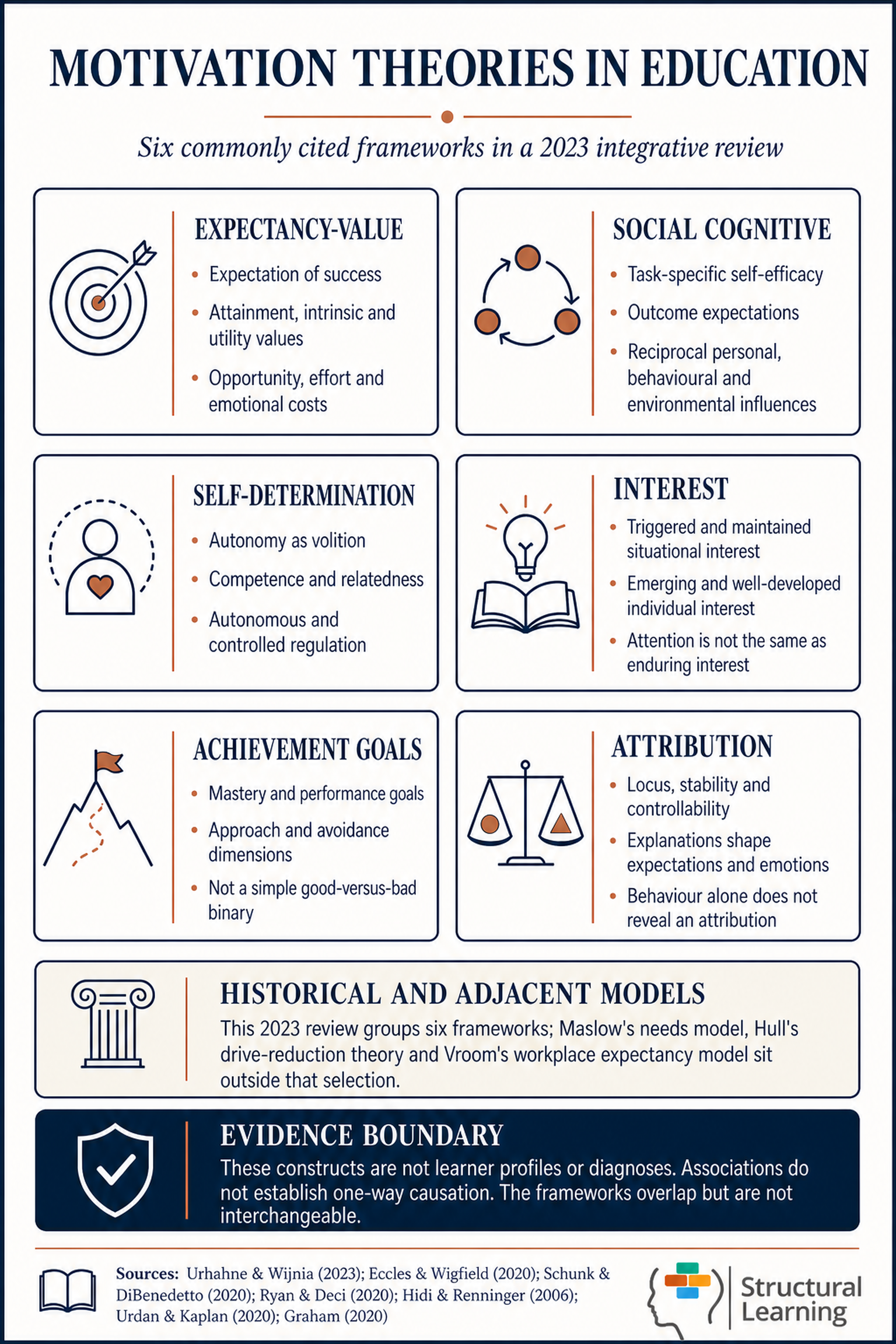
Six commonly cited frameworks in a 2023 integrative review.
This 2023 review groups six frameworks; Maslow's needs model, Hull's drive-reduction theory and Vroom's workplace expectancy model sit outside that selection.
These constructs are not learner profiles or diagnoses. Associations do not establish one-way causation. The frameworks overlap but are not interchangeable.
Sources: Urhahne & Wijnia (2023); Eccles & Wigfield (2020); Schunk & DiBenedetto (2020); Ryan & Deci (2020); Hidi & Renninger (2006); Urdan & Kaplan (2020); Graham (2020).
Situated expectancy-value theory asks if success seems in reach and if the task is worth its costs. It links these views with choice, effort and persistence. It also places each view in its social and cultural context.
Expectancies for success are one part. Subjective task values are another. Value can come from joy, use or a sense that the task matters to the self.
Cost can take the form of time, lost choice, strain or fear. Eccles and Wigfield (2020) set out these parts.
A learner may think, “I can do this,” yet still opt out. The task may take too much time or may feel of little use. A second learner may care a great deal but expect to fail. The same act can thus stem from quite distinct sets of views.
The word situated is key. Prior experiences, peer norms, family views, school cues and the task itself can shape both expectancies for success and task values. These are not fixed marks held only in the mind. They can shift with the domain, the group and the point in time.
For school use, this model gives a set of questions. Is the task clear? Does success seem in reach?
What does the learner value? What costs do they see? The answers must come from more than one act. They should include the learner's own words.
This model is distinct from Vroom's workplace model. Urhahne and Wijnia (2023) group situated expectancy-value theory among six academic motivation theories and place Vroom's model outside that selected set. The two should not be merged because they share some terms.
Social cognitive theory links the person, the act and the world around them. Each can shape the other two. The model covers agency, goals, self-regulation and self-efficacy. It is much wider than a claim about self-belief alone (Schunk and DiBenedetto, 2020).
Self-efficacy is a view of what one can do on a set task. It is not broad self-worth or generic confidence. A learner may feel able to talk about a text but not to write an essay on it. A change in the task can change the view.
The level of the measure must fit the claim. A broad survey on confidence may not test skill belief for one task. This is why the name of the task and field matter. It is also why a high score should not be read as proof that success will follow.
For academic self-efficacy, the link with performance can run both ways. Prior performance can shape later efficacy beliefs. Efficacy beliefs can also predict subsequent performance. A study must track time and rule out other causes before it can make a firm causal claim.
Social and cultural life shape which signs of skill seem true. They also shape how a scale is read. Usher (2018) argues that prominent motivation research has often centred White US contexts and has insufficiently addressed race, culture, power and privilege. A result from one group or place may not hold in a new one.
Models, feedback and well-set tasks may give clues about skill. Yet none is a sure fix. Praise cannot make up for poor access, weak teaching or lack of time. Our guide to social cognitive theories gives more depth on the full model.
Self-determination theory asks why a person acts and how much the reason feels like their own. It splits self-led forms from forms driven by pressure or guilt. It also asks about three basic needs: autonomy, competence and relatedness (Ryan and Deci, 2020).
Autonomous motivation means that the person owns the reason for the act. Controlled motivation comes with a push, threat, prize or felt demand. Amotivation means that there is no clear will to act. These forms are not the same as a simple inner versus outer split.
Some acts start with an outside prompt and then gain worth for the person. Some acts feel fun from the start. Both can be self-led in distinct ways. A prize is not bound to harm drive, just as praise is not bound to help it.
Autonomy means a sense of will. It does not mean that the learner works alone or gets free choice at all times. Competence means a felt chance to act well and grow. Relatedness means a bond with others and a sense of place.
A clear, well-led lesson can still support autonomy. The aim can make sense, and the learner can grasp why the work has worth. A long list of choices may not help if none feels real. Choice and autonomy are thus linked at times, but not the same.
The model does not say that rewards always cause harm. It does not cast direct teaching as control by default. Need support may aid sound growth, but it does not make good test scores sure. For more detail, see self-determination theory and intrinsic motivation.
Interest theory asks how a brief spark can grow into a more stable bond with a field. It keeps short-term situational interest apart from individual interest. Hidi and Renninger (2006) set out four phases. These phases mark growth, not fixed types of learner.
The first phase is triggered situational interest. A task, fact or event draws notice. The next is maintained situational interest.
The learner stays with the topic for a while. Good support and a base of new facts may help that shift, but do not make it sure.
The third phase is emerging individual interest. The learner starts to seek the topic with less help. The fourth is well-developed individual interest. The person has more stored facts, more worth tied to the field and a stronger wish to return to it.
A bright hook may trigger situational interest, but that alone does not show maintained situational interest or developing individual interest. Ask whether attention persists and whether knowledge and value grow.
Interest need not be in place before study starts. New facts can help it grow. In turn, more interest can lead to more search and study. This two-way link makes the claim “not an interested learner” far too broad for sound use.
School examples should stay modest. A teacher can link a new question to what the class knows. The class can return to the theme over time.
These are ways to test the model, not set rules. See curiosity-driven learning for a nearby idea.
Achievement goal theory asks how a person defines and seeks competence. A learner may aim to grow in skill or to show skill next to peers. The learner may seek a good result or try to avoid a bad one. These aims can mix (Urdan and Kaplan, 2020).
A mastery goal is tied to growth, skill or grasp of the work. A performance goal is tied to how one's skill looks next to that of others. An approach goal seeks a wanted end. An avoidance goal seeks to stop an end that is feared.
This is not a good-goal and bad-goal chart. The same learner can hold more than one aim. The effects can shift with age, task, group, test and measure. A performance-approach goal need not work like a performance-avoidance goal.
These goals are not lesson aims on a plan. They concern what counts as being able in the learner's eyes. Two learners can seek the same mark for quite distinct reasons.
One may seek growth. One may seek rank. One may seek to hide a fear of failure.
Feedback, group work and public rank can shape which view of skill stands out. Yet a neat task or high mark does not reveal the goal in a learner's mind. The school needs the learner's own account, the task context and a pattern seen over time.
Research results also depend on how goals are named and scored. The field has changed its terms and models through time. A claim about “performance goals” is weak if it does not state whether the goal seeks gain or seeks to avoid loss.
Attribution theory examines how people explain outcomes. Graham (2020) organises perceived causes by locus, stability and controllability. These dimensions are linked to expectations, emotions and subsequent action, but the same outcome can prompt different attributions.
Locus asks whether the cause is perceived as internal or external. Stability asks whether it is expected to persist or change. Controllability asks whether the person believes the cause can be influenced. These dimensions should not be merged.
Ability, effort, task difficulty and luck are common examples. Yet the same term may carry a different meaning for each learner. One learner may see ability as stable, while another may see it as able to change. A label alone does not reveal the full causal attribution.
An adult cannot read an attribution from an act. Silence after a mark may show shock, shame, doubt or calm thought. It may show none of these.
Ask and listen before you form a view. Even a self-report is one account made in one context.
Praise after an easy success can be interpreted as signalling that low ability was expected; unsolicited help can also function as a low-ability cue. These are possible interpretations, not universal effects.
Attribution theory is close to, but not the same as, locus of control. Locus of control deals with broad views about control. Attribution work asks how a person explains a set result. The scope, terms and tests are not the same.
Urhahne and Wijnia (2023) group six commonly cited theories of academic motivation. Maslow's needs model, Hull's drive-reduction theory and Vroom's workplace expectancy model are not part of that selected set. They belong to separate historical or adjacent literatures and should not be merged with the six.
For source-led treatments of those traditions, see our articles on Maslow's hierarchy of needs, drive-reduction theory and expectancy theories.
The research base uses surveys, long-term studies, trials and reviews. Each design answers some questions but not others. A survey can show a link. A trial can test a change and help test a cause.
A long-term study can show which thing came first, but may still miss a cause.
Associations between motivation constructs and attainment do not establish a one-way causal chain. Direction and reciprocity must be tested for each construct with suitable longitudinal or experimental designs. For academic self-efficacy specifically, prior performance can shape later efficacy beliefs, while efficacy beliefs can also predict later performance.
Home, peer and school life can shape the path too. Good teaching and fair access can change what a learner can do. A model that puts all blame in the learner misses these facts. It may also turn a research term into a moral label.
Lazowski and Hulleman (2016) synthesised 74 reports, 92 independent effects and 38,377 participants. Motivation-theory interventions had a mean effect of d = 0.49 (95% CI [0.43, 0.56]) on authentic educational outcomes. Randomised designs produced smaller estimates than quasi-experimental designs, and the review does not identify one universal method.
The name of a theory does not make a plan sound. A trial still needs a clear aim, a fair test and a measure that fits the claim. What works in one age group or field may not work in the next. Mean effects can hide a wide spread.
Measures have limits. A self-report can give the learner's view, but words and peer norms can shape the score. Time on task can show effort, stress, lack of choice or lack of grasp. No single score gives a full account of the cause.
Culture and place also matter. Usher (2018) argues that prominent motivation research has often centred White US contexts and has insufficiently addressed race, culture, power and privilege. Samples, scales and their assumptions need close checks. A result from one nation or group should not be cast as a rule for all.
The six models are not tests for a child. They cannot prove intent or reveal a home need. They cannot replace checks on access, health, language, care, prior chance to learn or the task itself. Their best use is to frame a claim that can be tested.
Schools can use the six models to ask more exact questions. They can split expectancies for success from subjective task values and costs. They can split task- and domain-specific self-efficacy from generic confidence. They can also keep reasons, interest, goals and causal attributions apart.
Teams can look at the setting as well as the learner. Is the aim clear? Is there a fair path to success?
Does rank drown out growth? Is the cost too high? Does the learner feel part of the group? These are open questions, not a quick test.
Schools cannot infer a private state from one act. A missed task does not prove low value. Quiet work does not prove deep interest.
Fast work does not prove ease. Each act fits more than one account, so a firm label goes past the data.
A fair review draws on more than one source. It may use the learner's words, work over time and facts about the task. It should state other possible causes. If the team makes a small change, it should then check what changed and what did not.
The models should not rank learners by drive. They should not excuse poor access or low aims. They cannot stand in for subject skill, clear teaching, due aid or safe care. A research term is not a reason to blame a child for a weak fit.
This stance is both useful and modest. Name the construct. Ask what data could test it.
Rule out clear access barriers first. Make a small, bounded change. Then check the result. The model guides thought, but it does not hand down a recipe.
These answers deal with common scope errors. They keep the six models apart and show why one act cannot reveal a hidden cause. They also explain why a mean effect does not make one school method best for each learner and each task.
Not as a single fixed trait. The six frameworks include task- and context-sensitive constructs and, in some cases, more enduring dispositions such as individual interest. A person can show different motivational patterns across domains and times, so “motivated” and “not motivated” are not diagnoses.
No one model is best for each question. Use situated expectancy-value theory for expectancies for success, subjective task values and costs. Use social cognitive theory for task- and domain-specific self-efficacy, agency and self-regulation. Use self-determination theory for the quality of motivation. Use the other three for interest, goals and causal attributions.
No. Urhahne and Wijnia (2023) do not include Maslow's needs model in their selected six. That is a boundary of this review, not proof that Maslow is irrelevant or disproved. Read it as a separate historical account, not a diagnostic classroom ladder.
The terms in that question are too broad. Self-determination theory asks how a prompt or prize is felt and why the person acts. An outside prompt may be experienced as informational feedback or as control. “Inner good, outer bad” is not a sound account.
No. The same act can stem from skill, value, cost, mood, fear, access or the group. A pause or refusal may prompt a question, but it does not give the answer. Use more than one source and ask the learner with care.
Lazowski and Hulleman (2016) found a mean effect of d = 0.49 across varied motivation-theory interventions and authentic educational outcomes. Randomised designs produced smaller estimates than quasi-experimental designs. The review reports a mean across varied studies; it does not identify one universal method.
Start with the six-part map by Urhahne and Wijnia (2023). Then read Eccles and Wigfield (2020), Schunk and DiBenedetto (2020), Ryan and Deci (2020), Hidi and Renninger (2006), Urdan and Kaplan (2020), and Graham (2020). Lazowski and Hulleman (2016) review trials. Usher (2018) tests the field's cultural scope.
This order helps keep each model in view. It also keeps a theory claim apart from a link in data, a trial result and a school judgement. Those four forms of claim need distinct kinds of proof.