Symbolic interactionism explains how people create and revise meaning through interaction. Learn Mead, Cooley, Blumer and Goffman, then apply the theory carefully to labels, expectations and classroom life.
Main, P. (2023, November 21). Symbolic Interaction Theory: Meaning and Classroom Examples. Structural Learning. https://www.structural-learning.com/post/symbolic-interaction-theory
What is symbolic interactionism?
Symbolic interactionism is a sociological perspective that studies how people act in relation to meanings attached to objects, words, roles and situations. Those meanings develop through social interaction and can change through interpretation. The perspective helps explain identity and everyday encounters, but it is not a tested teaching method.
Symbolic interactionism is a sociological perspective that studies how people act in relation to meanings attached to objects, words, roles and situations. Those meanings develop through social interaction and can change through interpretation. The perspective helps explain identity and everyday encounters, but it is not a tested teaching method.
In a classroom, the same pause before an answer can mean uncertainty, careful thought, fear of being wrong or a need for more processing time. What happens next depends partly on the meaning that the teacher and learner give to the pause. Symbolic interactionism makes that act of interpretation visible (Blumer, 1969).
This article explains the general theory and its main thinkers before applying it to education. It separates an observable event from the label placed on it, checks alternative meanings and keeps classroom advice within the limits of the evidence.
Key takeaways
People act towards things on the basis of meaning, and meanings can change through interaction and interpretation.
Mead developed a social account of mind and self. Cooley introduced the looking-glass self. Blumer named symbolic interactionism and stated its three premises.
Labels and expectations can shape later interaction, but they do not determine a learner's identity or attainment.
Symbolic interactionism is a lens for studying classroom life, not proof that one teaching method works.
What Is Symbolic Interactionism?
Symbolic interactionism examines how people create, use and revise meaning in social interaction. It is a micro-level perspective because it often studies encounters, talk, roles and identity in particular settings. A symbol may be a word, gesture, grade, uniform, seating place or other object that carries shared or disputed meaning.
The symbol does not control action by itself. People interpret it in a situation. A raised hand can mean a request to speak in one classroom, agreement in another setting or a question in an online platform. Past experience, relationships and the response of other people help shape what it means.
This focus gives people agency. They are not treated as passive products of rules or institutions. They can accept, resist, negotiate or change a meaning.
At the same time, their options are not unlimited. Status, power, resources, racism, class, policy and institutional routines also shape an encounter.
Symbolic interactionism is therefore best treated as a sociological perspective and research tradition. It helps researchers ask how a situation becomes meaningful. It does not by itself predict attainment, diagnose a learner or establish an effective teaching intervention. The sociology theories guide places it beside wider macro and micro perspectives.
A Simple Symbolic Interactionism Example
A symbolic interactionist example follows three steps: an event is interpreted, that meaning shapes the next interaction, and later behaviour may reinforce the first interpretation. Consider a learner who pauses for several seconds when asked a question.
Observable event: the learner pauses and looks down before speaking.
Meaning inferred: the teacher interprets the pause as lack of knowledge or low confidence.
Interaction that follows: the teacher moves quickly to another learner and asks fewer follow-up questions next time.
Meaning for the learner: the learner may come to expect that their ideas are not wanted or that a fast answer matters more than a careful one.
Possible pattern: reduced chances to speak lead to less visible participation, which seems to confirm the teacher's first interpretation.
The account is a hypothesis, not a verdict. The pause may reflect careful thought, word finding, uncertainty, anxiety, language processing or a wish not to dominate the discussion. A teacher can test the first meaning by adding wait time, inviting the learner to clarify and comparing participation across questions and lessons.
This example shows why meaning is social and revisable. The teacher's response changes the setting in which the learner acts. The learner can also resist the label, explain the pause or act differently with another person. Neither side simply receives a fixed meaning from the gesture.
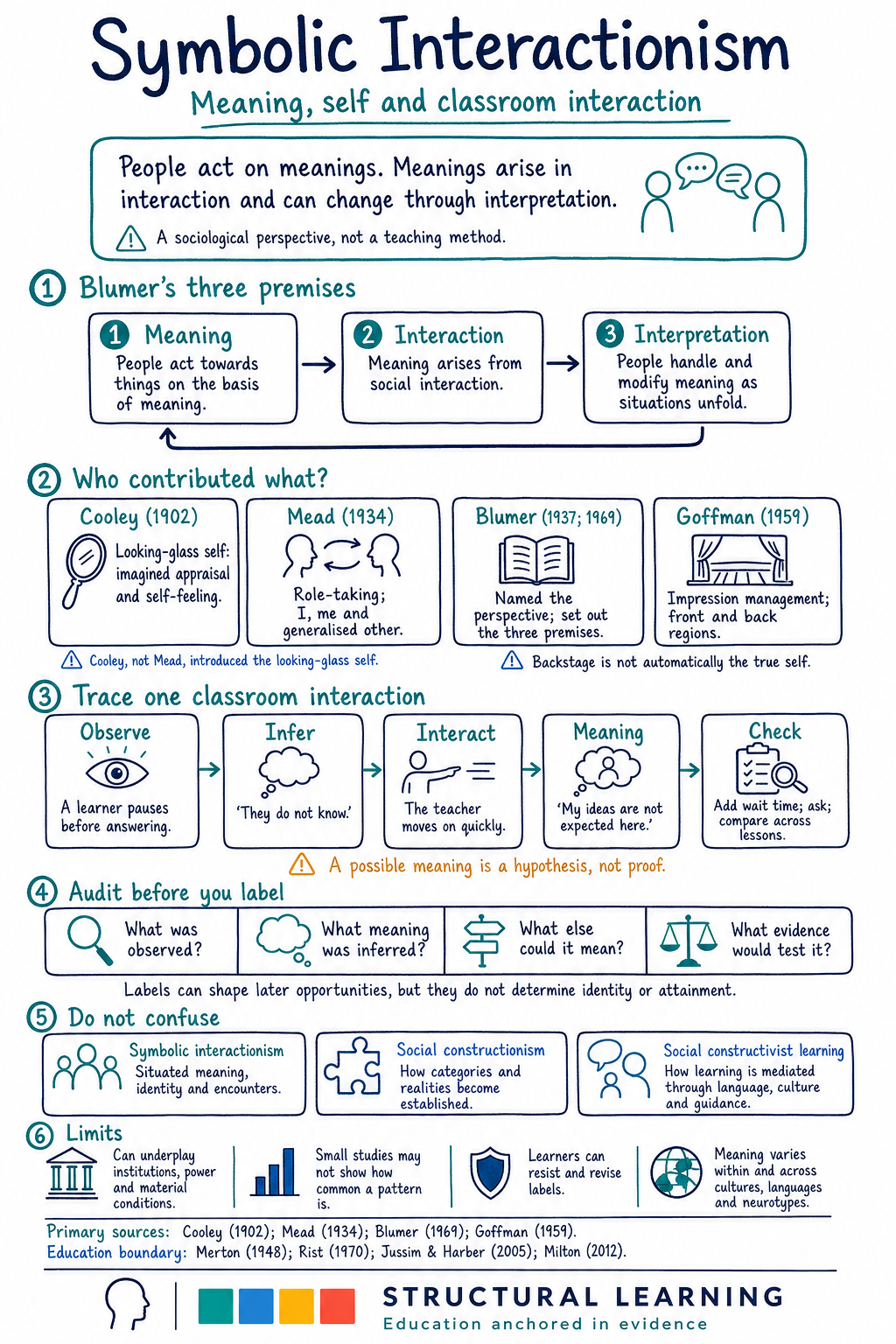
A concise guide to meaning, interaction, identity and careful classroom use. Download the full-size study note.Read the study note as text
Definition: symbolic interactionism studies how people act on meanings that arise through interaction and are revised through interpretation. It is a sociological perspective, not a teaching method.
Main figures: Cooley introduced the looking-glass self in 1902. Mead developed role-taking, the I, the me and the generalised other. Blumer named the perspective and set out three premises. Goffman used a dramaturgical lens to study impression management.
Blumer's three premises: people act on meaning; meaning arises in interaction; interpretation can modify meaning.
Classroom audit: record what was observed, the meaning inferred, an alternative interpretation and the evidence needed. A label can shape later opportunities, but it does not determine identity or attainment.
Limits: interactionism can underplay institutions, power and material conditions. It is distinct from social constructionism and social constructivist learning.
Mead, Cooley, Blumer and Goffman
Four thinkers have different jobs in this account: Cooley described reflected self-feeling, Mead explained the social emergence of mind and self, Blumer named the perspective, and Goffman analysed impression management. Their ideas overlap, but they should not be merged into one classroom theory.
George Herbert Mead and the social self
George Herbert Mead's Mind, Self, and Society was published in 1934, after his death. Charles Morris edited the book from lecture materials. Mead argued that mind and self emerge through social activity. He did not treat them as sealed inner objects.
Significant symbols allow one person to anticipate the response of another. Through role-taking, people can view their own conduct from another standpoint. Mead described the me as the organised attitudes of others that a person takes towards themselves. The I is the person's response to that me, known after it occurs.
The generalised other is the organised attitude of a community or group. Mead used play and the organised game to explain increasingly coordinated role-taking. He did not establish fixed birth-to-three, three-to-seven and seven-plus stages. Nor did his theory prove that role play causes theory of mind or that group work becomes suitable at one set age.
Charles Horton Cooley and the looking-glass self
Charles Horton Cooley described the looking-glass self in Human Nature and the Social Order in 1902. This predates Mead's posthumous book. Cooley's account involves imagining how we appear to another person, imagining their judgement and experiencing self-feeling in response.
The idea does not mean that other people simply install a fixed identity. A person responds to an imagined appraisal, which may be incomplete or wrong. It is a useful way to examine feedback, status and belonging, but it was not a trial showing that praise directly raises attainment.
Herbert Blumer and the named perspective
Herbert Blumer coined the term symbolic interactionism in 1937 and gave the perspective its best-known statement in Symbolic Interactionism: Perspective and Method (1969). His three premises are the conceptual centre of the theory:
People act towards things on the basis of the meanings those things have for them.
Meaning arises from social interaction.
Meaning is handled and changed through an interpretive process.
Blumer also argued for naturalistic inquiry into the empirical social world. He did not conduct the classroom studies sometimes assigned to him. An education example is an application of his premises, not a result that Blumer found.
Erving Goffman and social performance
Erving Goffman's dramaturgical analysis treats interaction through the language of performances, audiences, fronts and regions. People manage impressions through what they deliberately present and what they unintentionally give off.
A classroom can be examined as a setting with recognised roles and audiences. Front and back regions are relative to a given performance. A conversation among friends may be a back region for one classroom performance and a front region for another. Backstage conduct is not automatically a person's true self.
The Key Concepts of Symbolic Interactionism
The main concepts connect symbols, interpreted meaning, role-taking and an identity that develops through social experience. Each concept describes a process to investigate rather than a label that settles why someone acted.
Symbols: words, gestures, objects and roles that carry meaning for participants. Meanings may be shared, contested or unclear.
Interpretation: the process through which a person handles meaning before acting. The same cue can lead to different action in another relationship or setting.
Definition of the situation: an account of what is happening and what conduct fits. Participants can hold different definitions of the same event.
Role-taking: taking the standpoint of another person or group towards one's own conduct. It is more precise than using role play as a generic activity.
The I and the me: the response of the person and the organised attitudes of others within the social self. They are linked phases, not an impulse system and a rule checker.
Generalised other: the organised attitude of a community that a person can take towards their conduct. It is not a hidden social-cue test or a diagnostic construct.
Looking-glass self: Cooley's account of self-feeling through imagined appraisals by others.
Impression management: Goffman's analysis of how people present themselves before audiences.
These ideas help explain why a classroom rule may feel fair to one learner and arbitrary to another, or why the word ability may open opportunities for one group while narrowing them for another. They do not mean that every private thought comes from other people or that all meanings are freely chosen.
Symbolic Interactionism in Education
In education, symbolic interactionism draws attention to how everyday talk, labels, routines and roles shape participation and learner identity. It asks what a grade, group name, correction, praise comment or seating place means to the people involved and how later interaction changes that meaning.
A timetable is not only a practical schedule. It can also signal which subjects and activities carry status. A uniform can mean belonging, control, safety or exclusion in different interactions.
A term such as top set may affect peer expectations as well as lesson placement. These are questions for inquiry, not claims that one symbol has the same effect on every learner.
Interactionists often use observation, interviews, field notes and ethnography because they want to understand participants' definitions of a situation. A researcher may compare what a teacher intends with how learners interpret the same exchange. This produces depth and context, although it can be difficult to generalise.
For teachers, the safest value is diagnostic. Ask what was observed, what meaning was inferred and whether the learner shares that meaning. Do not infer low effort, disrespect or lack of knowledge from one gesture. Collect evidence over time and invite the learner's account.
Labelling, Teacher Expectations and Self-Fulfilling Prophecies
Labels and expectations can alter later opportunities and interaction, but classic studies do not show that a label inevitably determines identity or attainment. The evidence is most useful when it prompts teachers to check the accuracy and distribution of their expectations.
Howard Becker argued in Outsiders (1963) that an act is not deviant by itself. Social groups make rules and apply labels. His earlier study of teacher-learner relationships examined how teachers' image of an ideal learner varied by social-class context (Becker, 1952). These are related works, not one study.
In 1970, Ray Rist described grouping and teacher treatment in one Black urban American school. Hargreaves, Hester and Mellor later studied social typing and classroom deviance in one British setting. These studies show how expectations can become part of daily practice. They do not prove that all grouping works in the same way or that every formal category is false.
This distinction matters for special educational needs. A category can shape interaction and still have valid legal, assessment and provision functions. Symbolic interactionism should never be used to dismiss disability, diagnosis, entitlement or support. It can help examine how a category is spoken about and whether it narrows a learner's opportunities.
Robert Merton introduced the term self-fulfilling prophecy in 1948. A false definition of a situation may lead to conduct that makes the first definition appear true. Rosenthal and Jacobson then manipulated teacher expectations in their influential 1968 school experiment. Their reported IQ effects became known as the Pygmalion effect, but the methods and size of the findings were heavily debated.
Later reviews find that self-fulfilling expectation effects can occur. They are usually small, do not grow without limit and vary by context (Jussim & Harber, 2005). Effects may matter more when false expectations are stable or linked to a stigmatised group. Claims about question difficulty, wait time or feedback still need direct observation. They should not be attributed wholesale to the original study.
A measured response is to compare access to questions, wait time, feedback, challenge and support across learners. High expectations should not mean giving everyone the same task or ignoring a real need. It means avoiding an untested label as the ceiling on what a learner can do.
Classroom Examples and an Interaction Audit
Classroom examples become useful when a teacher separates the event from the meaning attached to it and decides what evidence could test that meaning. This prevents the theory from turning into a list of vague strategies.
Grades: a score can represent progress, status, failure or a temporary gap. Ask what comparison the learner is making and what action follows.
Ability groups: a group name can organise instruction and also signal a lasting identity. Check movement, task access and the language adults and peers use.
Praise: the same comment can feel informative, controlling, sincere or routine. Observe what it refers to and whether it helps the learner judge the work.
Silence: silence can mean thought, uncertainty, respect, withdrawal or difficulty finding words. Do not treat it as one stable trait.
Rules and routines: a routine may signal safety and predictability to some learners while another learner experiences it as unexplained control.
On a phone, swipe across the table to compare all columns.
On a smaller screen, swipe across to read all columns.
What was observed?
Meaning inferred
Alternative interpretation
Evidence to collect
A learner pauses before answering.
They do not know.
They are forming a careful response or need more processing time.
Add wait time, offer another response mode and compare answers across tasks.
A learner avoids eye contact during feedback.
They are not listening.
Eye contact may be uncomfortable or compete with processing the words.
Ask how feedback is easiest to receive and check recall through a neutral response.
A group rejects a classroom role.
They lack motivation.
The role may carry low status or have been assigned without voice.
Ask what the role means, rotate access and observe participation after the change.
A learner jokes after an error.
They do not care.
The joke may manage embarrassment before peers.
Speak privately, compare behaviour across audiences and invite the learner's account.
This is an audit, not a diagnostic test. It does not ask the teacher to ignore professional judgement. It asks them to make the judgement open to evidence and revision, which follows Blumer's emphasis on interpretation.
Communication also varies within and across cultures, languages and neurotypes. Milton's double-empathy account argues that misunderstanding between autistic and non-autistic people can be reciprocal rather than a one-sided social deficit (Milton, 2012). Explicit language, visible steps and learner voice can reduce reliance on ambiguous cues, but support should still be individualised. The inclusive education guide owns wider provision and practice.
Symbolic Interactionism vs Social Constructionism and Social Constructivism
These traditions all study social life, but they ask different questions. Symbolic interactionism focuses on meaning and identity in a specific situation. Social constructionism asks how discourse and institutions establish categories and versions of reality. Social constructivist education asks how language, culture and guidance shape learning.
On a phone, swipe across the table to compare all columns.
On a smaller screen, swipe across to read all columns.
Tradition
Main question
Typical concepts
Owner
Symbolic interactionism
How do people interpret symbols, roles and encounters?
Meaning, I and me, generalised other, looking-glass self, impression management.
This article.
Social constructionism
How do social processes establish categories and versions of reality?
Discourse, classification, institutions and historical contingency.
Interaction and language matter in all four traditions. The key difference is what each one tries to explain. A group discussion can be studied as knowledge construction, as negotiation of identity, or as discourse that defines what counts as knowledge. The same event does not make the theories interchangeable.
Strengths, Limitations and Research Methods
Symbolic interactionism gives a close view of meaning and agency, but it can understate the larger structures that shape power, resources and status. A strong account uses this micro lens without claiming that every inequality begins in face-to-face talk.
Its first strength is detail. Observation and interviews can reveal why two people respond differently to the same rule. The perspective also treats meanings as open to change, so learners and teachers are not reduced to fixed roles. It highlights processes that a large dataset may miss, such as how a label is applied in one exchange and resisted in the next.
This close view also has limits. A small qualitative study may not show how common a pattern is. A researcher may interpret an event differently from a participant. Clear field notes help. So do reflexivity, comparison across sources and attention to exceptions.
A second limit is scale. Local meanings alone cannot explain funding, admissions, assessment policy, curriculum access, racism, class or disability rights. Conflict theory offers a stronger macro analysis of power and inequality. Social identity theory explains group membership and relations between groups. Both can complement interactionism.
Finally, an appealing interpretation can become circular. Saying that a learner withdraws because they see themselves as withdrawn only renames the behaviour. A useful account identifies the interaction, the proposed meaning, the evidence and at least one rival explanation.
Frequently Asked Questions
Readers most often ask who founded symbolic interactionism, how it applies to education and how it differs from a learning theory. The answers below keep the historical perspective distinct from later classroom evidence.
Who founded symbolic interactionism?
There was no single founding event. Mead's social psychology and Cooley's account of the self were key early influences. Herbert Blumer coined the term in 1937 and later set out its three best-known premises. Goffman and later interactionists developed related lines of inquiry.
What is symbolic interactionism in education?
It is the use of an interactionist lens to study how learners and adults interpret labels, rules, roles, grades, feedback and everyday encounters. It can reveal how meanings shape later participation and identity. It does not prescribe one method of teaching.
What is an example of symbolic interactionism in school?
An ability-group label may shape what teachers, peers and learners expect from the group. Those expectations can affect questions, task access and participation. The label does not guarantee an outcome, so the pattern must be checked against observation and learner voice.
Is the looking-glass self Mead's idea?
No. Charles Horton Cooley introduced the looking-glass self in 1902. Mead later developed a distinct account of the social self, including role-taking, the I, the me and the generalised other.
Is symbolic interactionism a learning theory?
It is primarily a sociological perspective. It can analyse meaning and identity in educational settings, which makes it relevant to a Learning Theories pillar. However, it does not explain learning in the same way as constructivism, behaviourism or cognitivism.
Hargreaves, D. H., Hester, S. K., & Mellor, F. J. (1975). Deviance in classrooms. Routledge & Kegan Paul.
Jackson, P. W. (1968). Life in classrooms. Holt, Rinehart and Winston.
Jussim, L., & Harber, K. D. (2005). Teacher expectations and self-fulfilling prophecies: Knowns and unknowns, resolved and unresolved controversies. Personality and Social Psychology Review, 9, 131-155.
Paul Main is an educator and metacognition researcher who founded Structural Learning in 2002. With a psychology degree from the University of Sunderland and 22+ years helping schools embed thinking skills, he bridges the gap between educational research and classroom practice. Fellow of the RSA and Chartered College of Teaching, with 128+ Google Scholar citations.