Peer Pressure Beats Facts: How Conformity Works (Asch, 1951)
Asch (1951) found 75% of people conformed to wrong group answers. Classroom strategies that protect independent thinking, and why public answers backfire.


Asch (1951) found 75% of people conformed to wrong group answers. Classroom strategies that protect independent thinking, and why public answers backfire.
Asch Conformity Experiment: What Teachers Should Know describes how Solomon Asch's line judgement studies showed that people may give an answer they know is wrong when a unanimous group gives that answer first (Asch, 1951). For teachers, the point is not that learners are weak; it is that belonging, confidence, task difficulty and classroom norms can shape whether a learner trusts their own judgement.
For example, in a Year 9 history discussion, a learner may correctly identify the stronger source. They may then change their answer after three confident peers choose another option. The research helps teachers design routines that protect first thinking, such as private written answers, anonymous polling and planned dissent. These routines make groupwork a place for reasoning rather than quiet compliance.
Solomon Asch's conformity experiments showed that people often match their answers to the group's view, even when it is clearly wrong. Teachers use this research to understand peer pressure in the classroom. It can also help them design inclusive groupwork and create classrooms where learners feel safe disagreeing with peers.
Solomon Asch's conformity theory changed how psychologists understood social pressure and individual judgement. In his 1950s line judgement studies, people sometimes gave up a correct answer. They did this after hearing a unanimous group give an obviously wrong one.
For teachers, the useful point is concrete: a learner may know the answer but still copy the room to avoid standing out. The findings connect individual autonomy with group influence, from classroom discussion to assessment moderation and online learning.
Evidence overview
What does the research say? In Asch's line-judgment studies, about 74-75% of participants conformed at least once, and about one third of critical-trial responses, often rounded to 37%, showed conformity. Bond and Smith's (1996) meta-analysis of 133 studies in 17 countries supported these findings, with higher conformity rates in collectivist cultures. In classrooms, Deutsch and Gerard (1955) separated informational influence, wanting to be correct, from normative influence, wanting to be accepted, and both affect learner participation.
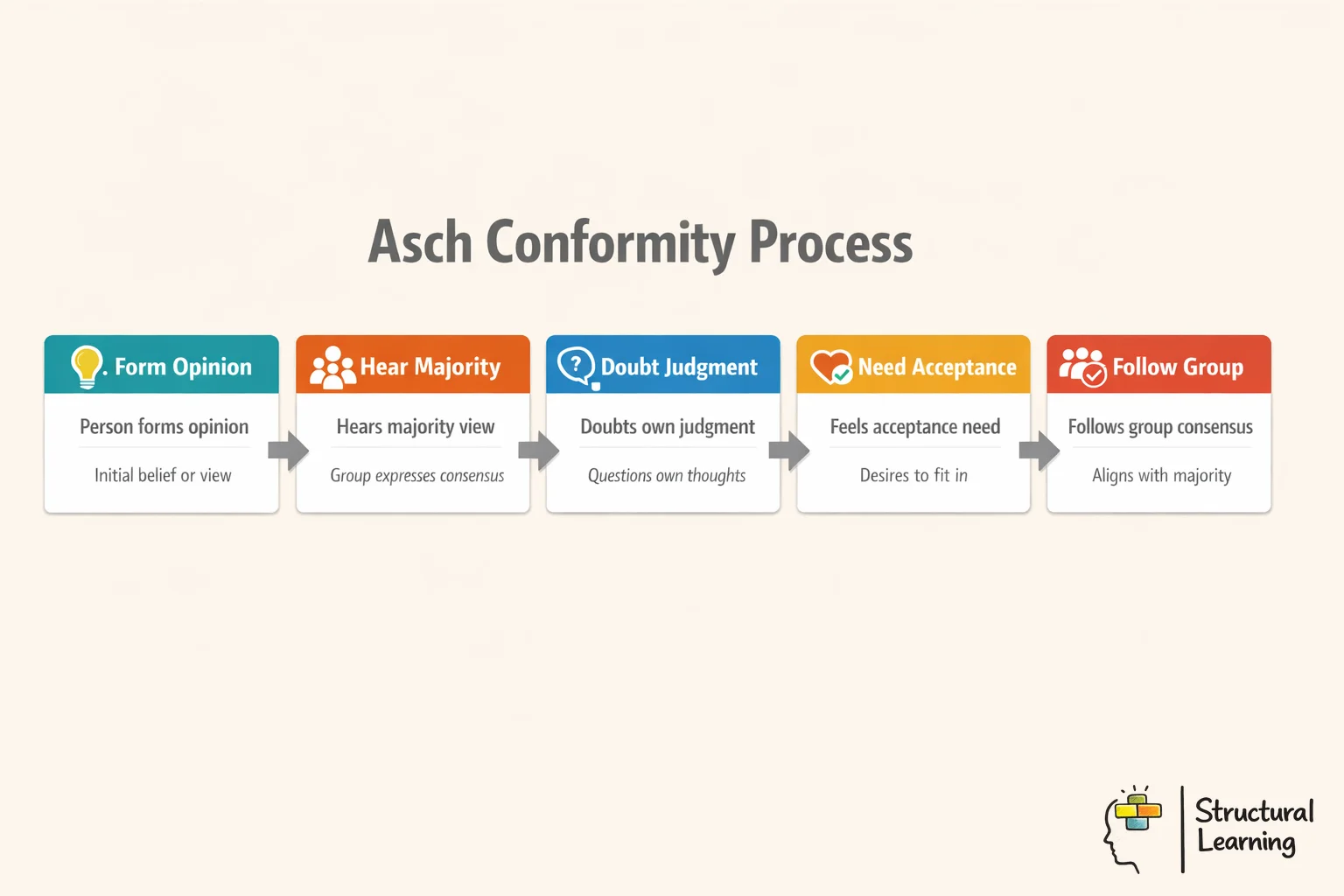
Asch's work matters because it separates two ideas teachers often blend together: public compliance and private belief. A learner may repeat a group's answer to stay accepted, while privately knowing the answer is wrong. This distinction helps teachers interpret social behaviour in group tasks, discussion and peer assessment.
Key Insights
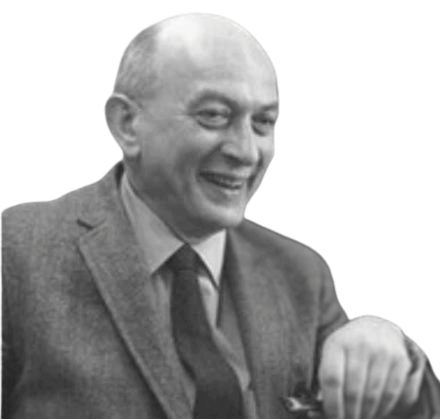
Solomon E. Asch was born on September 14, 1907, in Warsaw, Poland. He became one of the most important psychologists of the 20th century. His legacy still shapes how we understand social behaviour today.
Asch grew up in a close-knit Jewish family that deeply valued education, ideas, and cultural tradition. His father was a merchant, and his mother managed the household. Both wanted to give their children the best chances they could, despite the challenges of early 20th-century Europe. Books, lively discussion, and a love of learning were part of daily life, and this shaped Asch's lifelong commitment to scholarship.
In the early 1920s, the Asch family immigrated to the United States and settled in New York City, seeking safety and more opportunity. This move mattered for young Solomon. It exposed him to a lively mix of cultures, languages, and ideas that later shaped his interest in conformity and group dynamics. Asch arrived as a teenager with limited English, but persevered by teaching himself the language through Charles Dickens novels and their Yiddish translations.
His early experience of adjusting to a new culture and finding belonging in a new country may have shaped his later research. He went on to study how social environments shape perception and behaviour. From modest beginnings, his academic work took him to Swarthmore College, the Institute for Cognitive Studies, the University of Pennsylvania, and Rutgers University, where he refined theories that still matter in psychology classrooms and research labs today.
Solomon Eliot Asch's intellectual process began in earnest at the City College of New York. He wanted to understand human cognition and behaviour, including how people think and act. This led him to further study at Columbia University. There, Max Wertheimer, a founder of Gestalt psychology, strongly influenced him.
Asch's strong academic work soon earned him a respected role as a professor of psychology at Brooklyn College. There, he began to build his interest in the phenomena of social conformity and normative influence.
His scholarly work caught the attention of the psychology department at Harvard University. There, Asch kept studying how social forces shape individual judgment. Through careful research, he examined social conformity. He believed it played a important role in everyday life, shaping decisions and beliefs within groups.
Asch's studies of perception and independence helped establish conformity as a core topic in social psychology. His experiments showed that group pressure can distort public judgement even when the task is simple. Later replications and critiques then tested how far those findings travel across cultures, subjects and school contexts.
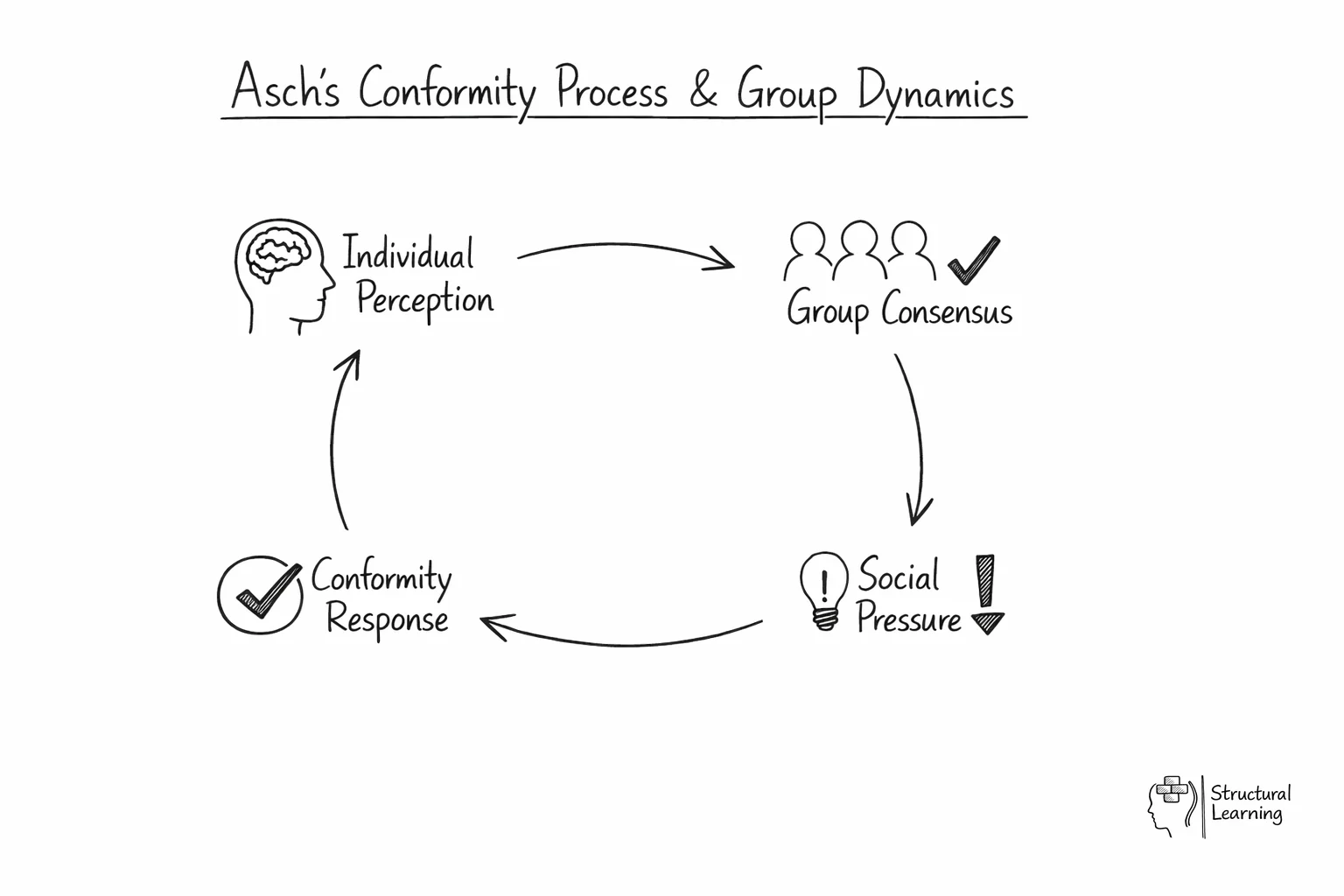
Asch (1951) showed that social pressure can change public judgements even in a simple line matching task. Learners do not need to be confused to conform; they may simply want to avoid being the only person who disagrees.
The experimental design was deceptively simple yet profoundly revealing. Participants were asked to complete what they believed was a straightforward visual perception task: comparing the length of lines. Each participant was seated in a room with seven to nine other people, who were actually confederates (actors working with the researcher). The group was shown a standard line and then asked to identify which of three comparison lines matched its length.
The correct answer was always obvious, with differences between the lines clearly visible to anyone with normal vision. However, the confederates had been instructed to give incorrect answers on 12 of the 18 trials. The real participant, unaware of this deception, typically answered after hearing most of the group's responses.
The results were startling. In the control condition, where participants answered privately, less than 1% made errors. However, When faced with unanimous incorrect responses, about 35.7-37% of critical-trial responses conformed to the group's wrong answer; about 74-75% of participants conformed at least once. Even more remarkably, about 75% of participants conformed on at least one trial during the experiment.
These findings showed how strongly social pressure can affect what a person sees and decides. Asch's experiments showed that people may reject the evidence of their own senses to avoid standing out from the group. This points to a strong psychological need for social acceptance and belonging.
Asch (various dates) found key factors affecting how learners conform. These factors help teachers build classrooms promoting independent thought. Teachers can use this to support individual learner ideas.
Group size proved to be a significant factor, though not in the way one might expect. Asch found that conformity rates increased as group size grew from one to three or four confederates, but beyond this point, additional group members had little impact. This suggests that a relatively small number of peers can exert substantial influence over an individual's decisions.
Unanimity, when everyone gives the same answer, emerged as perhaps the most important factor. When all confederates gave the same incorrect answer, conformity rates were highest. But when just one confederate broke ranks and gave the correct answer, conformity dropped sharply to about 5-10%. This shows the strong effect of having even one ally who supports a person's perceptions.
Task difficulty also played a role. When Asch made the line judgments more challenging by making the differences less obvious, conformity rates increased. This suggests that people are more likely to rely on others' opinions when they feel uncertain about their own judgment.
Researchers (Asch, 1951) found that personality affected conformity. Cultural background and self-confidence mattered too. Learners with high self-esteem resisted group pressure (Bond & Smith, 1996). Individualistic cultures showed similar results (Markus & Kitayama, 1991).
Asch's findings matter for classroom practice and educational design. They show how conformity dynamics, or pressure to follow the group, can shape learning. Understanding this helps teachers build classrooms that support real learning, not just agreement with group thinking.
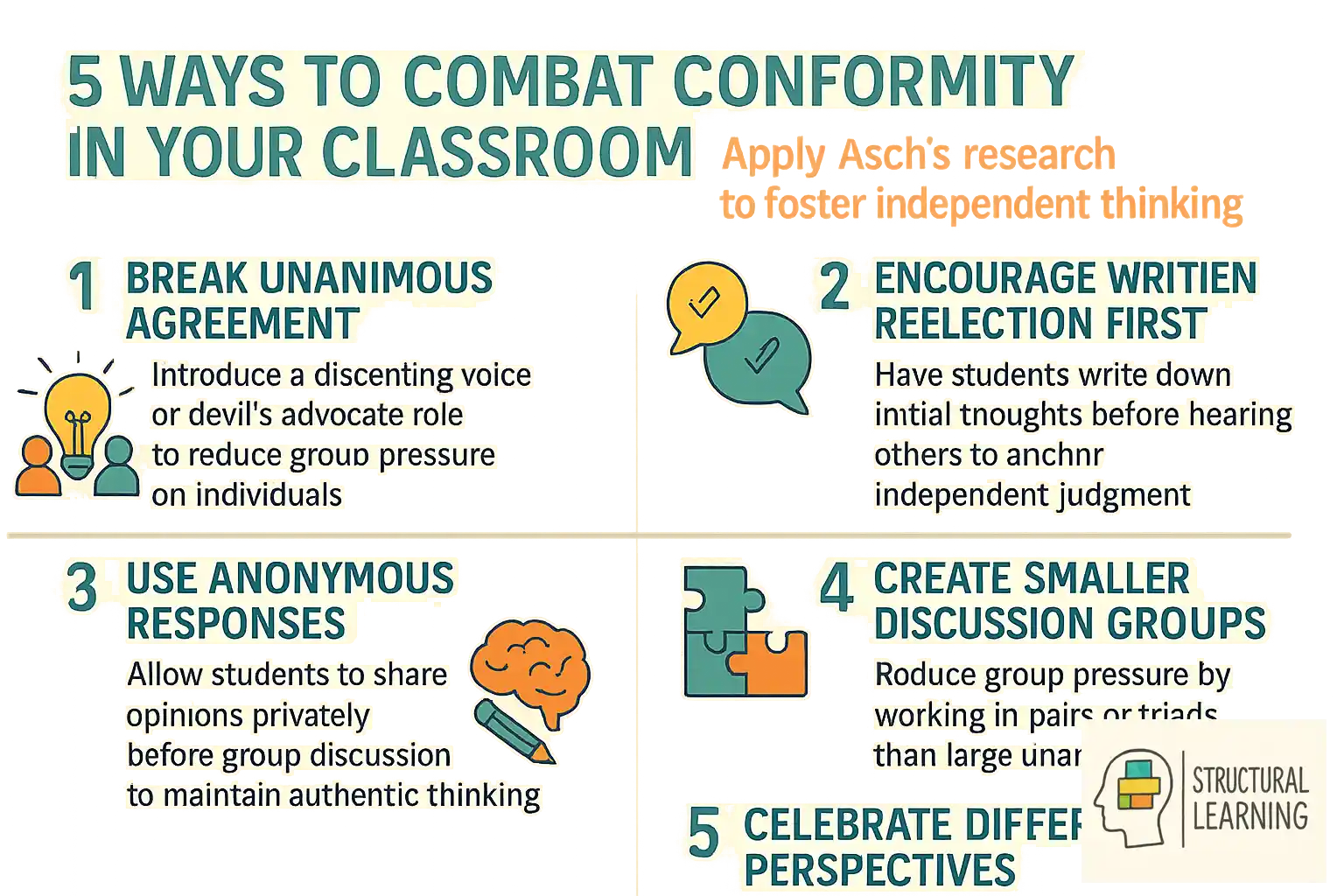
One key use is to structure group discussions so learners hear different views. Teachers can introduce an alternative view or play devil's advocate before one shared opinion takes over. This can reduce the conformity effect and helps students build critical thinking skills and confidence in expressing dissenting views.
Assessment strategies can also benefit from Asch's insights. Anonymous voting or private reflection before group discussion can help learners form their own views first. This means peer responses have less influence. It mirrors Asch's control condition, where individual judgment stayed largely accurate.
The classroom physical environment and seating plan can encourage conformity, or reduce it. Circle seating makes all learners visible to each other. This may increase pressure to fit in. Seating that gives learners more privacy at first can support independent thought.
Teachers can also teach learners directly about conformity pressures. They can then help learners use simple strategies to keep thinking for themselves. This metacognitive awareness can serve as a protective factor against unwanted social influence whilst st ill allowing learners to benefit from collaborative learning experiences.
Asch's (1951) conformity research still matters for teachers today. Learners face peer pressure online and in person. These pressures can strongly shape how learners behave (Crutchfield, 1955; Bond & Smith, 1996).
In online learning, 'digital conformity' mirrors many of Asch's original findings. Learners may follow the main opinion in forums or shared platforms, especially when they can see others' answers first. When teachers understand these patterns, they can design digital learning that supports real engagement rather than echo chambers.
The research also points to key issues for inclusive education. Learners from minority backgrounds, or those with different views, may feel extra pressure to fit in with the main classroom culture. Asch showed that even one dissenting voice can make a difference. This means teachers should make room for varied views and help all learners feel safe to share their real thoughts and experiences.
Asch's work informs our understanding of school culture. It helps us see academic dishonesty and peer pressure (Asch, various dates). Schools using conformity insights can tackle cheating or bullying. They can build positive learning communities valuing collaboration and independent thought.

Asch's (date unspecified) conformity research gives teachers vital insight. Group settings greatly shape learner behaviour. Experiments showed the balance between fitting in and thinking freely. Teachers can build learning that supports both group work and individual thought.
Asch's work remains vital, showing conformity's strength and what develops brave learners. Understanding group size (Asch, 1951), unanimity and difficulty lets teachers use peer work well. This protects each learner's original thinking and creative voice.
Asch's (various dates) work helps in changing classrooms. Learners need social skills and collaboration, and also intellectual independence. This cultivates real understanding (Asch, various dates).
For educators who want to explore Solomon Asch's work in more detail, the following research papers and studies are useful. They also show how his ideas can apply in practice:
Asch's (date) ideas offer teachers theory and useful strategies. Use them to build supportive classrooms. Balance learners' social needs and independent thought, research by other experts (date) shows.
Asch's results are often retold as a story of blind conformity, but they also show the power of independence. In the critical trials, participants resisted the incorrect majority on about 68% of responses. Hodges and Geyer (2006) and Friend, Rafferty, and Bramel (1990) argue that this makes Asch a study of independence under pressure, not only a study of compliance.
For teachers, this changes the lesson. The aim is not to assume learners will copy the group, but to make independent judgement easier to voice. A written first answer, a named challenger role and a norm that reasons matter more than popularity all lower the social cost of dissent.
The research found clear patterns that teachers can spot in class. When everyone else disagreed, people conformed on average 32% of the time. This fell sharply to just 5% when even one other person gave the correct answer. This 'ally effect' shows why pairing confident learners with quieter ones during group work can help protect independent thinking.
Asch also found that conformity peaked in groups of three to five members. This is vital information for teachers planning collaborative activities.
Asch's post-experiment interviews are useful for teachers. Many participants knew their conforming answers were wrong, but they still went along to avoid standing out. This helps explain why a learner who succeeds alone may suddenly do less well in a group task.
Teachers can respond by setting class norms that welcome different views. They can use anonymous response systems for first answers and praise learners who disagree with the majority in a respectful way. These routines make reasoning easier to see than social approval.
Asch's post-experiment interviews showed something his raw statistics could not show. Participants who gave incorrect answers were not all behaving in the same way. Through careful analysis, Asch (1951) identified three distinct types of conformity response. Recognising which type a learner is showing during group work helps teachers respond in a targeted way, rather than a generic way.
For teachers, this three-part framework is more useful than the headline conformity figure on its own. A learner showing distortion of action needs reassurance about social safety. A learner showing distortion of judgement needs scaffolding in self-assessment. A learner showing distortion of perception may need direct, concrete counter-evidence before group discussion begins.
Asch's experiments show that conformity is not a fixed trait. It changes with group size, unanimity, task difficulty and the status of the people speaking. Teachers can use these variables to predict when learners are likely to abandon a correct answer and when peer influence can support better reasoning.
Group size emerged as a critical factor in Asch's research. Conformity increased sharply as groups grew from one to three opposing voices, but plateaued beyond that point. In classroom terms, this means a learner facing three classmates who confidently share the same wrong answer experiences maximum pressure to conform. Teachers can use this knowledge strategically: when checking understanding, ask learners to write answers privately before sharing, or use think-pair-share activities where initial pairs reduce the immediate pressure of larger group dynamics.
Perhaps Asch's most striking finding was about unanimity, when everyone in a group agrees. When just one other person in the group gave the correct answer, conformity dropped by up to 80%. This gives teachers a practical strategy: appoint a 'devil's advocate' during group discussions or place learners with different viewpoints in the same group. Even one dissenting voice can free others to show their real understanding rather than follow the crowd.
Task difficulty also affects conformity rates. When problems become harder or less clear, learners often look to their peers for guidance, which increases conformity. Teachers can reduce this by giving clear success criteria and worked examples before group work begins. They can also set classroom norms that value questions and mistakes as part of learning, lowering the social cost of disagreeing with the group during complex work.
Deutsch and Gerard (1955) built directly on Asch's work to explain why people conform in the first place. Their central insight is that there are two separate mechanisms at work, and they produce very different outcomes for teachers to watch for.
Normative Social Influence (NSI) occurs when a learner agrees with the group in public while privately disagreeing. The driver is social: the learner wants to be liked, accepted or protected from looking foolish. Their spoken answer changes, but their understanding may not.
A classroom signal is the learner who agrees in whole-class discussion but writes a different, often correct, answer in an independent task. NSI can be strong in Year 9 and Year 10 groups, where peer status often carries extra weight (Aronson, 2011). Teachers can reduce it with devil's advocate roles, anonymous voting and "write before you share" routines.
Informational Social Influence (ISI) is different. Here, the learner changes their mind because the group seems to offer better evidence. This is more likely when the task is ambiguous, unfamiliar or cognitively demanding, as in a hard maths proof or a contested interpretation of a poem.
This distinction matters because Asch's original line task was deliberately clear. It mainly shows public compliance under normative pressure, which means agreeing with a group to fit in. Sherif's (1936) autokinetic studies are the clearer classic example of informational influence. In class, teachers can use ISI by asking learners to explain their reasoning before they share conclusions, so evidence, not confidence, drives any change of mind (Deutsch & Gerard, 1955).
The practical point is simple. If a learner changes their answer after group discussion, speak with them briefly in private. Check whether they understand the new answer, or whether they only chose it to fit in.
A limitation that is rarely discussed in classroom summaries of Asch's work concerns the historical moment in which the experiments took place. Asch conducted his studies in the early 1950s in the United States, during the height of McCarthyism. This was a period of intense social and political pressure to conform; publicly expressing dissent carried serious professional and social consequences. The broader cultural climate may have primed participants to yield to group consensus in ways that would not apply in all contexts (Gleitman et al., 2004).
Perrin and Spencer (1980) tested this directly. They repeated Asch's original procedure with British engineering learners. The results were striking: conformity was found in only one out of nearly 400 trials. They argued that these learners valued empirical precision and were accustomed to being judged on technical accuracy, so they were far less affected by social pressure on a visual judgement task than Asch's original American participants had been.
The classroom message is important: conformity rates are not fixed psychological constants. They are shaped by history, culture and subject norms. A class that expects intellectual challenge, or a department that values careful evidence, is likely to show less unhelpful conformity. This is different from a class where approval seeking dominates social life.
This also applies to staffrooms. During GCSE or SATs moderation, a junior teacher may defer to a Head of Department because the group's confidence feels like evidence. Leaders can reduce that risk by asking colleagues to record marks privately first, then compare evidence against criteria before discussing consensus.
Asch's experiments would not gain ethical approval under modern research guidelines. Participants were deceived about the true nature of the study; they believed they were taking part in a simple visual perception task, not a study of social pressure. Many reported feeling considerable discomfort and self-doubt during the procedure. No informed consent was obtained in the modern sense, and participants were not fully debriefed about the conformity hypothesis until after their session had concluded.
This matters for any teacher who wants to use a classroom version of the Asch line task. Before running it with learners, teachers must protect psychological safety. A learner who conforms during a demonstration may feel embarrassed or self-critical when the deception is revealed.
The safer choice is to obtain informed consent first, accepting that this will reduce the conformity effect, or to use video recordings of the original experiments as a discussion stimulus. The emotional experience of the study can be useful, but not at the cost of a learner's confidence or trust.
Asch's research showed conformity's power. Educators can use strategies to reduce its downsides in group work. This helps learners share real thoughts and explore ideas confidently in class (Asch, date).
Anonymous Response Systems can help reduce pressure to conform. Teachers can use digital polls, index cards, or exit tickets so learners share their first thoughts privately. This matches Asch's control conditions, where people stayed more accurate when their answers were private.
Think-Pair-Share with a Twist adapts traditional collaborative structures by ensuring learners have enough time to think alone before group discussion. Written reflections before sharing help learners record their first ideas. This makes them less likely to change their view straight away because of group influence.
Devil's Advocate brings different views into discussion. Teachers give learners roles, so they argue varied points instead of accepting the first shared answer. This follows Asch's (1951, 1956) finding that one dissenting voice can reduce conformity.
Gallery Walks and Silent Discussions let learners meet several views at the same time. This helps stop the first few loud answers from shaping everyone else's thinking. Learners move around the room, read different prompts and respond before talk begins. This gives the class a stronger base for honest dialogue.
Instruct learners on conformity research (Asch, 1956). Ask them to notice peer pressure. This helps learners maintain independent thought. They also gain collaborative benefits through scaffolded peer discussion, as proposed by Vygotsky (1978).
Asch's confederates gave clearly wrong answers about line lengths. ChatGPT, Gemini, and similar tools can also give wrong answers that sound convincing, on almost any topic. They deliver these answers with complete confidence and no social awkwardness. The psychological mechanics are the same as in Asch's experiment; only the scale and the stakes have changed.
When a learner asks an AI tool a question and receives a fluent, authoritative-sounding response, they face a new version of Asch's participant hearing a unanimous group. The AI can act like a digital confederate: confident, immediate and difficult for a novice to challenge.
The mechanism is mainly informational social influence. Learners may accept the answer not because they fear rejection, but because they assume the system knows more than they do. This fits wider work on human-AI influence, including evidence that opinionated language models can shift users' views during writing tasks (Jakesch et al., 2023).
Consider this classroom scenario. A teacher shows learners a screenshot in which ChatGPT confidently attributes a quotation to the wrong historical figure, with a plausible date and context. She asks: "How many of you would have corrected this before you looked it up?" Few hands go up.
She then links the moment to Asch's ally effect: one person who voices doubt can break the conformity pattern. The lesson becomes a discussion about who, or what, can act as the ally when the "group" is a language model. The answer is the learner, equipped with the habit of verification.
For teachers, this reframing offers a concrete way to teach AI literacy through social psychology. The goal is not to make learners distrust AI entirely. It is to build calibrated scepticism: the same skill that stops a learner writing down a peer's incorrect answer just because it was said confidently.
Teachers can use simple classroom moves. Ask learners to check one claim from any AI-generated text before they use it. Discuss the difference between a confident tone and reliable sourcing. Use Asch's three-type framework to ask whether an AI error has changed perception, judgement or action.
A further caution is needed for SEND and inclusion work. Yafai, Verrier, and Reidy (2014) found that autistic participants showed different patterns of conformity from neurotypical participants, which means teachers should not treat resistance to peer pressure, masking or group agreement as simple signs of confidence or weakness. A neurodiversity-informed reading asks what social information the learner is using, what pressure they are under and whether the group norm itself is fair.
Download this free Social Learning, Personality & Psychology Theories resource pack for your classroom and staff room. Includes printable posters, desk cards, and CPD materials. Use it as a starting point for professional discussion: identify the learner's current need, record evidence from more than one lesson, and agree the next classroom adjustment with the SENCO or family.
Asch's work links to CASEL's framework (Durlak et al., 2011). Learners gain self-awareness and responsible decision-making skills. Teaching Asch gives learners words to describe conformity, boosting understanding and practical use.
This connection also makes Asch relevant to the UK school priorities around student wellbeing and resilience. Learners who understand conformity as a documented psychological phenomenon, rather than a personal weakness, develop psychological resilience against peer pressure. Link to: Wellbeing in Schools: A Evidence-Based Approach.
Goffman (1959) examined social interaction. We need to explore digital identity in online learning. Consider how neurodivergence shapes responses to social cues. The invisible curriculum impacts learners (Jackson, 1968). School leadership shapes the wider classroom culture in which conformity operates.
Asch's line judgement studies remain useful, but teachers should not treat them as a complete theory of classroom behaviour. The original task was artificial: participants judged line lengths in a laboratory, not moral, emotional or academic questions in a real class. This limits ecological validity, especially when teachers apply the findings to groupwork, bullying or assessment talk.
The sample also matters. Asch (1951) studied male college learners in 1950s America, a setting shaped by strong pressure to fit in. Perrin and Spencer (1980) later found almost no conformity when they repeated the task with British engineering learners, suggesting that subject culture, historical context and confidence with evidence can sharply change the result.
Cultural evidence complicates the story further. Bond and Smith (1996) found variation across countries, so teachers should avoid treating independence as the only healthy response. In some communities, social harmony can be a valued form of responsibility rather than a failure of judgement. The article should also keep Vygotsky (1978) and Karpicke (2008) in their proper place: they help explain peer learning and retrieval practice, but they are not evidence from the Asch experiments.
Finally, later critics warn against the simple "people conform" reading. Friend, Rafferty, and Bramel (1990), Hodges and Geyer (2006), and Franzen and Mader (2023) all support a more balanced view: Asch shows both social pressure and the durable human capacity for independent judgement.
Asch, S. (1951). Effects of group pressure upon the modification and distortion of judgments.
Karpicke, J. (2008). The critical importance of retrieval for learning.
Vygotsky, L. (1978). Mind in society: The development of higher psychological processes.
v>These seminal studies examine conformity, social influence, and their implications for education:
Studies of independence and conformity: A minority of one against a unanimous majority View study ↗
~3000 citations
Asch, S. (1956)
Asch (various dates) showed group pressure shapes individual choices. Teachers can use this to understand learner behaviour. Consider group effects, as documented by Asch.
Culture and conformity: A meta-analysis of studies using Asch's line judgment task View study ↗
~1500 citations
Bond, R. & Smith, P. (1996)
Bond and Smith (1996) found conformity changes across cultures. Teachers can use this to understand different learner reactions in class. Berry's (1967) work is also useful when considering cultural influences.
Social influence: Compliance and conformity View study ↗
~2000 citations
Cialdini, R. & Goldstein, N. (2004)
Understanding social influence helps you manage learners (Asch, 1956). Group dynamics affect individual thinking (Milgram, 1963). Support critical thought and independence in learners (Zimbardo, 1971).
Conformity to peer pressure in preschool children View study ↗
~400 citations
Haun, D. & Tomasello, M. (2011)
Conformity starts young, (Asch, 1951). Early years teachers can nurture belonging. They can also encourage each learner's independence, (Milgram, 1963; Zimbardo, 1971). Educators should balance these aims, (Tajfel, 1979).
Free for teachers. The platform builds a classroom-ready lesson plan from your topic in under two minutes.
Look for signs such as confident learners suddenly changing their answers after hearing peers respond, reluctance to volunteer first responses, or learners glancing around the room before answering. You might also notice previously engaged learners becoming withdrawn during group discussions when their views differ from the majority.
Whilst Asch's original studies focussed on adults, subsequent research shows conformity peaks during adolescence (ages 11-14) when peer acceptance becomes important. Primary school children show less conformity pressure, whilst older secondary learners gradually develop more confidence to resist group influence.
Create a supportive environment by acknowledging different viewpoints positively and using anonymous response systems like voting or written answers. Encourage learners to explain their reasoning before revealing correct answers, and praise independent thinking even when responses are incorrect.
Conformity helps shy learners participate (Asch, 1951). It builds good habits, like listening well and respecting others (Milgram, 1963). Teachers should encourage positive behaviours in learners (Zimbardo, 1971). Protect each learner's thinking and independence (Haney, Banks & Zimbardo, 1973).
Research suggests conformity pressure increases with group size up to about 4-5 people, then plateaus. Smaller classroom discussions (3-6 learners) can reduce overwhelming pressure whilst still encouraging participation, making them ideal for sensitive topics or building confidence.
These peer-reviewed studies provide the research foundation for the strategies discussed in this article:
What Happens when the learners Work in Groups? Group Dynamics in English Language Classroom View study ↗
Adi Suryani & S. Soedarso (2020)
This research examines what actually happens when English language learners work together in groups, revealing both the benefits and challenges of collaborative learning. The study found that group work helps learners develop communication skills and cultural understanding, but also identified common problems that can derail learning if not properly managed. English teachers can apply these insights to structure more effective group activities and intervene strategically when group dynamics become counterproductive to language learning.
Theory grounded. Classroom workable. Free for teachers.