Social Contract Theory: Rules and Rights in EducationGCSE students aged 15-16 in royal blue jumpers debating Social Contract Theory at individual desks.

Updated on  

March 22, 2026

Social Contract Theory: Rules and Rights in Education

|

November 20, 2023

Social contract theory applied to education: Hobbes, Locke, and Rousseau's ideas for classroom management, collaborative rule-making, and building pupil responsibility.

Course Enquiry
Copy citation

Main, P. (2023, November 20). Social Contract Theory. Structural Learning. Retrieved from https://www.structural-learning.com/post/social-contract-theory

Feminist and Postcolonial Critiques of Social Contract Theory

Since the 1980s, feminist and postcolonial scholars have subjected the social contract tradition to searching criticism, arguing that the apparent universality of contractarian theory conceals systematic exclusions. These critiques matter for educators because they illuminate whose interests school structures have historically served, and whose have been marginalised or rendered invisible.

Carole Pateman (1988), in The Sexual Contract, argued that the canonical social contract accounts of Hobbes, Locke, and Rousseau all presuppose a prior, unacknowledged agreement: the sexual contract that assigns women to the private sphere and excludes them from the public contract between men. The supposedly universal contracting individual is implicitly male; women appear in contract theory as dependants, wards, or objects of protection rather than as autonomous agents with the standing to negotiate terms. Pateman's critique has direct implications for schooling: curricula, assessment systems, and pedagogical norms that present themselves as neutral frequently encode assumptions about whose knowledge counts, whose modes of reasoning are valued, and which life trajectories are taken as the norm.

Charles Mills (1997), in The Racial Contract, extended this analysis to race. Mills argued that the modern political order rests on an implicit racial contract: a set of agreements among white people to maintain systems of racial hierarchy, while presenting those systems as natural, colour-blind, or legally resolved. The social contract's promise of equal standing before the law and equal access to opportunity has historically been conditional on race in ways that official theory systematically obscures. For schools, Mills's analysis supports the case for explicit engagement with the history of educational exclusion and with ongoing patterns of racialised attainment that cannot be explained by individual ability alone.

Seyla Benhabib (1992) identified a related problem at the level of moral reasoning. She distinguished the generalised other, the abstract, rights-bearing individual of contractarian theory, from the concrete other, the specific person with particular needs, relationships, and vulnerabilities whom we actually encounter in moral life. Contractarian ethics, by reasoning from the generalised other, tends to produce principles that are impartial and universal but that struggle to accommodate the particular moral claims of the most vulnerable. Martha Nussbaum (2006), in Frontiers of Justice, drew on the capabilities approach developed with Amartya Sen as an alternative to contractarianism. Rather than asking what rational individuals would agree to from behind a veil of ignorance, Nussbaum asked what conditions are necessary for a life of full human dignity. The capabilities approach has been influential in disability studies and in arguments for inclusive education, because it begins from the full diversity of human functioning rather than from a idealised rational agent.

For teachers, these critiques do not invalidate the social contract tradition but they do complicate it in productive ways. They prompt questions that belong in both the explicit curriculum and the design of school structures: Whose voices shaped the rules we follow? Whose experiences are made invisible by systems that claim to be universal? How can classrooms be genuinely inclusive rather than superficially so? Engaging pupils with these questions, particularly in secondary PSHE, citizenship, and history lessons, is itself a form of civic education that takes the social contract seriously enough to ask whether it has, historically, applied to everyone.

What is Social Contract Theory?

Social Contract Theory, a cornerstone in the edifice of , offers a window into the intricate relationship between individual people and societal structures. At its core, this theory posits that members of a society implicitly agree to surrender some freedoms to authority figures in exchange for protection of their remaining rights. This conceptual framework, championed by social contract theorists, explores into the origins of moral and political order, examining how collective agreements shape human life.

Key Takeaways

  1. Social contract theory offers a crucial lens for understanding the implicit agreements governing rules and rights within educational settings. Drawing from thinkers like Jean-Jacques Rousseau (The Social Contract, 1762), it highlights how pupils and educators tacitly consent to certain norms and structures to foster a productive learning community. This perspective helps educators articulate the rationale behind school policies and the reciprocal responsibilities involved.
  2. Feminist critiques profoundly challenge the supposed universality of social contract theory, exposing its inherent gendered exclusions. Carole Pateman (The Sexual Contract, 1988) argues that a prior "sexual contract" underpins canonical accounts, assigning women to the private sphere and thus marginalising their public and educational contributions. Educators must consider how school structures and curricula might perpetuate these historical exclusions, impacting girls' and women's experiences.
  3. Postcolonial and critical race theory perspectives expose how social contract ideals have historically legitimised and perpetuated racial inequalities within educational frameworks. Charles W. Mills (The Racial Contract, 1997) argues that a "racial contract" underpins Western societies, systematically disadvantaging non-white populations and shaping educational access and curriculum content. Understanding this helps educators recognise and dismantle systemic biases that marginalise pupils from diverse backgrounds.
  4. Engaging with social contract theory, alongside its critiques, empowers pupils to critically examine justice, fairness, and their roles as citizens within the school community. As highlighted by Amy Gutmann (Democratic Education, 1987), fostering democratic deliberation in schools enables pupils to question existing rules, understand their rights, and participate in shaping a more equitable learning environment. This approach encourages active citizenship and ethical reasoning from an early age.

The theory's roots can be traced back to the Enlightenment era, where thinkers like John Locke and Jean-Jacques Rousseau pondered over the human condition in a 'state of nature', a hypothetical life without political institutions. They argued that rational individuals would agree to form a society governed by mutual obligations, moving away from the brutish, solitary life that characterises the state of nature. This transition, according to them, is guided by an inherent understanding of moral codes and the laws of nature.

Comparison of Hobbes, Locke, and Rawls' social contract theories showing evolution from security to rights to justice
Three Philosophers, Three Visions: How Social Contract Theory Evolved

Comparison table showing Hobbes', Locke's, and Rousseau's different views on social contract theory
Side-by-side comparison table: Three Philosophers' Views on Social Contract Theory

In the 20th century, John Rawls revitalized the theory with his ' theory of justice', which reimagined the social contract as a fair agreement among equals. Rawls' perspective underscores the role of moral persons in shaping a just society, where political power is exercised in ways that are beneficial to all, especially the least advantaged. His ideas resonate profoundly in modern society, where equity and fairness in educational and political institutions are increasingly scrutinized.

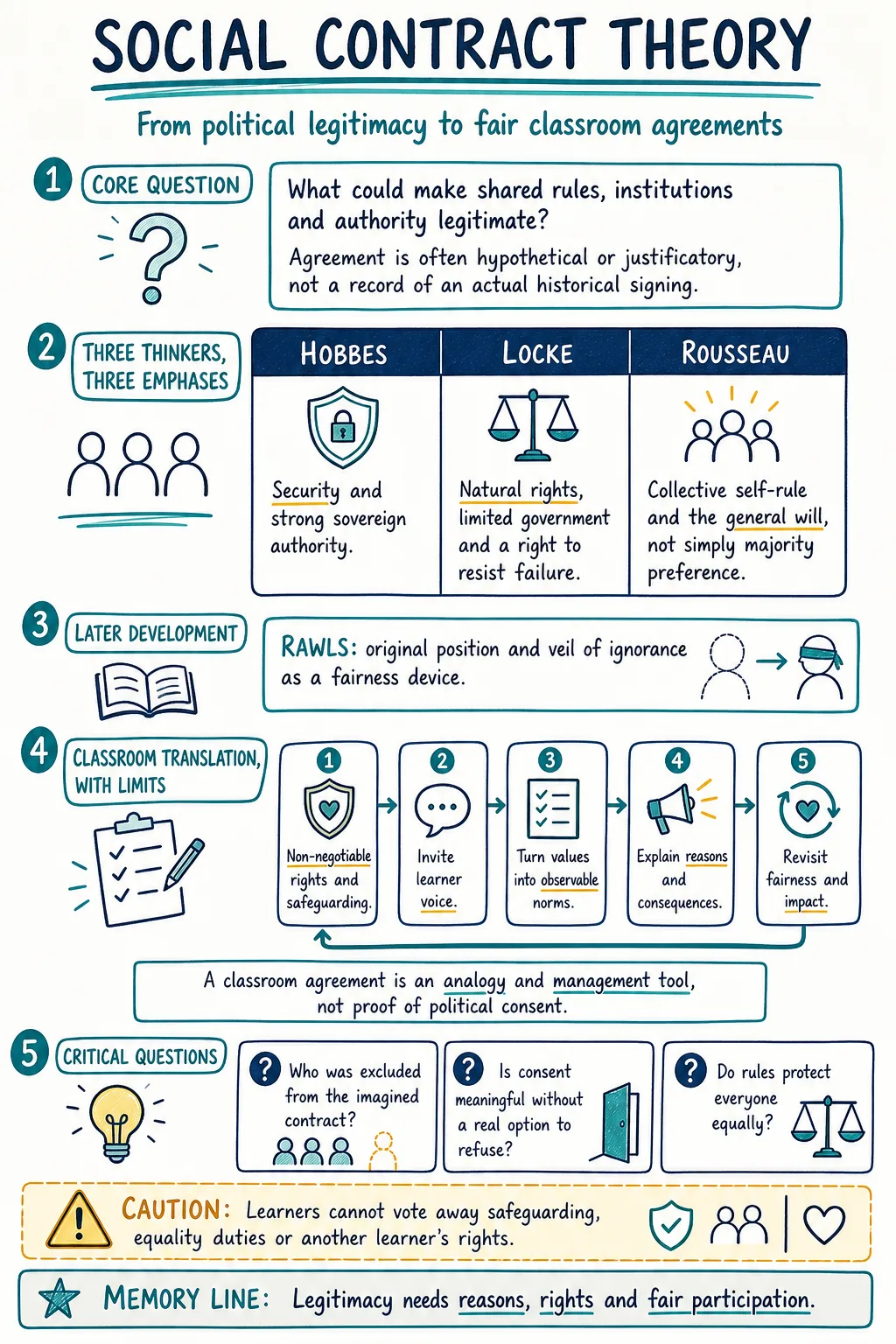
Comparison of Hobbes, Locke, and Rousseau's social contract theories showing their different views
Three Pillars of Social Contract Theory

Social Contract Theory offers a lens to view the evolution of societal norms and the balance between individual liberty and collective good. It remains a dominant theory in understanding the philosophical underpinnings of modern governance and social structures.

Key ideas to explore:

  • The Foundation of Societal Agreements: How implicit contracts form the basis of societal structures and individual relationships with authority.
  • Role of Rational Individuals: The impact of critical thinking in shaping political and moral frameworks within societies.
  • Evolution from Theory to Practise: The transition of Social Contract Theory from philosophical discourse to practical applications in modern political and educational systems.
  • ◆ Structural Learning
    Rules We Agree To: Social Contract Theory in Education
    A deep-dive podcast for educators

    From Hobbes to Rawls, how social contract theory explains classroom rules, school culture, and the implicit agreements between teachers and pupils.

    Hobbes, Locke, and Rousseau each developed distinct versions of social contract theory that differ fundamentally in their views of human nature, government legitimacy, and individual rights.

    History of Social Contract Theory

    The history of social contract theory dates back to ancient Greece, with the contributions of Socrates. Socrates believed that individuals enter into a social contract voluntarily in order to establish a just and moral society. However, it was Thomas Hobbes who popularized the concept of social contract theory in the 17th century.

    Hobbes argued that in a state of nature, without any governing authority, individuals would suffer a constant fear of violent death. To avoid this, they willingly enter into a social contract where they surrender certain freedoms to a sovereign ruler in exchange for protection and security.

    This idea was further developed by John Locke in the 17th century. Locke emphasised the importance of individual rights and believed that the purpose of the social contract was to protect these rights. He argued that if a government failed to do so, individuals had the right to rebel and establish a new social contract.

    Jean-Jacques Rousseau contributed to the theory in the 18th century with his idea of the "general will." He believed that in order for a society to be just, decisions should be made collectively, considering the common good rather than individual interests. This emphasis on collective decision-making connects to modern concepts of social-emotional learning in educational contexts.

    Overall, social contract theory proposes that moral and political obligations are dependent on a contract or agreement among individuals to form a society. This theory has shaped modern political thought and continues to be relevant in discussions on governance and individual rights. In educational settings, these principles inform classroom management approaches that emphasise shared responsibility and student engagement in creating learning environments.

    Social Contract Theory Explained
    Social Contract Theory Explained

    Contemporary Social Contract Scholars

    Social contract theory examines into the fundamental questions of political legitimacy, individual rights, and the moral foundations of society. Understanding this theory is crucial for educators, as its principles directly influence classroom management, student engagement, and the cultivation of democratic values.

    Here are some key theorists:

    • Thomas Hobbes: Advocated for a strong, centralised authority to maintain order, arguing that individuals surrender some freedoms for protection.
    • John Locke: Emphasised individual rights and limited government, asserting that individuals retain rights that the government must protect.
    • Jean-Jacques Rousseau: Promoted the idea of the general will, suggesting that decisions should reflect the collective good to ensure social justice.
    • John Rawls: Revitalised the theory with his concept of 'justice as fairness', advocating for equal rights and opportunities for all members of society.
    • Social Contract Theory in Education

      Social Contract Theory provides a strong framework for educators to establish ethical and effective learning environments. By understanding the core principles of this theory, teachers can create classrooms that promote fairness, respect, and shared responsibility.

      Here are some practical applications:

      • Establishing classroom rules and management: Involve students in creating classroom rules to creates a sense of ownership and responsibility. This approach mirrors the social contract, where everyone agrees to abide by certain norms for the common good.
      • Promoting Democratic Values: Encourage critical thinking and open dialogue on social and political issues. This helps students understand their rights and responsibilities as citizens, preparing them to participate actively in a democratic society.
      • Addressing Conflicts: Use conflict resolution strategies that emphasise fairness and mutual respect. Teach students to negotiate and compromise, reflecting the principles of social contract theory in resolving disputes.
      • Cultivating Social Responsibility: Integrate service-learning projects into the curriculum to promote social responsibility and civic engagement. This allows students to apply the principles of social contract theory to real-world issues, reinforcing their understanding of collective obligations.

      Effective pedagogical approaches include using current events to illustrate social contract principles in action. For instance, discussions about taxation, public services, or emergency powers during crises can help students understand how citizens consent to government authority in exchange for protection and services. Role-playing activities where students negotiate classroom rules or simulate constitutional conventions can make abstract concepts tangible and accessible to learners of different ages.

      Educators should also encourage students to examine different cultural and historical contexts for social contracts. Comparing democratic systems with other forms of governance helps students appreciate the voluntary nature of democratic participation whilst developing analytical skills for evaluating political systems. Cross-curricular connections with history, literature, and contemporary studies can reinforce understanding of how social contract theory influences modern civic life.

      Assessment strategies might include debates about competing visions of the social contract, analytical essays examining real-world applications, or collaborative projects exploring how different societies structure their political agreements. Such approaches ensure that students not only grasp theoretical concepts but can apply social contract theory to evaluate contemporary political developments and their own roles as democratic citizens.

      Key Theorists of Social Contract Theory

      Understanding social contract theory requires examining four pivotal thinkers whose ideas fundamentally shaped modern political philosophy for children. Thomas Hobbes argued that without government, human life would be "solitary, poor, nasty, brutish, and short," necessitating a powerful sovereign to maintain order. John Locke countered with a more optimistic view, proposing that individuals surrender some freedoms to protect their natural rights to life, liberty, and property. Jean-Jacques Rousseau famously declared that "man is born free, and everywhere he is in chains," advocating for a social contract that preserves individual freedom whilst creating collective will.

      John Rawls transformed twentieth-century political theory with his "veil of ignorance" concept, where rational individuals design a just society without knowing their position within it. This thought experiment powerfully demonstrates how fairness emerges when self-interest is temporarily suspended. Each theorist's contribution offers educators distinct pedagogical opportunities: Hobbes illustrates the necessity of rules, Locke emphasises individual rights, Rousseau explores democratic participation, and Rawls provides a framework for discussing justice and equality.

      In classroom practise, educators can engage students by presenting scenarios that mirror these philosophical positions. Asking students to design classroom rules using Rawls' approach, or debating Hobbes versus Locke regarding school governance, transforms abstract theory into concrete understanding of democratic PSHE education and civic responsibility.

      Ancient Origins and Historical Development

      Social contract theory emerged during the 17th and 18th centuries as Enlightenment philosophers grappled with fundamental questions about political authority and individual rights. This intellectual movement arose partly as a response to the absolute monarchies that dominated Europe, where rulers claimed divine right to govern without consent from their subjects. Educators should emphasise to students that these theories weren't merely abstract philosophical exercises, but urgent attempts to understand and justify political power during periods of civil war, revolution, and social upheaval.

      The historical context becomes particularly valuable when teaching students about the evolution of democratic thought. Thomas Hobbes wrote during the English Civil War, influencing his pessimistic view of human nature, whilst John Locke's theories emerged after the Glorious Revolution of 1688, reflecting more optimistic possibilities for constitutional government. Jean-Jacques Rousseau's contributions came during the intellectual ferment preceding the French Revolution, emphasising popular sovereignty and the general will.

      In the classroom, educators can help students understand these theories by connecting them to specific historical crises and social transformations. Consider using timeline activities that juxtapose major political events with the publication of key texts, enabling students to see how political philosophy responds to real-world challenges. This approach demonstrates that democratic institutions and civic rights emerged through centuries of intellectual struggle and practical experimentation.

      Teaching Social Contract Theory in the Classroom

      Effective instruction in social contract theory requires scaffolded learning approaches that move students from concrete examples to abstract philosophical concepts. Begin with familiar scenarios such as classroom rules or school policies, helping students recognise that these represent agreements between individuals for mutual benefit. Role-playing activities prove particularly valuable, where students negotiate hypothetical social contracts for desert island scenarios or new communities, experiencing firsthand the tensions between individual freedom and collective security that Hobbes, Locke, and Rousseau explored.

      Comparative analysis exercises allow students to examine different philosophers' perspectives systematically. Create structured comparison charts where students evaluate how each theorist would approach contemporary issues such as digital privacy, environmental protection, or pandemic responses. Jerome Bruner's constructivist theory supports this approach, as students build understanding by connecting new philosophical concepts to current events and personal experiences.

      Assessment strategies should emphasise critical thinking over rote memorisation. Design tasks requiring students to apply social contract principles to real-world situations, such as analysing school policies or local government decisions. Socratic seminars encourage deep discussion whilst developing civic engagement skills essential for democratic citizenship. These methods ensure that students not only understand theoretical concepts but can also articulate how social contract theory remains relevant to modern democratic society.

      Social Contract Theory and School Behaviour Management

      The language of social contract theory maps naturally onto the challenge of establishing and maintaining expectations in schools. A classroom in which rules are negotiated rather than simply imposed mirrors the contractarian insight that legitimate authority requires the consent of those governed by it. William Glasser (1998), in Choice Theory, argued that almost all behaviour in school is purposeful: pupils act to meet one or more of five basic needs, which he identified as survival, belonging, power, freedom, and fun. When school rules are experienced as external impositions that frustrate these needs, pupils resist them. When rules are co-constructed in ways that address these needs, compliance becomes rational rather than merely enforced. Glasser's approach to behaviour management is, in effect, a Lockean model: authority is legitimate only when it serves the genuine interests of those subject to it.

      The contrast with Lee Canter's (1976) Assertive Discipline model is instructive. Canter argued that teachers have a right to teach and pupils have a right to learn, and that clear non-negotiable boundaries, enforced consistently with known consequences, protect both rights. This is closer to a Hobbesian position: the teacher as sovereign whose authority creates the conditions in which productive activity becomes possible. Both models have attracted substantial research attention, and both have demonstrable classroom utility. The relevant question is not which model is correct in the abstract, but which best fits the particular community of pupils, parents, and staff who constitute a given school.

      Restorative justice approaches, introduced into UK schools from the mid-2000s, represent a third contractarian model. Belinda Hopkins (2004) described restorative justice in schools as a process of repairing harm and rebuilding relationships after a rule has been broken, rather than simply applying a sanction. Where punitive approaches treat rule-breaking as a violation of the school's authority, restorative approaches treat it as a rupture in the relational contract between the individuals involved, and between those individuals and their community. Conferences bring together the person who caused harm and those affected by it, to agree on what needs to happen to put things right. This approach treats the social contract not as a fixed document but as a living agreement that must be renewed after each breach.

      The PSHE curriculum in England and the Citizenship Education framework both provide structured opportunities to teach social contract principles explicitly. Pupils who understand why communities need agreed rules, what happens when those rules are violated, and how communities repair themselves after conflict are better prepared both to follow school expectations and to participate in democratic life beyond school. Incorporating deliberate discussion of the reasoning behind school rules, rather than presenting rules as self-evident, aligns the hidden curriculum of behaviour management with the explicit curriculum of civic and moral education.

      Question 1 of 10
      In Thomas Hobbes' political philosophy, what primary motivation drives individuals to enter into a social contract?
      AThe desire to protect inherent natural rights like property.
      BThe fear of violent death in a chaotic state of nature.
      CThe pursuit of the 'general will' for the collective good.
      DThe need to establish a system of 'justice as fairness'.

      Conclusion

      Social Contract Theory offers a compelling framework for understanding the relationship between individuals and society. From the ancient ideas of Socrates to the modern interpretations of John Rawls, this theory has shaped political thought and continues to influence contemporary debates on governance and individual rights.

      For educators, Social Contract Theory provides invaluable insights into creating ethical and effective learning environments. By applying the principles of shared responsibility, mutual respect, and democratic participation, teachers can cultivate classrooms that helps students to become engaged, responsible, and critically thinking members of society. Embracing this theory allows educators to move beyond traditional authority-based approaches, developing a collaborative environment where every student feels valued and heard.

      Major Social Contract Philosophers

      Four thinkers fundamentally shaped our understanding of social contracts, each offering distinct perspectives that directly inform modern classroom dynamics. Thomas Hobbes painted humanity as naturally selfish and violent, arguing that without strong authority, life would be 'solitary, poor, nasty, brutish, and short'. His vision translates to classrooms where strict rules prevent chaos; think of supply teachers walking into unfamiliar classes where established authority structures have temporarily dissolved.

      John Locke offered a more optimistic view, proposing that people possess natural rights to life, liberty, and property. In Lockean classrooms, teachers act as facilitators rather than enforcers, establishing rules through discussion rather than decree. When Year 9 students collaboratively create their own behaviour contracts at term's start, they're embodying Locke's belief that legitimate authority stems from consent, not force.

      Jean-Jacques Rousseau believed humans were naturally good but corrupted by society, advocating for education that preserves this innate goodness. His concept of the 'general will' manifests when entire classes vote on reward systems or collectively decide consequences for disruption. Modern restorative justice practices in schools, where students help determine fair outcomes for misbehaviour, echo Rousseau's vision of collective decision-making.

      John Rawls brought social contract theory into contemporary times with his 'veil of ignorance' thought experiment. He asked: what rules would we choose if we didn't know our position in society? Teachers can apply this by having students design classroom policies whilst imagining they could be anyone in the room; the quiet student, the class clown, or someone with learning difficulties. This exercise reveals how fairness emerges when self-interest is removed from rule-making.

      Written by the Structural Learning Research Team

      Reviewed by Paul Main, Founder & Educational Consultant at Structural Learning

      Frequently Asked Questions

      How can teachers use social contract theory to create classroom rules with students?

      Teachers can facilitate collaborative rule-making sessions where students negotiate and agree upon classroom expectations together. This approach mirrors the consent principle by ensuring students have genuine input into the social contract that governs their learning environment. The resulting rules carry more weight because students helped create them rather than having them imposed from above.

      What age groups can understand social contract concepts in school?

      Primary school children (ages 7-11) can grasp basic ideas about fairness and agreements through simplified discussions about classroom communities. Secondary students (ages 11-18) can engage with more complex concepts like individual rights versus collective responsibility. Even young children naturally understand the concept of 'fair trades' which forms the foundation of social contract thinking.

      How does social contract theory help teachers handle student behaviour problems?

      When behaviour issues arise, teachers can refer back to the collectively agreed classroom contract rather than relying solely on external authority. This approach helps students understand that rule-breaking affects the community they helped create, fostering accountability and reflection. It also provides a framework for discussing why certain behaviours undermine the social agreement everyone consented to follow.

      What classroom activities teach social contract theory to students?

      Teachers can use mock parliamentary debates, classroom constitution-writing exercises, and role-playing scenarios about desert island survival to illustrate social contract principles. Group project negotiations and peer mediation sessions also demonstrate how individuals surrender some freedoms for collective benefits. These hands-on activities make abstract philosophical concepts tangible and relevant to students' daily experiences.

      How can social contract theory improve student-teacher relationships?

      Making implicit classroom expectations explicit through collaborative agreement-setting creates transparency and mutual respect between teachers and students. When teachers acknowledge that their authority comes from student consent rather than position alone, it builds trust and legitimacy. This approach transforms the classroom dynamic from authoritarian control to democratic partnership whilst maintaining necessary structure for learning.

      To examine deeper into Social Contract Theory and its implications, consider the following resources:

      1. Hobbes, T. (1651). *Leviathan*. London: Andrew Crooke.

      2. Locke, J. (1689). *Two Treatises of Government*. London: Awnsham Churchill.

      3. Rousseau, J.J. (1762). *The Social Contract*. Paris: Michel Rey.

      4. Rawls, J. (1971). *A Theory of Justice*. Cambridge, MA: Harvard University Press.

      5. Hampton, J. (1986). *Hobbes and the Social Contract Tradition*. Cambridge: Cambridge University Press.

    Social Contract Theory: A Visual Guide

    Visual presentation of social contract theory and its relevance to education and classroom management.

    ⬇️ Download Slide Deck (.pptx)
    PowerPoint format. Structural Learning.

    Free Resource Pack

    Download this free Systems Theories, Bronfenbrenner & Ecological Models resource pack for your classroom and staff room. Includes printable posters, desk cards, and CPD materials.

    Free Resource Pack

    Bronfenbrenner's Ecological Systems

    3 evidence-informed resources for educators to understand and apply ecological systems theory in practice.

    Bronfenbrenner's Ecological Systems — 3 resources
    CPD Briefing VisualQuick Reference GuidePlanning TemplateEcological Systems TheoryBronfenbrennerChild DevelopmentWhole Child ApproachSystemic Thinking

    Download your free bundle

    Fill in your details below and we'll send the resource pack straight to your inbox.

    Quick survey (helps us create better resources)

    How confident are you in explaining Bronfenbrenner's Ecological Systems Theory to colleagues?

    Not confident
    Slightly confident
    Moderately confident
    Very confident
    Extremely confident

    To what extent does your school's approach to student well-being reflect an understanding of interconnected ecological systems?

    Not at all
    Minimally
    Moderately
    Significantly
    Extensively

    How often do you consciously consider factors from all five of Bronfenbrenner's ecological systems when planning support for individual students?

    Never
    Rarely
    Sometimes
    Often
    Always

    Your resource pack is ready

    We've also sent a copy to your email. Check your inbox.

    Further Reading: Key Research Papers

    These peer-reviewed studies provide the research foundation for the strategies discussed in this article:

    Promoting Quality Language Learning Through Efficient Classroom Management: The Case of English Language Teaching in Bukavu Secondary Schools View study ↗

    Heritier Ombeni Kalalizi et al. (2025)

    This research examined how effective classroom management directly impacts English language learning quality in secondary schools in the Democratic Republic of Congo. The study found that poor classroom control strategies and outdated teaching methods were major barriers to student success in English as a Foreign Language. For teachers, this highlights the critical connection between strong classroom management skills and actual learning outcomes, especially in challenging educational environments.

    Exploring the Connectivity Between Education 4.0 and Classroom 4.0: Technologies, Student Perspectives, and Engagement in the Digital Era View study ↗
    20 citations

    K. Joshi et al. (2024)

    This study investigated how digital technologies are transforming modern classrooms and what students actually think about these changes. The research found both significant opportunities and challenges in integrating advanced digital tools into everyday teaching practise. For educators, this provides valuable insights into how to effectively balance traditional teaching with new technologies while ensuring equitable access and meaningful student engagement.

Loading audit...

Feminist and Postcolonial Critiques of Social Contract Theory

Since the 1980s, feminist and postcolonial scholars have subjected the social contract tradition to searching criticism, arguing that the apparent universality of contractarian theory conceals systematic exclusions. These critiques matter for educators because they illuminate whose interests school structures have historically served, and whose have been marginalised or rendered invisible.

Carole Pateman (1988), in The Sexual Contract, argued that the canonical social contract accounts of Hobbes, Locke, and Rousseau all presuppose a prior, unacknowledged agreement: the sexual contract that assigns women to the private sphere and excludes them from the public contract between men. The supposedly universal contracting individual is implicitly male; women appear in contract theory as dependants, wards, or objects of protection rather than as autonomous agents with the standing to negotiate terms. Pateman's critique has direct implications for schooling: curricula, assessment systems, and pedagogical norms that present themselves as neutral frequently encode assumptions about whose knowledge counts, whose modes of reasoning are valued, and which life trajectories are taken as the norm.

Charles Mills (1997), in The Racial Contract, extended this analysis to race. Mills argued that the modern political order rests on an implicit racial contract: a set of agreements among white people to maintain systems of racial hierarchy, while presenting those systems as natural, colour-blind, or legally resolved. The social contract's promise of equal standing before the law and equal access to opportunity has historically been conditional on race in ways that official theory systematically obscures. For schools, Mills's analysis supports the case for explicit engagement with the history of educational exclusion and with ongoing patterns of racialised attainment that cannot be explained by individual ability alone.

Seyla Benhabib (1992) identified a related problem at the level of moral reasoning. She distinguished the generalised other, the abstract, rights-bearing individual of contractarian theory, from the concrete other, the specific person with particular needs, relationships, and vulnerabilities whom we actually encounter in moral life. Contractarian ethics, by reasoning from the generalised other, tends to produce principles that are impartial and universal but that struggle to accommodate the particular moral claims of the most vulnerable. Martha Nussbaum (2006), in Frontiers of Justice, drew on the capabilities approach developed with Amartya Sen as an alternative to contractarianism. Rather than asking what rational individuals would agree to from behind a veil of ignorance, Nussbaum asked what conditions are necessary for a life of full human dignity. The capabilities approach has been influential in disability studies and in arguments for inclusive education, because it begins from the full diversity of human functioning rather than from a idealised rational agent.

For teachers, these critiques do not invalidate the social contract tradition but they do complicate it in productive ways. They prompt questions that belong in both the explicit curriculum and the design of school structures: Whose voices shaped the rules we follow? Whose experiences are made invisible by systems that claim to be universal? How can classrooms be genuinely inclusive rather than superficially so? Engaging pupils with these questions, particularly in secondary PSHE, citizenship, and history lessons, is itself a form of civic education that takes the social contract seriously enough to ask whether it has, historically, applied to everyone.

What is Social Contract Theory?

Social Contract Theory, a cornerstone in the edifice of , offers a window into the intricate relationship between individual people and societal structures. At its core, this theory posits that members of a society implicitly agree to surrender some freedoms to authority figures in exchange for protection of their remaining rights. This conceptual framework, championed by social contract theorists, explores into the origins of moral and political order, examining how collective agreements shape human life.

Key Takeaways

  1. Social contract theory offers a crucial lens for understanding the implicit agreements governing rules and rights within educational settings. Drawing from thinkers like Jean-Jacques Rousseau (The Social Contract, 1762), it highlights how pupils and educators tacitly consent to certain norms and structures to foster a productive learning community. This perspective helps educators articulate the rationale behind school policies and the reciprocal responsibilities involved.
  2. Feminist critiques profoundly challenge the supposed universality of social contract theory, exposing its inherent gendered exclusions. Carole Pateman (The Sexual Contract, 1988) argues that a prior "sexual contract" underpins canonical accounts, assigning women to the private sphere and thus marginalising their public and educational contributions. Educators must consider how school structures and curricula might perpetuate these historical exclusions, impacting girls' and women's experiences.
  3. Postcolonial and critical race theory perspectives expose how social contract ideals have historically legitimised and perpetuated racial inequalities within educational frameworks. Charles W. Mills (The Racial Contract, 1997) argues that a "racial contract" underpins Western societies, systematically disadvantaging non-white populations and shaping educational access and curriculum content. Understanding this helps educators recognise and dismantle systemic biases that marginalise pupils from diverse backgrounds.
  4. Engaging with social contract theory, alongside its critiques, empowers pupils to critically examine justice, fairness, and their roles as citizens within the school community. As highlighted by Amy Gutmann (Democratic Education, 1987), fostering democratic deliberation in schools enables pupils to question existing rules, understand their rights, and participate in shaping a more equitable learning environment. This approach encourages active citizenship and ethical reasoning from an early age.

The theory's roots can be traced back to the Enlightenment era, where thinkers like John Locke and Jean-Jacques Rousseau pondered over the human condition in a 'state of nature', a hypothetical life without political institutions. They argued that rational individuals would agree to form a society governed by mutual obligations, moving away from the brutish, solitary life that characterises the state of nature. This transition, according to them, is guided by an inherent understanding of moral codes and the laws of nature.

Comparison of Hobbes, Locke, and Rawls' social contract theories showing evolution from security to rights to justice
Three Philosophers, Three Visions: How Social Contract Theory Evolved

Comparison table showing Hobbes', Locke's, and Rousseau's different views on social contract theory
Side-by-side comparison table: Three Philosophers' Views on Social Contract Theory

In the 20th century, John Rawls revitalized the theory with his ' theory of justice', which reimagined the social contract as a fair agreement among equals. Rawls' perspective underscores the role of moral persons in shaping a just society, where political power is exercised in ways that are beneficial to all, especially the least advantaged. His ideas resonate profoundly in modern society, where equity and fairness in educational and political institutions are increasingly scrutinized.

Comparison of Hobbes, Locke, and Rousseau's social contract theories showing their different views
Three Pillars of Social Contract Theory

Social Contract Theory offers a lens to view the evolution of societal norms and the balance between individual liberty and collective good. It remains a dominant theory in understanding the philosophical underpinnings of modern governance and social structures.

Key ideas to explore:

  • The Foundation of Societal Agreements: How implicit contracts form the basis of societal structures and individual relationships with authority.
  • Role of Rational Individuals: The impact of critical thinking in shaping political and moral frameworks within societies.
  • Evolution from Theory to Practise: The transition of Social Contract Theory from philosophical discourse to practical applications in modern political and educational systems.
  • ◆ Structural Learning
    Rules We Agree To: Social Contract Theory in Education
    A deep-dive podcast for educators

    From Hobbes to Rawls, how social contract theory explains classroom rules, school culture, and the implicit agreements between teachers and pupils.

    Hobbes, Locke, and Rousseau each developed distinct versions of social contract theory that differ fundamentally in their views of human nature, government legitimacy, and individual rights.

    History of Social Contract Theory

    The history of social contract theory dates back to ancient Greece, with the contributions of Socrates. Socrates believed that individuals enter into a social contract voluntarily in order to establish a just and moral society. However, it was Thomas Hobbes who popularized the concept of social contract theory in the 17th century.

    Hobbes argued that in a state of nature, without any governing authority, individuals would suffer a constant fear of violent death. To avoid this, they willingly enter into a social contract where they surrender certain freedoms to a sovereign ruler in exchange for protection and security.

    This idea was further developed by John Locke in the 17th century. Locke emphasised the importance of individual rights and believed that the purpose of the social contract was to protect these rights. He argued that if a government failed to do so, individuals had the right to rebel and establish a new social contract.

    Jean-Jacques Rousseau contributed to the theory in the 18th century with his idea of the "general will." He believed that in order for a society to be just, decisions should be made collectively, considering the common good rather than individual interests. This emphasis on collective decision-making connects to modern concepts of social-emotional learning in educational contexts.

    Overall, social contract theory proposes that moral and political obligations are dependent on a contract or agreement among individuals to form a society. This theory has shaped modern political thought and continues to be relevant in discussions on governance and individual rights. In educational settings, these principles inform classroom management approaches that emphasise shared responsibility and student engagement in creating learning environments.

    Social Contract Theory Explained
    Social Contract Theory Explained

    Contemporary Social Contract Scholars

    Social contract theory examines into the fundamental questions of political legitimacy, individual rights, and the moral foundations of society. Understanding this theory is crucial for educators, as its principles directly influence classroom management, student engagement, and the cultivation of democratic values.

    Here are some key theorists:

    • Thomas Hobbes: Advocated for a strong, centralised authority to maintain order, arguing that individuals surrender some freedoms for protection.
    • John Locke: Emphasised individual rights and limited government, asserting that individuals retain rights that the government must protect.
    • Jean-Jacques Rousseau: Promoted the idea of the general will, suggesting that decisions should reflect the collective good to ensure social justice.
    • John Rawls: Revitalised the theory with his concept of 'justice as fairness', advocating for equal rights and opportunities for all members of society.
    • Social Contract Theory in Education

      Social Contract Theory provides a strong framework for educators to establish ethical and effective learning environments. By understanding the core principles of this theory, teachers can create classrooms that promote fairness, respect, and shared responsibility.

      Here are some practical applications:

      • Establishing classroom rules and management: Involve students in creating classroom rules to creates a sense of ownership and responsibility. This approach mirrors the social contract, where everyone agrees to abide by certain norms for the common good.
      • Promoting Democratic Values: Encourage critical thinking and open dialogue on social and political issues. This helps students understand their rights and responsibilities as citizens, preparing them to participate actively in a democratic society.
      • Addressing Conflicts: Use conflict resolution strategies that emphasise fairness and mutual respect. Teach students to negotiate and compromise, reflecting the principles of social contract theory in resolving disputes.
      • Cultivating Social Responsibility: Integrate service-learning projects into the curriculum to promote social responsibility and civic engagement. This allows students to apply the principles of social contract theory to real-world issues, reinforcing their understanding of collective obligations.

      Effective pedagogical approaches include using current events to illustrate social contract principles in action. For instance, discussions about taxation, public services, or emergency powers during crises can help students understand how citizens consent to government authority in exchange for protection and services. Role-playing activities where students negotiate classroom rules or simulate constitutional conventions can make abstract concepts tangible and accessible to learners of different ages.

      Educators should also encourage students to examine different cultural and historical contexts for social contracts. Comparing democratic systems with other forms of governance helps students appreciate the voluntary nature of democratic participation whilst developing analytical skills for evaluating political systems. Cross-curricular connections with history, literature, and contemporary studies can reinforce understanding of how social contract theory influences modern civic life.

      Assessment strategies might include debates about competing visions of the social contract, analytical essays examining real-world applications, or collaborative projects exploring how different societies structure their political agreements. Such approaches ensure that students not only grasp theoretical concepts but can apply social contract theory to evaluate contemporary political developments and their own roles as democratic citizens.

      Key Theorists of Social Contract Theory

      Understanding social contract theory requires examining four pivotal thinkers whose ideas fundamentally shaped modern political philosophy for children. Thomas Hobbes argued that without government, human life would be "solitary, poor, nasty, brutish, and short," necessitating a powerful sovereign to maintain order. John Locke countered with a more optimistic view, proposing that individuals surrender some freedoms to protect their natural rights to life, liberty, and property. Jean-Jacques Rousseau famously declared that "man is born free, and everywhere he is in chains," advocating for a social contract that preserves individual freedom whilst creating collective will.

      John Rawls transformed twentieth-century political theory with his "veil of ignorance" concept, where rational individuals design a just society without knowing their position within it. This thought experiment powerfully demonstrates how fairness emerges when self-interest is temporarily suspended. Each theorist's contribution offers educators distinct pedagogical opportunities: Hobbes illustrates the necessity of rules, Locke emphasises individual rights, Rousseau explores democratic participation, and Rawls provides a framework for discussing justice and equality.

      In classroom practise, educators can engage students by presenting scenarios that mirror these philosophical positions. Asking students to design classroom rules using Rawls' approach, or debating Hobbes versus Locke regarding school governance, transforms abstract theory into concrete understanding of democratic PSHE education and civic responsibility.

      Ancient Origins and Historical Development

      Social contract theory emerged during the 17th and 18th centuries as Enlightenment philosophers grappled with fundamental questions about political authority and individual rights. This intellectual movement arose partly as a response to the absolute monarchies that dominated Europe, where rulers claimed divine right to govern without consent from their subjects. Educators should emphasise to students that these theories weren't merely abstract philosophical exercises, but urgent attempts to understand and justify political power during periods of civil war, revolution, and social upheaval.

      The historical context becomes particularly valuable when teaching students about the evolution of democratic thought. Thomas Hobbes wrote during the English Civil War, influencing his pessimistic view of human nature, whilst John Locke's theories emerged after the Glorious Revolution of 1688, reflecting more optimistic possibilities for constitutional government. Jean-Jacques Rousseau's contributions came during the intellectual ferment preceding the French Revolution, emphasising popular sovereignty and the general will.

      In the classroom, educators can help students understand these theories by connecting them to specific historical crises and social transformations. Consider using timeline activities that juxtapose major political events with the publication of key texts, enabling students to see how political philosophy responds to real-world challenges. This approach demonstrates that democratic institutions and civic rights emerged through centuries of intellectual struggle and practical experimentation.

      Teaching Social Contract Theory in the Classroom

      Effective instruction in social contract theory requires scaffolded learning approaches that move students from concrete examples to abstract philosophical concepts. Begin with familiar scenarios such as classroom rules or school policies, helping students recognise that these represent agreements between individuals for mutual benefit. Role-playing activities prove particularly valuable, where students negotiate hypothetical social contracts for desert island scenarios or new communities, experiencing firsthand the tensions between individual freedom and collective security that Hobbes, Locke, and Rousseau explored.

      Comparative analysis exercises allow students to examine different philosophers' perspectives systematically. Create structured comparison charts where students evaluate how each theorist would approach contemporary issues such as digital privacy, environmental protection, or pandemic responses. Jerome Bruner's constructivist theory supports this approach, as students build understanding by connecting new philosophical concepts to current events and personal experiences.

      Assessment strategies should emphasise critical thinking over rote memorisation. Design tasks requiring students to apply social contract principles to real-world situations, such as analysing school policies or local government decisions. Socratic seminars encourage deep discussion whilst developing civic engagement skills essential for democratic citizenship. These methods ensure that students not only understand theoretical concepts but can also articulate how social contract theory remains relevant to modern democratic society.

      Social Contract Theory and School Behaviour Management

      The language of social contract theory maps naturally onto the challenge of establishing and maintaining expectations in schools. A classroom in which rules are negotiated rather than simply imposed mirrors the contractarian insight that legitimate authority requires the consent of those governed by it. William Glasser (1998), in Choice Theory, argued that almost all behaviour in school is purposeful: pupils act to meet one or more of five basic needs, which he identified as survival, belonging, power, freedom, and fun. When school rules are experienced as external impositions that frustrate these needs, pupils resist them. When rules are co-constructed in ways that address these needs, compliance becomes rational rather than merely enforced. Glasser's approach to behaviour management is, in effect, a Lockean model: authority is legitimate only when it serves the genuine interests of those subject to it.

      The contrast with Lee Canter's (1976) Assertive Discipline model is instructive. Canter argued that teachers have a right to teach and pupils have a right to learn, and that clear non-negotiable boundaries, enforced consistently with known consequences, protect both rights. This is closer to a Hobbesian position: the teacher as sovereign whose authority creates the conditions in which productive activity becomes possible. Both models have attracted substantial research attention, and both have demonstrable classroom utility. The relevant question is not which model is correct in the abstract, but which best fits the particular community of pupils, parents, and staff who constitute a given school.

      Restorative justice approaches, introduced into UK schools from the mid-2000s, represent a third contractarian model. Belinda Hopkins (2004) described restorative justice in schools as a process of repairing harm and rebuilding relationships after a rule has been broken, rather than simply applying a sanction. Where punitive approaches treat rule-breaking as a violation of the school's authority, restorative approaches treat it as a rupture in the relational contract between the individuals involved, and between those individuals and their community. Conferences bring together the person who caused harm and those affected by it, to agree on what needs to happen to put things right. This approach treats the social contract not as a fixed document but as a living agreement that must be renewed after each breach.

      The PSHE curriculum in England and the Citizenship Education framework both provide structured opportunities to teach social contract principles explicitly. Pupils who understand why communities need agreed rules, what happens when those rules are violated, and how communities repair themselves after conflict are better prepared both to follow school expectations and to participate in democratic life beyond school. Incorporating deliberate discussion of the reasoning behind school rules, rather than presenting rules as self-evident, aligns the hidden curriculum of behaviour management with the explicit curriculum of civic and moral education.

      Question 1 of 10
      In Thomas Hobbes' political philosophy, what primary motivation drives individuals to enter into a social contract?
      AThe desire to protect inherent natural rights like property.
      BThe fear of violent death in a chaotic state of nature.
      CThe pursuit of the 'general will' for the collective good.
      DThe need to establish a system of 'justice as fairness'.

      Conclusion

      Social Contract Theory offers a compelling framework for understanding the relationship between individuals and society. From the ancient ideas of Socrates to the modern interpretations of John Rawls, this theory has shaped political thought and continues to influence contemporary debates on governance and individual rights.

      For educators, Social Contract Theory provides invaluable insights into creating ethical and effective learning environments. By applying the principles of shared responsibility, mutual respect, and democratic participation, teachers can cultivate classrooms that helps students to become engaged, responsible, and critically thinking members of society. Embracing this theory allows educators to move beyond traditional authority-based approaches, developing a collaborative environment where every student feels valued and heard.

      Major Social Contract Philosophers

      Four thinkers fundamentally shaped our understanding of social contracts, each offering distinct perspectives that directly inform modern classroom dynamics. Thomas Hobbes painted humanity as naturally selfish and violent, arguing that without strong authority, life would be 'solitary, poor, nasty, brutish, and short'. His vision translates to classrooms where strict rules prevent chaos; think of supply teachers walking into unfamiliar classes where established authority structures have temporarily dissolved.

      John Locke offered a more optimistic view, proposing that people possess natural rights to life, liberty, and property. In Lockean classrooms, teachers act as facilitators rather than enforcers, establishing rules through discussion rather than decree. When Year 9 students collaboratively create their own behaviour contracts at term's start, they're embodying Locke's belief that legitimate authority stems from consent, not force.

      Jean-Jacques Rousseau believed humans were naturally good but corrupted by society, advocating for education that preserves this innate goodness. His concept of the 'general will' manifests when entire classes vote on reward systems or collectively decide consequences for disruption. Modern restorative justice practices in schools, where students help determine fair outcomes for misbehaviour, echo Rousseau's vision of collective decision-making.

      John Rawls brought social contract theory into contemporary times with his 'veil of ignorance' thought experiment. He asked: what rules would we choose if we didn't know our position in society? Teachers can apply this by having students design classroom policies whilst imagining they could be anyone in the room; the quiet student, the class clown, or someone with learning difficulties. This exercise reveals how fairness emerges when self-interest is removed from rule-making.

      Written by the Structural Learning Research Team

      Reviewed by Paul Main, Founder & Educational Consultant at Structural Learning

      Frequently Asked Questions

      How can teachers use social contract theory to create classroom rules with students?

      Teachers can facilitate collaborative rule-making sessions where students negotiate and agree upon classroom expectations together. This approach mirrors the consent principle by ensuring students have genuine input into the social contract that governs their learning environment. The resulting rules carry more weight because students helped create them rather than having them imposed from above.

      What age groups can understand social contract concepts in school?

      Primary school children (ages 7-11) can grasp basic ideas about fairness and agreements through simplified discussions about classroom communities. Secondary students (ages 11-18) can engage with more complex concepts like individual rights versus collective responsibility. Even young children naturally understand the concept of 'fair trades' which forms the foundation of social contract thinking.

      How does social contract theory help teachers handle student behaviour problems?

      When behaviour issues arise, teachers can refer back to the collectively agreed classroom contract rather than relying solely on external authority. This approach helps students understand that rule-breaking affects the community they helped create, fostering accountability and reflection. It also provides a framework for discussing why certain behaviours undermine the social agreement everyone consented to follow.

      What classroom activities teach social contract theory to students?

      Teachers can use mock parliamentary debates, classroom constitution-writing exercises, and role-playing scenarios about desert island survival to illustrate social contract principles. Group project negotiations and peer mediation sessions also demonstrate how individuals surrender some freedoms for collective benefits. These hands-on activities make abstract philosophical concepts tangible and relevant to students' daily experiences.

      How can social contract theory improve student-teacher relationships?

      Making implicit classroom expectations explicit through collaborative agreement-setting creates transparency and mutual respect between teachers and students. When teachers acknowledge that their authority comes from student consent rather than position alone, it builds trust and legitimacy. This approach transforms the classroom dynamic from authoritarian control to democratic partnership whilst maintaining necessary structure for learning.

      To examine deeper into Social Contract Theory and its implications, consider the following resources:

      1. Hobbes, T. (1651). *Leviathan*. London: Andrew Crooke.

      2. Locke, J. (1689). *Two Treatises of Government*. London: Awnsham Churchill.

      3. Rousseau, J.J. (1762). *The Social Contract*. Paris: Michel Rey.

      4. Rawls, J. (1971). *A Theory of Justice*. Cambridge, MA: Harvard University Press.

      5. Hampton, J. (1986). *Hobbes and the Social Contract Tradition*. Cambridge: Cambridge University Press.

    Social Contract Theory: A Visual Guide

    Visual presentation of social contract theory and its relevance to education and classroom management.

    ⬇️ Download Slide Deck (.pptx)
    PowerPoint format. Structural Learning.

    Free Resource Pack

    Download this free Systems Theories, Bronfenbrenner & Ecological Models resource pack for your classroom and staff room. Includes printable posters, desk cards, and CPD materials.

    Free Resource Pack

    Bronfenbrenner's Ecological Systems

    3 evidence-informed resources for educators to understand and apply ecological systems theory in practice.

    Bronfenbrenner's Ecological Systems — 3 resources
    CPD Briefing VisualQuick Reference GuidePlanning TemplateEcological Systems TheoryBronfenbrennerChild DevelopmentWhole Child ApproachSystemic Thinking

    Download your free bundle

    Fill in your details below and we'll send the resource pack straight to your inbox.

    Quick survey (helps us create better resources)

    How confident are you in explaining Bronfenbrenner's Ecological Systems Theory to colleagues?

    Not confident
    Slightly confident
    Moderately confident
    Very confident
    Extremely confident

    To what extent does your school's approach to student well-being reflect an understanding of interconnected ecological systems?

    Not at all
    Minimally
    Moderately
    Significantly
    Extensively

    How often do you consciously consider factors from all five of Bronfenbrenner's ecological systems when planning support for individual students?

    Never
    Rarely
    Sometimes
    Often
    Always

    Your resource pack is ready

    We've also sent a copy to your email. Check your inbox.

    Further Reading: Key Research Papers

    These peer-reviewed studies provide the research foundation for the strategies discussed in this article:

    Promoting Quality Language Learning Through Efficient Classroom Management: The Case of English Language Teaching in Bukavu Secondary Schools View study ↗

    Heritier Ombeni Kalalizi et al. (2025)

    This research examined how effective classroom management directly impacts English language learning quality in secondary schools in the Democratic Republic of Congo. The study found that poor classroom control strategies and outdated teaching methods were major barriers to student success in English as a Foreign Language. For teachers, this highlights the critical connection between strong classroom management skills and actual learning outcomes, especially in challenging educational environments.

    Exploring the Connectivity Between Education 4.0 and Classroom 4.0: Technologies, Student Perspectives, and Engagement in the Digital Era View study ↗
    20 citations

    K. Joshi et al. (2024)

    This study investigated how digital technologies are transforming modern classrooms and what students actually think about these changes. The research found both significant opportunities and challenges in integrating advanced digital tools into everyday teaching practise. For educators, this provides valuable insights into how to effectively balance traditional teaching with new technologies while ensuring equitable access and meaningful student engagement.

Psychology

Back to Blog

{"@context":"https://schema.org","@graph":[{"@type":"Article","@id":"https://www.structural-learning.com/post/social-contract-theory#article","headline":"Social Contract Theory in Education: Rules, Rights and","description":"Explore how social contract theory from Hobbes, Locke and Rousseau applies to classroom management. Practical guide to collaborative rule-making.","datePublished":"2023-11-20T12:39:04.429Z","dateModified":"2026-03-02T11:00:34.644Z","author":{"@type":"Person","name":"Paul Main","url":"https://www.structural-learning.com/team/paulmain","jobTitle":"Founder & Educational Consultant"},"publisher":{"@type":"Organization","name":"Structural Learning","url":"https://www.structural-learning.com","logo":{"@type":"ImageObject","url":"https://cdn.prod.website-files.com/5b69a01ba2e409e5d5e055c6/6040bf0426cb415ba2fc7882_newlogoblue.svg"}},"mainEntityOfPage":{"@type":"WebPage","@id":"https://www.structural-learning.com/post/social-contract-theory"},"image":"https://cdn.prod.website-files.com/5b69a01ba2e409501de055d1/69a2e36ba467fd14221291c2_69a2e36872115219d9283f52_social-contract-pillars-nb2-infographic.webp","wordCount":2899},{"@type":"BreadcrumbList","@id":"https://www.structural-learning.com/post/social-contract-theory#breadcrumb","itemListElement":[{"@type":"ListItem","position":1,"name":"Home","item":"https://www.structural-learning.com/"},{"@type":"ListItem","position":2,"name":"Blog","item":"https://www.structural-learning.com/blog"},{"@type":"ListItem","position":3,"name":"Social Contract Theory in Education: Rules, Rights and","item":"https://www.structural-learning.com/post/social-contract-theory"}]}]}