Updated on
August 25, 2026
Self-Actualisation: Meaning, Maslow's Hierarchy and Examples
Self-actualisation explained through Goldstein, Maslow and Rogers, with examples, evidence, measurement problems, cultural critiques and educational limits.


Updated on
August 25, 2026
Self-actualisation explained through Goldstein, Maslow and Rogers, with examples, evidence, measurement problems, cultural critiques and educational limits.
What is self-actualisation?
Self-actualisation is an influential but contested idea about developing or realising one's capacities. Goldstein used it in an organismic theory, Maslow placed it within a hierarchy of motives, and Rogers described an actualising tendency within person-centred theory. These are related historical accounts, not one validated learner type, fixed developmental endpoint or evidence-based classroom method.
Self-actualisation, also spelt self-actualization, is an influential but contested idea about developing or realising one's capacities. Goldstein used the term within an organismic theory. Maslow placed self-actualisation within a hierarchy of motives, while Rogers described an actualising tendency within person-centred theory. These accounts are related in the history of humanistic thought, but they are not one validated theory, learner type or fixed endpoint.
The term often means “fulfilling one's potential” in everyday use (Maslow, 1943). That short definition hides important differences. It also makes a broad ideal sound easier to measure than it is. A sound account therefore separates the theorists, their settings and the evidence that followed.
Key takeaways
The idea is about how people grow and make use of what they can do. It can refer to a broad process, a motive or a view of growth. Its meaning rests on which writer is being read. It is not one clear state that all people reach in the same way.
In popular use, the phrase often means becoming the fullest form of oneself. Maslow made that sense well known. Yet the idea has older roots, and his own account changed with time. Rogers used close terms in his work on the self and on therapy.
This past sits within humanistic psychology. That field looks at lived events, choice, meaning and growth. Self-actualisation is one idea in the field. It does not stand for all humanistic thought.
The idea also sits near wider theories of motivation. This link helps map the field. It does not turn the idea into a tested law of effort. Basic points about its meaning, tests and fit across cultures are still in dispute.
Kurt Goldstein was an early and influential source for the organismic concept that Maslow later called self-actualisation. His 1939 book grew from neurological work with brain-injured people. Its title is The Organism (Goldstein, 1939).
Goldstein viewed the organism as a whole rather than as a set of isolated functions. Actualisation concerned the tendency to bring capacities into action under the circumstances. This was not a five-level hierarchy, a learner checklist or an educational programme.
Maslow placed self-actualisation within a wider theory of human motivation. His 1943 paper described physiological, safety, love, esteem and self-actualisation goals. He asked how motives gain or lose relative priority. His work made the term central to later humanistic psychology (Maslow, 1943).
Carl Rogers developed a separate person-centred account. He wrote about an actualising tendency and about how experience may fit, or fail to fit, a person's self-concept. His 1957 paper proposed conditions for therapeutic personality change. It did not test a classroom intervention (Rogers, 1957).
Rogers later wrote about education and favoured learning that was relevant, participatory and self-initiated. He also stressed self-evaluation and low external threat (Rogers, 1969). These were educational principles drawn from his wider approach. They should not be merged silently with his claims about therapy.
Readers can place all three accounts within fundamental theories of learning for orientation. Yet self-actualisation is mainly a construct from organismic, motivational and humanistic psychology. It is not a complete account of memory, instruction or skill acquisition.
All three accounts deal with growth and what a person can do. Yet they ask about a different unit, setting and main claim. If they are cast as one theory, the key points that mark each account are lost.
On a small screen, swipe across the table to compare all columns.
| Theorist | Core idea | First setting | State of the research | Limit |
|---|---|---|---|---|
| Goldstein | A drive to use one's powers as a whole under the conditions at hand | Brain injury, clinical work and a theory of the whole organism | An early account based on theory and clinical work | Not Maslow's needs model and not a set path for growth in school |
| Maslow | Growth as a goal within an order of motives that tend to have more or less force | Human motives and the later humanistic field | A well-known theory with only partial support for a fixed hierarchy | Does not show that lower needs must be complete or that conduct shows a need level |
| Rogers | A drive for growth linked with lived events, the self and person-centred ties | A theory of the self, therapy and later work on learning | Claims from theory and practice that need their own tests | Rogers's therapy conditions have not been proved necessary or sufficient classroom conditions |
The terms also differ. Goldstein's account is not just about a person's aims. Maslow's idea is not the same as Rogers's idea of congruence. Rogers's drive for growth is not a name for the top of Maslow's needs model.
These lines guide the links to nearby topics. The wider movement belongs to humanistic psychology. The full needs model belongs to Maslow's hierarchy of needs. Work on the self, congruence and person-centred theory belongs to the Carl Rogers theory page.
Maslow described five broad sets of goals in 1943. Physiological goals had the greatest relative priority, followed by safety, love, esteem and self-actualisation. Self-actualisation concerned the desire to become what one could become. Its form would differ between people because capacities and aims differ (Maslow, 1943).
The phrase “hierarchy of relative prepotency” matters. Maslow did not say that one level must be fully completed before any other motive can appear. He discussed partial satisfaction, simultaneous motives, reversals and exceptions. A person can pursue creativity while facing insecurity, or value love more than esteem.
The usual pyramid makes the account look more fixed. Maslow did not draw that pyramid. Bridgman and colleagues traced how later management education turned the theory into the familiar triangular image (Bridgman et al., 2019). The visual was memorable, but it reduced the qualifications in Maslow's writing.
The pyramid can also suggest that self-actualisation is a final platform. Maslow's language was less tidy. Growth can continue, motives can overlap and life's conditions can change. The theory does not offer an objective test that marks the moment when a person arrives at the top.
Wahba and Bridwell reviewed empirical work on the needs theory. They found only partial support for a hierarchy. Longitudinal studies did not support the predicted gratification-activation sequence, in which satisfying one need activates the next (Wahba and Bridwell, 1976).
The review does not show that every part of Maslow's work is false. It does mean that a strict bottom-to-top sequence should not be stated as settled evidence. The hierarchy remains historically important, but its claims must be separated from its popularity.
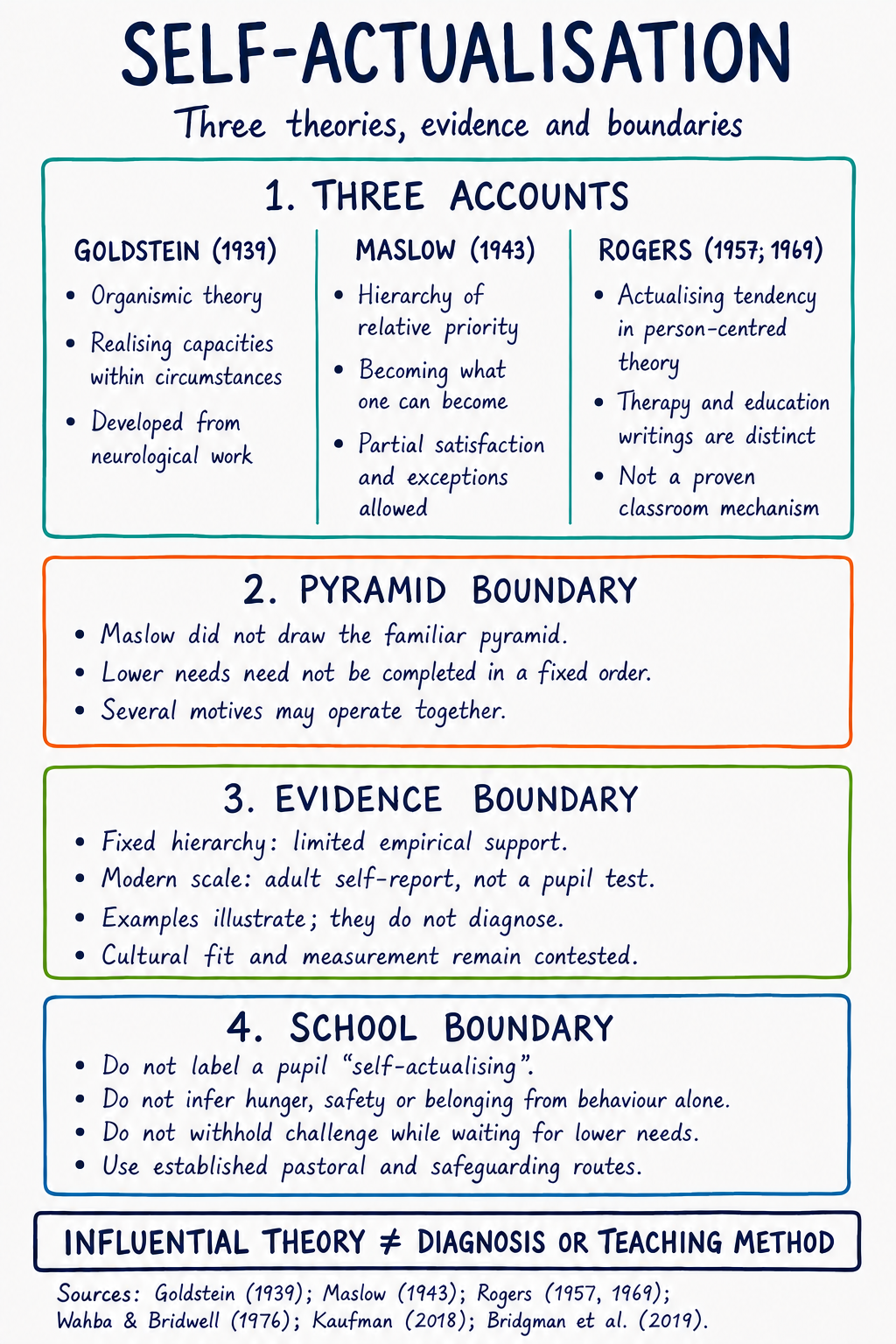
Meaning: Self-actualisation is an influential but disputed set of ideas, not a diagnosis, teaching method, proven endpoint, test or learner type.
Goldstein (1939): Goldstein's organismic theory grew from neurological work. It concerned realising capacities within the circumstances and was not a needs hierarchy.
Maslow (1943): Maslow described a hierarchy of relative priority and becoming what one can become. He allowed partial satisfaction, overlap and exceptions. He did not draw the familiar pyramid, and lower needs need not be completed in a fixed order.
Rogers (1957, 1969): Rogers described an actualising tendency in person-centred theory. His therapy and education writings make distinct claims. They do not prove a classroom mechanism.
Evidence boundary: A fixed hierarchy has limited empirical support. Kaufman's modern scale is adult self-report, not a pupil test. Examples illustrate the accounts but do not diagnose a person. Cultural fit and measurement remain contested.
School boundary: Do not label a pupil as self-actualising. Do not infer hunger, safety or belonging from behaviour alone. Do not withhold challenge while waiting for lower needs. Use established pastoral and safeguarding routes.
Sources shown: Goldstein (1939); Maslow (1943); Rogers (1957, 1969); Wahba and Bridwell (1976); Kaufman (2018); Bridgman et al. (2019).
Maslow described qualities that he associated with self-actualising people. These included acceptance of self and others, relative autonomy, a focus on problems beyond the self, creativity, continued appreciation and occasional peak experiences. Kaufman's later scale drew ten characteristics from Maslow's 1950 list (Kaufman, 2018).
These qualities were not produced through a representative population survey. Maslow selected people he regarded as especially healthy or accomplished and interpreted biographical and other material. His method made the list exploratory and value-laden, not diagnostic criteria (Kaufman, 2018).
Named historical figures are therefore examples of Maslow's judgement, not proof that self-actualisation exists as a measurable state. A scientist's creativity, a reformer's sense of purpose or an artist's independence may illustrate part of the concept. The same observation could have other explanations.
Ordinary examples need the same caution. Pursuing a demanding craft, revising a life aim or creating work that expresses a person's values can illustrate realised capacity. None of these acts shows that the person has completed lower needs or reached a final psychological level.
Nor are creativity, curiosity, empathy or resilience unique signs. Each is a separate construct with its own definitions and measures. People may show them unevenly and in specific settings. A checklist cannot turn a cluster of valued traits into a verified category.
The danger is strongest when adults apply the list to children. A learner's quietness, friendship pattern, grades or willingness to take risks cannot reveal a level in Maslow's hierarchy. Broader accounts of child development theories also require evidence tied to the specific construct and age group.
Maslow's later version of the hierarchy gave self-transcendence a place beyond self-actualisation. The term points towards service, shared values, meaning or a cause beyond the individual self. This was a later revision (Koltko-Rivera, 2006).
This later account does not establish an agreed sixth step that everyone enters after self-actualisation. It is a development in Maslow's thought, not proof of a universal sequence (Koltko-Rivera, 2006).
Self-realisation sounds close in daily speech, but its use can change across fields. Some works in faith or thought deal with knowledge of the self, not with a motive. Writers need to state which sense they mean.
Self-determination theory is distinct. It studies autonomy, competence and relatedness in a modern research field (Ryan and Deci, 2000). It shares an interest in growth. It does not prove Maslow's order or a self-actualising type. The self-determination theory page owns that work.
Theories of the person can deal with traits, stable trends or change. Self-actualisation is not a score for the person unless a sound test and clear claim are in place. The personality theories guide maps those other views.
The research does not support one fixed path to a final state. Studies use varied definitions and mostly rely on reports from adults. Some traits and needs have links with wellbeing, but those links do not prove Maslow's order, a cause or a learner type.
Any test of self-actualisation rests on what the study team decides to count. An ideal such as “using one's full gifts” has no one clear unit. A score may in fact track purpose, autonomy, wellbeing, traits or assent to a list of prized acts. These ideas are close, but none is a sure test of one end state.
Wahba and Bridwell tested the strong claims about Maslow's order against the work then in print. The work did not back a simple set path. They also found flaws in the core ideas and in the ways they had been tested (Wahba and Bridwell, 1976).
Tay and Diener used reports from adults in 123 nations. Meeting a range of needs had links with distinct parts of subjective wellbeing. Some needs still had their own links when other needs were not met (Tay and Diener, 2011).
This large study bears on claims about order. It does not prove a fixed needs model. It took one set of reports at one point in time, so it cannot show what caused what. Nor did it test self-actualisation or an effect in class.
Kaufman made a 30-item scale from ten traits in Maslow's work. The main validation sample comprised 522 Mechanical Turk adults. Their mean age was 36.6, with ages from 18 to 74. In that group, 72 per cent were White (Kaufman, 2018).
The ten traits formed one broad factor. Scores also had links with life satisfaction, self-acceptance, autonomy, purpose and growth. These were links in adult reports taken at one point in time. They do not show that one factor caused the next.
Kaufman called for larger tests that track change with time, draw on more cultures and fit life beyond a survey. The scale is not a test for a child, a needs model or a list for an adult to score by eye. It cannot mark a learner as self-actualising from conduct.
Krems and colleagues asked adults what it meant to fulfil their potential. Status often formed part of their view. The answer also changed with age and from one person to the next (Krems et al., 2017). The study shows that common views differ. It does not show who has met an objective goal.
These studies support a careful stance. Some linked traits can be scored, and met needs can have links with wellbeing. The strong claim of one set path or a final state is still hard to prove.
Self-actualisation often centres an autonomous individual who develops a distinctive potential. That ideal fits some modern Western values. Other traditions may place greater weight on family, duty, spiritual life, shared identity or reciprocal obligation.
A cultural critique does not require the rejection of personal growth. It asks who defined growth, which qualities were valued and whether the same ideal makes sense in each setting. A concept can travel widely while changing meaning.
Maslow's chosen exemplars also raise selection questions. They were not a representative cultural sample. Admired public lives can hide conflict, dependence and ordinary limits. Biographical selection may reproduce the researcher's values.
Measurement can carry the same assumptions. A self-report item that rewards autonomy or independence may treat a culturally valued commitment to family as a lower score. That result may show a mismatch between scale and setting rather than less personal development.
Cultural variation also prevents a simple list of universal examples. Creative work, care, scholarship, public service, religious practice and community leadership can each express valued capacity. Their meaning depends on social relations as well as private aims.
This critique distinguishes self-actualisation from Jung's archetypes, another influential but contested account sometimes framed in universal terms. Similar language about human depth does not make their theories or evidence interchangeable.
Self-actualisation can help scholars trace the development of organismic, motivational and humanistic psychology. It can also frame questions about capacity, meaning, purpose and the values built into accounts of a good life. These are legitimate conceptual uses.
The construct cannot show that a person has completed a universal sequence. It cannot explain one action without other evidence. It does not establish that someone is psychologically healthy, morally good or successful because they resemble a list of valued traits.
In education, the concept can be studied as research history or used as a prompt for critical reflection. It does not justify labelling learners, inferring unmet needs from behaviour, withholding challenge or prescribing classroom techniques. Safeguarding and pastoral concerns require direct evidence and established school procedures.
Senior leaders should also separate a theory's influence from evidence for a practice. A school may value agency, purpose or supportive relationships for many reasons. That does not show that self-actualisation caused attainment, confidence, resilience or wellbeing.
The same boundary applies to technology. Interaction traces cannot reveal a learner's place in a hierarchy or prove how they feel. Systems should not claim to detect self-actualisation, safety or belonging. Psychological and educational decisions need transparent evidence and human judgement.
This approach is part of research-informed teaching: define the claim, identify the population and method, and separate historical theory from tested intervention. It allows readers to preserve the idea's intellectual importance without presenting it as settled practice.
These short answers cover the idea's meaning, roots, pyramid, examples and limits. They keep the three early accounts apart. They also draw a line between a well-known theory and a test, a fixed path or a school method.
It means, in broad terms, growing and making use of what one can do. The sense changes across Goldstein, Maslow and Rogers. Their three accounts are not the same. Nor is the idea one agreed end point that a test can mark.
No. Goldstein was an early source for an account of growth in the whole organism. Maslow put the idea in his theory of human needs and made it well known. Rogers set out a related but distinct drive for growth.
No. The well-known pyramid spread through later teaching in business schools. It makes the needs model look more fixed than Maslow's 1943 text. He allowed needs to be met in part, to overlap, to shift in order and to break the broad rule (Bridgman et al., 2019).
Maslow thought lower needs tend to have more force, but he did not say they must be complete in a fixed order. Reviews of the tests do not back one strict path for all. People can seek growth, meaning and art in hard times.
Examples include long work on an art, skill or cause that has deep worth for the person. They show why the idea has appeal. They do not prove that the person has reached a final state. The same act can have more than one cause.
No sound learner type or checklist for staff comes from these sources. New ideas, a wish to learn, marks, friends and grit do not show a needs level. Any concern about a learner's care or safety needs direct facts and the school's set route.
These sources move from the first major theories to reviews of the hierarchy, the pyramid's later history and modern adult measurement.