Updated on
September 24, 2026
Psychodynamic Theory: Meaning, Key Concepts and Evidence
Psychodynamic theory explained: its main concepts, development after Freud, evidence for modern psychotherapy and major scientific critiques.


Updated on
September 24, 2026
Psychodynamic theory explained: its main concepts, development after Freud, evidence for modern psychotherapy and major scientific critiques.
What is psychodynamic theory?
Psychodynamic theory is a family of psychological approaches that interprets behaviour through non-conscious processes, inner conflict, relationships and the continuing influence of earlier experience. It began with Freud but now includes several distinct traditions. Some broad propositions and specific psychodynamic therapies have empirical support, while many classical claims remain disputed or difficult to test.
Psychodynamic theory is a family of views about the mind. It links behaviour with thought outside awareness, inner conflict, close bonds and early life. Sigmund Freud began the field, but later writers changed many of his claims and formed separate schools.
The word psychodynamic names a school of thought, not one settled theory. Research backs some broad claims, such as the fact that thought can occur outside awareness. Other old claims, such as the psychosexual stages and parts of drive theory, remain in doubt or hard to test.
This gap matters. Proof that a modern therapy can help one health group does not prove each idea from Freud. A psychodynamic reading also does not reveal the hidden cause of another person's acts.
The theory treats mental life as a set of forces that act on each other. Wishes, fears, memories, moral demands and bonds may pull in separate ways. Some thought may occur outside awareness. Defences may also keep painful thoughts out of view.
In Freud's account, symptoms and everyday actions could express compromises between conflicting motives. The term dynamic refers to this movement and conflict, not simply to any thought that happens unconsciously.
Modern accounts are wider. Westen (1998) listed five common claims. They concern thought outside awareness, rival motives, the effect of early life, views of self and others, and the role of emotion.
Other fields also study these ideas. Support for one claim does not support all five.
This is not a theory of how people learn school content. The main theories of learning ask how knowledge, skill or behaviour changes through experience and teaching. This tradition asks about the self, emotion, bonds, distress and care.
The ideas below matter in the history of psychology, but they do not share one status. Some are tools for care or for reading a case. Researchers have defined and measured others in ways that may differ from the first psychoanalytic claim.
Swipe across to read all columns on a smaller screen.
| Concept | Psychodynamic meaning | Evidence boundary |
|---|---|---|
| Dynamic unconscious | Mental contents and motives may remain outside awareness because they conflict with other wishes or demands. | Non-conscious processing is well established, but that does not confirm Freud's specific account of repression or hidden drives. |
| Psychic conflict | A person may hold rival aims, feelings or rules at the same time. | Conflict and mixed feelings are real. A claim about one hidden conflict still needs its own proof. |
| Defence mechanisms | Denial, projection and displacement are said to reduce fear or cope with conflict. | Later work has tested some defences (Cramer, 2000). A brief act cannot show which defence is at work. |
| Internal relationships | Past bonds may shape our views of ourselves and other people. | Research on growth and attachment asks related questions. It is a separate field, and its results do not fix one person's fate. |
| Transference | Feelings tied to past bonds may be felt again in therapy. | This is a term used in care. It should not become a firm account of normal school life. |
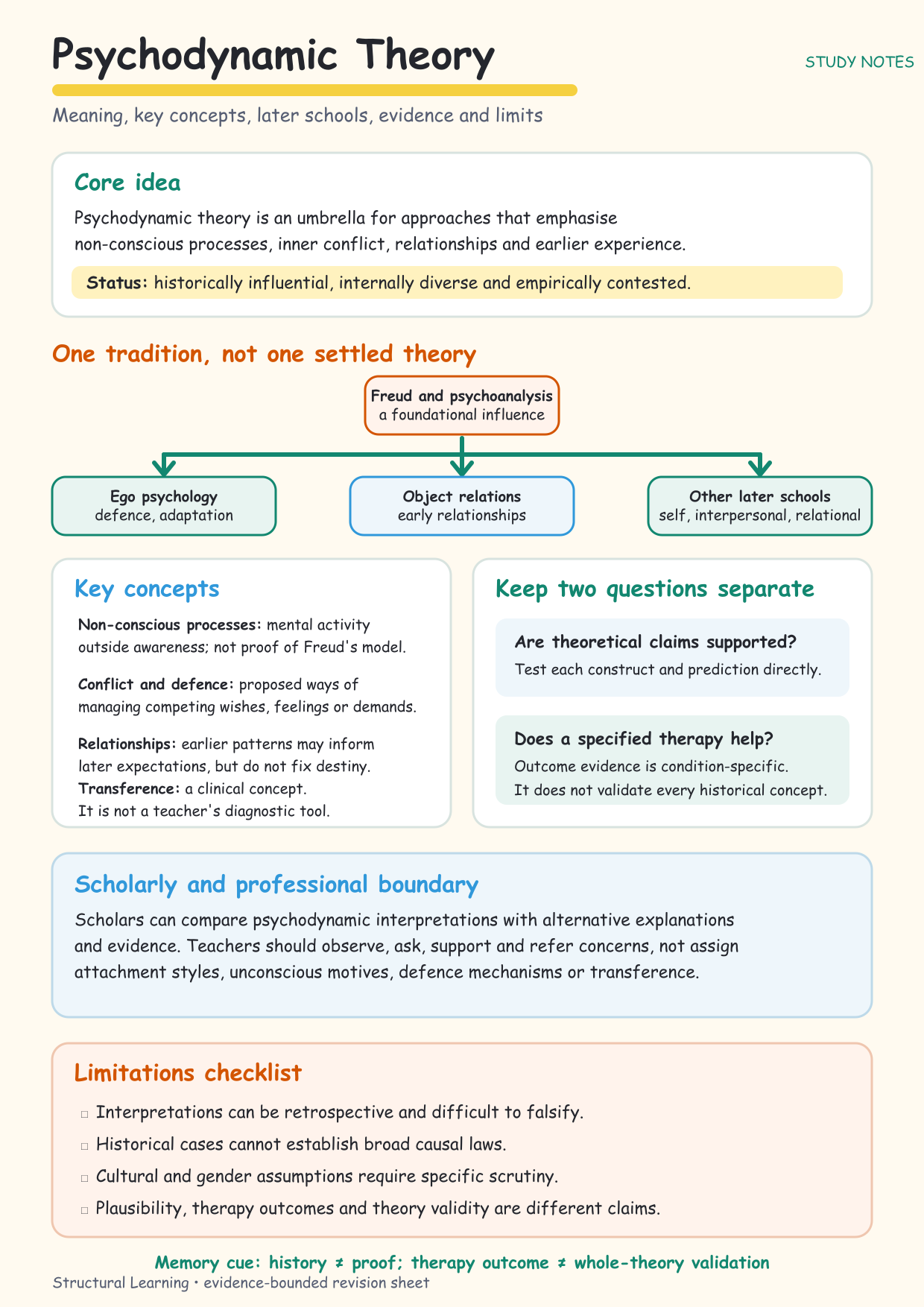
Core idea: Psychodynamic theory is an umbrella for approaches that stress mental processes outside awareness, inner conflict, relationships and earlier experience. It has shaped psychology, but it contains rival schools and contested claims.
One tradition, not one settled theory: Freud founded psychoanalysis. Ego psychology then gave more weight to defence and adaptation. Object-relations writers gave more weight to early relationships.
Later schools studied the self and the relationship between therapist and client. These writers changed or rejected parts of Freud's account.
Key concepts: Mental activity can occur outside awareness, but this fact does not prove Freud's model. Conflict and defence describe proposed ways of coping with competing wishes, feelings or demands. Earlier relationships may shape later expectations, but they do not fix a person's fate. Transference is a clinical concept, not a teacher's tool for diagnosis.
Keep two questions separate: Are the theory's claims supported? Each claim needs a clear test. Does a named therapy help?
Treatment results depend on the condition and the people studied. A good result does not prove every old concept.
Scholarly and professional boundary: Scholars can compare a psychodynamic reading with other accounts and with research. Teachers should observe, ask, support and refer concerns. They should not assign attachment styles, unconscious motives, defence mechanisms or transference.
Limits: Some readings look back from an event to a claimed cause and can be hard to disprove. Historical cases cannot establish broad causal laws. Cultural and gender assumptions need close review. A plausible idea, a helpful therapy and a valid theory are three different claims.
Freud's 1923 model split the mind into the id, ego and superego. The id stood for basic urges. The ego dealt with the real world.
The superego stood for rules and ideals taken in from others. These are parts of a model, not brain areas that we can see.
The dedicated guide to Sigmund Freud's theories covers this model, dream interpretation and psychosexual development in detail. The present article uses Freud as the starting point for a wider tradition.
Defence is one of the school's best-known ideas. Anna Freud's The Ego and the Mechanisms of Defence (1936) set out ways in which the ego was said to cope with fear. Later work sought to define and measure defences apart from old forms of analysis (Cramer, 2000).
That research does not make everyday labelling reliable. The same outward action can have several explanations. Avoiding feedback, for example, could reflect anxiety, confusion, fatigue, prior experience, a hostile environment or a reasonable judgement that the feedback has little value.
Freud's psychoanalysis emerged from clinical work in the late nineteenth and early twentieth centuries. It combined a theory of mind, a theory of development and a method of treatment. Disagreements soon produced separate traditions.
Carl Jung formed analytical psychology. His ideas include archetypes and a shared unconscious. Alfred Adler formed individual psychology. He gave more weight to social interest, felt inferiority and chosen goals.
Both broke with Freud, so their work is not a mere add-on to his model. The pages on Jungian psychology and Adlerian psychology explain each school in its own terms.
Later ego writers gave more weight to coping, defence and the role of the ego. Object-relations writers moved the focus from drives to bonds. Melanie Klein wrote about early states of mind and projective identification. Donald Winnicott wrote about a child's first objects and the care around the child.
Erik Erikson extended psychoanalytic development across the lifespan and described eight psychosocial conflicts. His account remains influential as an organising framework, but the stages are not a diagnostic timetable. A fuller historical account belongs to Erikson's psychosocial stages.
John Bowlby trained in psychoanalysis. He also drew on animal study, control systems and records of child loss. From this work he formed attachment theory. Research on attachment later grew into a large field.
That work does not prove Freud's account. Nor does it let us assign an attachment type from a brief act. The guides to Bowlby's attachment theory and attachment theory in education keep these questions apart.
Modern interpersonal and relational schools place the bond in therapy at the heart of their work. They keep different parts of Freud's drive theory. No single list of ideas is shared by every writer or therapist in the field.
Consider a person who repeatedly avoids feedback on important work. A psychodynamic formulation asks whether evaluation evokes anxiety, shame or a conflict between wanting recognition and fearing judgement. It also asks whether the present relationship resembles an earlier pattern.
This is a guess to test, not the person's hidden cause. The same act could stem from unclear work, a recent failure or poor feedback. Low mood, too much noise, bias, lack of time or a wish for privacy could also play a part. We need the person's account and the full context before we favour one view.
This example shows both the attraction and the risk of the approach. Psychodynamic theory can draw attention to emotion, ambivalence and relationship patterns that a surface account can miss. Yet a flexible interpretation can also become difficult to disconfirm. If both accepting and rejecting feedback are treated as confirmation of the same theory, the explanation has little power to distinguish among alternatives.
The evidence is mixed and depends on the claim. Research asks whether a broad idea holds up, whether a named therapy helps the study group, and whether the proposed cause led to the result. Each question needs its own kind of test.
Westen (1998) argued that research backs several ideas linked to this school. They include thought outside awareness, mixed motives, emotion and mental views of our bonds. This is a narrow claim about its legacy. Many fields study the same ideas without using Freud's account.
Research on defence mechanisms offers another example. Cramer (2000) reviewed efforts to define defences as processes involved in adaptation. Such work moves a concept towards measurement, but it does not show that an observer can read a specific defence from a single action.
Large reviews link attachment security or disorganisation with some later social or behaviour outcomes (Fearon et al., 2010; Groh et al., 2014). These are trends across groups, not fixed forecasts for one child. Attachment is also a separate field.
Studies have tested forms of psychodynamic therapy. Shedler (2010) reviewed work that found gains, some of which lasted.
Bhar et al. (2010) disputed stronger claims about long-term therapy. They pointed to flaws in study choice, control groups and how results were read.
Fonagy (2015) concluded that evidence varies considerably by disorder and form of treatment. Some areas have a stronger body of controlled research than others. Leichsenring et al. (2015) identified randomised trials for several adult mental-health conditions, while also calling for more adequately powered comparisons.
A later umbrella review found evidence for psychodynamic therapy in adult depressive, anxiety, personality and somatic symptom disorders (Leichsenring et al., 2023). Its authors also found limits. Some analyses relied on few trials, some trials were old or poor quality, and several diagnostic groups had to be pooled because condition-specific evidence was sparse. The review supports specified treatments for specified conditions. It does not validate every historical psychodynamic claim.
The safe claim is narrow. Named forms of this therapy have support for some health needs. The studies do not show that all forms work alike or that one form suits each person. Good results also do not prove each claim about how change took place.
The evidence base for children and adolescents is smaller. Midgley and Kennedy (2011) found growing evidence but also frequent limitations in sample size and control groups. Their later review retained the conclusion that the child and adolescent literature was less developed than the adult literature.
The IMPACT trial compared cognitive behavioural therapy, short-term psychoanalytic therapy and a brief psychosocial intervention for adolescents with major depression in specialist NHS services. It found no evidence that one treatment was superior on the main symptom trajectory (Goodyer et al., 2017). Because the trial had three active treatments and no untreated control, it could not isolate the specific effect of psychodynamic theory.
NICE lists this form of therapy as one choice for some young people with depression. It must be given by trained mental-health staff. For teens, NICE puts one-to-one CBT first.
NICE says the case for other choices is less sure. This is health guidance. It does not ask teachers to give therapy.
The broader guide to counselling theories compares forms of care. A choice of treatment needs a trained review, the right skills, the person's wishes and guidance for the health need.
Psychodynamic theory faces concerns about how its claims can be tested, how analysts infer causes and how far ideas drawn from clinical cases apply to other people. Critics also question vague constructs, cultural assumptions and claims about treatment mechanisms. These concerns do not mean that every psychodynamic idea is meaningless or that no psychodynamic therapy can work.
A fair review keeps four things apart: its place in history, its use in care, research on each claim and the parts not yet shown. The whole school of thought need not get one yes-or-no verdict.
This theory matters to scholars who study the history of the mind, childhood, therapy or schools. It may also help school leaders trace the roots of terms now used in work on mental health and bonds.
It is not a classroom method. A teacher cannot know from behaviour alone that a learner is repressing a memory, projecting a feeling, repeating an attachment pattern or transferring feelings from a parent. Such interpretations can harden into labels and distract from learning needs, neurodevelopmental differences, safeguarding concerns or the learner's own account.
In school, staff should record what they can see and ask rather than assume. They should use agreed care and safety routes, make the right changes and refer health concerns to trained staff. None of these acts needs a psychodynamic diagnosis.
For a wider view, read the guide to child development theories. Keep three things apart when you compare them: an old model, a research result and advice for skilled work.
Sigmund Freud founded psychoanalysis and supplied the starting point for psychodynamic theory. The modern umbrella also includes approaches that revised or rejected parts of Freud's account, so it should not be treated as Freud's theory alone.
Common ideas include thought outside awareness, inner conflict, defence, the effect of past bonds, views of self and others, and patterns that may recur in new bonds. Each school defines and weighs these ideas in its own way.
There is no single answer for the whole tradition. Some broad propositions and specified psychodynamic therapies have empirical support. Several classical claims are weakly operationalised, difficult to falsify or unsupported. Each claim should be judged by its definition, evidence and research design.
No. Psychoanalysis can refer to Freud's body of theory and to an intensive form of treatment. Psychodynamic is a broader term covering later theories and therapies that retain some emphasis on non-conscious processes, conflict and relationships.
Psychodynamic theory should not be used to diagnose learners or infer hidden motives. Teachers can provide calm, predictable and respectful support using education and safeguarding guidance, but those practices need their own evidence and do not require a psychodynamic explanation.
No. Evidence that a specified therapy helps a defined clinical group supports the treatment under those conditions. It does not prove every psychodynamic construct or show that the proposed mechanism caused the improvement.
Bhar, S. S., Thombs, B. D., Pignotti, M., Bassel, M., Jewett, L. R., Coyne, J. C., & Beck, A. T. (2010). Is longer-term psychodynamic psychotherapy more effective than shorter-term therapies? Psychotherapy and Psychosomatics, 79(4), 208-216. DOI: 10.1159/000313689.
Cramer, P. (2000). Defense mechanisms in psychology today: Further processes for adaptation. American Psychologist, 55(6), 637-646. DOI: 10.1037/0003-066X.55.6.637.
Fearon, R. P., Bakermans-Kranenburg, M. J., Van IJzendoorn, M. H., Lapsley, A. M., & Roisman, G. I. (2010). The significance of insecure attachment and disorganization in the development of children's externalizing behavior. Child Development, 81(2), 435-456. DOI: 10.1111/j.1467-8624.2009.01405.x.
Fonagy, P. (2015). The effectiveness of psychodynamic psychotherapies: An update. World Psychiatry, 14(2), 137-150. DOI: 10.1002/wps.20235.
Freud, A. (1936). The Ego and the Mechanisms of Defence. International Universities Press.
Freud, S. (1923). The Ego and the Id. International Psycho-Analytical Press.
Goodyer, I. M., et al. (2017). Cognitive behavioural therapy and short-term psychoanalytical psychotherapy versus a brief psychosocial intervention in adolescents with unipolar major depressive disorder. The Lancet Psychiatry, 4(2), 109-119. DOI: 10.1016/S2215-0366(16)30378-9.
Groh, A. M., Fearon, R. P., Bakermans-Kranenburg, M. J., Van IJzendoorn, M. H., Steele, R. D., & Roisman, G. I. (2014). The significance of attachment security for children's social competence with peers. Attachment & Human Development, 16(2), 103-136. DOI: 10.1080/14616734.2014.883636.
Leichsenring, F., et al. (2015). Psychodynamic therapy meets evidence-based medicine: A systematic review using updated criteria. The Lancet Psychiatry, 2(7), 648-660. DOI: 10.1016/S2215-0366(15)00155-8.
Leichsenring, F., Abbass, A., Heim, N., Keefe, J. R., Kisely, S., Luyten, P., Rabung, S., & Steinert, C. (2023). The status of psychodynamic psychotherapy as an empirically supported treatment for common mental disorders: An umbrella review based on updated criteria. World Psychiatry, 22(2), 286-304. DOI: 10.1002/wps.21104.
Midgley, N., & Kennedy, E. (2011). Psychodynamic psychotherapy for children and adolescents: A critical review of the evidence base. Journal of Child Psychotherapy, 37(3), 232-260. DOI: 10.1080/0075417X.2011.614738.
Shedler, J. (2010). The efficacy of psychodynamic psychotherapy. American Psychologist, 65(2), 98-109. DOI: 10.1037/a0018378.
Westen, D. (1998). The scientific legacy of Sigmund Freud. Psychological Bulletin, 124(3), 333-371. DOI: 10.1037/0033-2909.124.3.333.