Updated on
September 22, 2026
Pedagogical Content Knowledge: Definition and Examples
Pedagogical content knowledge links subject expertise, teaching methods and learner misconceptions. See Shulman's PCK framework, strategies and examples.

Updated on
September 22, 2026
Pedagogical content knowledge links subject expertise, teaching methods and learner misconceptions. See Shulman's PCK framework, strategies and examples.
What is pedagogical content knowledge?
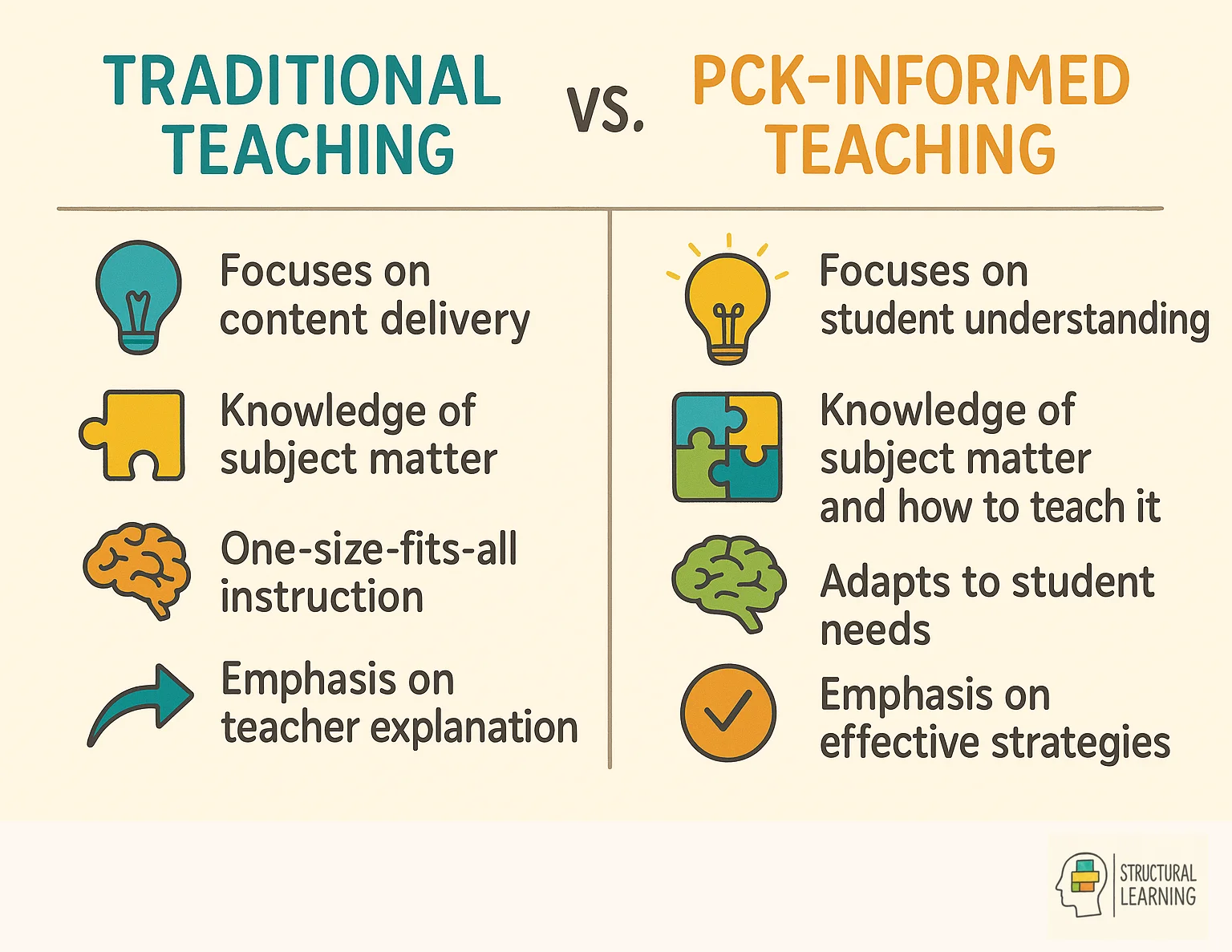
Pedagogical content knowledge (PCK), defined by Shulman, is the specialist teacher knowledge that turns subject expertise into teachable explanations, knowing how learners typically misunderstand a topic, how to represent it, and how to sequence it. For teachers, it means deep subject knowledge only helps when paired with knowing how that subject is best taught.
Pedagogical Content Knowledge: Why Subject Expertise Isn't Enough describes the specialist teacher knowledge that turns subject expertise into teachable explanations. Shulman (1986) used PCK to show that knowing a topic is different from knowing how learners misunderstand it, how to represent it, and how to sequence it for understanding.
This connects to the wider context of fundamental theories of learning in modern classroom practice.
In a Year 5 fractions lesson, this means anticipating that learners may think a larger denominator makes a larger fraction, then using fraction strips, comparison questions, and quick checks to surface the misconception before independent practice. Strong PCK helps teachers choose the representation, question, example, and assessment that fit the content, not just deliver more information.
Pedagogical content knowledge (PCK), introduced by Shulman (1986), is the specialised teacher knowledge that turns subject expertise into teachable explanations. PCK combines deep subject knowledge with the ability to represent ideas in ways learners can grasp: choosing useful analogies, anticipating misconceptions, and sequencing ideas so they build on one another. It is the bridge between knowing your subject and knowing how to teach it.
Shulman (1986) defined PCK as the knowledge teachers use to make particular topics understandable. It helps teachers foresee learner errors, select explanations, and adapt lessons to the demands of the content.
Shulman (1987) later placed PCK within a broader knowledge base for teaching. The idea now shapes teacher education across subjects and phases because it links curriculum, learner thinking, and classroom representation.
Unlike general teaching skills or subject expertise alone, PCK focuses on how well a teacher can anticipate learner misconceptions, choose appropriate representations or explanations, and adapt teaching to the specific demands of the content. In essence, it is about knowing what to teach and how to teach it in a way that makes sense to learners.
Experienced teachers use PCK in lessons. They integrate questioning and analogies to clarify ideas (Shulman, 1986). These techniques make content meaningful and accessible. Novice teachers find this hard as they develop their pedagogy and subject knowledge (Grossman, 1990; Ball et al., 2008).
According to Shulman (1986), PCK informs lesson planning, teaching, and assessment. It connects teaching methods to subject goals, so learners meet ideas through examples, questions, and tasks that fit the content (Grossman, 1990; Ball et al., 2008).
Reflecting on lessons helps teachers build PCK. Feedback from colleagues supports this, as does subject and pedagogy research (Shulman, 1986). Analysing learner work reveals misconceptions so teachers can adapt their plans. Continued learning is vital.
Consider collaborative lesson planning, which reinforces PCK through shared experiences (Grossman, 1990). Analysing video recordings of your teaching can highlight areas for PCK growth (Tripp & Rich, 2012). Reflecting on learners' misconceptions helps target teaching and strengthens PCK (Shulman, 1986).
There are numerous tools and techniques that can support the development and application of PCK:
Teachers actively build Pedagogical Content Knowledge, understanding how to teach subjects (Shulman, 1986). Reflect on practice and seek feedback to refine PCK. This helps learners and improves educational outcomes (Grossman, 1990; Cochran et al., 1993). Continuous learning grows PCK (Park & Oliver, 2008).
Shulman (1986) showed PCK's importance. Magnusson et al. (1999) refined it. PCK helps teachers make subjects understandable for each learner. Consider learner thinking and fix misunderstandings. PCK builds deeper knowledge, not just memorising facts.
Shulman's framework has practical issues because PCK is often unspoken. Teachers show it through examples and questions but struggle to explain it. Loughran, Mulhall, and Berry (2004) tackled this with two tools. They created Content Representation (CoRe) and PaP-eRs for documentation.
A CoRe is a planning grid for one specific topic. It asks what learners should understand, why the idea matters, which difficulties are likely, and which contextual factors will shape teaching.
Completing a CoRe makes tacit PCK visible. A PaP-eR is a narrative account of a teaching episode that captures the reasoning behind instructional decisions. Together, these tools turn personal craft knowledge into shared professional knowledge. Loughran et al. (2004) argued that a library of CoRe and PaP-eR documents could build the collective PCK that teacher education has often lacked.
Van Driel, Verloop and De Vos (1998) found that PCK is strongly shaped by teaching experience and reflection on specific content and learner difficulties. Reflection impacts the growth of PCK quality. Teachers who review lessons and discuss pedagogy with colleagues develop PCK faster. Lewis, Perry, and Murata (2006) showed Lesson Study makes PCK clear. Teachers collaboratively plan, observe, and analyse lessons within Lesson Study.
Ball, Thames, and Phelps (2008) explored maths teaching. Their MKT concept details content knowledge teachers need. This includes explaining maths clearly to learners. Also, it involves spotting errors and choosing good representations. MKT is measurable using tests. These scores predict learner progress, said Ball et al. Their work shows subject PCK has a structure and can guide training.
Subject knowledge training improves teaching only when it is joined to topic-specific pedagogy. Fukaya et al. (2024) found that content knowledge interventions alone have limited effects compared with interventions that explicitly develop PCK. Mathematics teachers, for example, should study Year 4 fraction errors and plan representations that correct them. Science teachers can use diagnostic questions and investigations to challenge the belief that heavier objects fall faster.
Mentoring builds PCK when it stays close to the subject. Mentors model how to anticipate learner difficulties, such as algebra misconceptions, then plan the sequence, representation, resource choice, and assessment. For decimals, a mentor can move from base-ten blocks to images and then to abstract notation.
Professional learning communities can improve teachers' PCK. They focus on curriculum design and learner misconceptions. Teachers analyse learners' work, spot patterns, and make shared plans.
For example, history teachers could address Year 8 chronology problems (Counsell, 2011). Geography staff can tackle issues with map scale (Lee & Bednarz, 2012). This helps teachers understand subject learning more clearly (Shulman, 1986).
Effective professional development links theory to classroom practice. Teachers try new methods, like teaching forces (Year 5 science). They reflect on results, as suggested by Shulman (1986). Subject associations offer resources. Collaboration and reflection, as noted by Schön (1983), improve learner outcomes.
In England, the Initial Teacher Training and Early Career Framework makes subject-specific pedagogy part of the minimum entitlement from September 2025 (Department for Education, 2024). This fits Shulman's argument. Trainees and early career teachers need subject knowledge, but they also need to know how learners meet specific concepts, examples, texts, problems, and misconceptions.
Teacher training builds PCK with activities. Learners watch expert teacher videos, finding examples (Shulman, 1986). Microteaching lets learners practise explaining and get feedback (Grossman, 1990). Seminars address common misconceptions like fractions (Kind, 2009).
New teachers develop PCK through various methods. Mentors help learners plan lessons together, tackling specific issues (Shulman, 1986). Journals help learners track successful explanations ( Schön, 1983). Some schemes use misconception maps for planning targeted support (Hashweh, 2005).
Kind (2009) shows PCK grows past initial training. Good teacher training builds strong foundations. This speeds up growth (Kind, 2009). Learners benefit from confident, adaptable new teachers.
Select your subject and key stage to see the top five EEF-ranked strategies with subject-specific examples and key researchers.
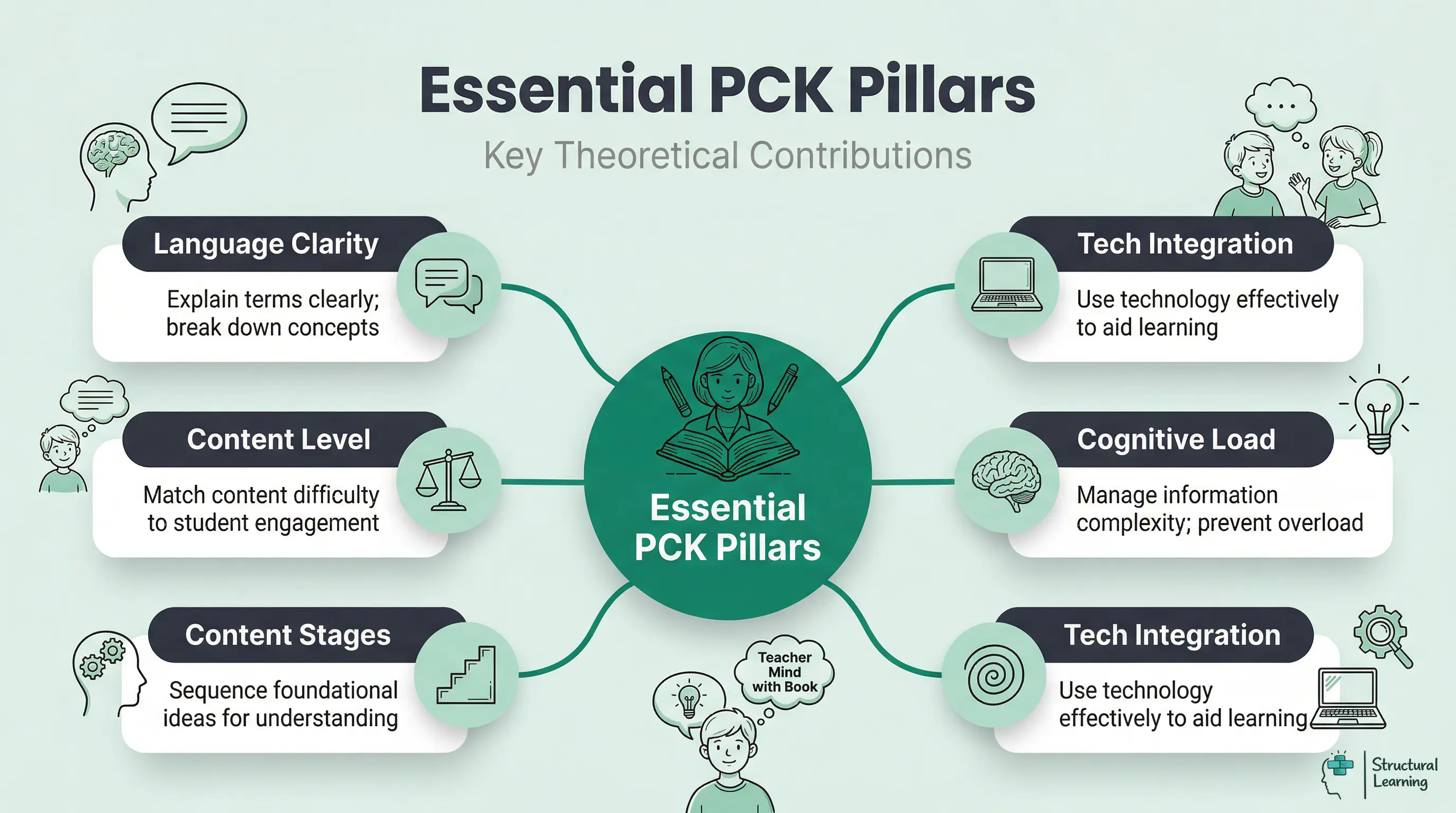
Download this free Pedagogy, Teaching Practice & Learning Design resource pack for your classroom and staff room. Includes printable posters, desk cards, and CPD materials.
Building on Shulman's foundational work, contemporary research has refined PCK through the Refined Consensus Model (RCM). Carlson and Daehler (2019) describe PCK as collective, personal, and enacted knowledge, shaped by classroom context rather than stored as a fixed body of teacher knowledge.
The RCM posits that PCK operates across three distinct yet interdependent dimensions: collective PCK (cPCK), personal PCK (pPCK), and enacted PCK (ePCK). This framework helps educators and researchers analyse how PCK develops and manifests in teaching practice. Understanding these components clarifies how teachers access, adapt, and apply their knowledge in the classroom.
Collective PCK (cPCK) is the shared knowledge that is open to everyone in a subject area or teaching group. This covers standard lesson materials, common teaching methods for certain topics, and proven ideas from research. For example, a science department can share a graphic organiser to explain the water cycle. This template can include common mistakes and useful analogies, acting as a great example of their collective PCK.
Personal PCK (pPCK) refers to an individual teacher's internalised and adapted version of PCK. It is shaped by their unique experiences, beliefs, and reflections on their teaching practice, transforming collective knowledge into something personally meaningful. A teacher can take the shared water cycle graphic organiser, but then adapt it with a specific local example or a mnemonic device they know works well with their particular class, reflecting their personal PCK.
Finally, enacted PCK (ePCK) is the PCK demonstrated during instruction. It is the observable form of collective and personal PCK, shaped by real classroom interactions and learner responses. When the teacher uses the adapted water cycle graphic organiser and adjusts the explanation in response to learner questions or confusion, they are demonstrating enacted PCK.
The RCM highlights the continuous interplay between these three PCK dimensions. Teachers draw on collective knowledge, adapt it personally, and enact it in response to learners' needs and classroom conditions (Carlson & Daehler, 2019). This process shows why effective teaching requires more than knowing content: teachers must notice, interpret, and respond during the lesson.
Shulman's first idea of Pedagogical Content Knowledge (PCK) gave teacher educators a clear starting point. Later models show how teachers link subject knowledge, learner knowledge, curriculum, assessment, and teaching strategies in daily lessons. These models make PCK easier to discuss, develop, and assess.
One such development is the Pentagonal Model of PCK proposed by Park and Oliver (2008). This model positions content knowledge at its core, surrounded by five interconnected components: orientation to teaching, knowledge of curricula, knowledge of learners, knowledge of instructional strategies, and knowledge of assessment. It illustrates how a teacher's deep understanding of their subject is continuously mediated and applied through these pedagogical lenses.
Each part of the pentagonal model is a separate area of expertise, but the parts depend on each other. For example, a teacher's "orientation to teaching" means their beliefs about teaching and learning. These beliefs shape their "knowledge of instructional strategies" when they choose methods. In the same way, "knowledge of learners" helps a teacher use "knowledge of assessment" to check understanding and adapt future teaching (Park & Oliver, 2008).
Building on this, Park and Chen (2012) refined the model further. This version is sometimes seen as a Hexagonal Model of PCK because it adds "knowledge of educational contexts" as a sixth part. This means that teaching is shaped by the school, classroom, and wider community. The model shows how subject expertise works together with a teacher's knowledge of the setting where learning takes place.
These pentagonal and hexagonal models underscore that PCK is not merely a sum of its parts but a complex, integrated system. A teacher's effectiveness stems from their ability to fluidly draw upon and connect these different knowledge domains in real-time classroom situations. The models emphasise the adaptive interaction between these components, rather than viewing them as isolated silos of knowledge (Park & Chen, 2012).
Consider a Year 5 teacher planning a science lesson on the water cycle. Their content knowledge of evaporation and condensation is central. They use their orientation to teaching (e.g., belief in active learning) to choose instructional strategies, such as a hands-on experiment.
Their knowledge of learners (e.g., common misconceptions about clouds) shapes their explanations. Their knowledge of curricula helps them cover the required learning objectives. Finally, their knowledge of assessment helps them design questions to check understanding, within the specific educational context of their classroom's resources and time constraints.
These broad models give teachers a useful framework for understanding and developing PCK. They go beyond a simple definition and show the complex thinking that supports expert teaching. By recognising how the parts connect, teachers can reflect on their practice and identify areas for professional growth.
While Shulman (1986) initially described Pedagogical Content Knowledge (PCK) as a blend of subject matter and pedagogy, the precise nature of this blend has been a subject of epistemological debate. Researchers propose two primary perspectives: the integrative model of PCK and the transformative model of PCK. Understanding these distinctions helps teachers refine their approach to professional learning and classroom practice.
The integrative model of PCK views PCK as the sum of its constituent parts: subject matter knowledge, pedagogical knowledge, and curriculum knowledge. In this perspective, these knowledge bases remain distinct but are brought together by the teacher during instruction (Gess-Newsome, 1999). A teacher draws upon each component separately and then combines them to address a specific teaching situation.
For instance, a history teacher using an integrative approach can first recall specific historical facts about the Roman Empire. They would then consider general teaching strategies for engaging learners, such as group work or debates, and finally align these with curriculum objectives for the topic. The teacher consciously selects and combines these separate knowledge domains to construct their lesson plan.
In contrast, the transformative model of PCK posits that PCK is a unique, new form of knowledge that emerges from the interaction and synthesis of content, pedagogy, and curriculum. This model suggests that PCK is not simply the sum of its parts, but rather a distinct knowledge base that transforms the original components into something new (Gess-Newsome, 1999). It is a reorganisation of knowledge specifically for teaching purposes.
Consider a science teacher explaining cellular respiration using a transformative approach. Through experience, they build a mental model for teaching this complex process. This model brings together common learner misconceptions, useful analogies (e.g., a cell as a factory), and a clear sequence of experiments. This teaching construct comes from the link between content and pedagogy, and it is different from pure scientific understanding or general teaching skills.
Knowing about these models changes how teachers build their PCK. An integrative view suggests improving each area of knowledge on its own. In contrast, a transformative view highlights the need for reflection and testing to combine different areas into a new teaching skill. Both views offer helpful ideas for ongoing teacher training.
Pedagogical Content Knowledge (PCK) has grown to include the role of technology in teaching. This wider idea is called Technological Pedagogical Content Knowledge (TPACK), which brings technology knowledge together with PCK and subject matter knowledge (Mishra & Koehler, 2006). TPACK shows that modern teachers need to know how technology can support teaching methods and help learners meet the content.
Generative Artificial Intelligence (GenAI) in TPACK is a major step forward for teachers. Tools like large language models can help with planning lessons and making new resources. This support directly boosts a teacher's PCK and TPACK skills. AI can quickly draft different explanations, suggest helpful analogies, and spot common learner mistakes for specific topics. As a result, teachers can easily improve how they teach.
For instance, a history teacher planning a lesson on the causes of World War I can use a GenAI tool. They could input the topic and ask for "five different analogies to explain the complex web of alliances to 14-year-olds" or "common misconceptions learners have about the assassination of Archduke Franz Ferdinand." The GenAI output provides a starting point, offering varied pedagogical representations that the teacher then evaluates and adapts based on their knowledge of their learners and curriculum demands.
GenAI can also support teachers in differentiating instruction, a core component of PCK. A science teacher could ask a GenAI tool to "create three differentiated activities for a Year 7 lesson on photosynthesis, catering to varying literacy levels." The tool can suggest a visual diagram completion task, a cloze activity, and a short explanatory paragraph writing task, all tailored to the content. The teacher then uses their professional judgement to select and refine these suggestions.
While GenAI offers helpful support, teachers must closely guide how it fits into the TPACK framework. Teachers need to check if AI-created content is accurate, relevant, and good for learning. This checking process actually strengthens a teacher's own PCK. It forces them to think hard about what makes an explanation work, whether an analogy fits, or if an activity suits their specific class.
Ultimately, GenAI acts as a smart teaching assistant rather than a replacement for human expertise. It helps teachers quickly find and combine teaching strategies and lesson ideas. This support actively improves their TPACK framework. However, the teacher remains essential. They must still use their deep knowledge of the subject, pedagogy, and technology to design meaningful lessons.
Understanding PCK Taxonomies helps teachers see the different layers of knowledge needed for good teaching. These frameworks break down pedagogical content knowledge into smaller parts. This allows teachers to spot areas to improve and refine their practice. By grouping PCK in this way, teachers can carefully review how they teach specific topics to meet learner needs.
One influential framework is Veal and MaKinster's (1999) hierarchical taxonomy of PCK. It organises this specialised knowledge into three clear levels. The model shows how general teaching strategies become more specific to a subject and then to individual topics. It gives teachers a structured way to think about the link between pedagogy and content.
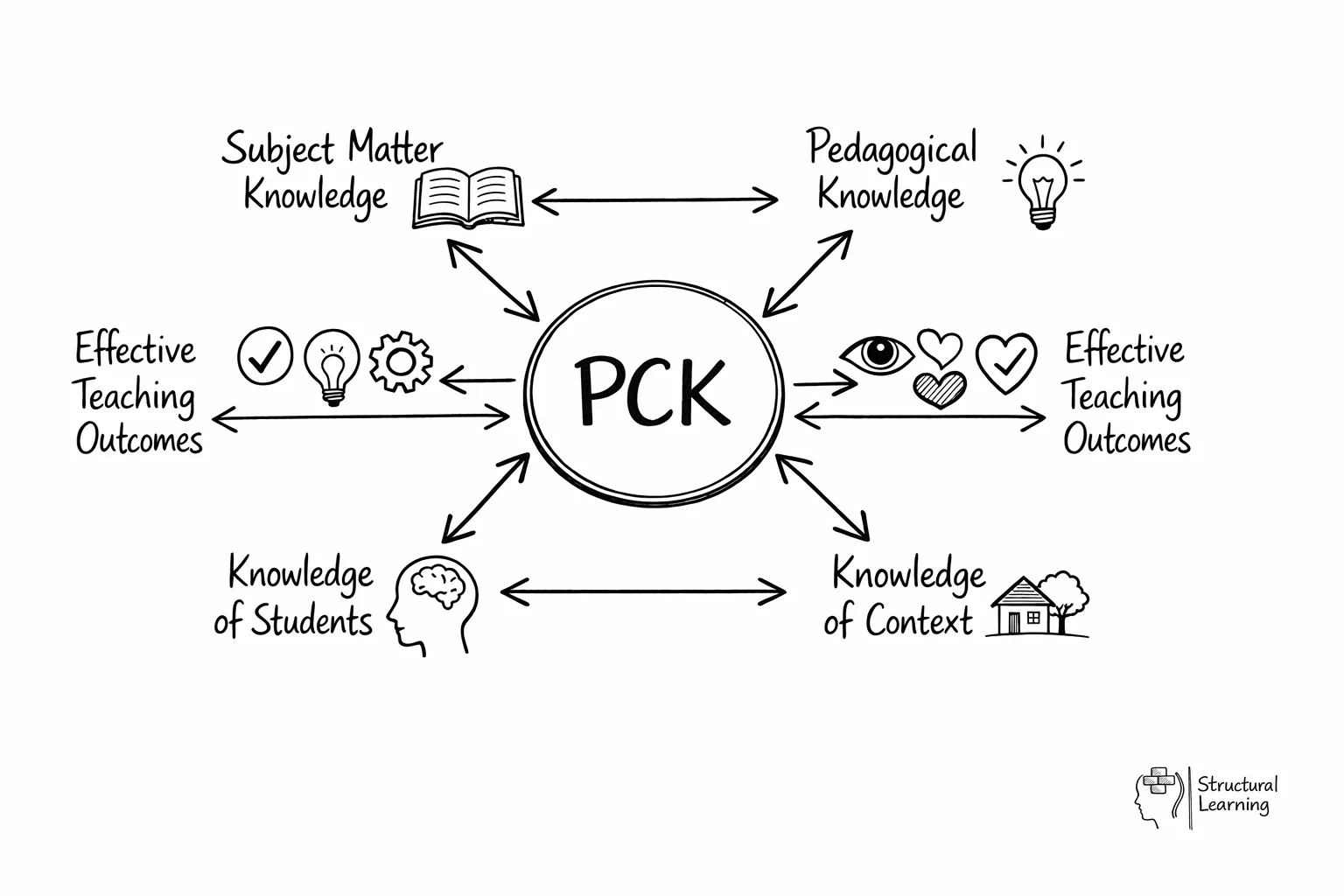
The broadest level is General PCK. This covers teaching methods that work across all subjects and classrooms. It includes core skills like asking good questions, managing behaviour, and using formative assessment. For example, using a "think-pair-share" task to spark discussion shows General PCK in action, no matter what subject you teach.
Looking more closely, Domain-Specific PCK is the knowledge needed to teach a certain subject, like Science, History, or Mathematics. It means understanding the unique ways of thinking, common mistakes, and normal learning challenges found in that topic. For example, a History teacher uses Domain-Specific PCK to help learners study primary sources. They do this by understanding how historical study works and what makes good evidence.
The most detailed level is Topic-Specific PCK. This focuses on the pedagogical knowledge needed to teach a particular concept or topic within a subject. It includes specific analogies, representations, examples, and expected misconceptions linked to that exact content. For example, a Science teacher shows Topic-Specific PCK when explaining photosynthesis by using the analogy of a plant as a "food factory" and by addressing the common misconception that plants get food from the soil rather than producing it themselves.
Consider a Year 5 teacher planning a lesson on fractions. Their General PCK informs the decision to begin with a short retrieval practice activity on prior number knowledge. Karpicke (2008) showed why retrieval practice supports memory, and the teacher uses mini-whiteboards to check understanding.
Their Domain-Specific PCK for mathematics guides them to use fraction circles or Cuisenaire rods to show fractional parts. Their Topic-Specific PCK for fractions helps them anticipate that learners may think a larger denominator means a larger fraction, then prepare visual comparisons to address that misconception (Veal & MaKinster, 1999).
Liping Ma (1999) shared the idea of a Profound Understanding of Fundamental Mathematics (PUFM), which is a key part of pedagogical content knowledge for maths teachers. PUFM goes beyond just knowing how to do maths sums to include a strong, linked grasp of the whole subject. This deep knowledge allows teachers to explain ideas in many ways. It also helps them predict where learners can struggle.
A teacher with PUFM understands the "why" behind mathematical operations, not just the "how". They see the connections between different mathematical ideas, recognising how a concept taught in one year links to prior learning and future topics (Ma, 1999). This includes a firm grasp of the basic principles and axioms that underpin the entire mathematical structure.
PUFM also means being able to approach a mathematical concept from different perspectives. Teachers can represent it in different forms, such as concrete manipulatives, diagrams, or abstract symbols. Also, teachers with PUFM have a strong sense of longitudinal coherence, which means understanding how mathematical topics develop across grade levels. They can identify the foundational ideas needed for later, more complex learning (Ma, 1999).
Consider a Year 5 teacher explaining fraction addition, for instance, 1/2 + 1/4. A teacher with PUFM would not just show the common denominator method. They can first ask learners to draw diagrams, use fraction strips, or relate it to sharing half a pizza and then another quarter. They would then explicitly connect these concrete representations to the abstract common denominator procedure, explaining why finding a common denominator works by demonstrating equivalent fractions.
This strong subject knowledge helps teachers predict common mistakes. For example, they know learners can incorrectly add numerators and denominators together (1/2 + 1/4 = 2/6). Teachers can tackle these errors early by reviewing what a fraction actually means. They can easily change their explanation and offer new examples until the class understands.
In the end, a teacher's PUFM has a direct effect on learner learning outcomes. With this deep grasp of the subject, teachers can build learning experiences that fit together and make sense. This helps learners form strong conceptual frameworks in mathematics, so they understand ideas deeply rather than only memorising procedures (Ma, 1999).
Beyond a single teacher's personal Pedagogical Content Knowledge (PCK), there is a shared pool of expertise. This is known as Topic-Specific Professional Knowledge (TSPK). This shared knowledge base is a key part of frameworks like the Consensus Model of PCK. TSPK represents the gathered wisdom of the profession about how to teach specific concepts. It exists long before a new teacher tries to teach that topic for the first time.
TSPK covers the common problems learners face with specific content. It also includes the teaching approaches that help learners overcome these problems. This means knowing common misconceptions, useful analogies, clear representations, and the best order for teaching ideas. For example, in fractions, TSPK includes knowing that learners often see fractions only as parts of a whole, not as numbers, and that visual models such as fraction walls can help (Shulman, 1986).
While an individual teacher develops their own PCK through classroom experience and reflection, TSPK provides a foundational layer of established best practice. It is the collective understanding of "what works" for a specific topic, refined over time by many educators. A teacher's personal PCK then integrates and adapts this shared TSPK with their unique understanding of their learners and context.
Consider a Year 5 teacher introducing equivalent fractions. They rely on Topic-Specific Professional Knowledge (TSPK) to guide their lesson. This knowledge helps them spot common mistakes. For example, teachers know that learners often add numerators and denominators instead of keeping the fraction in proportion.
The teacher can access this TSPK through departmental schemes of work, shared resources, or professional learning. They then plan to address the error explicitly and use diagrams showing why multiplying both parts of a fraction by the same number keeps the value equal.
Having strong Topic-Specific Professional Knowledge (TSPK) helps teachers improve, especially if they are new to a subject. It acts as a clear guide so teachers do not have to invent methods from scratch for every topic. By using this shared knowledge, teachers can quickly apply proven strategies and spot common learner struggles. This creates better and more consistent teaching across a whole school (Grossman, 1999).
Shulman's idea of Pedagogical Content Knowledge became very popular in English-speaking countries. However, the European tradition of Fachdidaktik offers a similar and older view on how to teach specific subjects. This German term translates as 'subject didactics' or 'pedagogy of a subject matter'. It describes the exact knowledge a teacher needs to teach their subject well.
This idea covers the specific theories, methods, and research for teaching a certain subject. For example, Mathematikdidaktik looks at the unique challenges of teaching maths. Meanwhile, Sprachdidaktik focuses on teaching languages. It goes further than general teaching tips. It looks at the core structure of each subject, making sure the teaching matches how the subject works.
The roots of Fachdidaktik go back to the 18th and 19th centuries. It grew as teaching became a profession and academic subjects developed (Kansanen, 1999). It acts as a complete guide that links curriculum planning, lesson design, and assessment for a specific subject. This tradition shows that good teaching needs more than general skills. It requires a deep grasp of how learners build and share knowledge in a particular subject area.
Think about a history teacher using strong Geschichtsdidaktik (history didactics) to teach the causes of World War I. Instead of just listing facts, the teacher plans activities that help learners think like real historians. Learners learn to analyse primary sources and evaluate different historical views. For example, they can compare various accounts of the Sarajevo assassination. They can then discuss how each writer's viewpoint shapes the story and judge the reliability of the evidence.
While Shulman's PCK comes from a different academic background, both ideas share a core belief. They both agree that teaching expertise relies heavily on subject knowledge. Looking at Fachdidaktik gives us a wider global and historical view of how subjects are best taught. It highlights a universal truth across education. Teaching is not a general skill, but a highly skilled craft that combines deep subject knowledge with the art of teaching.
Shulman's initial conceptualisation of Pedagogical Content Knowledge (PCK) in the 1980s proved highly influential, yet over time, various interpretations emerged. This led to a fragmented understanding of PCK, making it challenging for researchers to compare findings and for teacher educators to develop consistent training programmes. A clear, shared definition was needed to advance both research and practice in this important area of teacher expertise.
To address this fragmentation, a major international summit of PCK scholars met in 2012. The group aimed to bring together different views and build a shared understanding of PCK. The result was the Consensus Model of PCK (2012), which gave teachers and researchers a clear framework for defining, researching, and developing pedagogical content knowledge.
The Consensus Model posits PCK not as a mere sum of subject matter knowledge and pedagogical knowledge, but as an integrated and transformed knowledge base. It emphasises that PCK is context-specific, developed through teaching experience, and continually refined. This model highlights how teachers integrate their understanding of content, learners, curriculum, and instructional strategies into a unique form of professional knowledge (Gess-Newsome, 2015).
Under this model, a teacher's PCK is evident in their instructional decisions and actions. For example, a Year 5 history teacher planning a lesson on the Roman invasion of Britain demonstrates PCK by anticipating that learners can struggle with the concept of empire or the motivations for conquest. They select specific primary source excerpts accessible to this age group, prepare a graphic organiser to compare Roman and Celtic perspectives, and plan targeted questions to uncover misunderstandings.
also, the Consensus Model shows the adaptive nature of PCK. Teachers constantly adapt their explanations and activities based on learner responses, reflecting their evolving understanding of how to teach particular content effectively. This continuous refinement ensures that teaching remains responsive and tailored to the specific learning needs of learners in a given subject area. The 2012 Consensus Model therefore provides a robust foundation for both the study and practical application of PCK in classrooms worldwide.
Shulman's early idea of Pedagogical Content Knowledge (PCK) focused on what teachers know. However, Cochran, DeRuiter, & King (1993) suggested a major change. They shifted the focus from "knowledge" to Pedagogical Content Knowing (PCKg). This shift shows that great teaching is an active process, rather than just holding onto fixed facts.
Pedagogical Content Knowing (PCKg) highlights that a teacher's understanding of how to teach specific content is constantly evolving and enacted in real-time. It moves beyond a fixed body of knowledge to recognise the adaptive, co-constructive nature of teaching and learning. Teachers do not simply apply pre-existing knowledge; they continuously construct and refine it through interaction.
Consider a Year 5 teacher explaining fractions. Instead of just delivering a planned explanation, a teacher demonstrating PCKg observes learners' facial expressions and initial attempts at a task. If several learners struggle with equivalent fractions, the teacher immediately adapts, perhaps drawing a new visual representation on the board or asking a probing question like, "How many quarters make a whole?" This immediate adjustment reflects active 'knowing' rather than static 'knowledge'.
This co-constructive aspect means PCKg emerges from the interplay between the teacher, the content, and the learners within the classroom environment. It acknowledges that teaching is an interactive process where the teacher's understanding of how to present content is shaped by learners' responses and questions. The teacher's knowing is thus collaboratively built.
Therefore, Pedagogical Content Knowing (PCKg) is the ongoing way teachers work with subject content and learners. It means teachers keep reading the lesson, adapting ideas, and creating teaching strategies as learners show what they understand. This active 'knowing' sits at the heart of expert teaching.
| RCM Component | Description |
|---|---|
| Orientation to Teaching | A teacher's overarching beliefs and goals for teaching a particular subject or topic. This influences their instructional decisions. |
| Knowledge of learner Understanding | Awareness of learners' prior knowledge, common misconceptions, learning difficulties, and developmental stages related to specific content. |
| Knowledge of Curriculum | Understanding of the curriculum goals, specific learning objectives, sequencing of topics, and available resources for teaching the content. |
| Knowledge of Instructional Strategies | Proficiency in selecting and using content-specific representations, analogies, examples, activities, and teaching approaches to make concepts comprehensible. |
| Knowledge of Assessment | Ability to design, administer, and interpret assessments that reveal learners' understanding of specific content, and to use this information to adapt instruction. |
Pedagogical Content Knowledge is a broad idea, so researchers have built more detailed frameworks for specific subjects. One key example is Mathematical Knowledge for Teaching (MKT), developed by Deborah Ball and colleagues to describe the distinct knowledge teachers need to teach mathematics well (Ball, Thames, & Phelps, 2008). MKT is more than knowing mathematics. It shows the special ways teachers must understand and use mathematical content in the classroom.
MKT separates common content knowledge from specialised content knowledge. Common content knowledge is what any adult with sound maths skills might have. Specialised content knowledge means understanding maths in ways needed for teaching, such as breaking a complex method into clear steps or judging whether an unusual learner answer is mathematically valid. For instance, a teacher with strong specialised content knowledge can explain why 'invert and multiply' works for fraction division, rather than just state the rule.
MKT includes knowledge of content and learners. This means predicting common misconceptions and understanding how learners think about particular mathematical concepts. It also includes knowledge of content and teaching, which helps teachers choose examples, representations, and instructional strategies.
For example, when teaching fractions, a teacher drawing on MKT can anticipate that learners will confuse 'half of a half' with 'half plus half'. They can prepare fraction bars or area models to clarify multiplication of fractions.
This specialised knowledge helps teachers diagnose learner errors, use precise mathematical language, and adapt teaching for different learning needs. Strong MKT helps teachers move beyond rote instruction. It helps them build deeper conceptual understanding and problem-solving skills in their learners (Ball, Thames, & Phelps, 2008).
Within Pedagogical Content Knowledge (PCK), Orientations to Teaching (OTS) show a teacher's core beliefs about their subject. These beliefs outline the main purpose of teaching that specific topic. They guide the choices a teacher makes, from planning lessons to setting tests. OTS are more than just personal preferences. They are strong beliefs about what makes learning successful in a certain subject (Magnusson et al., 1999).
A teacher's OTS dictates their emphasis in the classroom. For instance, a science teacher with an OTS focused on conceptual change can prioritise activities that challenge learners' preconceptions and guide them towards scientific models. Conversely, a teacher whose OTS leans towards process skills can design lessons that heavily feature experimental design and data analysis, even if it means less time on specific content memorisation.
Consider a history teacher preparing a lesson on the causes of World War I. If their OTS prioritises historical empathy and perspective-taking, they will likely use primary source documents from various nations and encourage learners to debate different viewpoints. They can ask, "How would a German soldier's experience differ from a British soldier's, and why?" This approach aims to develop precise understanding rather than simply memorising a list of causes.
Alternatively, a history teacher with an OTS focused on chronological understanding and factual recall can instead present a clear timeline of events and key figures, followed by a quiz requiring learners to identify dates and names. Both approaches are valid, but they stem from differing beliefs about the most important learning outcomes in history. Recognising one's own OTS, and how it aligns with curriculum goals, is a critical aspect of developing robust PCK.
Lesson Study is a team approach where teachers work together to plan, teach, observe, and improve lessons (Lewis et al., 2009). This shared process helps staff build and record their pedagogical content knowledge. It moves past teachers just thinking on their own. Instead, it creates group skill and a shared idea of what works best in the classroom.
During planning, teachers work together to predict learner misconceptions. They then choose teaching strategies and representations for a specific topic. For instance, science teachers might discuss the best analogy for atomic structure, taking account of common gaps in prior knowledge and prior learning. When they observe the lesson, they can see how these PCK-informed choices work in practice, including learner responses and learning outcomes.
The post-lesson debrief helps teachers build shared PCK. Teachers discuss what learners learned and identify which explanations or activities worked best, and why. They can refine a questioning sequence or adapt a graphic organiser based on learner feedback and engagement. This shared reflection means the new pedagogical content knowledge is shared and formally recorded for future use by the team and wider school community.
TPACK (Technological Pedagogical Content Knowledge) builds on Shulman's PCK. It adds technology to what a teacher needs to know (Mishra & Koehler, 2006). This model shows the complex link between subject content, teaching methods, and technology. It shows that technology is more than just an add-on tool.
Within TPACK, Technological Content Knowledge (TCK) means knowing how technology can show or change subject content. For example, a geography teacher might use a Geographic Information System (GIS) so learners can study real-world spatial data. This helps learners see patterns in urban development that static maps cannot show. It shows how technology can reshape the content itself.
Technological Pedagogical Knowledge (TPK) looks at how technology can support specific teaching methods. For example, a primary teacher can use an interactive whiteboard app for group story writing. This lets learners build stories together and edit the text in real time. Using technology in this way improves how the teacher guides the writing lesson.
When these elements are fully joined, they form Technological Pedagogical Content Knowledge (TPACK). This helps teachers make sound choices about using technology. For example, an English teacher can use a digital annotation tool (TCK) to highlight textual features in a poem, while also using a collaborative online discussion forum (TPK) to encourage peer analysis. In this way, technology supports both the subject content and effective teaching strategies.
Magnusson et al.'s Five-Component Model builds on Shulman's original idea of PCK. It sets out five parts: orientation to teaching the subject, knowledge of the curriculum, knowledge of learners' understanding of the subject, knowledge of instructional strategies, and knowledge of assessment. These parts do not work alone. They link in a non-linear way, so a teacher's knowledge in one area shapes their choices in the others (Magnusson et al., 1999).
Consider a history teacher planning a lesson on the causes of World War I. Their knowledge of common learner misconceptions (knowledge of learners) about single causes, rather than multiple factors, directly influences their choice of a graphic organiser (instructional strategy) to map interconnected events. This also shapes the specific questions they ask during a plenary (assessment) to check for understanding of causality, demonstrating the adaptive interplay of PCK components in practice.
The Refined Consensus Model (RCM) is the current academic standard for explaining how PCK moves from the profession into classroom action. It distinguishes the shared knowledge held by a subject community, the knowledge a teacher adapts for planning, and the knowledge enacted during teaching (Carlson & Daehler, 2020).
In practical terms, collective PCK (cPCK) includes shared schemes, common misconceptions, research summaries, and departmental examples. Personal PCK (pPCK) is the teacher's adapted planning knowledge. Enacted PCK (ePCK) is what the teacher actually does when learner responses change the lesson. The model helps departments document what the profession knows while still respecting the judgement teachers use in the room.
When teaching about forces in Year 7 science, a teacher applies these RCM components. They anticipate learners can confuse mass and weight (Knowledge of learner Understanding) and decide to use a balance scale demonstration alongside a spring scale (Knowledge of Instructional Strategies).
The teacher also ensures the lesson aligns with the national curriculum's learning objectives for forces (Knowledge of Curriculum). During the lesson, they ask targeted questions, notice learner responses, and adjust the explanation. Behling et al. (2022) describe this movement from personal PCK to enacted PCK as being shaped by filters such as knowledge-based reasoning, classroom routines, and the teacher's ability to notice what learners mean.
Magnusson, Krajcik, and Borko (1999) created a five-part model of Pedagogical Content Knowledge (PCK). They built this upon the early work of Shulman. This model gives a clear picture of the special skills teachers use to teach certain subjects well. It explains the linked parts of PCK that help teachers make good choices in the classroom.
The first component is Orientations to Teaching, which encompasses a teacher's general beliefs about the purpose and goals of teaching a particular subject. For example, a primary science teacher can prioritise inquiry-based learning to develop scientific thinking over direct instruction of facts. Next, Knowledge of Curriculum involves understanding the specific curriculum goals, materials, and activities relevant to the subject and grade level. A Year 9 history teacher knows the required topics for their syllabus and selects appropriate primary sources.
Knowledge of Learners' Understanding means knowing what learners may already know, what misconceptions they may have, and what developmental levels they bring to the content. A mathematics teacher teaching algebra can predict that learners may struggle with balancing equations, then prepare scaffolded examples. Knowledge of Instructional Strategies means knowing which teaching approaches, representations, analogies, and examples can make content easier to understand. A biology teacher, for example, can use a cell diagram to explain organelles and their functions.
Finally, Knowledge of Assessment means knowing how to judge learner learning well in a specific subject area (Magnusson, Krajcik, & Borko, 1999). This includes designing assessments that show conceptual understanding as well as factual recall. For example, an English teacher can use a writing frame to assess how well learners structure an argumentative essay, with clear criteria for each section.
Pedagogical Content Knowledge (PCK) applies to all subjects. However, some subjects need their own highly specific forms of knowledge. Mathematical Knowledge for Teaching (MKT) is a clear example of this. It adapts Shulman's original idea to fit the unique challenges of teaching maths.
MKT includes deep understanding of mathematical concepts and the teacher knowledge needed to represent them, anticipate learner misconceptions, and respond to learner thinking (Ball, Thames, & Phelps, 2008). It includes specialised content knowledge that mathematicians may not use in their own work but that teachers need in the classroom.
For example, a Year 5 teacher showing division of fractions can explain why dividing by 1/2 is the same as multiplying by 2. They would expect some learners to use "invert and multiply" without understanding why it works. The teacher might draw diagrams that split a whole into halves, then split each half into smaller parts. This calls for specific mathematical knowledge used in a teaching context.
| PCK Epistemology | Teacher's Approach |
|---|---|
| Integrative | A Year 7 teacher planning a lesson on photosynthesis consciously selects an analogy, such as a plant as a food factory, by drawing separately on their science knowledge, their understanding of analogies, and their knowledge of learners' common misconceptions. |
| Transformative | An experienced Year 11 biology teacher teaching photosynthesis fluidly adapts explanations and activities. Their understanding of how to teach this specific topic is a unified knowledge, not a conscious combination of separate knowledge types. |
Technological Pedagogical Content Knowledge (TPACK) extends Shulman's original PCK framework by adding technological knowledge to content and pedagogy. Mishra and Koehler (2006) use TPACK to explain how teachers choose technology because it changes how a topic can be represented, practised, or assessed, not because the tool is new.
The TPACK framework groups a teacher's skills into seven linked areas. These include Content Knowledge (CK), Pedagogical Knowledge (PK), and Technological Knowledge (TK). It also includes blended areas: Pedagogical Content Knowledge (PCK), Technological Content Knowledge (TCK), Technological Pedagogical Knowledge (TPK), and Technological Pedagogical Content Knowledge (TPACK). In the age of Generative AI (GenAI), understanding these areas helps teachers use new tools effectively.
GenAI tools, such as large language models and image generators, change how teachers approach each TPACK domain. Teachers need Technological Knowledge (TK) to understand what these tools can and cannot do. This includes writing clear prompts, checking outputs against subject knowledge, protecting data, and deciding whether the tool actually improves the representation of the content (Mollick & Mollick, 2023).
For example, a history teacher planning a lesson on the causes of World War I can use GenAI to generate diverse primary source excerpts or create alternative historical narratives for learners to analyse. The teacher's Pedagogical Content Knowledge (PCK) guides the selection and adaptation of these AI-generated resources, ensuring they align with learning objectives and address potential misconceptions. The teacher can prompt, "Generate five short, contrasting perspectives on the assassination of Archduke Franz Ferdinand, suitable for Year 9 learners."
Technological Content Knowledge (TCK) becomes highly important when using GenAI to explore a subject. For example, a science teacher can use GenAI to show complex biological processes or model chemical reactions. This helps learners understand difficult, abstract concepts more easily. In the same way, Technological Pedagogical Knowledge (TPK) means using GenAI to tailor learning or give quick feedback. This frees up the teacher to spend more time having meaningful discussions with their learners.
Ultimately, a teacher demonstrating strong TPACK in the GenAI era integrates their deep subject knowledge (CK), pedagogical strategies (PK), and understanding of GenAI tools (TK) to design rich, engaging, and critically informed learning experiences. This whole-school approach ensures GenAI serves as a useful teaching support rather than a mere new tool.
There is also a serious dispute about whether PCK is a separate domain at all. Settlage (2013) argues that some uses of PCK rest on unstable boundaries between content, pedagogy, and learner knowledge. A cognitive load reading makes the challenge plainer: teachers need deep subject knowledge organised around the mental load a topic creates for novices.
That does not make PCK useless. It means schools should treat it as a practical design problem: identify the intrinsic load in the topic, choose representations that reduce unnecessary load, and check whether learners can use the idea independently.
The integrative view suggests that subject matter knowledge, pedagogical knowledge, and contextual knowledge remain distinct but interact. Teachers consciously draw upon each knowledge type, applying them in concert without them merging into a new entity.
By contrast, the transformative view says that these knowledge bases interact to create a new and unique form of knowledge. In this view, the original parts are changed and brought together into one topic-specific understanding for teaching.
Veal and MaKinster (1999) created a system to organise pedagogical content knowledge. Their model moves from broad subject strategies down to specific lesson ideas. This framework helps teachers see how PCK works at different levels. As a result, it guides their daily teaching choices and wider curriculum planning.
This system outlines clear levels of PCK for teachers to use. Each level needs a different approach to ensure effective teaching. When teachers understand these levels, they can review and improve their classroom methods step by step.
Using this taxonomy, a mathematics teacher can use general PCK to plan problem-solving tasks across all topics. They then use domain-specific PCK for algebra, where the challenges differ from geometry. In a lesson on quadratic equations, topic-specific PCK helps them address common errors in factorisation. They might use a visual representation, such as an area model, to make the process clearer.
Pedagogical Content Knowledge (PCK) goes far beyond just predicting common academic mistakes. It also includes a deep understanding of neurodivergent learning profiles. Teachers use PCK to see how conditions like ADHD, autism, dyslexia, or dyscalculia change how a learner learns a specific subject. With this special knowledge, teachers can adapt their methods and materials to support all learners.
Teachers use PCK to anticipate how sensory input or processing speed can affect a neurodivergent learner's engagement with a lesson. They consider the impact of classroom acoustics, lighting, visual clutter, and the pace of instruction on a learner's ability to focus and assimilate information. Adjustments are then made to create a more accessible learning environment.
For example, in a Year 3 science lesson on plant growth, a teacher with strong SEN-PCK can reduce the number of posters on display and use a muted colour palette for visual aids. They can also provide noise-cancelling headphones for learners sensitive to auditory stimuli during group work, ensuring all learners can concentrate on the task.
PCK helps teachers support learners with executive function difficulties. These may include problems with organisation, planning, working memory, or sustained attention. When teachers understand how these issues affect learning in a specific subject, they can give more focused instructional scaffolding. They can also design tasks that reduce cognitive load and give learners clear structures.
Consider a Year 9 history class analysing primary sources. A teacher can provide a graphic organiser with pre-filled sections for "Source Type," "Date," and "Key Message," rather than asking learners to generate categories independently. This reduces the working memory load and structures the analytical process, making the task more manageable for learners with ADHD or dyspraxia (Sweller, 1988).
Good SEN-PCK helps teachers adapt how they speak and set up group work for neurodivergent learners. This means being very clear about what you expect from the class. Teachers should use simple, direct language and give learners different ways to show what they know. It also requires teachers to think carefully about how social groups can affect a learner's ability to take part.
In a Year 6 English lesson, when discussing character motivations, a teacher can provide sentence stems for learners to articulate their ideas, such as "I think [character] felt this way because..." This supports learners who may struggle with spontaneous verbalisation or social communication. The teacher also explicitly checks for understanding using non-verbal cues or individual check-ins, rather than relying solely on whole-class questioning (Wiliam, 2011).
Teachers can use this broader view of learning profiles to share their subject knowledge clearly. This ensures the content is easy for every learner to access and understand. This method goes beyond basic differentiation. Instead, it creates teaching that is truly personal and supportive for all learners.
The Content Representation (CoRe) tool is well known in research because it records a teacher's Pedagogical Content Knowledge (PCK). Its weakness is workload. Teachers often find CoRes time-consuming, and they can struggle to write down the tacit reasoning behind an explanation or analogy (Bertram, 2014). This matters because the main barrier is not knowing that PCK exists. The barrier is finding sustainable ways to turn subject expertise into shared planning tools.
Teachers should begin by isolating the fundamental concepts within any given topic. This involves asking critical questions such as: "What are the essential ideas learners must grasp?" and "What prior knowledge is necessary for this new learning?"
| PCK Level | Description | Classroom Example |
|---|---|---|
| General PCK | Broad teaching strategies common to an entire discipline. | A science teacher consistently uses inquiry-based learning principles across all biology, chemistry, and physics units. |
| Domain-Specific PCK | Pedagogical approaches tailored to a specific content area within a discipline. | A history teacher knows how to effectively teach ancient civilisations, which differs from teaching modern European history. |
| Topic-Specific PCK | Strategies for particular topics within a domain, including common misconceptions. | Within ancient history, a teacher anticipates learners confusing the Roman Republic with the Roman Empire. |
| Lesson-Specific PCK | Specific instructional moves and representations for a single lesson. | For a lesson on Roman government, the teacher plans to use a specific graphic organiser to compare roles in the Republic versus the Empire. |
For example, when a Year 7 Science teacher introduces 'states of matter', they would name 'particle arrangement', 'energy', and 'intermolecular forces' as the core concepts. Clear learning goals then help the teacher plan focused explanations and activities (Wiliam, 2011).
Once core concepts are identified, teachers develop multiple ways to explain them. This includes verbal explanations, visual aids, and concrete analogies, ensuring varied access points for learners.
A Year 5 Maths teacher explaining fractions can use a pizza analogy for parts of a whole, then a number line to show relative size, and finally Cuisenaire rods for equivalent fractions. Providing varied representations helps address different learning preferences and deepens understanding (Rosenshine, 2012).
Effective teachers use their experience and subject knowledge to spot common learner misconceptions before they appear. This helps them plan focused teaching support.
A Year 9 History teacher teaching about the causes of World War I anticipates learners can oversimplify by blaming a single event. They plan to explicitly address this by presenting multiple contributing factors and discussing their interconnectedness. Planning specific questions or activities to expose and correct these misconceptions is important for effective teaching (Hattie & Timperley, 2007).
PCK also involves managing subject-specific intrinsic load. Teachers sequence content from simpler to more complex ideas so learners can connect new knowledge to prior learning without overload (Sweller, 1988).
A Year 11 English teacher planning a unit on Shakespearean tragedy might start with character analysis. They could then move to plot structure and thematic exploration, before detailed language analysis. This order reduces cognitive load and helps learners build deeper, more coherent understanding (Sweller, 1988).
Tactile Pedagogical Content Knowledge (PCK) means a teacher's specialist knowledge of how to use physical objects, movement, and hands-on activities to show abstract concepts. It moves learning beyond digital screens and uses concrete experience to support understanding. This is especially useful in subjects where learners cannot easily observe ideas directly or use immediate sensory input, helping them build strong mental models (Bruner, 1966).
Many complex ideas are hard to picture physically. These include historical causes, grammar rules, or science concepts. Hands-on methods offer vital support here. They lower the mental effort needed by linking new facts to physical experiences (Sweller, 1988). This active learning can greatly boost understanding, memory, and the ability to use knowledge in new ways.
Consider teaching sentence structure to Year 4 learners. A teacher with strong tactile PCK can use physical cards, each labelled with a word type (e.g., 'noun', 'verb', 'adjective') or a sentence part (e.g., 'subject', 'predicate'). Learners physically arrange these cards on their desks to build grammatically correct sentences, identify errors, or transform simple sentences into complex ones. This concrete manipulation makes abstract grammatical rules tangible and allows for immediate self-correction.
For secondary history, explaining the interconnected causes of a major event like the First World War presents an abstract challenge. A teacher could provide learners with large index cards, each detailing a contributing factor (e.g., 'Imperialism', 'Alliance System', 'Militarism'). Learners then use string or yarn to physically connect these cards on a classroom wall or large table, illustrating direct and indirect causal links and the web of relationships. This physical mapping helps learners visualise and articulate complex historical causality.
Using touch and movement gives learners extra ways to understand ideas. It is not a separate learning style. Physical cards, models, and movement can reduce working memory load because they make relationships easier to see. This fits Vygotsky's (1978) view that learners build understanding through social and material activity.
Hands-on tasks can also improve learner focus because they give discussion a shared object. Building, sorting, and moving objects helps learners rehearse complex relationships, explain choices aloud, and correct errors with peers. Teachers can then listen for misconceptions as learners work.
Early Career Teachers (ECTs) often face a "novice bottleneck" when building their Pedagogical Content Knowledge (PCK). It takes years of situated practice to learn which examples, misconceptions, and explanations fit a topic (Shulman, 1986). Generative AI can now act as an external planning support: it can draft analogies, list likely misconceptions, and suggest diagnostic questions faster than a novice can build that repertoire alone (Mollick & Mollick, 2023).
A Content Representation (CoRe) is a clear tool that teachers use to map out their PCK for a certain topic. It lists common mistakes, useful analogies, and good teaching steps. Recent research also looks at how AI can help teachers plan lessons. This moves beyond just talking about ideas and focuses on real classroom uses for teachers (Peikos & Stavrou, 2024).
Teachers can use AI as a "CoRe Prompt Engineer", but the teacher still owns the judgement. The prompt can produce a draft CoRe for a topic, including misconceptions, representations, sequencing, and checks for understanding. The teacher then tests those suggestions against the curriculum, learner prior knowledge, cultural context, and classroom evidence.
Teachers can ask AI to list common misconceptions learners may have about a particular topic. Spotting these early helps teachers plan targeted instruction and design formative assessment (Wiliam, 2011).
For example, a Key Stage 3 Science teacher preparing a lesson on photosynthesis can prompt: "List common misconceptions Key Stage 3 learners have about photosynthesis and suggest diagnostic questions." The AI can respond with ideas such as learners believing plants eat soil, or that oxygen comes from the soil, prompting the teacher to plan questions like, "Where do plants get their food from?"
This output helps the teacher design pre-assessment tasks or integrate specific clarifications into their lesson plan. Understanding these potential pitfalls allows the teacher to address them directly, rather than waiting for errors to emerge during instruction.
AI can suggest various ways to represent complex ideas, including analogies, metaphors, and visual aids. These representations make abstract concepts more concrete and accessible for learners (Bruner, 1966).
A Key Stage 2 maths teacher teaching fractions could prompt: "Provide analogies and visual representations for teaching equivalent fractions to 8-year-olds." The AI may suggest pizza, chocolate, or fraction walls. The teacher should then ask whether those analogies fit the class. Mutegi (2011) warns that supposedly universal examples can exclude learners when they assume shared cultural schemas. For EAL learners or working-class communities, a number line, school lunch portions, sports scores, or local shopping examples may make the mathematics clearer.
Such suggestions reduce the cognitive load on the teacher to invent these representations from scratch, allowing them to focus on how best to integrate them into their teaching (Sweller, 1988).
Good lesson sequencing ensures that new facts build clearly upon what learners already know. This logical step-by-step approach prevents cognitive overload and helps learners learn more deeply. AI tools can now help teachers design this steady lesson progression (Rosenshine, 2012).
A Key Stage 4 History teacher planning a unit on the causes of World War I can ask: "Suggest a logical sequence of sub-topics for teaching the causes of World War I to 15-year-olds, considering prior knowledge of European empires." The AI could propose starting with the long-term causes like imperialism and nationalism, before moving to short-term triggers.
The teacher reviews this sequence, adapting it based on their specific curriculum requirements and their learners' existing knowledge base. This process helps ensure a coherent and progressive learning experience.
Using AI as a CoRe Prompt Engineer significantly reduces the time and mental effort required for teachers, particularly ECTs, to develop robust PCK. It provides a rich repository of pedagogical strategies and insights that would otherwise take years to accumulate.
However, teachers must check all AI-generated content with care. AI suggestions are only a starting point, so teachers need to judge their accuracy, age-appropriateness, and fit with curriculum goals and learner needs. The teacher remains the expert and adapts the AI's output for their own classroom context.
Teachers usually need 3-5 years to build strong PCK. This timeframe changes depending on the subject and context. Mentoring and research help new teachers learn quicker (Shulman, 1986; Grossman, 1990; Ball et al., 2008).
Subject content shapes PCK, according to Shulman (1986). In Mathematics, PCK involves number sense and representations (Ball et al., 2008). In Science, PCK focuses on models, evidence, and causal reasoning (Osborne, 2010).
In English, PCK includes disciplinary literacy: how learners read, discuss, and write within the subject. These are signature pedagogies, not generic teaching tips.
School leaders build PCK through subject-specific training, peer observation, joint planning, and subject mentoring. Generic lesson observations can damage early-career development when non-specialists judge surface features without seeing the subject reasoning behind a task. A better approach is to ask: what misconception was the teacher anticipating, why was this representation chosen, and what learner evidence changed the explanation? This fits the ITTECF focus on training tailored to subject, phase, and context.
PCK can be studied through observations, interviews, lesson plans, video, and learner work, but it remains hard to measure reliably. Depaepe, Verschaffel, and Kelchtermans (2013) show that researchers still struggle to separate PCK from content knowledge, general pedagogy, and classroom context. This is why the RCM matters: it separates collective PCK, personal PCK, and enacted PCK, rather than treating teacher knowledge as one score. ERIC - Education Resources Information Center and Springer Nature Link are useful citation trails for this measurement debate.
Learner feedback shapes PCK by showing what explanations and strategies work (Shulman, 1986). Teachers use assessments and chats to spot misconceptions. This informs how learners grasp content, so teachers adapt methods (Sadler, 1998; Black & Wiliam, 1998).
Ball et al. (2008).
Bertram (2014).
Bruner (1966).
Cochran et al. (1993).
Counsell (2011).
Gess-Newsome (2015).
Gess-Newsome (1999).
Grossman (1990).
Grossman (1999).
Hashweh (2005).
Kansanen (1999).
Kind (2009).
Lewis et al. (2009).
Loughran et al. (2004).
Ma (1999).
Magnusson et al. (1999).
Osborne (2010).
Rosenshine (2012).
Shulman (1986).
Sweller (1988).
Wiliam (2011).
These peer-reviewed studies provide the evidence base for the strategies discussed above.
Computer science in K-12 school curricula of the 2lst century: Why, what and when?
287 citations
Webb et al. (2016)
This paper guides educators on integrating Computer Science into K-12 curricula. It proposes principles for curriculum design, helping teachers decide what and when to teach computational thinking effectively to prepare learners for the future.
Debate as a Tool for Developing Critical Thinking in History Teaching
Baura et al. (2024)
This research offers history teachers a practical approach to developing critical thinking through classroom debates. It provides a strong pedagogical rationale for using debate as an effective didactic tool applicable across many subjects.
Kavitha et al. (2024)
This paper examines a blended learning model designed to develop essential attributes in engineering graduates. Teachers can apply these pedagogical strategies to cultivate personal and interpersonal skills, preparing learners for broader professional and societal demands.
How Mobile ECCE Practitioners Use a Variety of Learning Materials in Resource-Scarce Communities
Selepe et al. (2024)
Valuable for Early Childhood Care and Education practitioners, this study demonstrates how to use diverse learning materials in resource-scarce communities. It offers practical insights for supporting comprehensive child development despite limited resources, promoting creative teaching methods.