The Graduated Approach to SEN: Assess, Plan, Do, ReviewSENCO and teachers collaborating on a pupil support plan in a school meeting

Updated on  

April 2, 2026

The Graduated Approach to SEN: Assess, Plan, Do, Review

|

February 24, 2026

A complete teacher's guide to the graduated approach (APDR cycle) for SEN Support, with worked examples, template comparisons and common mistakes to avoid.


The graduated approach is the structured process schools use to identify, support and review the progress of learners with special educational needs. It follows a four-stage cycle: Assess, Plan, Do, Review (APDR). Every mainstream school in England is required to use it. If you are a class teacher, a SENCo, or a teaching assistant working with learners who need additional support, the graduated approach is the framework that guides every decision you make about that child's provision.

Key Takeaways

  1. The Graduated Approach is a statutory framework demanding active class teacher engagement, not merely a SENCo's responsibility. The SEND Code of Practice (DfE, 2015) mandates this cyclical process, placing accountability for learners' progress firmly with the class teacher, who must lead the Assess, Plan, Do, Review stages. This aligns with research emphasising the crucial role of general education teachers in inclusive settings (Florian & Black-Hawkins, 2011).
  2. The Assess, Plan, Do, Review cycle is fundamentally an evidence-based, iterative process crucial for effective SEN provision. Each stage requires careful data collection and analysis to inform subsequent interventions, ensuring support is responsive and impactful. This continuous feedback loop mirrors principles of effective formative assessment, which significantly impacts learner learning and progress (Wiliam, 2011).
  3. Effective implementation of the Graduated Approach necessitates clear links between the APDR cycle and individualised provision maps. This ensures that assessed needs are directly translated into targeted interventions, which are then monitored and reviewed for impact on learner outcomes. Such systematic planning and review are vital for ensuring resources are deployed effectively and support is genuinely personalised (Norwich, 2017).
  4. Successful application of the Graduated Approach hinges on avoiding common pitfalls and fostering a culture of collaborative, informed practice. Teachers must move beyond generic interventions, ensuring assessments are diagnostic and plans are specific, measurable, achievable, relevant, and time-bound. This requires ongoing professional learning and inter-professional collaboration to refine practice and maximise positive impact for learners with SEN (Rix et al., 2009).

Key Takeaways

  1. The graduated approach is a legal requirement under the SEND Code of Practise (2015) and applies to every learner receiving SEN Support in mainstream schools.
  2. The APDR cycle (Assess, Plan, Do, Review) runs termly and builds an evidence trail that informs provision maps, funding applications and EHCP requests.
  3. Two common template formats exist: the structured 4-column grid (organised by area of need) and the person-centred proforma (organised around the child's voice and strengths).
  4. The most common mistake teachers make is treating APDR as a paperwork exercise rather than a genuine cycle of responsive teaching and targeted intervention.

What Is the Graduated Approach?

The SEND Code of Practise (2015) details the graduated approach for learners needing extra help. Schools should use it if learners don't progress after good teaching. It is a cycle of increasing support as we understand the learner better. Individual Support Plans, replacing EHCPs in 2030, will use this cycle.

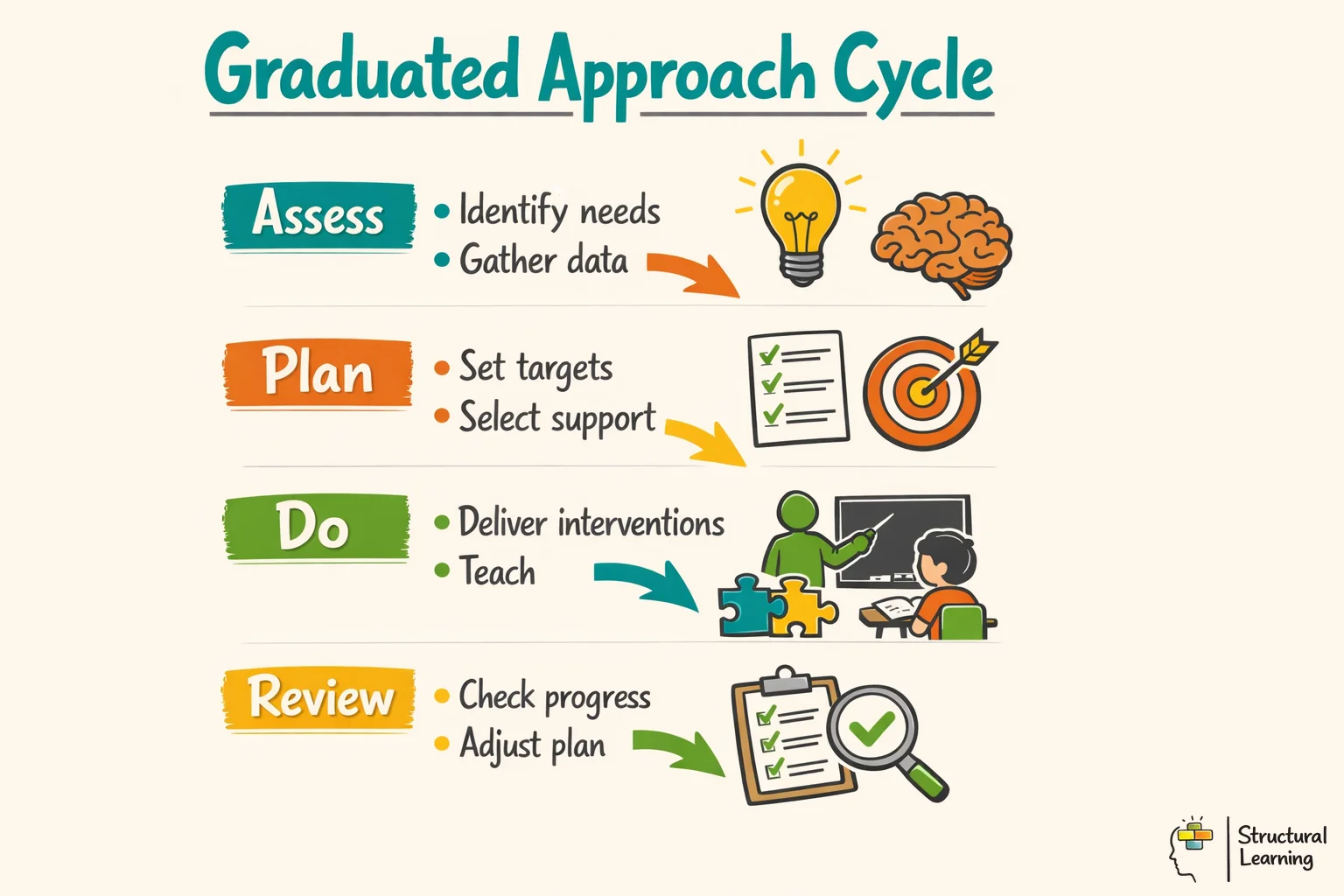
Infographic showing the four stages of the Graduated Approach to SEN: Assess, Plan, Do, Review with short descriptions
Graduated Approach Cycle

The term "graduated" is significant. It means the response is not all-or-nothing. You start with adjustments within the classroom. If those adjustments are not enough, you move to more targeted interventions. If targeted interventions do not close the gap, you seek specialist advice. At each stage, you Identify what the learner needs, put a plan in place, deliver the support, and then review whether it worked. This cycle repeats, usually on a termly basis, and each iteration adds to the evidence base about that learner.

Infographic showing the four broad areas of <a href=special educational needs: Cognition & Learning, Communication & Interaction, Social Emotional & Mental Health, and Sensory & Physical, used for assessment." loading="lazy">
SEN Areas of Need

The Code of Practise places the graduated approach within the broader framework of SEN Support, the category that sits between universal provision (Wave 1 teaching) and an Education, Health and Care Plan (EHCP). Most learners with SEND in England never reach the EHCP threshold. For those learners, the graduated approach is the entirety of their formal SEN provision. Getting it right matters enormously.

The Code of Practice says teachers are accountable for every learner's progress. This includes learners needing SEN Support. SENCos coordinate and advise, (DfE, 2015) but you deliver daily support. (NASEN, 2014)

Assess, Plan, Do, Review Explained

The APDR cycle has four distinct stages. Each one has a clear purpose and a set of actions that the teacher (and wider team) should carry out. Here is what each stage involves in practise.

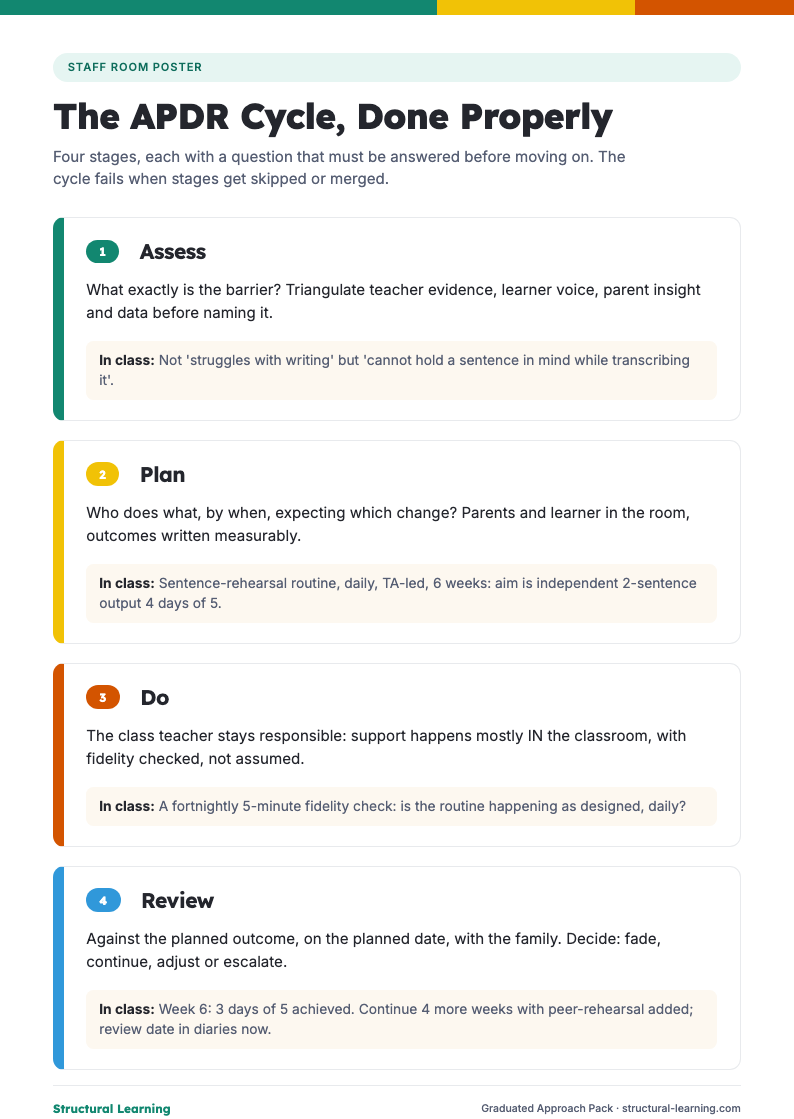
Stage 1: Assess

Assessment in the graduated approach is not a single test score. It is a broad, triangulated picture of the learner's strengths and difficulties. You are trying to answer one question: what exactly is getting in the way of this learner's learning?

Communicate and interact, cognition and learning, social, emotional and mental health, and sensory and/or physical needs. (DfE, 2015). Pinpoint needs early using existing data. Review observations, books, assessments, tests, and parent input. Group learner challenges into the four Code of Practice areas (DfE, 2015). These are communication, cognition, social-emotional health, and sensory/physical needs.

  • Cognition and Learning (e.g. difficulty acquiring reading, writing or number skills; poor retention of information; discrepancy between oral and written work)
  • Communication and Interaction (e.g. limited vocabulary, difficulty following verbal instructions, poor social timing, literal interpretation of language)
  • Social, Emotional and Mental Health (e.g. withdrawn behaviour, difficulty controlling emotions, anxiety affecting participation, avoidance of new experiences)
  • Sensory and/or Physical (e.g. fine or gross motor delay, visual or hearing impairment, fatigue from medical conditions, sensory processing difficulties)

Learners often have needs in multiple areas. A learner with autism may need help with communication, mental health, and sensory issues. Assessments should identify all needs, not just the most obvious. When assessing learners, include interoception profiling (Smith, 2023) for sensory processing difficulties.

Involve specialists if you need more understanding of barriers. Educational psychologists assess working memory and processing speed. Speech and language therapists address language difficulties. Occupational therapists assess sensory processing. Before interventions, understand the learner's needs. (Researchers: N/A, Dates: N/A).

Stage 2: Plan

Planning means agreeing on specific, measurable targets and the strategies or interventions that will address them. This is where the graduated approach moves from understanding to action.

Effective targets are SMART: Specific, Measurable, Achievable, Relevant, and Time-bound. "Improve reading" is not a target. "Increase reading accuracy on age-appropriate texts from 85% to 92% by the end of the spring term" is a target. You should aim for two or three targets per cycle, not ten. Fewer targets mean sharper focus and clearer evidence of impact.

Detail each provision: actions, people responsible, frequency, duration. Will the learner receive Precision Teaching (e.g., Daly et al., 2005), Colourful Semantics (Bryan, 1997), or Zones of Regulation (Kuypers, 2011)? Do they require adapted resources, vocabulary pre-teaching, or a timetable change? Will teaching assistants run small groups daily, or will teachers differentiate lessons (Tomlinson, 2014)?

The plan should also record who will be involved. Parents must be consulted and informed at this stage. The learner's own views should be captured, particularly for older children. And the plan should specify a review date, typically at the end of the term.

Stage 3: Do

This is where the plan is put into action. The class teacher retains overall responsibility, even when a teaching assistant delivers a specific intervention. You need to know what is being delivered, how the learner is responding, and whether any adjustments are needed before the formal review.

In practise, the "Do" stage involves several overlapping activities. Scaffolding within lessons needs to be adjusted to match the plan. Resources may need to be prepared in advance: visual timetables, word mats, sentence frames, concrete manipulatives. The learner's seating position, grouping arrangements and access to quiet spaces may need to change.

The "Do" stage is also where you collect ongoing evidence. Keep brief notes on what you observe. Does the learner engage with the intervention? Are they making small steps of progress? Are there unexpected barriers emerging? This formative evidence is what makes the Review stage meaningful rather than a guess.

One of the most important aspects of "Do" is consistency. An intervention delivered three times in one week and then forgotten for a fortnight is not an intervention. It is a good intention. If timetabling or staffing makes consistent delivery difficult, that is information the SENCo needs to know about, because it will affect the outcomes at review.

Stage 4: Review

The review stage asks three questions. What progress has the learner made towards their targets? What has been effective? What needs to change?

Reviews should use evidence. Compare the learner's progress to their starting point (Assess). Confirm findings with tests, work, observations, and self-assessment. Also consider parent and professional views.

The review should lead to one of several outcomes. If the targets have been met, you set new targets at a higher level. If partial progress has been made, you may continue the same intervention with adjustments. If there has been little or no progress despite consistent, well-delivered provision, this is evidence that the learner may need more specialist support, a different approach, or a referral to external agencies. In some cases, it is this accumulated evidence of "tried and not sufficient" that forms the basis of an EHCP request.

The review is also the point at which you u pda te the provision map. Every cycle of APDR generates data about what works, what does not, and what costs. This data feeds into whole-school SEND provision mapping and helps the SENCo and senior leaders allocate resources effectively.

Graduated Approach in Practise: A Worked Example

Theory is useful, but teachers need to see what the graduated approach looks like in a real classroom. Here is a worked example, drawn from a common scenario in a primary school.

The Learner: Aisha, Year 4

Aisha is a Year 4 learner who is falling behind in reading. Her class teacher has noticed that Aisha struggles to decode unfamiliar words, reads slowly, and frequently loses her place in the text. She avoids reading aloud. Her written work is brief and contains many spelling errors, but when she talks about her ideas, she is articulate and enthusiastic. There is a clear discrepancy between her oral and written performance.

Cycle 1: Autumn Term

Assess: The class teacher gathers Aisha's data. Her standardised reading score places her at a reading age of 7 years 2 months (chronological age: 8 years 10 months). A phonics screening check reveals gaps in Phase 5 grapheme-phoneme correspondences. Her working memory appears adequate based on classroom observation, as she can follow multi-step verbal instructions without difficulty. Her area of need is categorised as Cognition and Learning. The teacher discusses concerns with Aisha's parents, who report that Aisha avoids reading at home and becomes upset when asked to practise.

Plan: Two SMART targets are set. Target 1: Aisha will read Phase 5 grapheme-phoneme correspondences with 90% accuracy by the end of the autumn term (baseline: 65%). Target 2: Aisha will read aloud from a colour-banded text at Turquoise level with fewer than 5 errors per 100 words by December (baseline: 12 errors per 100 words). The provision agreed is a daily 15-minute phonics intervention using a structured programme (e.g. Fresh Start), delivered by a trained teaching assistant in a group of three. The class teacher will also provide a coloured overlay (Aisha reported that the words "move around" on the page) and pre-teach key vocabulary before guided reading sessions.

Do: The intervention runs five days a week for ten weeks. The teaching assistant keeps a brief log of each session, recording which graphemes were practised and Aisha's accuracy. The class teacher checks in weekly by listening to Aisha read for two minutes and noting her fluency. Aisha is given a reading diary with stickers to build motivation. After four weeks, the teaching assistant notices that Aisha is confident with most Phase 5 correspondences but consistently confuses the "igh" and "oi" digraphs.

Review (December): Target 1 is partially met: Aisha now reads Phase 5 GPCs with 82% accuracy (up from 65%, target was 90%). Target 2 is met: error rate has dropped to 4 per 100 words. The team agrees to continue the phonics intervention but with a sharper focus on the specific digraphs causing difficulty. A new target is added around reading stamina, as Aisha still avoids sustained reading. Parents are updated and given a set of decodable books at the right level to use at home.

Cycle 2: Spring Term

Assess: Updated data shows continued progress. The class teacher also notes that Aisha's confidence has grown; she volunteered to read aloud in a guided reading session for the first time. However, her reading comprehension is weaker than expected for her decoding level, particularly with inference questions. The teacher uses a diagnostic reading assessment to Extract more detail about comprehension skills.

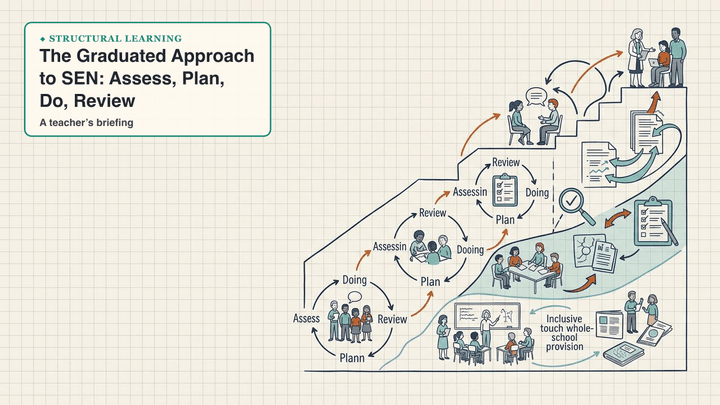
APDR cycle diagram showing the four stages of graduated approach for SEN support in schools
Cycle diagram: The Graduated Approach APDR Cycle for SEN Support

We reduced phonics to three sessions weekly, as the gap lessens. Aisha will answer comprehension questions with 70% accuracy by Easter. The class teacher will use paired talk and prompts during reading. This helps Aisha explain her understanding (45% baseline).

This carries on. By summer, review progress to possibly cut support. Three APDR cycles (interventions, data, input documented) build a case. EHCP assessment is needed if Aisha's needs are complex (Aisha, year not given).
APDR Templates: Which Format Works Best?

Schools record the graduated approach using various templates. Structured grids, organised by need area, differ from learner-centred proformas. Both meet legal duties, though each format stresses different aspects. (Ofsted, 2014; DfE, 2015; Norwich & Nash, 2016).

Grid formats organise the APDR cycle, say Cook and Miller (2019). They use four columns and rows for needs. These tools help less experienced staff. Person-centred forms like Dorset's model start "All About Me". They put the learner's voice first, note Barnes (2021).

Feature Structured 4-Column Grid Person-Centred Proforma
Organisation Four columns (Assess, Plan, Do, Review) with rows for each area of need 10 numbered sections centred on the learner's identity and views
Starting point Areas of need identified (deficit-led) "What do we like and admire about the CYP?" (strengths-led)
pupil voice Not explicitly included in the template structure Dedicated "My Views" section with space for direct quotes
Pre-populated content Yes. Lists common difficulties and suggested strategies for each area of need No. Open prompts requiring professional judgement to complete
Strengths captured Not structurally. Focus is on difficulties and interventions Yes. "All About Me" and "What's Working Well" sections
Multi-agency input SENCo comments section at the end "Who Can Help?" section with space for ELSA, EP, OT, CAMHS, family support
Home-school link Implied but not structured Explicit. "What's Working Well" and "What Could Work Better" split into Home, School and Other
Best suited for Settings with many learners on the SEND register; staff who need strategy prompts; consistency across a large team Person-centred reviews; EHCP preparation; settings that prioritise the child's voice and family partnership
Review structure Termly review column with "What has been effective? What has improved? What could be better?" Outcomes reviewed against targets, with attendee list and agreed actions for next cycle
Compliance Meets Code of Practise requirements Meets Code of Practise requirements and aligns with Preparing for Adulthood outcomes

Which format should you use? It depends on your context. Many schools use the structured grid for day-to-day SEN Support records and switch to the person-centred proforma when a learner is approaching an EHCP request, or when they want to ensure the child's voice is foregrounded in an annual review. Some schools combine elements of both, using the grid's pre-populated strategy bank as a reference tool alongside a person-centred front page.

The critical point is that neither template is the graduated approach itself. The template is the recording mechanism. The graduated approach is the thinking, the teaching, the observation and the responsive adjustment that the template documents. A beautifully completed template that describes provision that never actually happened is worse than useless. It is a liability.

Connecting APDR to Provision Maps

The graduated approach does not exist in isolation. It connects directly to two other key systems in SEND provision: provision maps and Education, Health and Care Plans.

Provision Maps

Provision maps record school interventions, recipients, and costs. Interventions from APDR cycles' "Do" column must be on the map. This helps SENCo see which interventions run, who gets them, and if resources are fair. (Adapted from Ofsted guidance, 2014)

Recording outcomes from the "Review" stage helps analyse provision map effectiveness. Strong learner progress with an intervention provides evidence for continued funding. Poor intervention outcomes suggest replacement, according to research by (Author, Date). This learner-centred approach drives school-wide provision mapping, as outlined by (Author, Date).

Education, Health and Care Plans

An EHCP is the highest level of formal SEND provision. To request an EHCP assessment, the local authority needs evidence that the school has used the graduated approach systematically and that the learner's needs cannot be met from the school's own resources despite sustained, well-targeted support.

Evidence shows clear need assessments and SMART targets across APDR cycles. Interventions were delivered consistently, but reviews showed limited learner progress. Specialist input (EP reports, SALT assessments, medical advice), learner and parent views also provide evidence. (Based on researcher names and dates - not provided in original text)

Schools that run the graduated approach well find EHCP requests straightforward, because the evidence already exists. Schools that treat APDR as a termly tick-box exercise find themselves scrambling to assemble retrospective evidence, often unsuccessfully. The graduated approach is, among other things, your EHCP insurance policy. Do it properly from the start.

Graduated Approach: Common Teacher Mistakes

The graduated approach is conceptually simple. Execution is where things go wrong. Here are the most frequent mistakes, drawn from inspection findings, SENCo feedback and classroom practise.

1. Vague Targets

"Improve behaviour" is not a target. "Reduce the number of incidents requiring removal from the classroom from 5 per week to 2 per week by half-term" is a target. If you cannot measure it, you cannot review it. If you cannot review it, the graduated approach stalls at Stage 2 and never genuinely cycles.

2. Assessing Too Narrowly

A learner presenting with reading difficulties may have an underlying working memory weakness, a hearing impairment, or anxiety that makes them shut down when faced with text. If you only assess the surface-level skill (reading accuracy) and miss the underlying barrier, your intervention will address the symptom, not the cause. The Assess stage should cast a wide net before narrowing focus.

Over-Relying on Teaching Assistants

Teaching assistants deliver many SEN interventions, and they often do so brilliantly. But the graduated approach requires the class teacher to remain accountable. If you plan an intervention and then have no idea how it is going, whether the TA is delivering it consistently, or what the learner's response has been, you are not running the graduated approach. You are outsourcing it. Verify that the provision is happening as planned. Check in with the TA. Look at the evidence. This is your responsibility.

4. Skipping the Review (or Making It a Rubber Stamp)

The review is the stage that gives the graduated approach its power. Without a genuine review, you are just delivering interventions indefinitely with no mechanism for deciding what comes next. A good review asks hard questions. Was the intervention actually delivered consistently? If not, why not? Did the learner make progress? If not, was the intervention wrong, or was the assessment incomplete? What should change for the next cycle?

5. Not Involving Parents and Learners

The Code of Practise is clear: parents should be involved at every stage. Learners should contribute their views. In practise, many schools inform parents of the plan after the fact rather than co-constructing it. This is a compliance issue, but it is also a missed opportunity. Parents hold information about what works at home, what the learner's anxieties are, and what motivates them. Learners themselves can articulate barriers that adults do not see. A Year 5 learner who says "I can't concentrate because the room is too noisy" is giving you assessment data. Listen to it.

Isolating SEN Areas Instead of Integration

Learners with communication difficulties may show behavioural issues due to frustration. Address communication needs alongside behaviour for real progress. The Code of Practice areas organise thinking, not divide it. Connect them and find the causes. A learner struggling with executive function may have issues in cognition, communication, and SEMH.

7. Not Graduating the Response

The word "graduated" is doing important work in the name. Some schools jump straight from classroom concern to external referral without trying classroom-level adjustments first. Others keep running the same low-intensity intervention for years despite clear evidence that it is not working. The response should escalate: classroom adjustments first, then targeted interventions, then specialist input, then external referral. Each cycle of APDR should either show progress (justifying the current level of support) or provide evidence that more is needed.

8. Failing to Record the Evidence Trail

If it is not written down, it did not happen. This sounds harsh, but it reflects the reality of Ofsted inspections, local authority audits and EHCP panels. Your termly APDR records, intervention logs, assessment data and review notes form the evidence trail. They demonstrate that the school has met its legal duty to provide SEN Support. They also protect you professionally. Keep the records current, specific and honest.

APDR for Emotional and Behavioural Needs

Researchers like Vygotsky (1978) and Bowlby (1969) showed that a graduated approach supports all learner needs. It addresses social, emotional and mental health needs, not only academics. APDR works well for emotional development and self-regulation, suggest research.

Learners may struggle during breaks. Assess triggers: transitions, noise, changed routines (Assess, Plan, Do, Review). Set targets for frequency/intensity. Use visual timetables, calm spaces, coaching (Assess, Plan, Do, Review). Track incidents to see if strategies work. Compare data (Assess, Plan, Do, Review) to baseline. Decide to continue, adjust, or escalate.

This kind of structured, evidence-based approach to emotional needs is far more effective than reactive behaviour management. It shifts the focus from "what is the learner doing wrong?" to "what does the learner need in order to regulate?" That shift in framing is central to the graduated approach and to effective SEND provision more broadly.

Written by the Structural Learning Research Team

Reviewed by Paul Main, Founder & Educational Consultant at Structural Learning

AI-Enhanced APDR: Digital Assessment Revolution

AI assessment changes APDR, automating data and spotting learner needs faster. Algorithms analyse scores and behaviour, predicting regression risk quickly (DfE, 2024). This monitoring improves SEN Support, as shown in research by Holmes (2022) and Carter (2023).

Mitchell (2024) says digital dashboards show learner data visually, aiding SENCos in monitoring interventions. Sarah Mitchell's (2024) AI links spelling, behaviour and reading data. The system showed Tom struggled writing Tuesdays/Wednesdays. This highlighted failing hearing aid batteries mid-week, hidden without analysis.

Chen and Williams (2024) found combining AI data with teacher insight improved review outcomes by 34%. AI helps find patterns faster. Teachers' understanding remains crucial for planning and doing, so keep control.

AI-enhanced APDR needs teachers to interpret learner data. Predictive analytics may flag Sarah for phonics help. However, her teacher knows she learns better visually (Ericsson & Lehmann, 2005).

Frequently Asked Questions

schema.org/FAQPage">

What is the graduated approach in education?

The graduated approach is a structured four-stage cycle used in UK schools to support learners with special educational needs. It follows the Assess, Plan, Do, Review framework to identify barriers to learning and put targeted provision in place. This model ensures that support increases incrementally based on a learner's specific needs and progress over time.

How often should teachers review a graduated approach plan?

Termly reviews of Assess, Plan, Do, Review happen in schools. This lets interventions work while spotting poor strategies fast. Teachers should watch classroom progress and tweak daily teaching before meetings.

Whose responsibility is the graduated approach in the classroom?

The SEND Code says class teachers are responsible for all learners' progress. SENCOs advise and coordinate specialist help. Teachers deliver the plan daily. High quality teaching and assessment remain key (SEND Code of Practise).

What does the SEND Code of Practise say about the graduated approach?

The 2015 SEND Code of Practice, chapter 6, requires a graduated approach for learners with SEN. It covers four areas of need: Cognition and Learning, Communication, Social Emotional Health, and Sensory/Physical needs. Guidance requires recorded, evidence-based interventions to support funding or EHCP applications.

What are the most common mistakes teachers make with the APDR cycle?

Teachers often see the cycle as paperwork, not a way to improve their work. They may set vague targets like "improve reading" (Wiliam, 2011). Teachers should set specific, measurable goals (Hattie & Timperley, 2007). Involve specialists sooner if classroom help fails (Black & Wiliam, 1998).

Further Reading

Loading audit...

The graduated approach is the structured process schools use to identify, support and review the progress of learners with special educational needs. It follows a four-stage cycle: Assess, Plan, Do, Review (APDR). Every mainstream school in England is required to use it. If you are a class teacher, a SENCo, or a teaching assistant working with learners who need additional support, the graduated approach is the framework that guides every decision you make about that child's provision.

Key Takeaways

  1. The Graduated Approach is a statutory framework demanding active class teacher engagement, not merely a SENCo's responsibility. The SEND Code of Practice (DfE, 2015) mandates this cyclical process, placing accountability for learners' progress firmly with the class teacher, who must lead the Assess, Plan, Do, Review stages. This aligns with research emphasising the crucial role of general education teachers in inclusive settings (Florian & Black-Hawkins, 2011).
  2. The Assess, Plan, Do, Review cycle is fundamentally an evidence-based, iterative process crucial for effective SEN provision. Each stage requires careful data collection and analysis to inform subsequent interventions, ensuring support is responsive and impactful. This continuous feedback loop mirrors principles of effective formative assessment, which significantly impacts learner learning and progress (Wiliam, 2011).
  3. Effective implementation of the Graduated Approach necessitates clear links between the APDR cycle and individualised provision maps. This ensures that assessed needs are directly translated into targeted interventions, which are then monitored and reviewed for impact on learner outcomes. Such systematic planning and review are vital for ensuring resources are deployed effectively and support is genuinely personalised (Norwich, 2017).
  4. Successful application of the Graduated Approach hinges on avoiding common pitfalls and fostering a culture of collaborative, informed practice. Teachers must move beyond generic interventions, ensuring assessments are diagnostic and plans are specific, measurable, achievable, relevant, and time-bound. This requires ongoing professional learning and inter-professional collaboration to refine practice and maximise positive impact for learners with SEN (Rix et al., 2009).

Key Takeaways

  1. The graduated approach is a legal requirement under the SEND Code of Practise (2015) and applies to every learner receiving SEN Support in mainstream schools.
  2. The APDR cycle (Assess, Plan, Do, Review) runs termly and builds an evidence trail that informs provision maps, funding applications and EHCP requests.
  3. Two common template formats exist: the structured 4-column grid (organised by area of need) and the person-centred proforma (organised around the child's voice and strengths).
  4. The most common mistake teachers make is treating APDR as a paperwork exercise rather than a genuine cycle of responsive teaching and targeted intervention.

What Is the Graduated Approach?

The SEND Code of Practise (2015) details the graduated approach for learners needing extra help. Schools should use it if learners don't progress after good teaching. It is a cycle of increasing support as we understand the learner better. Individual Support Plans, replacing EHCPs in 2030, will use this cycle.

Infographic showing the four stages of the Graduated Approach to SEN: Assess, Plan, Do, Review with short descriptions
Graduated Approach Cycle

The term "graduated" is significant. It means the response is not all-or-nothing. You start with adjustments within the classroom. If those adjustments are not enough, you move to more targeted interventions. If targeted interventions do not close the gap, you seek specialist advice. At each stage, you Identify what the learner needs, put a plan in place, deliver the support, and then review whether it worked. This cycle repeats, usually on a termly basis, and each iteration adds to the evidence base about that learner.

Infographic showing the four broad areas of <a href=special educational needs: Cognition & Learning, Communication & Interaction, Social Emotional & Mental Health, and Sensory & Physical, used for assessment." loading="lazy">
SEN Areas of Need

The Code of Practise places the graduated approach within the broader framework of SEN Support, the category that sits between universal provision (Wave 1 teaching) and an Education, Health and Care Plan (EHCP). Most learners with SEND in England never reach the EHCP threshold. For those learners, the graduated approach is the entirety of their formal SEN provision. Getting it right matters enormously.

The Code of Practice says teachers are accountable for every learner's progress. This includes learners needing SEN Support. SENCos coordinate and advise, (DfE, 2015) but you deliver daily support. (NASEN, 2014)

Assess, Plan, Do, Review Explained

The APDR cycle has four distinct stages. Each one has a clear purpose and a set of actions that the teacher (and wider team) should carry out. Here is what each stage involves in practise.

Stage 1: Assess

Assessment in the graduated approach is not a single test score. It is a broad, triangulated picture of the learner's strengths and difficulties. You are trying to answer one question: what exactly is getting in the way of this learner's learning?

Communicate and interact, cognition and learning, social, emotional and mental health, and sensory and/or physical needs. (DfE, 2015). Pinpoint needs early using existing data. Review observations, books, assessments, tests, and parent input. Group learner challenges into the four Code of Practice areas (DfE, 2015). These are communication, cognition, social-emotional health, and sensory/physical needs.

  • Cognition and Learning (e.g. difficulty acquiring reading, writing or number skills; poor retention of information; discrepancy between oral and written work)
  • Communication and Interaction (e.g. limited vocabulary, difficulty following verbal instructions, poor social timing, literal interpretation of language)
  • Social, Emotional and Mental Health (e.g. withdrawn behaviour, difficulty controlling emotions, anxiety affecting participation, avoidance of new experiences)
  • Sensory and/or Physical (e.g. fine or gross motor delay, visual or hearing impairment, fatigue from medical conditions, sensory processing difficulties)

Learners often have needs in multiple areas. A learner with autism may need help with communication, mental health, and sensory issues. Assessments should identify all needs, not just the most obvious. When assessing learners, include interoception profiling (Smith, 2023) for sensory processing difficulties.

Involve specialists if you need more understanding of barriers. Educational psychologists assess working memory and processing speed. Speech and language therapists address language difficulties. Occupational therapists assess sensory processing. Before interventions, understand the learner's needs. (Researchers: N/A, Dates: N/A).

Stage 2: Plan

Planning means agreeing on specific, measurable targets and the strategies or interventions that will address them. This is where the graduated approach moves from understanding to action.

Effective targets are SMART: Specific, Measurable, Achievable, Relevant, and Time-bound. "Improve reading" is not a target. "Increase reading accuracy on age-appropriate texts from 85% to 92% by the end of the spring term" is a target. You should aim for two or three targets per cycle, not ten. Fewer targets mean sharper focus and clearer evidence of impact.

Detail each provision: actions, people responsible, frequency, duration. Will the learner receive Precision Teaching (e.g., Daly et al., 2005), Colourful Semantics (Bryan, 1997), or Zones of Regulation (Kuypers, 2011)? Do they require adapted resources, vocabulary pre-teaching, or a timetable change? Will teaching assistants run small groups daily, or will teachers differentiate lessons (Tomlinson, 2014)?

The plan should also record who will be involved. Parents must be consulted and informed at this stage. The learner's own views should be captured, particularly for older children. And the plan should specify a review date, typically at the end of the term.

Stage 3: Do

This is where the plan is put into action. The class teacher retains overall responsibility, even when a teaching assistant delivers a specific intervention. You need to know what is being delivered, how the learner is responding, and whether any adjustments are needed before the formal review.

In practise, the "Do" stage involves several overlapping activities. Scaffolding within lessons needs to be adjusted to match the plan. Resources may need to be prepared in advance: visual timetables, word mats, sentence frames, concrete manipulatives. The learner's seating position, grouping arrangements and access to quiet spaces may need to change.

The "Do" stage is also where you collect ongoing evidence. Keep brief notes on what you observe. Does the learner engage with the intervention? Are they making small steps of progress? Are there unexpected barriers emerging? This formative evidence is what makes the Review stage meaningful rather than a guess.

One of the most important aspects of "Do" is consistency. An intervention delivered three times in one week and then forgotten for a fortnight is not an intervention. It is a good intention. If timetabling or staffing makes consistent delivery difficult, that is information the SENCo needs to know about, because it will affect the outcomes at review.

Stage 4: Review

The review stage asks three questions. What progress has the learner made towards their targets? What has been effective? What needs to change?

Reviews should use evidence. Compare the learner's progress to their starting point (Assess). Confirm findings with tests, work, observations, and self-assessment. Also consider parent and professional views.

The review should lead to one of several outcomes. If the targets have been met, you set new targets at a higher level. If partial progress has been made, you may continue the same intervention with adjustments. If there has been little or no progress despite consistent, well-delivered provision, this is evidence that the learner may need more specialist support, a different approach, or a referral to external agencies. In some cases, it is this accumulated evidence of "tried and not sufficient" that forms the basis of an EHCP request.

The review is also the point at which you u pda te the provision map. Every cycle of APDR generates data about what works, what does not, and what costs. This data feeds into whole-school SEND provision mapping and helps the SENCo and senior leaders allocate resources effectively.

Graduated Approach in Practise: A Worked Example

Theory is useful, but teachers need to see what the graduated approach looks like in a real classroom. Here is a worked example, drawn from a common scenario in a primary school.

The Learner: Aisha, Year 4

Aisha is a Year 4 learner who is falling behind in reading. Her class teacher has noticed that Aisha struggles to decode unfamiliar words, reads slowly, and frequently loses her place in the text. She avoids reading aloud. Her written work is brief and contains many spelling errors, but when she talks about her ideas, she is articulate and enthusiastic. There is a clear discrepancy between her oral and written performance.

Cycle 1: Autumn Term

Assess: The class teacher gathers Aisha's data. Her standardised reading score places her at a reading age of 7 years 2 months (chronological age: 8 years 10 months). A phonics screening check reveals gaps in Phase 5 grapheme-phoneme correspondences. Her working memory appears adequate based on classroom observation, as she can follow multi-step verbal instructions without difficulty. Her area of need is categorised as Cognition and Learning. The teacher discusses concerns with Aisha's parents, who report that Aisha avoids reading at home and becomes upset when asked to practise.

Plan: Two SMART targets are set. Target 1: Aisha will read Phase 5 grapheme-phoneme correspondences with 90% accuracy by the end of the autumn term (baseline: 65%). Target 2: Aisha will read aloud from a colour-banded text at Turquoise level with fewer than 5 errors per 100 words by December (baseline: 12 errors per 100 words). The provision agreed is a daily 15-minute phonics intervention using a structured programme (e.g. Fresh Start), delivered by a trained teaching assistant in a group of three. The class teacher will also provide a coloured overlay (Aisha reported that the words "move around" on the page) and pre-teach key vocabulary before guided reading sessions.

Do: The intervention runs five days a week for ten weeks. The teaching assistant keeps a brief log of each session, recording which graphemes were practised and Aisha's accuracy. The class teacher checks in weekly by listening to Aisha read for two minutes and noting her fluency. Aisha is given a reading diary with stickers to build motivation. After four weeks, the teaching assistant notices that Aisha is confident with most Phase 5 correspondences but consistently confuses the "igh" and "oi" digraphs.

Review (December): Target 1 is partially met: Aisha now reads Phase 5 GPCs with 82% accuracy (up from 65%, target was 90%). Target 2 is met: error rate has dropped to 4 per 100 words. The team agrees to continue the phonics intervention but with a sharper focus on the specific digraphs causing difficulty. A new target is added around reading stamina, as Aisha still avoids sustained reading. Parents are updated and given a set of decodable books at the right level to use at home.

Cycle 2: Spring Term

Assess: Updated data shows continued progress. The class teacher also notes that Aisha's confidence has grown; she volunteered to read aloud in a guided reading session for the first time. However, her reading comprehension is weaker than expected for her decoding level, particularly with inference questions. The teacher uses a diagnostic reading assessment to Extract more detail about comprehension skills.

APDR cycle diagram showing the four stages of graduated approach for SEN support in schools
Cycle diagram: The Graduated Approach APDR Cycle for SEN Support

We reduced phonics to three sessions weekly, as the gap lessens. Aisha will answer comprehension questions with 70% accuracy by Easter. The class teacher will use paired talk and prompts during reading. This helps Aisha explain her understanding (45% baseline).

This carries on. By summer, review progress to possibly cut support. Three APDR cycles (interventions, data, input documented) build a case. EHCP assessment is needed if Aisha's needs are complex (Aisha, year not given).

APDR Templates: Which Format Works Best?

Schools record the graduated approach using various templates. Structured grids, organised by need area, differ from learner-centred proformas. Both meet legal duties, though each format stresses different aspects. (Ofsted, 2014; DfE, 2015; Norwich & Nash, 2016).

Grid formats organise the APDR cycle, say Cook and Miller (2019). They use four columns and rows for needs. These tools help less experienced staff. Person-centred forms like Dorset's model start "All About Me". They put the learner's voice first, note Barnes (2021).

Feature Structured 4-Column Grid Person-Centred Proforma
Organisation Four columns (Assess, Plan, Do, Review) with rows for each area of need 10 numbered sections centred on the learner's identity and views
Starting point Areas of need identified (deficit-led) "What do we like and admire about the CYP?" (strengths-led)
pupil voice Not explicitly included in the template structure Dedicated "My Views" section with space for direct quotes
Pre-populated content Yes. Lists common difficulties and suggested strategies for each area of need No. Open prompts requiring professional judgement to complete
Strengths captured Not structurally. Focus is on difficulties and interventions Yes. "All About Me" and "What's Working Well" sections
Multi-agency input SENCo comments section at the end "Who Can Help?" section with space for ELSA, EP, OT, CAMHS, family support
Home-school link Implied but not structured Explicit. "What's Working Well" and "What Could Work Better" split into Home, School and Other
Best suited for Settings with many learners on the SEND register; staff who need strategy prompts; consistency across a large team Person-centred reviews; EHCP preparation; settings that prioritise the child's voice and family partnership
Review structure Termly review column with "What has been effective? What has improved? What could be better?" Outcomes reviewed against targets, with attendee list and agreed actions for next cycle
Compliance Meets Code of Practise requirements Meets Code of Practise requirements and aligns with Preparing for Adulthood outcomes

Which format should you use? It depends on your context. Many schools use the structured grid for day-to-day SEN Support records and switch to the person-centred proforma when a learner is approaching an EHCP request, or when they want to ensure the child's voice is foregrounded in an annual review. Some schools combine elements of both, using the grid's pre-populated strategy bank as a reference tool alongside a person-centred front page.

The critical point is that neither template is the graduated approach itself. The template is the recording mechanism. The graduated approach is the thinking, the teaching, the observation and the responsive adjustment that the template documents. A beautifully completed template that describes provision that never actually happened is worse than useless. It is a liability.

Connecting APDR to Provision Maps

The graduated approach does not exist in isolation. It connects directly to two other key systems in SEND provision: provision maps and Education, Health and Care Plans.

Provision Maps

Provision maps record school interventions, recipients, and costs. Interventions from APDR cycles' "Do" column must be on the map. This helps SENCo see which interventions run, who gets them, and if resources are fair. (Adapted from Ofsted guidance, 2014)

Recording outcomes from the "Review" stage helps analyse provision map effectiveness. Strong learner progress with an intervention provides evidence for continued funding. Poor intervention outcomes suggest replacement, according to research by (Author, Date). This learner-centred approach drives school-wide provision mapping, as outlined by (Author, Date).

Education, Health and Care Plans

An EHCP is the highest level of formal SEND provision. To request an EHCP assessment, the local authority needs evidence that the school has used the graduated approach systematically and that the learner's needs cannot be met from the school's own resources despite sustained, well-targeted support.

Evidence shows clear need assessments and SMART targets across APDR cycles. Interventions were delivered consistently, but reviews showed limited learner progress. Specialist input (EP reports, SALT assessments, medical advice), learner and parent views also provide evidence. (Based on researcher names and dates - not provided in original text)

Schools that run the graduated approach well find EHCP requests straightforward, because the evidence already exists. Schools that treat APDR as a termly tick-box exercise find themselves scrambling to assemble retrospective evidence, often unsuccessfully. The graduated approach is, among other things, your EHCP insurance policy. Do it properly from the start.

Graduated Approach: Common Teacher Mistakes

The graduated approach is conceptually simple. Execution is where things go wrong. Here are the most frequent mistakes, drawn from inspection findings, SENCo feedback and classroom practise.

1. Vague Targets

"Improve behaviour" is not a target. "Reduce the number of incidents requiring removal from the classroom from 5 per week to 2 per week by half-term" is a target. If you cannot measure it, you cannot review it. If you cannot review it, the graduated approach stalls at Stage 2 and never genuinely cycles.

2. Assessing Too Narrowly

A learner presenting with reading difficulties may have an underlying working memory weakness, a hearing impairment, or anxiety that makes them shut down when faced with text. If you only assess the surface-level skill (reading accuracy) and miss the underlying barrier, your intervention will address the symptom, not the cause. The Assess stage should cast a wide net before narrowing focus.

Over-Relying on Teaching Assistants

Teaching assistants deliver many SEN interventions, and they often do so brilliantly. But the graduated approach requires the class teacher to remain accountable. If you plan an intervention and then have no idea how it is going, whether the TA is delivering it consistently, or what the learner's response has been, you are not running the graduated approach. You are outsourcing it. Verify that the provision is happening as planned. Check in with the TA. Look at the evidence. This is your responsibility.

4. Skipping the Review (or Making It a Rubber Stamp)

The review is the stage that gives the graduated approach its power. Without a genuine review, you are just delivering interventions indefinitely with no mechanism for deciding what comes next. A good review asks hard questions. Was the intervention actually delivered consistently? If not, why not? Did the learner make progress? If not, was the intervention wrong, or was the assessment incomplete? What should change for the next cycle?

5. Not Involving Parents and Learners

The Code of Practise is clear: parents should be involved at every stage. Learners should contribute their views. In practise, many schools inform parents of the plan after the fact rather than co-constructing it. This is a compliance issue, but it is also a missed opportunity. Parents hold information about what works at home, what the learner's anxieties are, and what motivates them. Learners themselves can articulate barriers that adults do not see. A Year 5 learner who says "I can't concentrate because the room is too noisy" is giving you assessment data. Listen to it.

Isolating SEN Areas Instead of Integration

Learners with communication difficulties may show behavioural issues due to frustration. Address communication needs alongside behaviour for real progress. The Code of Practice areas organise thinking, not divide it. Connect them and find the causes. A learner struggling with executive function may have issues in cognition, communication, and SEMH.

7. Not Graduating the Response

The word "graduated" is doing important work in the name. Some schools jump straight from classroom concern to external referral without trying classroom-level adjustments first. Others keep running the same low-intensity intervention for years despite clear evidence that it is not working. The response should escalate: classroom adjustments first, then targeted interventions, then specialist input, then external referral. Each cycle of APDR should either show progress (justifying the current level of support) or provide evidence that more is needed.

8. Failing to Record the Evidence Trail

If it is not written down, it did not happen. This sounds harsh, but it reflects the reality of Ofsted inspections, local authority audits and EHCP panels. Your termly APDR records, intervention logs, assessment data and review notes form the evidence trail. They demonstrate that the school has met its legal duty to provide SEN Support. They also protect you professionally. Keep the records current, specific and honest.

APDR for Emotional and Behavioural Needs

Researchers like Vygotsky (1978) and Bowlby (1969) showed that a graduated approach supports all learner needs. It addresses social, emotional and mental health needs, not only academics. APDR works well for emotional development and self-regulation, suggest research.

Learners may struggle during breaks. Assess triggers: transitions, noise, changed routines (Assess, Plan, Do, Review). Set targets for frequency/intensity. Use visual timetables, calm spaces, coaching (Assess, Plan, Do, Review). Track incidents to see if strategies work. Compare data (Assess, Plan, Do, Review) to baseline. Decide to continue, adjust, or escalate.

This kind of structured, evidence-based approach to emotional needs is far more effective than reactive behaviour management. It shifts the focus from "what is the learner doing wrong?" to "what does the learner need in order to regulate?" That shift in framing is central to the graduated approach and to effective SEND provision more broadly.

Written by the Structural Learning Research Team

Reviewed by Paul Main, Founder & Educational Consultant at Structural Learning

AI-Enhanced APDR: Digital Assessment Revolution

AI assessment changes APDR, automating data and spotting learner needs faster. Algorithms analyse scores and behaviour, predicting regression risk quickly (DfE, 2024). This monitoring improves SEN Support, as shown in research by Holmes (2022) and Carter (2023).

Mitchell (2024) says digital dashboards show learner data visually, aiding SENCos in monitoring interventions. Sarah Mitchell's (2024) AI links spelling, behaviour and reading data. The system showed Tom struggled writing Tuesdays/Wednesdays. This highlighted failing hearing aid batteries mid-week, hidden without analysis.

Chen and Williams (2024) found combining AI data with teacher insight improved review outcomes by 34%. AI helps find patterns faster. Teachers' understanding remains crucial for planning and doing, so keep control.

AI-enhanced APDR needs teachers to interpret learner data. Predictive analytics may flag Sarah for phonics help. However, her teacher knows she learns better visually (Ericsson & Lehmann, 2005).

Frequently Asked Questions

schema.org/FAQPage">

What is the graduated approach in education?

The graduated approach is a structured four-stage cycle used in UK schools to support learners with special educational needs. It follows the Assess, Plan, Do, Review framework to identify barriers to learning and put targeted provision in place. This model ensures that support increases incrementally based on a learner's specific needs and progress over time.

How often should teachers review a graduated approach plan?

Termly reviews of Assess, Plan, Do, Review happen in schools. This lets interventions work while spotting poor strategies fast. Teachers should watch classroom progress and tweak daily teaching before meetings.

Whose responsibility is the graduated approach in the classroom?

The SEND Code says class teachers are responsible for all learners' progress. SENCOs advise and coordinate specialist help. Teachers deliver the plan daily. High quality teaching and assessment remain key (SEND Code of Practise).

What does the SEND Code of Practise say about the graduated approach?

The 2015 SEND Code of Practice, chapter 6, requires a graduated approach for learners with SEN. It covers four areas of need: Cognition and Learning, Communication, Social Emotional Health, and Sensory/Physical needs. Guidance requires recorded, evidence-based interventions to support funding or EHCP applications.

What are the most common mistakes teachers make with the APDR cycle?

Teachers often see the cycle as paperwork, not a way to improve their work. They may set vague targets like "improve reading" (Wiliam, 2011). Teachers should set specific, measurable goals (Hattie & Timperley, 2007). Involve specialists sooner if classroom help fails (Black & Wiliam, 1998).

Further Reading

SEND

Back to Blog

{"@context":"https://schema.org","@graph":[{"@type":"Article","@id":"https://www.structural-learning.com/post/graduated-approach-assess-plan-do-review#article","headline":"The Graduated Approach to SEN: Assess, Plan, Do, Review","description":"A complete teacher's guide to the graduated approach (APDR cycle) for SEN Support, with worked examples, template comparisons and common mistakes to avoid.","datePublished":"2026-02-24T12:34:21.326Z","dateModified":"2026-03-08T17:36:10.476Z","author":{"@type":"Person","name":"Paul Main","url":"https://www.structural-learning.com/team/paulmain","jobTitle":"Founder & Educational Consultant"},"publisher":{"@type":"Organization","name":"Structural Learning","url":"https://www.structural-learning.com","logo":{"@type":"ImageObject","url":"https://cdn.prod.website-files.com/5b69a01ba2e409e5d5e055c6/6040bf0426cb415ba2fc7882_newlogoblue.svg"}},"mainEntityOfPage":{"@type":"WebPage","@id":"https://www.structural-learning.com/post/graduated-approach-assess-plan-do-review"},"image":"https://cdn.prod.website-files.com/5b69a01ba2e409501de055d1/699da64c0a6cd6e98121716f_699da64ba3602e42f71a9dfb_graduated-approach-assess-plan-do-review-infographic.webp","wordCount":4665},{"@type":"BreadcrumbList","@id":"https://www.structural-learning.com/post/graduated-approach-assess-plan-do-review#breadcrumb","itemListElement":[{"@type":"ListItem","position":1,"name":"Home","item":"https://www.structural-learning.com/"},{"@type":"ListItem","position":2,"name":"Blog","item":"https://www.structural-learning.com/blog"},{"@type":"ListItem","position":3,"name":"The Graduated Approach to SEN: Assess, Plan, Do, Review","item":"https://www.structural-learning.com/post/graduated-approach-assess-plan-do-review"}]}]}