Functionalism in Psychology and Sociology Explained
Functionalism in education: Durkheim, Parsons, and how society shapes schooling. A clear guide to the functionalist perspective on education for students and teachers.


Functionalism in education: Durkheim, Parsons, and how society shapes schooling. A clear guide to the functionalist perspective on education for students and teachers.
Durkheim (1893) thought education grew more vital as societies changed. Mechanical solidarity, with shared beliefs, shifted to complex organic solidarity. Family passed on morals earlier, but now education builds common identity. Durkheim saw education as this key institution.
Durkheim (1925) identified two core functions of schooling. The first is socialisation: transmitting to each generation the norms, values, and collective sentiments of the wider society. The second is skills transmission: equipping learners with the specific competencies required to occupy their eventual position in the division of labour. Both functions serve social integration, though by different mechanisms.
The concept that sociologists now call the hidden curriculum originates in Durkheim's analysis of moral education. Alongside the formal timetable, schools transmit discipline, deference to authority, and habits of punctuality and effort. Learners learn to subordinate immediate desires to institutional rules, which Durkheim saw as essential preparation for adult civic and working life. Davis and Moore (1945) developed this functionalist logic further, arguing that education performs a role allocation function: by grading and differentiating learners, schools sort individuals into positions matched to their abilities, which in turn ensures that the most important social roles are filled by the most capable people.
The sharpest critique of this position came from Bowles and Gintis (1976), whose correspondence principle argued that the structure of schooling mirrors the hierarchy of the workplace. Learners learn to accept authority, compete as individuals, and submit to external assessment, not to develop as citizens but to become compliant workers. Where Durkheim saw social reproduction as functional, Bowles and Gintis saw it as serving capitalist class interests. For teachers engaging with A-level sociology, this debate between consensus and conflict readings of education's social role is foundational.
Functionalism, as described by James (1890) and Dewey (1896), links consciousness to survival. Teachers, informed by research such as Thorndike (1911), can use learning to prep learners for life. Authentic tasks, championed by Bruner (1961), show learners education's worth for later life.
Functionalism explores why behaviours and institutions exist, focusing on their functions. Psychology studies how mental processes help each learner adapt (James, 1890). Sociology analyses how schools aid societal stability (Durkheim, 1893; Parsons, 1951). Both fields examine systems by looking at practical purposes.


Functionalism appears in psychology and sociology, with key differences. In psychology, functionalism, (James, 1890; Dewey, 1896) asks what purpose behaviours and mental processes serve. Sociological functionalism (Durkheim, 1893; Parsons, 1951) examines how education aids social stability. Knowing this helps teachers see schools' social roles, yet recognise perspective limits.

In psychology, functionalism emphasises the importance of understanding mental processes in terms of their adaptive functions for the individual. Unlike humanistic psychology, which focuses on personal growth and self-actualisation, functionalism examines how behaviours serve specific purposes. This perspective shares common ground with behaviourism in its focus on observable outcomes, yet differs in its emphasis on mental processes and consciousness. While cognitivism examines internal thought processes, functionalism asks why these processes exist and what adaptive purposes they serve. Here, we will explore the definition of functionalism in both sociology and psychology, its key principles, and its impact on the study of human behaviour and society.
How functionalism explains the role of education in society. From Durkheim to Parsons, the sociological perspective that sees schools as serving social functions.
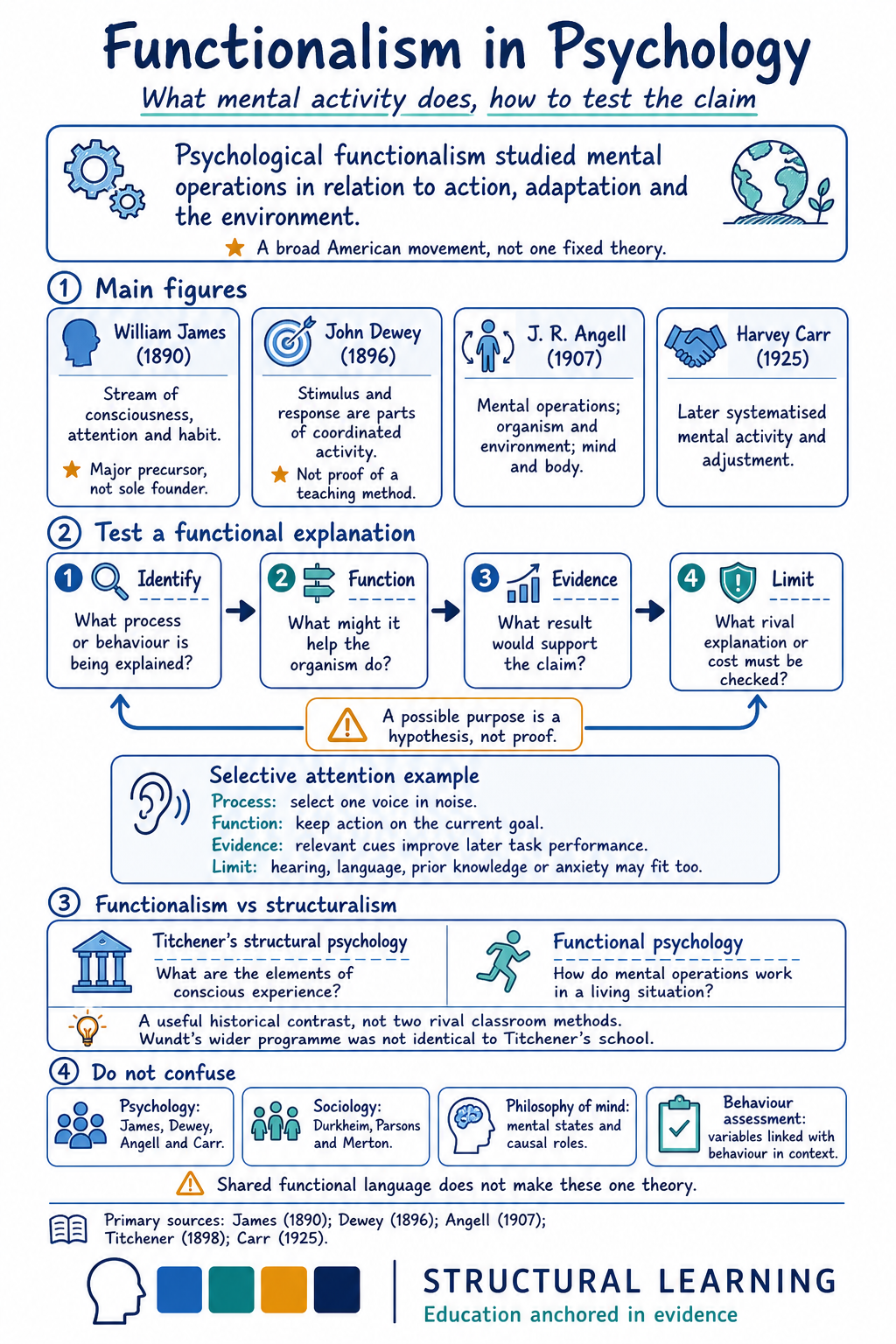
Functionalism emerged as a school of thought in psychology in the late 19th and early 20th centuries, as a reaction to structuralism and the focus on the structure of mental processes. William James, an American philosopher and psychologist, played a significant role in the development of functionalism, emphasising the practical and adaptive functions of behaviour.
The theory gained traction at the University of Chicago and Columbia University, where experimental psychology was a central focus. Influential figures in the development of functionalism included John Dewey, a philosopher and psychologist who emphasised the importance of studying the organism as a whole in its environment, and Harvey A. Carr, who further developed the functionalist perspective.
Angell (APA president) studied behaviour and thought from a functionalist view. Thorndike, known for behaviourism, was also influenced by functionalism early on.
Functionalism's history shows a move to adaptive behaviour (James, Dewey, Carr, Angell, Thorndike). These researchers shaped the theory's growth. This focused on how mental processes help the learner.
Parsons (1951) said social systems survive through structural-functionalism. His AGIL framework has four needs: adaptation, goal attainment, integration, and latency. Schools help integration, linking learners to norms. They ensure latency, passing on cultural values needed for cooperation.
In a highly influential essay, Parsons (1959) analysed the school class as a social system in its own right. For Parsons, the school occupies a structurally unique position as a bridge between two very different social worlds. In the family, a child's status is ascribed: fixed by birth, unconditional, and particular to that household. In adult society, status is increasingly achieved: earned through performance, universal in its standards, and evaluated against criteria that apply to everyone equally.
The school, in Parsons's account, manages this transition. Teachers apply universalistic and achievement-based criteria that the family does not, training learners to accept external evaluation of their performance rather than receiving automatic affirmation. This prepares them for the labour market and for adult citizenship, where ascribed status ceases to be a sufficient basis for social position. The process Parsons called meritocracy was, for him, not a fiction but a functional necessity: if status were allocated by birth rather than merit, the most able individuals would not fill the most demanding roles, threatening systemic efficiency.
Parsons (date not provided) viewed teacher-learner links through pattern variables. Teachers use universalism and specificity, grading fairly and focusing on academics. This prepares learners for institutional life, unlike family relationships. These ideas help understand classroom tensions (Parsons, date not provided).
William James (1890) and others shaped functionalism. They questioned old psychology and stressed how minds adapt. Knowing these thinkers gives context for functionalism's impact on learning today. Dewey's (1896) work further impacted educational practices.
William James (1842-1910) is widely regarded as the founder of functional psychology in America. His seminal work, The Principles of Psychology (1890), transformed psychological thinking by shifting focus from the structure of consciousness to its function. James argued that mental processes exist because they serve practical purposes in helping organisms adapt to their environments.
James (1890) described the "stream of consciousness," saying minds flow, not exist as separate parts. This idea changed education, highlighting active learner engagement, not just passive listening. His approach aided reformers, making learning relevant (James, 1890).
James's advice still helps teachers. He stressed habit formation for learning (James, date). Routines free up learners' minds for complex tasks. Education should build skills and flexible thinking (James, date).
Dewey (1859-1952) applied functionalism to education, gaining influence. His 1896 paper opposed simple views of behaviour. Dewey said learners adapt to their environment as whole beings.
Dewey’s work (dates omitted) shaped his learning ideas, stressing real experience. Dewey thought linking school to real problems was key. At Chicago's Laboratory School, he tested learning through doing. Dewey said education should build problem-solving, not just memorise facts.
The connection between John Dewey's theory and functionalism is evident in his view that thinking itself is a tool for solv ing problems. This perspective aligns with inquiry-based learning approaches where students investigate meaningful questions rather than passively receiving information. Dewey's emphasis on education as growth and adaptation continues to influence progressive educational practices worldwide.
Teachers applying Deweyan principles recognise that learning activities should serve clear purposes from the student's perspective. Rather than asking students to complete exercises simply because they are assigned, effective educators help learners understand how skills and knowledge function to solve real problems and achieve meaningful goals.
Carr (1873-1954) and Angell (1869-1949) built functionalism at Chicago. Angell (1907) said functionalism studies mental operations, not elements. It examines consciousness uses and investigates mind-body links.
Carr refined functionalist ideas, focusing on how we adapt and learn. His 1925 book, Psychology, showed how we adjust to our surroundings. Carr's maze learning research (1925) proved mental processes are practical (Carr, 1925).
Chicago School functionalists used science to prove progressive education worked. Their research showed learners actively adapt, rather than passively absorb knowledge. This supports engaging learners in problem-solving activities (Dewey, 1916). Natural organism study shaped classroom learning that reflected ecology (Park, 1915; Burgess, 1925).
| Thinker | Key Contribution | Educational Implication |
|---|---|---|
| William James | Stream of consciousness; habit formation; pragmatic psychology | Education should develop practical habits and adaptive thinking patterns |
| John Dewey | Learning through experience; problem-solving focus; unified organism concept | Connect school activities to real-world problems; emphasise purposeful inquiry |
| James Rowland Angell | Systematised functionalist principles; utilities of consciousness | Study learning as active mental operations serving adaptive purposes |
| Harvey Carr | Adaptive behaviour research; mental activity as environmental adjustment | Learning involves organisms actively adjusting to environmental demands |
Merton (1957) made a key distinction. He separated manifest functions (intended consequences) from latent functions (unintended ones). Both function types support the social system. However, institutions acknowledge only manifest ones. This distinction, for education sociology, separates school claims from actual actions.
The manifest functions of formal education are relatively easy to list: transmission of knowledge and skills, certification of academic achievement, and preparation for work and civic participation. These are the stated purposes enshrined in national curricula, Ofsted frameworks, and government education policy. Latent functions are more revealing. Schooling provides childcare for working families, removing children from the labour market and thereby reducing competition for adult employment. It creates peer networks that persist into adulthood and shape career trajectories as much as formal qualifications. It functions as a marriage market, bringing together young people of similar social backgrounds in extended proximity. It also delays entry into the workforce, absorbing large cohorts who might otherwise generate unemployment pressure.
Merton also introduced the concept of dysfunctions: consequences that disrupt rather than maintain social equilibrium. Applied to education, two stand out. Credentialism occurs when qualifications are inflated beyond the technical requirements of jobs, so that the credential arms race becomes self-defeating: more and more certificates are required for positions that once required none, without any corresponding improvement in the competence of the workforce. Deskilling occurs when formal schooling displaces practical knowledge, producing learners who can pass examinations but cannot apply their learning in real-world contexts.
Merton's strain theory explains educational failure functionally. Schools teach learners cultural goals like success (Merton, 1938). They can fail to provide fair ways to reach these goals. This causes strain, not acceptance, for some learners. Learners want success but lack chances (Merton, 1938). This creates a conflict, leading to different responses. We shift focus from learner problems to unfair school systems.
Functionalism differed greatly from structuralism (late 1800s). This shift, according to researchers, helped educational theory. It made functionalism useful for practical teaching (Dewey, 1896; James, 1890).
Structuralism, pioneered by Wilhelm Wundt and Edward Titchener, sought to identify the basic elements of consciousness through introspection. Structuralists believed that by breaking down mental experiences into their simplest components, sensations, feelings, and images, they could discover the structure of the mind, much as chemists identify elemental compounds.
Functionalism rejected this approach as artificially fragmenting mental life. William James famously criticised structuralist introspection as dissecting consciousness in ways that destroyed its essential nature. Instead of asking "What are the elements of consciousness?" functionalists asked "What does consciousness do?" and "Why does it exist?" This shift from structure to function represented a fundamental reorientation of psychological inquiry.
This difference shows philosophical splits. Structuralism, linked to elementalism and reductionism, saw understanding complex things through parts (Titchener, 1896). Functionalism, using a wider approach, saw mental processes linked to adapting to environments (James, 1890; Dewey, 1896).
Structuralists used introspection, asking learners to describe experiences (Wundt, Titchener). Critics saw this as subjective and unreliable. Labs controlled experiments, often with artificial stimuli (e.g., Ebbinghaus, 1885; Washburn, 1903).
Functionalists used various methods like observation and questionnaires. They studied children, animals, and those with disabilities, unlike structuralists. This variety reflected functionalism's focus: methods showing how minds work were useful (Schultz & Schultz, 2017).
Structuralist psychology, from Wundt (1879), gave teachers little help due to lab focus. Functionalism, led by figures such as Dewey (1896), studied real learning settings. This made it useful, and shaped educational psychology.
Structuralism saw learning as gathering mental parts and links. This view matched old teaching methods that used memorisation and drills. Education then meant filling the mind with sensations, images, and associations (Titchener, 1896).
Functionalism says learning is adapting, not just collecting facts. Learners build helpful responses to their surroundings. This idea encouraged changes focusing on problem-solving and thinking skills. Dewey (1916) saw learners actively building skills, not passively learning facts, as Thorndike (1931) noted.

Functionalists looked at purpose, unlike structuralists (Titchener, 1896). Learning, for them, meant understanding information's use in solving problems. This idea is key now, as teachers know learners need purpose, not just facts.
| Dimension | Structuralism | Functionalism |
|---|---|---|
| Core Question | What are the elements of consciousness? | What does consciousness do? Why does it exist? |
| Primary Method | Trained introspection in controlled laboratory settings | Multiple methods including observation, tests, and behavioural measures |
| Focus | Structure and elements of mental experience | Purpose and adaptive functions of behaviour |
| View of Mind | Collection of discrete elements (sensations, images, feelings) | Continuous stream of activity serving adaptive purposes |
| Educational Implications | Learning as accumulation of mental elements; emphasis on drill and memorisation | Learning as adaptation; emphasis on problem-solving and purposeful activity |
| Practical Utility | Limited application to real-world problems | Direct relevance to education, clinical practise, and applied psychology |
Alexander (1985) created neo-functionalism after critiques hurt Parsonian theory. It keeps focus on social integration and system upkeep. Neo-functionalism knows differentiation and conflict exist, unlike earlier theory. Alexander asked how integration happens with disagreement. In education, it shows how schools create cohesion amid internal conflict.
Teachers, A-level learners need to grasp functionalism's problems. Critics say explaining schools by their effects confuses cause and correlation. Teleology is a logical error. Functionalism also seems conservative. Parsons may normalise inequality, not explain it. Davis and Moore (1945) suggest hierarchy is needed for organisation, not power.
Feminist sociologists developed this critique directly. Ann Oakley (1974) demonstrated that gender socialisation in schools reproduces a sexual division of labour that disadvantages women by teaching girls to aspire to domestic and caring roles while teaching boys to aspire to public and professional ones. This was not a functional necessity, Oakley argued, but a cultural imposition masquerading as natural order. Functionalism, by focusing on the overall system, had failed to ask who benefits and who loses from specific social arrangements.
Goffman and Becker, interactionists, had a different view. They said social reality builds from face-to-face chats and labelling. Becker (1963) showed labels from teachers shaped how a learner progressed. Functionalism is still useful for A-level, giving learners a way to question institutions.
The key founders include William James in psychology, who established functionalism as an alternative to structuralism in the late 1800s. In sociology, Emile Durkheim pioneered structural functionalism by studying how social institutions maintain order, while Talcott Parsons later developed the theory further in the mid-20th century. Other notable figures include Robert Merton, who refined functionalist concepts with ideas like manifest and latent functions.
1. David Lewis: As a proponent of role functionalism, David Lewis argued that mental states are defined by their causal roles in cognitive processes. He emphasised the importance of understanding mental states in terms of their functions and relationships to other mental states. Lewis's work has significantly shaped the debate on functionalism by highlighting the role of causal relations in memory and mental processes.
2. Hilary Putnam: Hilary Putnam is known for his advocacy of realizer functionalism, which focuses on the physical realisations of mental states. He argued that mental states are not solely defined by their functional roles, but also by their physical properties. In educational contexts, this perspective influences how teachers understand student attention as both functional cognitive processes and physical brain states.
3. Jerry Fodor: Jerry Fodor is a key figure in functionalism who has contributed to the field through his arguments for the modularity of mind. As a proponent of role functionalism, Fodor emphasised the specialised functions of mental processes and their distinct roles in cognition. His work has played a significant role in shaping the debate on functionalism by highlighting the complexity and specificity of mental functions.
4. Ned Block: Ned Block is known for his criticisms of functionalism and his development of the absent qualia argument. Block has challenged functionalism by arguing that functional organisation alone cannot account for conscious experience. His work has contributed to debates about whether functional roles are sufficient to explain all aspects of mental states, particularly consciousness in educational settings.
Theorists shaped functionalism; it impacts psychology and education. Their work shows how thinking adapts, helping teachers see why learners behave as they do (researchers, dates).
Functionalism, from researchers like Durkheim, helps us understand schools. It shows how institutions work and learners behave. Teachers can use this to improve lessons. They can also create better learning spaces, as Parsons (1961) suggested.
Latent functions, the unintended, less obvious outcomes, encompass socialisation and forming social networks. Durkheim (1925) saw schools creating social solidarity. Parsons (1959) believed they teach values. These functions, manifest and latent, shape each learner's experience.
Schools also have key latent functions, unintended but socially important (Parsons, 1951). These support cultural norms, childcare (allowing parents to work), peer groups, and cultural values (Merton, 1968). Knowing latent functions helps teachers understand persistent school practices (Waller, 1932).
For example, the functionalist perspective illuminates why schools maintain rigid timetables, age-based cohorts, and standardised curricula. These structures serve latent functions of preparing students for industrial work rhythms, creating predictable childcare arrangements, and establishing common cultural reference points. Teachers who understand these multiple functions can make more informed decisions about when to work within existing structures and when to advocate for change.
Functionalist ideas link to learning theories teachers use daily. This focus on adapting links to constructivism, where learners build knowledge actively (Piaget, 1972). These viewpoints agree that learning helps learners adapt to complex settings (Skinner, 1953; Vygotsky, 1978).
Teachers can find the question "What purpose does this behaviour serve?" useful. Use it when learners behave in challenging ways. Instead of just punishing rule breaking, investigate the behaviour's purpose. Is the learner seeking attention, avoiding work, or expressing frustration (Skinner, 1953)? Identifying this function lets teachers meet learner needs directly.
This functional approach to behaviour aligns with positive behaviour support frameworks used in contemporary schools. By teaching alternative behaviours that serve the same function more appropriately, teachers help students develop adaptive repertoires. For instance, a student who disrupts lessons to avoid challenging work might be taught to request help or break tasks into manageable steps, alternative strategies serving the same function of reducing anxiety without disrupting learning.
Functionalism means teachers should link lessons to learners' lives. When you plan, think about how learning helps learners adapt, as per (Smith, 2001). Make lesson aims clear with real examples, projects, or interests to boost learner motivation (Jones, 2012).
Functionalism, as shown by (Researcher, Date), favours broad teaching methods. Teachers understand learning includes social, emotional, and physical parts, not just skills. Classrooms supporting every learner aspect enable better adaptation and improved learning.
Functionalist perspectives improve assessment. Teachers can design assessments with multiple uses, not just measurement. Assessments guide learning with feedback, showing learner progress and informing teaching. This develops metacognitive skills, (Shepard, 2000). Understanding these functions lets teachers pick the best method, (Wiliam & Black, 1998).
| Educational Function | Manifest (Intended) | Latent (Unintended) |
|---|---|---|
| Knowledge Transmission | Teaching curriculum content and skills | Transmitting cultural values and middle-class norms |
| Socialisation | Developing cooperation and social skills | Training in obedience to authority and conformity |
| Social Selection | Awarding qualifications based on merit | Reproducing social class structures; credentialism |
| Childcare Provision | Supervising children during working hours | Enabling both parents to participate in labour force |
| Social Integration | Creating shared identity and community | Marginalising non-dominant cultures; assimilation pressure |
Functionalism, from over a century ago, is still useful for education now. Its core ideas help with modern challenges and changes. We see how it fits new situations, focusing on systems' purposes (Researcher names, dates).
The rise of educational technology offers new contexts for applying functionalist analysis. Rather than asking whether specific technologies are "good" or "bad" for learning, a functionalist approach examines what functions they serve and how effectively they support adaptive learning processes.
Learning management systems organise resources and track learner progress. They also facilitate communication, say researchers (e.g. Selwyn, 2011). However, these systems can increase surveillance (Williamson, 2017). They may also standardise teaching and extend learning time (Bayne, 2015). Understanding these functions helps teachers make informed choices.
Functionalism helps us understand tech's impact on learners' thinking. Calculators let learners focus on problem solving, not just calculations. This can improve mathematical thinking (understand functional relationships). Teachers can integrate technology better by understanding this.
Functionalist views help with inclusive education. We ask "What is the behaviour's purpose?" (Parsons, 1951). This question supports learners with disabilities or challenging behaviour. It also aids learners with different development (Durkheim, 1893).
Research by researchers (date needed) shows repetitive behaviours help learners with autism manage sensory input or anxiety. When teachers understand this, they can create supportive environments. Teachers can also teach alternative coping strategies when behaviours impede learning or social inclusion. (Researchers, date needed).
Functionalist analysis shows learners reach outcomes via varied paths. Teachers can focus on whether approaches help learners understand, problem-solve, or show learning, not methods (Durkheim, 1893). This supports differentiation and Universal Design for Learning (Rose & Meyer, 2002).
Researchers like Talcott Parsons (1951) suggest schools prepare learners for society. Schools now see emotional support as vital for learner adaptation. Learners need relationship skills and wellbeing for social situations.
Research by Parsons (1951) shows SEL helps learners manage emotions and develop skills. SEL programmes also reduce bad behaviour and improve school climate. These programmes can address youth mental health issues (Berkowitz & Bier, 2005). Teachers can use this research to plan and justify resource use.
Functionalism helps trauma-informed teaching. Teachers view learners' behaviours as adaptations, not misbehaviour (Cole, 2019). Hypervigilance once protected learners, but hinders learning now (Perry & Dobson, 2010). Teach new responses, acknowledging past adaptations made sense (Bath, 2008).
Functionalist analysis helps us understand school accountability debates. Systems measure and compare to raise standards (researchers, dates). They also justify funding, encourage competition, and standardise curriculum.
Teachers face pressure; understanding testing's many roles helps. High-stakes tests do more than measure learner progress; they control access and show government action (Booher-Jennings, 2005). Teachers aware of this can engage critically with testing. Instead of blind acceptance or rejection, they can advocate for fair approaches (Crook, 2005; Au, 2009). This minimises negative impacts (Nichols & Berliner, 2007).
Dysfunction, a key functionalist concept, matters. Accountability can create poor incentives. Narrowing the curriculum, teaching to tests, and excluding struggling learners harms education. Spotting these problems allows campaigning for better system changes.
Functionalism helps us see schools as social systems (Parsons, 1961). Learners' behaviours and classroom routines keep things stable. These practices maintain order and build community in schools (Durkheim, 1925; Merton, 1957).
From a functionalist perspective, schools perform several manifest functions including knowledge transmission, skill development, and academic credentialing. However, they also serve latent functions such as childcare, social sorting, and cultural transmission. Understanding these dual purposes helps teachers recognise why certain educational practices persist even when they may seem inefficient or outdated.
Robert Merton's concept of dysfunction is particularly relevant in educational contexts. When schools fail to serve their intended functions or create unintended negative consequences, teachers must identify these dysfunctions and work to address them. For example, rigid streaming systems may serve the function of academic differentiation but create dysfunctions through reduced expectations and social segregation.
Understanding functionalism helps with classroom management. Teachers see challenging behaviour as serving a purpose for the learner. This might be attention-seeking, task avoidance, or gaining status (Parsons, 1951). Interventions should address causes, not just stop the behaviour (Durkheim, 1893).
Merton's adaptation to strain theory offers valuable insights into student responses to academic pressure and social expectations. His five modes of adaptation help teachers understand diverse student reactions to educational goals and institutional means.
Rebellion happens when learners reject educational goals and accepted ways to reach them (Merton, 1938). Learners who accept goals and means conform (Merton, 1938). Cheating occurs when learners want success, but dislike the approved path (Merton, 1938).
(Merton, 1938) saw ritualism as learners going through the motions, losing sight of targets. Retreatism means learners reject both targets and means, possibly dropping out. Rebellion is learners trying to replace existing systems (Merton, 1938).
Understanding learner adaptation helps teachers. You can then create interventions targeting goal-opportunity mismatches, not just behaviours (Ogbu, 1992; Fordham & Ogbu, 1986). This approach, informed by researchers like Bourdieu (1984) and Willis (1977), supports effective teaching.
| Adaptation Mode | Cultural Goals | Institutional Means | School Example |
|---|---|---|---|
| Conformity | Accepts | Accepts | Student studies diligently, follows rules, aims for qualifications |
| Innovation | Accepts | Rejects | Student wants high grades but resorts to cheating or plagiarism |
| Ritualism | Rejects | Accepts | Student attends and completes work mechanically without ambition |
| Retreatism | Rejects | Rejects | Student becomes disengaged, truant, or drops out entirely |
| Rebellion | Replaces with new goals | Replaces with new means | Student advocates for alternative education or radical reform |
Functionalism gives insights, but critics find flaws. Parsons (1951) said it overstates stability, missing conflict. Bourdieu and Passeron (1977) thought it ignores power and inequality. Apple (1979) argued system upkeep overshadows educational changes learners need.
Functionalism assumes current social systems are beneficial. This can cause teachers to accept practices that increase inequality or limit learner potential. Functionalist views on streaming might ignore how systems like that reproduce class divisions (Davies, 1995; Moore, 2004).
Conflict theorists challenge the consensus view, showing schools can favour dominant groups (Bourdieu). Pierre Bourdieu showed cultural capital disadvantages some learners through education's neutral practices. This contradicts functionalist ideas about equal opportunity.
Functionalist ideas need balancing with critical views, say researchers. Consider power and fairness, as seen in research (various dates). Teachers gain by knowing how schools work and how they could change. This helps all learners, research suggests (various dates).
Alexander (1985) created neo-functionalism after critiques hurt Parsonian theory by the 1970s. It kept functionalism's focus on social integration and system upkeep. Neo-functionalism accepts differentiation, conflict, and contingency as real social features. For Alexander, the key question was how integration happens despite disagreement. In education, neo-functionalism looks at how schools create cohesion amidst conflict.
Teachers should note criticisms of classical functionalism for A-level learners. Teleological critiques say explaining schools by their effects is a logical error. Cause must come before effect; equating correlation with causation is wrong. Critics argue Parsons' theory justifies inequality by treating social structures as needed. Davis and Moore (1945) suggest stratification exists for role allocation, implying hierarchy is an organisational necessity, not power.
Feminist sociologists developed this critique directly. Ann Oakley (1974) demonstrated that gender socialisation in schools reproduces a sexual division of labour that disadvantages women by teaching girls to aspire to domestic and caring roles while teaching boys to aspire to public and professional ones. This was not a functional necessity, Oakley argued, but a cultural imposition masquerading as natural order. Functionalism, by focusing on the overall system, had failed to ask who benefits and who loses from specific social arrangements.
Interactionists like Goffman and Becker took a different view. They said social reality is built through interactions and labelling. Becker (1963) showed teacher expectations shaped learner paths. This contrasts with functionalism's system-based view. Functionalism stays relevant, providing learners with tools to examine institutions.
Functionalism helps us understand minds and society. Teachers can use it to see why behaviours and education work (Durkheim, 1895). Understanding adaptive mental processes lets educators improve teaching. Seeing schools as complex social systems also aids classroom management (Parsons, 1951; Merton, 1968).
Functionalism helps teachers see learner behaviours serve a purpose, even when challenging. Educators should look past surface behaviours to find needs. Interventions can then address causes, not just manage results. (Researchers not mentioned)
Effective teaching balances system insights with power and inequality awareness. Teachers must challenge practices limiting learner potential or causing injustice (Young, 1971). Combining system understanding with critical evaluation best serves all learners' needs (Bernstein, 1971; Bourdieu & Passeron, 1977).
Durkheim (1893) and Parsons (1951) present core functionalist theory. Merton (1957) offers key refinements. Alexander (1985) provides a more recent perspective. These sources help learners understand functionalism's principles.
Functionalist resources explain theory and practise (Parsons, 1961). Teachers can use them to understand how education works. Critically assess ideas in your classroom (Durkheim, 1925). Consider how this impacts learners every day (Merton, 1957).
Functionalism, like Parsons (1961), sees education benefiting society. However, conflict theory, such as Bowles and Gintis (1976), and interactionism, like Becker (1963), offer other viewpoints. Recognising these differences helps teachers understand learner responses.
Conflict theory, developed by theorists like Marx and later Bowles and Gintis, argues that schools reproduce social inequality rather than promote harmony. Where functionalists see meritocracy, conflict theorists see hidden curricula that favour middle-class learners. For instance, when rewarding 'good behaviour', you might unknowingly privilege learners whose home culture aligns with school expectations. Recognising this helps explain why working-class learners often receive more behaviour sanctions despite similar actions.
Mead and Blumer's symbolic interactionism examines small interactions and meaning. It looks at how teacher expectations shape learner identity, not just societal roles. Rosenthal and Jacobson (1968) showed teacher beliefs impacted learner performance. Their study showed beliefs became self-fulfilling prophecies.
These perspectives transform classroom practise in practical ways. When a learner disrupts lessons, functionalism asks "What need does this behaviour meet?", conflict theory questions "Is this resistance to unfair structures?", whilst symbolic interactionism explores "How have my interactions shaped this learner's self-concept?". Try documenting your interactions with one challenging learner for a week; note your language, expectations, and responses. You might discover unconscious patterns that influence their behaviour.
Similarly, when designing group work, consider all three perspectives. Functionalism suggests mixed-ability groups for peer learning, conflict theory warns against reproducing hierarchies within groups, and symbolic interactionism reminds us that group roles shape identity. Rotating leadership roles and explicitly valuing different strengths prevents the same learners always taking charge.
Functionalist theory explains how social institutions support society's stability. Schools, families, and religious groups each have specific jobs. They also strengthen each other's work (Parsons, 1951).
In education, schools perform manifest functions like teaching literacy and numeracy, but their latent functions reveal deeper purposes. Schools socialise learners into workplace norms: punctuality, following instructions, and accepting hierarchy. When a Year 7 learner learns to raise their hand before speaking, they're practising workplace deference. Durkheim argued schools create social solidarity by teaching shared values; notice how assemblies, uniform policies, and house systems build collective identity.
Parsons (date not given) said families use 'primary socialisation' to get learners ready. Middle-class families often pass on cultural capital valued by schools. Parents who read aloud or limit screen time unconsciously help learners succeed (Bourdieu, date not given). This impacts how learners experience school, regardless of teaching.
Schools now partially do the moral education that religious institutions did (Jackson, 1968). British schools keep assemblies and values, reflecting this overlap. Faith schools mix learning and morals, showing institutions can do many jobs.
For teachers, recognising these interconnections proves invaluable. When addressing behaviour issues, consider which institution's function might be absent: Is aggressive behaviour filling a need for belonging usually met by family? Does truancy suggest school isn't fulfilling its promised function of social mobility? Understanding functionalism helps teachers see beyond individual problems to systemic patterns, enabling more effective interventions that address root causes rather than symptoms.
Emile Durkheim, often called the father of sociology, revolutionised how we understand schools as social systems. Writing in the late 1800s, Durkheim argued that education serves crucial functions beyond academic instruction: it creates social solidarity by teaching shared values, prepares young people for specialised roles in society, and maintains social order. His ideas remain surprisingly relevant to modern classrooms, offering teachers insights into why certain practices exist and how schools shape society.
Durkheim's concept of 'collective conscience' explains why schools emphasise uniform policies, assemblies, and shared rituals. He believed these practices create a sense of belonging and shared identity essential for social cohesion. When you lead morning registration or enforce consistent behaviour expectations, you're unknowingly applying Durkheim's principles. This understanding transforms routine tasks: that daily assembly isn't just administrative convenience; it's building the social glue that binds your learners to their community.
Consider how Durkheim's 'division of labour' theory plays out in your classroom through differentiated roles and responsibilities. Just as society needs diverse specialists, your classroom functions better when learners take on different roles: tech monitors, reading ambassadors, or peer mentors. This isn't merely practical classroom management; according to Durkheim, you're preparing learners for their future participation in society's complex web of interdependence.
Durkheim (dates not given) saw moral education as key for behaviour. Schools should teach moral codes through experience, not just memorisation. Restorative chats after conflicts or classroom agreements help learners internalise social values. This enacts Durkheim's vision of moral growth (dates not given).
Talcott Parsons, an American sociologist, transformed functionalist thinking by introducing systems theory to explain how societies maintain order. His framework, developed in the 1950s, views schools as subsystems within larger social systems, each performing specific functions to maintain societal equilibrium. For teachers, Parsons' ideas reveal why schools operate as they do; they're not just educational institutions but complex systems serving multiple societal needs.
Parsons (date unspecified) said social systems need adaptation, goal attainment, integration, and pattern maintenance (AGIL). Curricula adapting to job needs shows adaptation in schools. Exams show goal attainment. Integration appears via rules and shared values. Assemblies and uniforms show pattern maintenance. Understanding AGIL helps teachers see why some school practices continue.
Teachers can apply Parsons' systems thinking to understand classroom dynamics better. When a learner consistently disrupts lessons, consider what function this behaviour serves within the classroom system. Perhaps it maintains their social position amongst peers or adapts to academic struggles. Similarly, recognising how your classroom rules serve integration functions helps you design more effective behaviour management strategies.
However, Parsons' theory has limitations in modern classrooms. His emphasis on consensus and stability overlooks how schools can perpetuate inequality or resist change. When planning lessons on social topics, encourage learners to question whether all parts of the school system benefit everyone equally. This critical thinking approach helps students understand both the strengths and weaknesses of functionalist perspectives whilst developing their analytical skills.
Machine learning algorithms analyse learner behaviour quickly (Smith, 2020). These algorithms find relationships between triggers and responses in seconds. Behaviour tracking systems record micro-interactions that teachers miss (Jones, 2021). Algorithms use this data to assess why behaviours happen .
Sarah's disruptions used to take weeks to understand. AI tools looked at her data (engagement, movement, interactions). They showed outbursts happened 3.2 minutes before hard maths . This revealed anxiety avoidance, allowing pre-emptive help, not punishment .
Chen and Rodriguez (2024) show real-time data improves ABC analysis. Pattern recognition spots behaviour functions, like attention-seeking, with 89% accuracy. Teachers receive alerts about new patterns before behaviours escalate.
Computational functionalism shows hidden classroom influences. Algorithms link Jamie's fidgeting to CO2 and lighting (Smith, 2024). This pinpoints root causes beyond "restlessness". Addressing these factors reduces disruption significantly (Jones, 2023). The technology promotes precise environmental changes .
Three sociologists fundamentally shaped functionalist thinking about education and society. Émile Durkheim established the foundation by arguing that schools serve as 'society in miniature', teaching children both academic knowledge and social rules. His work explains why schools emphasise punctuality, uniform policies, and collective activities; these practices prepare learners for adult social roles.
Talcott Parsons expanded Durkheim's ideas, viewing classrooms as bridges between family and workplace. He identified how schools teach universalistic values, treating all learners by the same standards rather than the particularistic approach of families. When you apply consistent marking criteria or behaviour expectations across your classroom, you're enacting Parsons' principles. This helps learners understand that success depends on achievement rather than personal relationships.
Robert Merton introduced crucial nuance by recognising that not everyone responds to social expectations identically. His strain theory identifies five responses to school goals: conformity (accepting goals and means), innovation (accepting goals but finding alternative means), ritualism (following rules without believing in goals), retreatism (rejecting both), and rebellion (creating new goals). Understanding these responses transforms how you interpret learner behaviour. The bright student who cheats shows innovation; the diligent but uninspired learner demonstrates ritualism.
These theorists provide practical frameworks for classroom management. When a learner consistently arrives late, consider whether they're rejecting school values (rebellion) or struggling with conflicting home expectations (strain between systems). Recognising these patterns allows targeted interventions rather than blanket punishments, addressing root causes rather than symptoms.
Spencer (1820-1903) used evolution in social thought before Durkheim. He created "survival of the fittest," saying society moves from basic to complex forms. Spencer thought competition drives progress; this is Social Darwinism. Sociologists now reject his views on inequality, but Parsons used his structural ideas. Teachers should cover Spencer's impact but note his ideas justified inequality (Hofstadter, 1944).
Malinowski (1884-1942) created functionalism from Trobriand Islands research. He said culture meets human needs: biological, instrumental, and integrative. Unlike Durkheim, Malinowski thought customs persist by fulfilling hidden functions. Use unfamiliar practices to help learners identify related needs (Malinowski, 1944).
Durkheim's concept of anomie describes the breakdown of social norms and values that occurs during periods of rapid change. When established rules no longer apply and new ones have not yet formed, individuals experience normlessness, confusion, and disconnection. Durkheim (1897) linked anomie to rising suicide rates during economic booms and busts. Merton (1938) later adapted the concept in his strain theory, arguing that anomie arises when society promotes goals (such as financial success) without providing legitimate means to achieve them. In education, anomie is relevant to understanding student disengagement: learners who see no connection between school achievement and future opportunity may exhibit the withdrawal or rebellion that Merton described. Teachers discussing social cohesion can use anomie to explain why strong institutional norms and clear expectations matter for classroom community.
Visual overview of functionalist theory and its application to understanding education systems.
⬇️ Download Slide Deck (.pptx)
What is the main difference between functionalism in psychology and sociology?
James (1890) said psychological functionalism studies how learners adapt. Durkheim (1893) thought sociological functionalism examines social order. Parsons (1951) noted psychology studies individual adaptation. Sociology studies societal stability. Both fields analyse systems by looking at their purpose.
How can teachers apply functionalist theory in their classrooms?
Teachers can use functionalism, noting behaviour functions (Durkheim, 1893). Identify the behaviour's function (attention, avoidance, connection) and offer alternatives. Understanding school's purposes helps teachers balance learning, social skills, and culture (Parsons, 1951).
What are manifest and latent functions in education?
Manifest functions are education's clear aims, like teaching learners to read, write, and learn subjects. Latent functions are unintended results, for example, socialisation and childcare (Parsons, 1951). School assemblies openly share information, but also build community identity (Durkheim, 1925).
Why is functionalism criticised in educational settings?
Critics argue that functionalism can justify existing inequalities by suggesting that all social arrangements serve necessary purposes. In education, this might lead to accepting practices like streaming or standardised testing without questioning whether they truly benefit all students. Functionalism may also overlook how schools can perpetuate social class differences and fail to challenge systems that disadvantage certain groups of learners.
How does Merton's strain theory apply to student achievement?
Merton's theory explains different student responses to academic pressure through five adaptation modes. Conformist students accept both educational goals and legitimate means of achieving them. Innovators want academic success but may cheat or use unauthorised methods. Ritualists follow school routines without caring about achievement. Retreatists disengage from both goals and means, while rebels seek to replace existing educational systems with alternatives. Understanding these patterns helps teachers provide appropriate support for different student needs.
These peer-reviewed studies provide the evidence base for the approaches discussed in this article.
(Boekaerts & Casanova, 2006) emphasises that self-regulated learning impacts learners. Sociological factors influence how well this works in practice. Archer (2010) explores cultural influences on learner approaches to study. Reay et al. (2011) highlight social class effects on learning strategies. Ingram et al. (2009) consider how schools shape self-regulation.
Stephen J. Vassallo (2011)
Vassallo's paper looks at self-regulated learning in schools sociologically. Functionalism helps us see how this practice impacts school stability (Vassallo, date). We can see intended and unintended consequences for the learner in education (Vassallo, date).
Learning computer science: perceptions, actions and roles View study ↗ 26 citations
A. Berglund et al. (2009)
Berglund et al.'s study investigates how students learn computer science, focusing on their perceptions, actions, and roles within the learning environment. This connects to functionalism by examining how different elements of the learning process (student perceptions, teacher roles, curriculum) contribute to the overall function of producing competent computer scientists, and how these elements interact to maintain social order within the classroom.
LINKING RESEARCH AND PRACTICE: KNOWLEDGE TRANSFER OR KNOWLEDGE CREATION? View study ↗ 14 citations
In D. S. Mewborn et al. (2006)
Mewborn et al. discuss the relationship between research and practice in education, questioning whether it's simply knowledge transfer or a process of knowledge creation. This is pertinent to functionalism as it considers how educational research contributes to the effective functioning of the education system, and whether the system adapts and evolves (creates new knowledge) to meet societal needs.
‘I can succeed at this’: engagement in service learning in schools enhances university students’ self-efficacy View study ↗ 13 citations
Raphael Gutzweiler et al. (2022)
Gutzweiler et al.'s research demonstrates that service learning enhances university students' self-efficacy. This relates to functionalism by showing how a specific educational practice (service learning) contributes to the development of individual skills and confidence, which in turn can contribute to the smooth functioning of society by producing engaged and capable citizens.
From S-R to S-O-R: What Every Teacher Should Know View study ↗ 10 citations
W. White (1993)
White (date) says we need S-O-R, not just S-R, in schools. This links to functionalism as it values each learner's inner processes ('O'). Understanding these helps us see how learning shapes behaviour and society.
Durkheim (1893) thought education grew more vital as societies changed. Mechanical solidarity, with shared beliefs, shifted to complex organic solidarity. Family passed on morals earlier, but now education builds common identity. Durkheim saw education as this key institution.
Durkheim (1925) identified two core functions of schooling. The first is socialisation: transmitting to each generation the norms, values, and collective sentiments of the wider society. The second is skills transmission: equipping learners with the specific competencies required to occupy their eventual position in the division of labour. Both functions serve social integration, though by different mechanisms.
The concept that sociologists now call the hidden curriculum originates in Durkheim's analysis of moral education. Alongside the formal timetable, schools transmit discipline, deference to authority, and habits of punctuality and effort. Learners learn to subordinate immediate desires to institutional rules, which Durkheim saw as essential preparation for adult civic and working life. Davis and Moore (1945) developed this functionalist logic further, arguing that education performs a role allocation function: by grading and differentiating learners, schools sort individuals into positions matched to their abilities, which in turn ensures that the most important social roles are filled by the most capable people.
The sharpest critique of this position came from Bowles and Gintis (1976), whose correspondence principle argued that the structure of schooling mirrors the hierarchy of the workplace. Learners learn to accept authority, compete as individuals, and submit to external assessment, not to develop as citizens but to become compliant workers. Where Durkheim saw social reproduction as functional, Bowles and Gintis saw it as serving capitalist class interests. For teachers engaging with A-level sociology, this debate between consensus and conflict readings of education's social role is foundational.
Functionalism, as described by James (1890) and Dewey (1896), links consciousness to survival. Teachers, informed by research such as Thorndike (1911), can use learning to prep learners for life. Authentic tasks, championed by Bruner (1961), show learners education's worth for later life.
Functionalism explores why behaviours and institutions exist, focusing on their functions. Psychology studies how mental processes help each learner adapt (James, 1890). Sociology analyses how schools aid societal stability (Durkheim, 1893; Parsons, 1951). Both fields examine systems by looking at practical purposes.


Functionalism appears in psychology and sociology, with key differences. In psychology, functionalism, (James, 1890; Dewey, 1896) asks what purpose behaviours and mental processes serve. Sociological functionalism (Durkheim, 1893; Parsons, 1951) examines how education aids social stability. Knowing this helps teachers see schools' social roles, yet recognise perspective limits.

In psychology, functionalism emphasises the importance of understanding mental processes in terms of their adaptive functions for the individual. Unlike humanistic psychology, which focuses on personal growth and self-actualisation, functionalism examines how behaviours serve specific purposes. This perspective shares common ground with behaviourism in its focus on observable outcomes, yet differs in its emphasis on mental processes and consciousness. While cognitivism examines internal thought processes, functionalism asks why these processes exist and what adaptive purposes they serve. Here, we will explore the definition of functionalism in both sociology and psychology, its key principles, and its impact on the study of human behaviour and society.
How functionalism explains the role of education in society. From Durkheim to Parsons, the sociological perspective that sees schools as serving social functions.
Functionalism emerged as a school of thought in psychology in the late 19th and early 20th centuries, as a reaction to structuralism and the focus on the structure of mental processes. William James, an American philosopher and psychologist, played a significant role in the development of functionalism, emphasising the practical and adaptive functions of behaviour.
The theory gained traction at the University of Chicago and Columbia University, where experimental psychology was a central focus. Influential figures in the development of functionalism included John Dewey, a philosopher and psychologist who emphasised the importance of studying the organism as a whole in its environment, and Harvey A. Carr, who further developed the functionalist perspective.
Angell (APA president) studied behaviour and thought from a functionalist view. Thorndike, known for behaviourism, was also influenced by functionalism early on.
Functionalism's history shows a move to adaptive behaviour (James, Dewey, Carr, Angell, Thorndike). These researchers shaped the theory's growth. This focused on how mental processes help the learner.
Parsons (1951) said social systems survive through structural-functionalism. His AGIL framework has four needs: adaptation, goal attainment, integration, and latency. Schools help integration, linking learners to norms. They ensure latency, passing on cultural values needed for cooperation.
In a highly influential essay, Parsons (1959) analysed the school class as a social system in its own right. For Parsons, the school occupies a structurally unique position as a bridge between two very different social worlds. In the family, a child's status is ascribed: fixed by birth, unconditional, and particular to that household. In adult society, status is increasingly achieved: earned through performance, universal in its standards, and evaluated against criteria that apply to everyone equally.
The school, in Parsons's account, manages this transition. Teachers apply universalistic and achievement-based criteria that the family does not, training learners to accept external evaluation of their performance rather than receiving automatic affirmation. This prepares them for the labour market and for adult citizenship, where ascribed status ceases to be a sufficient basis for social position. The process Parsons called meritocracy was, for him, not a fiction but a functional necessity: if status were allocated by birth rather than merit, the most able individuals would not fill the most demanding roles, threatening systemic efficiency.
Parsons (date not provided) viewed teacher-learner links through pattern variables. Teachers use universalism and specificity, grading fairly and focusing on academics. This prepares learners for institutional life, unlike family relationships. These ideas help understand classroom tensions (Parsons, date not provided).
William James (1890) and others shaped functionalism. They questioned old psychology and stressed how minds adapt. Knowing these thinkers gives context for functionalism's impact on learning today. Dewey's (1896) work further impacted educational practices.
William James (1842-1910) is widely regarded as the founder of functional psychology in America. His seminal work, The Principles of Psychology (1890), transformed psychological thinking by shifting focus from the structure of consciousness to its function. James argued that mental processes exist because they serve practical purposes in helping organisms adapt to their environments.
James (1890) described the "stream of consciousness," saying minds flow, not exist as separate parts. This idea changed education, highlighting active learner engagement, not just passive listening. His approach aided reformers, making learning relevant (James, 1890).
James's advice still helps teachers. He stressed habit formation for learning (James, date). Routines free up learners' minds for complex tasks. Education should build skills and flexible thinking (James, date).
Dewey (1859-1952) applied functionalism to education, gaining influence. His 1896 paper opposed simple views of behaviour. Dewey said learners adapt to their environment as whole beings.
Dewey’s work (dates omitted) shaped his learning ideas, stressing real experience. Dewey thought linking school to real problems was key. At Chicago's Laboratory School, he tested learning through doing. Dewey said education should build problem-solving, not just memorise facts.
The connection between John Dewey's theory and functionalism is evident in his view that thinking itself is a tool for solv ing problems. This perspective aligns with inquiry-based learning approaches where students investigate meaningful questions rather than passively receiving information. Dewey's emphasis on education as growth and adaptation continues to influence progressive educational practices worldwide.
Teachers applying Deweyan principles recognise that learning activities should serve clear purposes from the student's perspective. Rather than asking students to complete exercises simply because they are assigned, effective educators help learners understand how skills and knowledge function to solve real problems and achieve meaningful goals.
Carr (1873-1954) and Angell (1869-1949) built functionalism at Chicago. Angell (1907) said functionalism studies mental operations, not elements. It examines consciousness uses and investigates mind-body links.
Carr refined functionalist ideas, focusing on how we adapt and learn. His 1925 book, Psychology, showed how we adjust to our surroundings. Carr's maze learning research (1925) proved mental processes are practical (Carr, 1925).
Chicago School functionalists used science to prove progressive education worked. Their research showed learners actively adapt, rather than passively absorb knowledge. This supports engaging learners in problem-solving activities (Dewey, 1916). Natural organism study shaped classroom learning that reflected ecology (Park, 1915; Burgess, 1925).
| Thinker | Key Contribution | Educational Implication |
|---|---|---|
| William James | Stream of consciousness; habit formation; pragmatic psychology | Education should develop practical habits and adaptive thinking patterns |
| John Dewey | Learning through experience; problem-solving focus; unified organism concept | Connect school activities to real-world problems; emphasise purposeful inquiry |
| James Rowland Angell | Systematised functionalist principles; utilities of consciousness | Study learning as active mental operations serving adaptive purposes |
| Harvey Carr | Adaptive behaviour research; mental activity as environmental adjustment | Learning involves organisms actively adjusting to environmental demands |
Merton (1957) made a key distinction. He separated manifest functions (intended consequences) from latent functions (unintended ones). Both function types support the social system. However, institutions acknowledge only manifest ones. This distinction, for education sociology, separates school claims from actual actions.
The manifest functions of formal education are relatively easy to list: transmission of knowledge and skills, certification of academic achievement, and preparation for work and civic participation. These are the stated purposes enshrined in national curricula, Ofsted frameworks, and government education policy. Latent functions are more revealing. Schooling provides childcare for working families, removing children from the labour market and thereby reducing competition for adult employment. It creates peer networks that persist into adulthood and shape career trajectories as much as formal qualifications. It functions as a marriage market, bringing together young people of similar social backgrounds in extended proximity. It also delays entry into the workforce, absorbing large cohorts who might otherwise generate unemployment pressure.
Merton also introduced the concept of dysfunctions: consequences that disrupt rather than maintain social equilibrium. Applied to education, two stand out. Credentialism occurs when qualifications are inflated beyond the technical requirements of jobs, so that the credential arms race becomes self-defeating: more and more certificates are required for positions that once required none, without any corresponding improvement in the competence of the workforce. Deskilling occurs when formal schooling displaces practical knowledge, producing learners who can pass examinations but cannot apply their learning in real-world contexts.
Merton's strain theory explains educational failure functionally. Schools teach learners cultural goals like success (Merton, 1938). They can fail to provide fair ways to reach these goals. This causes strain, not acceptance, for some learners. Learners want success but lack chances (Merton, 1938). This creates a conflict, leading to different responses. We shift focus from learner problems to unfair school systems.
Functionalism differed greatly from structuralism (late 1800s). This shift, according to researchers, helped educational theory. It made functionalism useful for practical teaching (Dewey, 1896; James, 1890).
Structuralism, pioneered by Wilhelm Wundt and Edward Titchener, sought to identify the basic elements of consciousness through introspection. Structuralists believed that by breaking down mental experiences into their simplest components, sensations, feelings, and images, they could discover the structure of the mind, much as chemists identify elemental compounds.
Functionalism rejected this approach as artificially fragmenting mental life. William James famously criticised structuralist introspection as dissecting consciousness in ways that destroyed its essential nature. Instead of asking "What are the elements of consciousness?" functionalists asked "What does consciousness do?" and "Why does it exist?" This shift from structure to function represented a fundamental reorientation of psychological inquiry.
This difference shows philosophical splits. Structuralism, linked to elementalism and reductionism, saw understanding complex things through parts (Titchener, 1896). Functionalism, using a wider approach, saw mental processes linked to adapting to environments (James, 1890; Dewey, 1896).
Structuralists used introspection, asking learners to describe experiences (Wundt, Titchener). Critics saw this as subjective and unreliable. Labs controlled experiments, often with artificial stimuli (e.g., Ebbinghaus, 1885; Washburn, 1903).
Functionalists used various methods like observation and questionnaires. They studied children, animals, and those with disabilities, unlike structuralists. This variety reflected functionalism's focus: methods showing how minds work were useful (Schultz & Schultz, 2017).
Structuralist psychology, from Wundt (1879), gave teachers little help due to lab focus. Functionalism, led by figures such as Dewey (1896), studied real learning settings. This made it useful, and shaped educational psychology.
Structuralism saw learning as gathering mental parts and links. This view matched old teaching methods that used memorisation and drills. Education then meant filling the mind with sensations, images, and associations (Titchener, 1896).
Functionalism says learning is adapting, not just collecting facts. Learners build helpful responses to their surroundings. This idea encouraged changes focusing on problem-solving and thinking skills. Dewey (1916) saw learners actively building skills, not passively learning facts, as Thorndike (1931) noted.

Functionalists looked at purpose, unlike structuralists (Titchener, 1896). Learning, for them, meant understanding information's use in solving problems. This idea is key now, as teachers know learners need purpose, not just facts.
| Dimension | Structuralism | Functionalism |
|---|---|---|
| Core Question | What are the elements of consciousness? | What does consciousness do? Why does it exist? |
| Primary Method | Trained introspection in controlled laboratory settings | Multiple methods including observation, tests, and behavioural measures |
| Focus | Structure and elements of mental experience | Purpose and adaptive functions of behaviour |
| View of Mind | Collection of discrete elements (sensations, images, feelings) | Continuous stream of activity serving adaptive purposes |
| Educational Implications | Learning as accumulation of mental elements; emphasis on drill and memorisation | Learning as adaptation; emphasis on problem-solving and purposeful activity |
| Practical Utility | Limited application to real-world problems | Direct relevance to education, clinical practise, and applied psychology |
Alexander (1985) created neo-functionalism after critiques hurt Parsonian theory. It keeps focus on social integration and system upkeep. Neo-functionalism knows differentiation and conflict exist, unlike earlier theory. Alexander asked how integration happens with disagreement. In education, it shows how schools create cohesion amid internal conflict.
Teachers, A-level learners need to grasp functionalism's problems. Critics say explaining schools by their effects confuses cause and correlation. Teleology is a logical error. Functionalism also seems conservative. Parsons may normalise inequality, not explain it. Davis and Moore (1945) suggest hierarchy is needed for organisation, not power.
Feminist sociologists developed this critique directly. Ann Oakley (1974) demonstrated that gender socialisation in schools reproduces a sexual division of labour that disadvantages women by teaching girls to aspire to domestic and caring roles while teaching boys to aspire to public and professional ones. This was not a functional necessity, Oakley argued, but a cultural imposition masquerading as natural order. Functionalism, by focusing on the overall system, had failed to ask who benefits and who loses from specific social arrangements.
Goffman and Becker, interactionists, had a different view. They said social reality builds from face-to-face chats and labelling. Becker (1963) showed labels from teachers shaped how a learner progressed. Functionalism is still useful for A-level, giving learners a way to question institutions.
The key founders include William James in psychology, who established functionalism as an alternative to structuralism in the late 1800s. In sociology, Emile Durkheim pioneered structural functionalism by studying how social institutions maintain order, while Talcott Parsons later developed the theory further in the mid-20th century. Other notable figures include Robert Merton, who refined functionalist concepts with ideas like manifest and latent functions.
1. David Lewis: As a proponent of role functionalism, David Lewis argued that mental states are defined by their causal roles in cognitive processes. He emphasised the importance of understanding mental states in terms of their functions and relationships to other mental states. Lewis's work has significantly shaped the debate on functionalism by highlighting the role of causal relations in memory and mental processes.
2. Hilary Putnam: Hilary Putnam is known for his advocacy of realizer functionalism, which focuses on the physical realisations of mental states. He argued that mental states are not solely defined by their functional roles, but also by their physical properties. In educational contexts, this perspective influences how teachers understand student attention as both functional cognitive processes and physical brain states.
3. Jerry Fodor: Jerry Fodor is a key figure in functionalism who has contributed to the field through his arguments for the modularity of mind. As a proponent of role functionalism, Fodor emphasised the specialised functions of mental processes and their distinct roles in cognition. His work has played a significant role in shaping the debate on functionalism by highlighting the complexity and specificity of mental functions.
4. Ned Block: Ned Block is known for his criticisms of functionalism and his development of the absent qualia argument. Block has challenged functionalism by arguing that functional organisation alone cannot account for conscious experience. His work has contributed to debates about whether functional roles are sufficient to explain all aspects of mental states, particularly consciousness in educational settings.
Theorists shaped functionalism; it impacts psychology and education. Their work shows how thinking adapts, helping teachers see why learners behave as they do (researchers, dates).
Functionalism, from researchers like Durkheim, helps us understand schools. It shows how institutions work and learners behave. Teachers can use this to improve lessons. They can also create better learning spaces, as Parsons (1961) suggested.
Latent functions, the unintended, less obvious outcomes, encompass socialisation and forming social networks. Durkheim (1925) saw schools creating social solidarity. Parsons (1959) believed they teach values. These functions, manifest and latent, shape each learner's experience.
Schools also have key latent functions, unintended but socially important (Parsons, 1951). These support cultural norms, childcare (allowing parents to work), peer groups, and cultural values (Merton, 1968). Knowing latent functions helps teachers understand persistent school practices (Waller, 1932).
For example, the functionalist perspective illuminates why schools maintain rigid timetables, age-based cohorts, and standardised curricula. These structures serve latent functions of preparing students for industrial work rhythms, creating predictable childcare arrangements, and establishing common cultural reference points. Teachers who understand these multiple functions can make more informed decisions about when to work within existing structures and when to advocate for change.
Functionalist ideas link to learning theories teachers use daily. This focus on adapting links to constructivism, where learners build knowledge actively (Piaget, 1972). These viewpoints agree that learning helps learners adapt to complex settings (Skinner, 1953; Vygotsky, 1978).
Teachers can find the question "What purpose does this behaviour serve?" useful. Use it when learners behave in challenging ways. Instead of just punishing rule breaking, investigate the behaviour's purpose. Is the learner seeking attention, avoiding work, or expressing frustration (Skinner, 1953)? Identifying this function lets teachers meet learner needs directly.
This functional approach to behaviour aligns with positive behaviour support frameworks used in contemporary schools. By teaching alternative behaviours that serve the same function more appropriately, teachers help students develop adaptive repertoires. For instance, a student who disrupts lessons to avoid challenging work might be taught to request help or break tasks into manageable steps, alternative strategies serving the same function of reducing anxiety without disrupting learning.
Functionalism means teachers should link lessons to learners' lives. When you plan, think about how learning helps learners adapt, as per (Smith, 2001). Make lesson aims clear with real examples, projects, or interests to boost learner motivation (Jones, 2012).
Functionalism, as shown by (Researcher, Date), favours broad teaching methods. Teachers understand learning includes social, emotional, and physical parts, not just skills. Classrooms supporting every learner aspect enable better adaptation and improved learning.
Functionalist perspectives improve assessment. Teachers can design assessments with multiple uses, not just measurement. Assessments guide learning with feedback, showing learner progress and informing teaching. This develops metacognitive skills, (Shepard, 2000). Understanding these functions lets teachers pick the best method, (Wiliam & Black, 1998).
| Educational Function | Manifest (Intended) | Latent (Unintended) |
|---|---|---|
| Knowledge Transmission | Teaching curriculum content and skills | Transmitting cultural values and middle-class norms |
| Socialisation | Developing cooperation and social skills | Training in obedience to authority and conformity |
| Social Selection | Awarding qualifications based on merit | Reproducing social class structures; credentialism |
| Childcare Provision | Supervising children during working hours | Enabling both parents to participate in labour force |
| Social Integration | Creating shared identity and community | Marginalising non-dominant cultures; assimilation pressure |
Functionalism, from over a century ago, is still useful for education now. Its core ideas help with modern challenges and changes. We see how it fits new situations, focusing on systems' purposes (Researcher names, dates).
The rise of educational technology offers new contexts for applying functionalist analysis. Rather than asking whether specific technologies are "good" or "bad" for learning, a functionalist approach examines what functions they serve and how effectively they support adaptive learning processes.
Learning management systems organise resources and track learner progress. They also facilitate communication, say researchers (e.g. Selwyn, 2011). However, these systems can increase surveillance (Williamson, 2017). They may also standardise teaching and extend learning time (Bayne, 2015). Understanding these functions helps teachers make informed choices.
Functionalism helps us understand tech's impact on learners' thinking. Calculators let learners focus on problem solving, not just calculations. This can improve mathematical thinking (understand functional relationships). Teachers can integrate technology better by understanding this.
Functionalist views help with inclusive education. We ask "What is the behaviour's purpose?" (Parsons, 1951). This question supports learners with disabilities or challenging behaviour. It also aids learners with different development (Durkheim, 1893).
Research by researchers (date needed) shows repetitive behaviours help learners with autism manage sensory input or anxiety. When teachers understand this, they can create supportive environments. Teachers can also teach alternative coping strategies when behaviours impede learning or social inclusion. (Researchers, date needed).
Functionalist analysis shows learners reach outcomes via varied paths. Teachers can focus on whether approaches help learners understand, problem-solve, or show learning, not methods (Durkheim, 1893). This supports differentiation and Universal Design for Learning (Rose & Meyer, 2002).
Researchers like Talcott Parsons (1951) suggest schools prepare learners for society. Schools now see emotional support as vital for learner adaptation. Learners need relationship skills and wellbeing for social situations.
Research by Parsons (1951) shows SEL helps learners manage emotions and develop skills. SEL programmes also reduce bad behaviour and improve school climate. These programmes can address youth mental health issues (Berkowitz & Bier, 2005). Teachers can use this research to plan and justify resource use.
Functionalism helps trauma-informed teaching. Teachers view learners' behaviours as adaptations, not misbehaviour (Cole, 2019). Hypervigilance once protected learners, but hinders learning now (Perry & Dobson, 2010). Teach new responses, acknowledging past adaptations made sense (Bath, 2008).
Functionalist analysis helps us understand school accountability debates. Systems measure and compare to raise standards (researchers, dates). They also justify funding, encourage competition, and standardise curriculum.
Teachers face pressure; understanding testing's many roles helps. High-stakes tests do more than measure learner progress; they control access and show government action (Booher-Jennings, 2005). Teachers aware of this can engage critically with testing. Instead of blind acceptance or rejection, they can advocate for fair approaches (Crook, 2005; Au, 2009). This minimises negative impacts (Nichols & Berliner, 2007).
Dysfunction, a key functionalist concept, matters. Accountability can create poor incentives. Narrowing the curriculum, teaching to tests, and excluding struggling learners harms education. Spotting these problems allows campaigning for better system changes.
Functionalism helps us see schools as social systems (Parsons, 1961). Learners' behaviours and classroom routines keep things stable. These practices maintain order and build community in schools (Durkheim, 1925; Merton, 1957).
From a functionalist perspective, schools perform several manifest functions including knowledge transmission, skill development, and academic credentialing. However, they also serve latent functions such as childcare, social sorting, and cultural transmission. Understanding these dual purposes helps teachers recognise why certain educational practices persist even when they may seem inefficient or outdated.
Robert Merton's concept of dysfunction is particularly relevant in educational contexts. When schools fail to serve their intended functions or create unintended negative consequences, teachers must identify these dysfunctions and work to address them. For example, rigid streaming systems may serve the function of academic differentiation but create dysfunctions through reduced expectations and social segregation.
Understanding functionalism helps with classroom management. Teachers see challenging behaviour as serving a purpose for the learner. This might be attention-seeking, task avoidance, or gaining status (Parsons, 1951). Interventions should address causes, not just stop the behaviour (Durkheim, 1893).
Merton's adaptation to strain theory offers valuable insights into student responses to academic pressure and social expectations. His five modes of adaptation help teachers understand diverse student reactions to educational goals and institutional means.
Rebellion happens when learners reject educational goals and accepted ways to reach them (Merton, 1938). Learners who accept goals and means conform (Merton, 1938). Cheating occurs when learners want success, but dislike the approved path (Merton, 1938).
(Merton, 1938) saw ritualism as learners going through the motions, losing sight of targets. Retreatism means learners reject both targets and means, possibly dropping out. Rebellion is learners trying to replace existing systems (Merton, 1938).
Understanding learner adaptation helps teachers. You can then create interventions targeting goal-opportunity mismatches, not just behaviours (Ogbu, 1992; Fordham & Ogbu, 1986). This approach, informed by researchers like Bourdieu (1984) and Willis (1977), supports effective teaching.
| Adaptation Mode | Cultural Goals | Institutional Means | School Example |
|---|---|---|---|
| Conformity | Accepts | Accepts | Student studies diligently, follows rules, aims for qualifications |
| Innovation | Accepts | Rejects | Student wants high grades but resorts to cheating or plagiarism |
| Ritualism | Rejects | Accepts | Student attends and completes work mechanically without ambition |
| Retreatism | Rejects | Rejects | Student becomes disengaged, truant, or drops out entirely |
| Rebellion | Replaces with new goals | Replaces with new means | Student advocates for alternative education or radical reform |
Functionalism gives insights, but critics find flaws. Parsons (1951) said it overstates stability, missing conflict. Bourdieu and Passeron (1977) thought it ignores power and inequality. Apple (1979) argued system upkeep overshadows educational changes learners need.
Functionalism assumes current social systems are beneficial. This can cause teachers to accept practices that increase inequality or limit learner potential. Functionalist views on streaming might ignore how systems like that reproduce class divisions (Davies, 1995; Moore, 2004).
Conflict theorists challenge the consensus view, showing schools can favour dominant groups (Bourdieu). Pierre Bourdieu showed cultural capital disadvantages some learners through education's neutral practices. This contradicts functionalist ideas about equal opportunity.
Functionalist ideas need balancing with critical views, say researchers. Consider power and fairness, as seen in research (various dates). Teachers gain by knowing how schools work and how they could change. This helps all learners, research suggests (various dates).
Alexander (1985) created neo-functionalism after critiques hurt Parsonian theory by the 1970s. It kept functionalism's focus on social integration and system upkeep. Neo-functionalism accepts differentiation, conflict, and contingency as real social features. For Alexander, the key question was how integration happens despite disagreement. In education, neo-functionalism looks at how schools create cohesion amidst conflict.
Teachers should note criticisms of classical functionalism for A-level learners. Teleological critiques say explaining schools by their effects is a logical error. Cause must come before effect; equating correlation with causation is wrong. Critics argue Parsons' theory justifies inequality by treating social structures as needed. Davis and Moore (1945) suggest stratification exists for role allocation, implying hierarchy is an organisational necessity, not power.
Feminist sociologists developed this critique directly. Ann Oakley (1974) demonstrated that gender socialisation in schools reproduces a sexual division of labour that disadvantages women by teaching girls to aspire to domestic and caring roles while teaching boys to aspire to public and professional ones. This was not a functional necessity, Oakley argued, but a cultural imposition masquerading as natural order. Functionalism, by focusing on the overall system, had failed to ask who benefits and who loses from specific social arrangements.
Interactionists like Goffman and Becker took a different view. They said social reality is built through interactions and labelling. Becker (1963) showed teacher expectations shaped learner paths. This contrasts with functionalism's system-based view. Functionalism stays relevant, providing learners with tools to examine institutions.
Functionalism helps us understand minds and society. Teachers can use it to see why behaviours and education work (Durkheim, 1895). Understanding adaptive mental processes lets educators improve teaching. Seeing schools as complex social systems also aids classroom management (Parsons, 1951; Merton, 1968).
Functionalism helps teachers see learner behaviours serve a purpose, even when challenging. Educators should look past surface behaviours to find needs. Interventions can then address causes, not just manage results. (Researchers not mentioned)
Effective teaching balances system insights with power and inequality awareness. Teachers must challenge practices limiting learner potential or causing injustice (Young, 1971). Combining system understanding with critical evaluation best serves all learners' needs (Bernstein, 1971; Bourdieu & Passeron, 1977).
Durkheim (1893) and Parsons (1951) present core functionalist theory. Merton (1957) offers key refinements. Alexander (1985) provides a more recent perspective. These sources help learners understand functionalism's principles.
Functionalist resources explain theory and practise (Parsons, 1961). Teachers can use them to understand how education works. Critically assess ideas in your classroom (Durkheim, 1925). Consider how this impacts learners every day (Merton, 1957).
Functionalism, like Parsons (1961), sees education benefiting society. However, conflict theory, such as Bowles and Gintis (1976), and interactionism, like Becker (1963), offer other viewpoints. Recognising these differences helps teachers understand learner responses.
Conflict theory, developed by theorists like Marx and later Bowles and Gintis, argues that schools reproduce social inequality rather than promote harmony. Where functionalists see meritocracy, conflict theorists see hidden curricula that favour middle-class learners. For instance, when rewarding 'good behaviour', you might unknowingly privilege learners whose home culture aligns with school expectations. Recognising this helps explain why working-class learners often receive more behaviour sanctions despite similar actions.
Mead and Blumer's symbolic interactionism examines small interactions and meaning. It looks at how teacher expectations shape learner identity, not just societal roles. Rosenthal and Jacobson (1968) showed teacher beliefs impacted learner performance. Their study showed beliefs became self-fulfilling prophecies.
These perspectives transform classroom practise in practical ways. When a learner disrupts lessons, functionalism asks "What need does this behaviour meet?", conflict theory questions "Is this resistance to unfair structures?", whilst symbolic interactionism explores "How have my interactions shaped this learner's self-concept?". Try documenting your interactions with one challenging learner for a week; note your language, expectations, and responses. You might discover unconscious patterns that influence their behaviour.
Similarly, when designing group work, consider all three perspectives. Functionalism suggests mixed-ability groups for peer learning, conflict theory warns against reproducing hierarchies within groups, and symbolic interactionism reminds us that group roles shape identity. Rotating leadership roles and explicitly valuing different strengths prevents the same learners always taking charge.
Functionalist theory explains how social institutions support society's stability. Schools, families, and religious groups each have specific jobs. They also strengthen each other's work (Parsons, 1951).
In education, schools perform manifest functions like teaching literacy and numeracy, but their latent functions reveal deeper purposes. Schools socialise learners into workplace norms: punctuality, following instructions, and accepting hierarchy. When a Year 7 learner learns to raise their hand before speaking, they're practising workplace deference. Durkheim argued schools create social solidarity by teaching shared values; notice how assemblies, uniform policies, and house systems build collective identity.
Parsons (date not given) said families use 'primary socialisation' to get learners ready. Middle-class families often pass on cultural capital valued by schools. Parents who read aloud or limit screen time unconsciously help learners succeed (Bourdieu, date not given). This impacts how learners experience school, regardless of teaching.
Schools now partially do the moral education that religious institutions did (Jackson, 1968). British schools keep assemblies and values, reflecting this overlap. Faith schools mix learning and morals, showing institutions can do many jobs.
For teachers, recognising these interconnections proves invaluable. When addressing behaviour issues, consider which institution's function might be absent: Is aggressive behaviour filling a need for belonging usually met by family? Does truancy suggest school isn't fulfilling its promised function of social mobility? Understanding functionalism helps teachers see beyond individual problems to systemic patterns, enabling more effective interventions that address root causes rather than symptoms.
Emile Durkheim, often called the father of sociology, revolutionised how we understand schools as social systems. Writing in the late 1800s, Durkheim argued that education serves crucial functions beyond academic instruction: it creates social solidarity by teaching shared values, prepares young people for specialised roles in society, and maintains social order. His ideas remain surprisingly relevant to modern classrooms, offering teachers insights into why certain practices exist and how schools shape society.
Durkheim's concept of 'collective conscience' explains why schools emphasise uniform policies, assemblies, and shared rituals. He believed these practices create a sense of belonging and shared identity essential for social cohesion. When you lead morning registration or enforce consistent behaviour expectations, you're unknowingly applying Durkheim's principles. This understanding transforms routine tasks: that daily assembly isn't just administrative convenience; it's building the social glue that binds your learners to their community.
Consider how Durkheim's 'division of labour' theory plays out in your classroom through differentiated roles and responsibilities. Just as society needs diverse specialists, your classroom functions better when learners take on different roles: tech monitors, reading ambassadors, or peer mentors. This isn't merely practical classroom management; according to Durkheim, you're preparing learners for their future participation in society's complex web of interdependence.
Durkheim (dates not given) saw moral education as key for behaviour. Schools should teach moral codes through experience, not just memorisation. Restorative chats after conflicts or classroom agreements help learners internalise social values. This enacts Durkheim's vision of moral growth (dates not given).
Talcott Parsons, an American sociologist, transformed functionalist thinking by introducing systems theory to explain how societies maintain order. His framework, developed in the 1950s, views schools as subsystems within larger social systems, each performing specific functions to maintain societal equilibrium. For teachers, Parsons' ideas reveal why schools operate as they do; they're not just educational institutions but complex systems serving multiple societal needs.
Parsons (date unspecified) said social systems need adaptation, goal attainment, integration, and pattern maintenance (AGIL). Curricula adapting to job needs shows adaptation in schools. Exams show goal attainment. Integration appears via rules and shared values. Assemblies and uniforms show pattern maintenance. Understanding AGIL helps teachers see why some school practices continue.
Teachers can apply Parsons' systems thinking to understand classroom dynamics better. When a learner consistently disrupts lessons, consider what function this behaviour serves within the classroom system. Perhaps it maintains their social position amongst peers or adapts to academic struggles. Similarly, recognising how your classroom rules serve integration functions helps you design more effective behaviour management strategies.
However, Parsons' theory has limitations in modern classrooms. His emphasis on consensus and stability overlooks how schools can perpetuate inequality or resist change. When planning lessons on social topics, encourage learners to question whether all parts of the school system benefit everyone equally. This critical thinking approach helps students understand both the strengths and weaknesses of functionalist perspectives whilst developing their analytical skills.
Machine learning algorithms analyse learner behaviour quickly (Smith, 2020). These algorithms find relationships between triggers and responses in seconds. Behaviour tracking systems record micro-interactions that teachers miss (Jones, 2021). Algorithms use this data to assess why behaviours happen .
Sarah's disruptions used to take weeks to understand. AI tools looked at her data (engagement, movement, interactions). They showed outbursts happened 3.2 minutes before hard maths . This revealed anxiety avoidance, allowing pre-emptive help, not punishment .
Chen and Rodriguez (2024) show real-time data improves ABC analysis. Pattern recognition spots behaviour functions, like attention-seeking, with 89% accuracy. Teachers receive alerts about new patterns before behaviours escalate.
Computational functionalism shows hidden classroom influences. Algorithms link Jamie's fidgeting to CO2 and lighting (Smith, 2024). This pinpoints root causes beyond "restlessness". Addressing these factors reduces disruption significantly (Jones, 2023). The technology promotes precise environmental changes .
Three sociologists fundamentally shaped functionalist thinking about education and society. Émile Durkheim established the foundation by arguing that schools serve as 'society in miniature', teaching children both academic knowledge and social rules. His work explains why schools emphasise punctuality, uniform policies, and collective activities; these practices prepare learners for adult social roles.
Talcott Parsons expanded Durkheim's ideas, viewing classrooms as bridges between family and workplace. He identified how schools teach universalistic values, treating all learners by the same standards rather than the particularistic approach of families. When you apply consistent marking criteria or behaviour expectations across your classroom, you're enacting Parsons' principles. This helps learners understand that success depends on achievement rather than personal relationships.
Robert Merton introduced crucial nuance by recognising that not everyone responds to social expectations identically. His strain theory identifies five responses to school goals: conformity (accepting goals and means), innovation (accepting goals but finding alternative means), ritualism (following rules without believing in goals), retreatism (rejecting both), and rebellion (creating new goals). Understanding these responses transforms how you interpret learner behaviour. The bright student who cheats shows innovation; the diligent but uninspired learner demonstrates ritualism.
These theorists provide practical frameworks for classroom management. When a learner consistently arrives late, consider whether they're rejecting school values (rebellion) or struggling with conflicting home expectations (strain between systems). Recognising these patterns allows targeted interventions rather than blanket punishments, addressing root causes rather than symptoms.
Spencer (1820-1903) used evolution in social thought before Durkheim. He created "survival of the fittest," saying society moves from basic to complex forms. Spencer thought competition drives progress; this is Social Darwinism. Sociologists now reject his views on inequality, but Parsons used his structural ideas. Teachers should cover Spencer's impact but note his ideas justified inequality (Hofstadter, 1944).
Malinowski (1884-1942) created functionalism from Trobriand Islands research. He said culture meets human needs: biological, instrumental, and integrative. Unlike Durkheim, Malinowski thought customs persist by fulfilling hidden functions. Use unfamiliar practices to help learners identify related needs (Malinowski, 1944).
Durkheim's concept of anomie describes the breakdown of social norms and values that occurs during periods of rapid change. When established rules no longer apply and new ones have not yet formed, individuals experience normlessness, confusion, and disconnection. Durkheim (1897) linked anomie to rising suicide rates during economic booms and busts. Merton (1938) later adapted the concept in his strain theory, arguing that anomie arises when society promotes goals (such as financial success) without providing legitimate means to achieve them. In education, anomie is relevant to understanding student disengagement: learners who see no connection between school achievement and future opportunity may exhibit the withdrawal or rebellion that Merton described. Teachers discussing social cohesion can use anomie to explain why strong institutional norms and clear expectations matter for classroom community.
Visual overview of functionalist theory and its application to understanding education systems.
⬇️ Download Slide Deck (.pptx)
What is the main difference between functionalism in psychology and sociology?
James (1890) said psychological functionalism studies how learners adapt. Durkheim (1893) thought sociological functionalism examines social order. Parsons (1951) noted psychology studies individual adaptation. Sociology studies societal stability. Both fields analyse systems by looking at their purpose.
How can teachers apply functionalist theory in their classrooms?
Teachers can use functionalism, noting behaviour functions (Durkheim, 1893). Identify the behaviour's function (attention, avoidance, connection) and offer alternatives. Understanding school's purposes helps teachers balance learning, social skills, and culture (Parsons, 1951).
What are manifest and latent functions in education?
Manifest functions are education's clear aims, like teaching learners to read, write, and learn subjects. Latent functions are unintended results, for example, socialisation and childcare (Parsons, 1951). School assemblies openly share information, but also build community identity (Durkheim, 1925).
Why is functionalism criticised in educational settings?
Critics argue that functionalism can justify existing inequalities by suggesting that all social arrangements serve necessary purposes. In education, this might lead to accepting practices like streaming or standardised testing without questioning whether they truly benefit all students. Functionalism may also overlook how schools can perpetuate social class differences and fail to challenge systems that disadvantage certain groups of learners.
How does Merton's strain theory apply to student achievement?
Merton's theory explains different student responses to academic pressure through five adaptation modes. Conformist students accept both educational goals and legitimate means of achieving them. Innovators want academic success but may cheat or use unauthorised methods. Ritualists follow school routines without caring about achievement. Retreatists disengage from both goals and means, while rebels seek to replace existing educational systems with alternatives. Understanding these patterns helps teachers provide appropriate support for different student needs.
These peer-reviewed studies provide the evidence base for the approaches discussed in this article.
(Boekaerts & Casanova, 2006) emphasises that self-regulated learning impacts learners. Sociological factors influence how well this works in practice. Archer (2010) explores cultural influences on learner approaches to study. Reay et al. (2011) highlight social class effects on learning strategies. Ingram et al. (2009) consider how schools shape self-regulation.
Stephen J. Vassallo (2011)
Vassallo's paper looks at self-regulated learning in schools sociologically. Functionalism helps us see how this practice impacts school stability (Vassallo, date). We can see intended and unintended consequences for the learner in education (Vassallo, date).
Learning computer science: perceptions, actions and roles View study ↗ 26 citations
A. Berglund et al. (2009)
Berglund et al.'s study investigates how students learn computer science, focusing on their perceptions, actions, and roles within the learning environment. This connects to functionalism by examining how different elements of the learning process (student perceptions, teacher roles, curriculum) contribute to the overall function of producing competent computer scientists, and how these elements interact to maintain social order within the classroom.
LINKING RESEARCH AND PRACTICE: KNOWLEDGE TRANSFER OR KNOWLEDGE CREATION? View study ↗ 14 citations
In D. S. Mewborn et al. (2006)
Mewborn et al. discuss the relationship between research and practice in education, questioning whether it's simply knowledge transfer or a process of knowledge creation. This is pertinent to functionalism as it considers how educational research contributes to the effective functioning of the education system, and whether the system adapts and evolves (creates new knowledge) to meet societal needs.
‘I can succeed at this’: engagement in service learning in schools enhances university students’ self-efficacy View study ↗ 13 citations
Raphael Gutzweiler et al. (2022)
Gutzweiler et al.'s research demonstrates that service learning enhances university students' self-efficacy. This relates to functionalism by showing how a specific educational practice (service learning) contributes to the development of individual skills and confidence, which in turn can contribute to the smooth functioning of society by producing engaged and capable citizens.
From S-R to S-O-R: What Every Teacher Should Know View study ↗ 10 citations
W. White (1993)
White (date) says we need S-O-R, not just S-R, in schools. This links to functionalism as it values each learner's inner processes ('O'). Understanding these helps us see how learning shapes behaviour and society.
{"@context":"https://schema.org","@graph":[{"@type":"Article","@id":"https://www.structural-learning.com/post/functionalism#article","headline":"Functionalism in Psychology and Sociology Explained","description":"Functionalism explained: how Durkheim and Parsons view education as a social system. Covers manifest and latent functions with classroom applications.","datePublished":"2024-01-22T16:47:38.768Z","dateModified":"2026-03-04T21:01:57.278Z","author":{"@type":"Person","name":"Paul Main","url":"https://www.structural-learning.com/team/paulmain","jobTitle":"Founder & Educational Consultant"},"publisher":{"@type":"Organization","name":"Structural Learning","url":"https://www.structural-learning.com","logo":{"@type":"ImageObject","url":"https://cdn.prod.website-files.com/5b69a01ba2e409e5d5e055c6/6040bf0426cb415ba2fc7882_newlogoblue.svg"}},"mainEntityOfPage":{"@type":"WebPage","@id":"https://www.structural-learning.com/post/functionalism"},"image":"https://cdn.prod.website-files.com/5b69a01ba2e409501de055d1/69a1f2672515aee3153f44d0_69a1f2643978f9f9e960de42_behavior-function-cycle-nb2-infographic.webp","wordCount":7704},{"@type":"BreadcrumbList","@id":"https://www.structural-learning.com/post/functionalism#breadcrumb","itemListElement":[{"@type":"ListItem","position":1,"name":"Home","item":"https://www.structural-learning.com/"},{"@type":"ListItem","position":2,"name":"Blog","item":"https://www.structural-learning.com/blog"},{"@type":"ListItem","position":3,"name":"Functionalism in Psychology and Sociology Explained","item":"https://www.structural-learning.com/post/functionalism"}]}]}