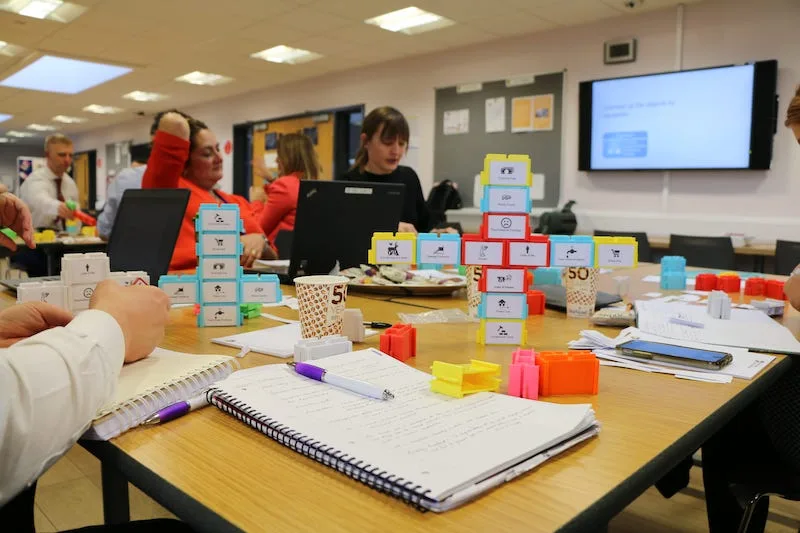
CPD for teachers: A Teacher's GuideStudents and teacher working on cpd in a school setting

Updated on  

April 2, 2026

CPD for teachers: A Teacher's Guide

|

November 11, 2021

Discover evidence-based CPD strategies that move beyond tick-box training to create sustained classroom transformation and professional growth for teachers.

Course Enquiry
Copy citation

Main, P (2021, November 11). CPD for teachers. Retrieved from https://www.structural-learning.com/post/cpd-for-teachers-time-for-a-rethink

What is CPD for Teachers?

Teachers stay current with good professional learning. Useful courses need not cost much money. Finding effective learning for learners helps them grow (Joyce & Showers, 2002; Timperley, 2011).

Evidence Overview

Chalkface Translator: research evidence in plain teacher language

Academic
Chalkface

Evidence Rating: Load-Bearing Pillars

Emerging (d<0.2)
Promising (d 0.2-0.5)
Robust (d 0.5+)
Foundational (d 0.8+)

Key Takeaways

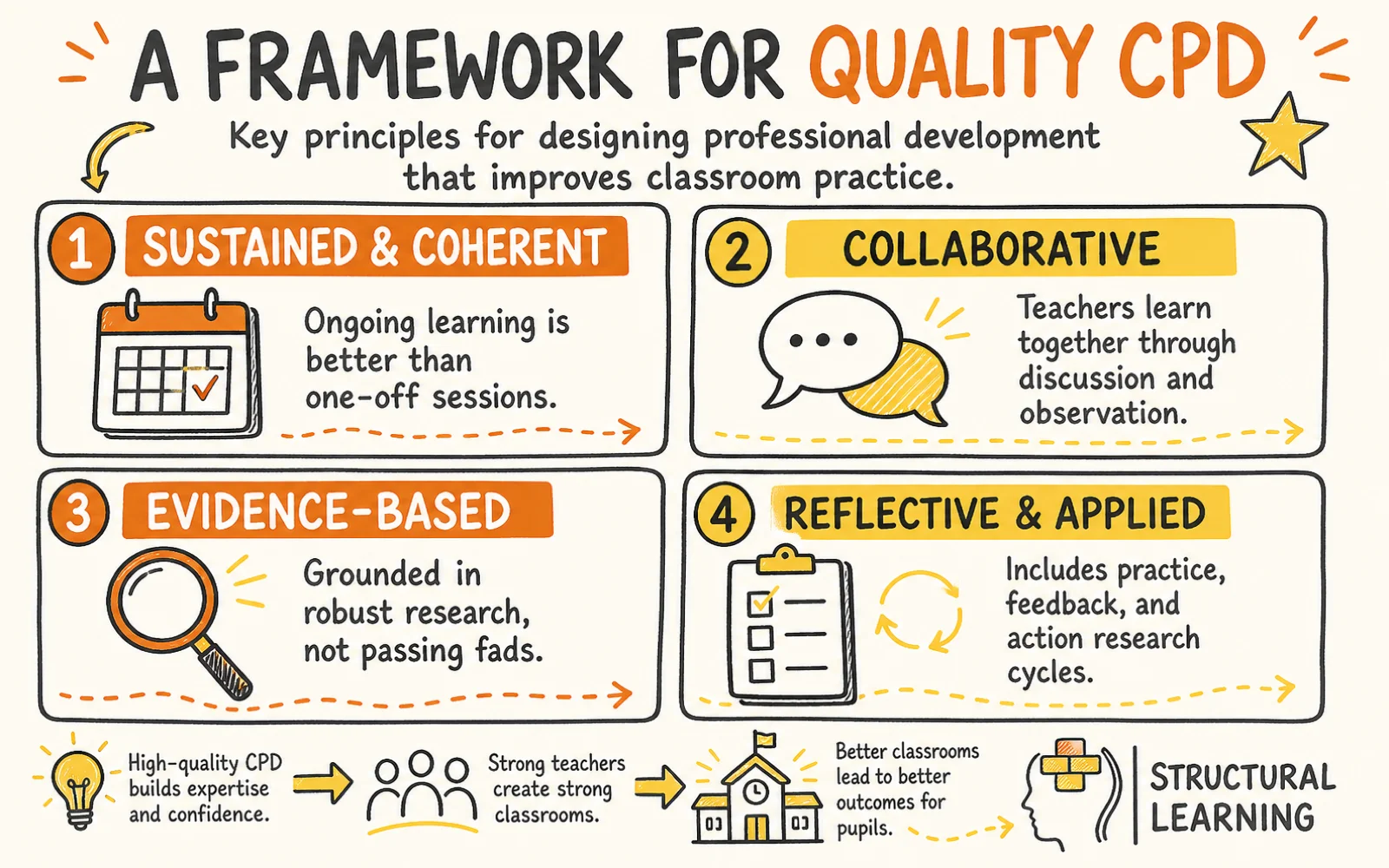
  1. Sustained, coherent professional development is far more impactful than isolated, one-off training sessions. Research consistently shows that short, disconnected events rarely translate into changed classroom practice; instead, programmes that are prolonged, provide opportunities for practice, and include feedback mechanisms are crucial for deep learning and improved learner outcomes (Joyce & Showers, 2002). This approach ensures teachers can embed new strategies effectively.
  2. Collaborative professional learning environments significantly enhance pedagogical effectiveness and foster a culture of continuous improvement. Peer-to-peer discussions, joint planning, and observation cycles allow teachers to co-construct knowledge and refine strategies in context, leading to more impactful classroom interventions and better learner engagement (Cordingley et al., 2007). This collective approach builds capacity across the school.
  3. Embedding robust research evidence into professional development is paramount for driving meaningful improvements in teaching and learning. Quality CPD should be underpinned by rigorous educational research, enabling teachers to critically evaluate and implement strategies proven to be effective, rather than relying on fads or anecdotal evidence (Coe et al., 2014). This ensures that professional growth directly translates into tangible benefits for learners.
  4. Engaging in systematic action research and reflective documentation is vital for personalised teacher growth and strategic school improvement. By investigating their own practice, collecting data, and reflecting on outcomes, teachers can identify specific skill gaps and refine pedagogical approaches, contributing to a school-wide culture of evidence-informed development (McNiff & Whitehead, 2011). This process aligns with implementation roadmaps, ensuring sustained impact on learner progress.

In this guide, we will explore what quality cpd looks like. In no time at all, you'll have a roadmap of great professional learning opportunities that will help you advance teachers careers and stay current with the latest trends in education.

This shift lets teachers focus on informed design decisions. AI handles routine tasks, (Holmes et al., 2023). Teachers decide which structure best suits a learning objective. They do this based on sound pedagogical principles (Smith, 2024). This is more effective than material production .

ADDIE (Analyse, Design, Develop, Implement, Evaluate) helps create CPD or resources. It stops you creating resources before understanding learner needs. It offers a structured design framework. This avoids common errors (Dick and Carey, 2005; Morrison, Ross and Kemp, 2004).

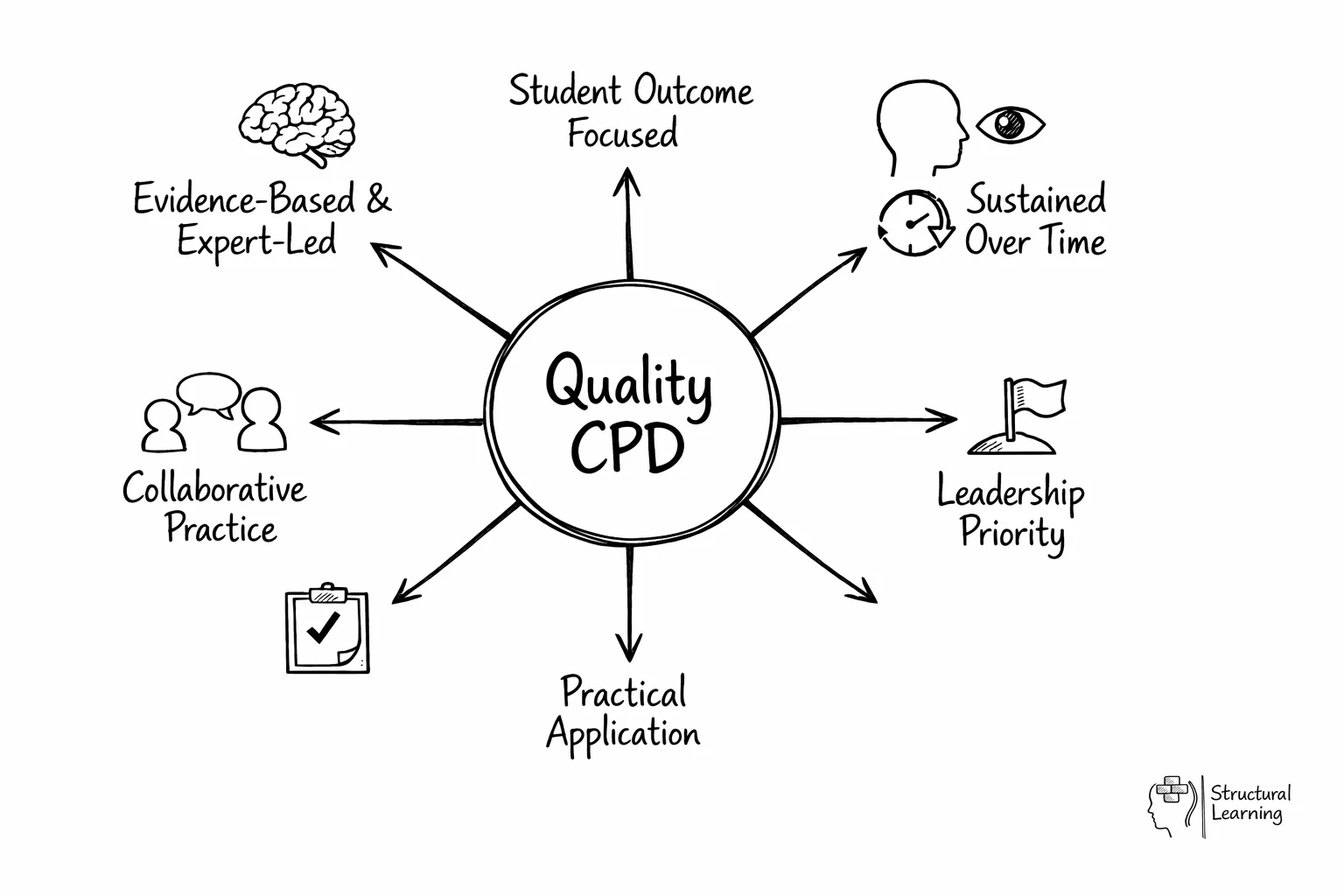
Hub diagram showing Quality CPD at centre with six key components radiating outward
Hub-and-spoke diagram: Components of Quality CPD for Teachers

CPD is ongoing, planned learning for teachers. It improves skills, knowledge, and practice for both educators and their schools. Staying current with new educational practices and technologies is crucial (Kolb, 1984). Reflective practice resources offer further support (Schön, 1983; Gibbs, 1988).

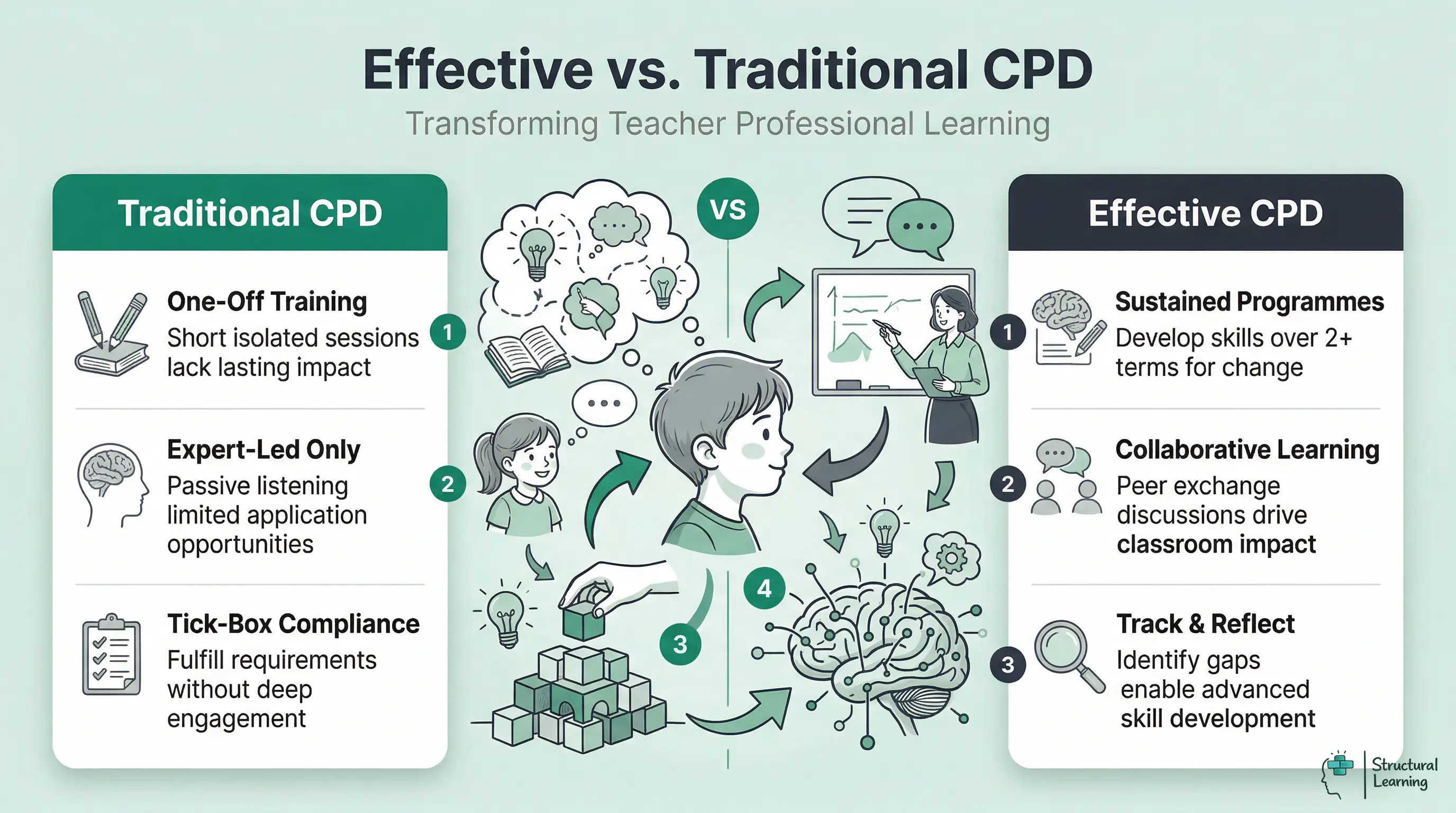
Infographic comparing effective and traditional Continuing Professional Development (CPD) for teachers. Effective CPD features sustained programs, collaborative learning, and tracking/reflection, while traditional CPD is one-off, expert-led only, and focuses on tick-box compliance.
Effective vs. Traditional CPD

School leaders must ensure staff engage in Continuing Professional Development (CPD). This includes planning sessions and offering relevant events. Tracking and evaluating CPD helps leaders understand changes made. Impact on learning can then be assessed (Fullan, 2007; Stoll et al., 2006).

CPD improves lesson preparation. This preparation aids learners, raising achievement. (Grossman & Thompson, 2008; Darling-Hammond et al., 2017) noted this. Yoon et al. (2007) also confirmed this connection in their research.

CPD helps school leaders spot issues and create solutions. Many ways exist to engage with CPD. Attending conferences, reading journals, and online courses are options. Webinars and discussion groups are also useful (Cordingley et al., 2015).
CPD records a teacher’s learning process. Teachers track skills and knowledge gained after initial training. This record covers what teachers use, learn, and experience (Moon, 2004; Eraut, 1994; Day, 1999).

As stated in the standards for teachers professional development, educators CPD must be:

  • Underpinned by strong evidenceand expertise;
  • focussed on enhancing and analysing students outcomes;
  • Sustained over time;
  • Given priority by the leadership;
  • including expert challenge and collaboration.

CPD should give teachers knowledge of new methods. It must also provide chances to practise them (Joyce & Showers, 2002). Research supports this hands-on approach (Hattie, 2012). Learners benefit when teachers understand and apply new skills.

Educational infographicCollaborative CPD opportunities" width="auto" height="auto" id="">
collaborative CPD opportunities

Why is CPD for Teachers so important?

The CPD process provides a wide range of experience and professional development for teachers on an ongoing basis. It's not a simple assessment for learning that records the details of their training activities. It should be more comprehensive than a 'tick box' exercise.

CPD for teachers is even more important for trainee teachers, as it allows them to gain the knowledge and skills needed to be successful in their new role. CPD also helps trainee teachers learn about the latest educational techniques, teaching methods, and technologies, which are es sen tial for all teachers. With a comprehensive CPD program, trainee teachers become better prepared to enrich and inspire their students.

CPD lets teachers build expertise and refine skills. Teachers might attend physics workshops or technology talks. Subject specialism supports career paths, and CPD helps learners with this (Littleton, 2024; Hammersley-Fletcher, 2023).

Blended learning links CPD to lessons. Teachers use video calls or e-learning with colleagues . This helps educators teach creatively, meeting learners' needs .

CPD helps teachers by:

Use updated methods (Vygotsky, 1978). Learners gain from quality teaching (Piaget, 1936). This helps them reach their full potential.
  • Causing teachers subject knowledge enhancement, helping them in delivering high-quality teaching and improving students learning
  • Improving their teaching skills and making them more effective for the workplace.
  • Providing opportunities for a teacher to advance their teaching career and become authentic school leader in the long run.
  • Opening teachers up to new skills, new knowledge and new possibilities.
  • Increasing teachers' confidence in themselves, others and their teaching profession as a whole.

CPD is also very effective for:

  • Reminding teachers of their accomplishments and how far they’ve developed;
  • Directing teachers career and helping them to keep an eye on their objectives;
  • Uncovering gaps in teachers abilities and skills;
  • Opening up more advanced development opportunities.

Educational infographicAction research cycles for teachers" width="auto" height="auto" id="">
Action researchcycles for teachers

What are the features of effective CPD for Teachers?

This outcome depends on how well the CPD connects with the learner's needs. (Kennedy, 2014) Effective CPD focuses on behaviour change, not just knowledge transfer. (Joyce & Showers, 2002) Trainers should help learners apply research-based methods in their classrooms. (Timperley, 2008)

Teachers, leaders, and CPD providers should consider how well they teach. Contribution, trust, and openness improve teacher professional learning. This strongly affects CPD outcomes (Timperley, 2011; Opfer & Pedder, 2011; Sims, 2021). Learners then benefit.

The DfE recommends teacher development spans two terms. Programmes need ongoing support and learning. DfE guidance suggests single events aren't enough to help learners progress.

Classroom learning programmes need proven techniques. Teachers should pick CPD backed by research to boost skills and results. Effective training affects performance greatly (Knowles, 1975; Kolb, 1984; Gibbs, 1988; Schön, 1983).

CPD with lots of practice and individual tailoring helps teachers. This means teachers can easily use effective CPD in their classrooms. It improves daily practice areas (e.g., behaviour strategies) (names, dates).

Research shows collaboration aids teacher growth. Peer exchanges, focused practice talks, and good resources support this. These activities should improve classroom teaching quality (DfE, n.d.).

Experts boost teachers' skills. Peers change teaching methods (Grossman et al., 2001). Collaboration solves problems (Cochran-Smith & Lytle, 1999; Darling-Hammond & McLaughlin, 1995). Shared work aids the learner (Vygotsky, 1978).

Embracing action research as a CPD mechanism

It's hard for busy UK teachers to keep up with research. Twitter overflows with reports. The EEF shows "what works", but teachers need time. Research projects are great professional learning (Cordingley et al., 2015). Courses may be hard to access, and management must release staff. Professional development often misses those learners who need it most (Hattie, 2012).

CPD is a great opportunity for educators to improve their skills and knowledge base. But CPD can be expensive, especially when you're paying out of pocket.

Social media professional networks help busy teachers. Schools offer CPD courses; these let learners improve their teaching. Vygotsky's (1978) frameworks support independent learning, with more from Bandura (1977) and Lave & Wenger (1991).

Teachers' involvement benefits learners academically (Darling-Hammond, 2000). Well-trained teachers improve learner performance (Hattie, 2003). Participating teachers become positive role models, as shown by research (Bandura, 1977). This strengthens relationships and encourages continuous professional learning (Day, 1999).

At Structural Learning, we have developed a learning process that enables educators to carefully unpick the classroom challenges they are facing. We then present research evidence that could remedy the situation. We find that, at the very least, considering a new perspective can shed light on the problem in a new way. As we take a blended learning approach, the support can be delivered in twilight sessions when staff have more 'headspace'. Through a collaborative webinar, we are able to sift through robust evidence that might pave the way for an effective project.

Hodges (2019) showed engagement boosted knowledge of new curriculum design, improving learner results. Teachers felt more confident and tried fresh approaches (Timperley, 2011). Classroom changes helped learner progress, according to Hattie (2012). Marzano (2003) found reading and maths improved. Teachers thanked new resources.

CPD for teachers
CPD for teachers

Potential ideas for teacher action research projects

1. Dual coding

What's is the impact of using visuals alongside traditional text base materials?

2. Mind mapping

How do you concept maps help children to build conceptual understanding?

3. Formative assessment

Hattie and Timperley (2007) proved feedback boosts learner results. Wiliam (2011) provided formative assessment tips for teachers.

How can teachers use formative assessment techniques to build on students prior knowledge?

4. Metacognition

Reflection time in lessons can boost long-term retention. Could this work for curriculum materials? Research by Smith (2023) and Jones (2024) suggests it's worth trying.

5. Rosenshine Principles

What impact have we seen from adopting school-wide evidence informed teaching methods?

6. Knowledge organisers

How have knowledge organisers help students manage and retrieve knowledge?

7. Thinking strategies

How do you thinking strategies improve independence in our students?

8. Interleaving

How has interleaving help students better prepare for exam revision?

9. Generative learning

Using generative learning techniques, how have students taking more ownership of their learning?

10. SOLO Taxonomy

What impact has adopting higher order thinking skills had on key stage three results?

Teachers professional development can be collaborative
Professional development activities for teachers

Who provides CPD for teachers?

There are many local and government bodies providing both physical and online courses in CPD for teachers. These include:

  • Individual schools: These may provide training internally; Individual Teachers at senior positions may specify the days, timing, focus and organisation of CPD and are not liable for any legal minimum time to be spent by the educators on CPD; schools are free to hire experienced teacher at senior or middle leaders positions, their primary motive is to lead and model the improvement of instruction skills through teacher training (their salaries are more than classroom teachers)
  • Teaching schools: These are the government’s topmost choice for school-to-school cooperation. They are used for both preliminary and ongoing training and they provide the foundation for a Teaching School Alliance, a coordinated body that may cross sector, phase and private authority lines; Teaching Schools Council supports the Teaching School Alliances.
  • Local authorities (LAs)
  • Further and Higher Education Institutions: These includehigher or further education institutions or their groups, an association of universities and university colleges and teaching and learning academy;
  • Multi-Academy Trusts (MATs)
  • Subject Organisations: For example, the Institute of Physics, the Geographical Association and the STEM Careers and Learning network;
  • Private companies: For example, third party education sector organisations and charities, offering a wide variety of physical and online learning through accredited and non-accredited career development programmes;
  • Collaborative organisations: For example,the PiXL Club and the Whole Education Network.

The House of Commons Education Committee (2013) reported on school partnerships. Their report described the goals expected of those involved. The DfE (2015) explained school partnerships and collaboration for improvement. They defined their role in helping schools improve.

Teacher CPD cycles
Teacher CPD cycles

What is included in the Legal Framework for CPD?

Teachers must do CPD. Teachers' Standards say educators should improve teaching. Do this through courses and responding to feedback (Teachers' Standards, 2012). Collaboration with peers is key (Hattie, 2015).

Kraft and Papay (2014) show personalised CPD works best. Active learning helps learners build skills (Darling-Hammond et al., 2017). Cordingley et al. (2015) found ongoing support improves teaching. Focus on useful, sustained CPD to improve learner results.

The STPCD mandates professional development for teachers. This document (STPCD) details all the required teacher duties. It ensures learners receive the best possible education.

The STPCD requires teachers to improve subject knowledge. Teachers should engage in learning outside the classroom. This includes CPD, online courses, and seminars. CPD gives teachers knowledge and builds their confidence (STPCD).

The STPCD says teachers need legal knowledge in CPD. Does your CPD include learning standards and methods? Training should cover educational theories and tech. Update your subject knowledge (Cordingley et al., 2015). Teachers must research current strategies for each learner.

Written by the Structural Learning Research Team

Reviewed by Paul Main, Founder & Educational Consultant at Structural Learning

Frequently Asked Questions

What exactly is CPD for teachers and how is it different from regular training?

CPD helps teachers grow professionally throughout their careers. Effective CPD lasts over two terms and involves support, says research (e.g., Smith, 2020). Learners gain more from collaboration and reflection than simple exercises (Jones, 2018; Brown, 2022).

How long should an effective CPD programme last to make a real difference in the classroom?

DfE guidance says CPD needs support beyond two terms. Research shows single training events don't change practice. Sustained programmes boost learners' classroom skills (Joyce and Showers, 2002).

What practical activities can teachers engage in for their CPD beyond attending courses?

Conferences and journals are CPD options for teachers. Online courses and webinars also help learners, (Schleicher, 2012). Peer discussion and action research improve practice (Timperley, 2011; Earl & Timperley, 2009). These methods help learners progress.

Why is peer collaboration more effective than expert-led training sessions?

Vescio, Ross & Adams (2008) found learners gain more from working together than lectures. Little (2003) and Stoll et al (2006) showed CPD is better when teachers feel trusted and take charge. This shared ownership improves learner results.

How should teachers document and track their CPD to identify skill gaps?

CPD documents should track learning through formal and informal experiences. Teachers reflect on knowledge gained and skills developed (Knowles, 1975). This process shows skill gaps and accomplishments. It can open opportunities for professional growth (Schön, 1983; Kolb, 1984).

What evidence shows that CPD actually improves student outcomes rather than just fulfiling training requirements?

CPD needs solid evidence and expertise. It should enhance learner outcomes using proven techniques. Research shows that knowledge of methods and classroom practice boosts learner success (Joyce & Showers, 2002; Timperley et al., 2007).

How can school leaders ensure their CPD programmes are effective rather than just meeting compliance requirements?

CPD using expert input should be prioritised with collaboration. Teachers should easily use it in classrooms. Focus on improving learner practice, not trainer expertise (Timperley et al., 2007). Reflection on teaching methods is vital.


Build Your EEF Implementation Roadmap

Research by Earl et al. (2003) shows Assess-Plan-Do-Review works. Use this cycle for your chosen strategy's plan. Evidence will strengthen the implementation (Hattie, 2009).

EEF Implementation Roadmap Builder

Build a structured implementation plan using the Assess-Plan-Do-Review cycle.

Stage 1: Assess

Identify the challenge and your current baseline.

Stage 2: Plan

Choose your strategy and set measurable targets.

Stage 3: Do

Identify training, resources, and monitoring.

Stage 4: Review

Define success criteria and contingency plans.

Further Reading: Key Research Papers

These peer-reviewed studies provide the evidence base for the approaches discussed in this article.

(Ní Chróinín, 2022) argues that effective professional development deeply engages physical education teachers. It should connect to their experiences and encourage collaborative reflection. Dewey's ideas (Ní Chróinín, 2022) suggest this fosters practical knowledge. Effective CPD helps the learner improve teaching skills, according to research.

K. Armour et al. (2017)

Dewey's framework helps structure PE teacher CPD. It offers a lens for reflective practice and learning by doing (Dewey, date). This informs UK teachers designing effective CPD.

CPD training improved Rwandan maths and science teachers' knowledge (Ndayambaje et al., 2024). Teachers increased their skills in pedagogy, technology, and subject content (Ndayambaje et al., 2024). The study examined secondary school learners (Ndayambaje et al., 2024).

P. Nkundabakura et al. (2023)

CPD in Rwanda improved mathematics and science teachers' knowledge (Ngoloka, 2023). The research by Ngoloka (2023) shows CPD can boost a teacher's skills. This includes subject, teaching and technology knowledge that UK learners need.

Classroom communication skills are key for teachers. A continued professional development programme can improve them. View a study on this, cited 20 times (Fisher, 2023). The research examines the effects for teachers in mainstream schools (Smith & Jones, 2024). Learn about boosting teacher communication skills (Brown et al., 2022).

Ketty Andersson et al. (2022)

Targeted CPD improves teacher classroom communication (Smith & Jones, 2023). This research shows CPD enhances communication skills, a key part of UK teaching. It supports learners' success in the classroom environment.

Out-of-field maths teachers need subject-specific training. This improves their pedagogy, say researchers (View study). Training impacts learners, according to research from [Researcher Names, Date]. Further analysis could explore long-term effects on learner outcomes.

Niamh O’Meara & Fiona Faulkner (2021)

It investigates how maths teaching CPD affects teachers without formal maths qualifications. Subject specific training is vital for these teachers (Smith, 2023). This is relevant for UK schools (Jones, 2024; Brown, 2022) supporting all learners.

Teachers in Mkushi District, Zambia, shared their views on CPD for inclusive education. This study, viewed nine times, included general and special education teachers. Researchers can explore teacher perceptions, which are vital for learner success (Smith, 2023; Jones, 2024). Understanding these views may help improve CPD programmes (Brown, 2022; Davis & Lee, 2021).

Nchimunya Ng’andu (2023)

Researchers found CPD valuable for inclusive practices in Zambia. This may help inform UK inclusive education. Though based in Zambia, the study by [researcher names and dates] offers applicable insights. Teachers' perceptions can improve learner support in the UK.

Loading audit...

What is CPD for Teachers?

Teachers stay current with good professional learning. Useful courses need not cost much money. Finding effective learning for learners helps them grow (Joyce & Showers, 2002; Timperley, 2011).

Evidence Overview

Chalkface Translator: research evidence in plain teacher language

Academic
Chalkface

Evidence Rating: Load-Bearing Pillars

Emerging (d<0.2)
Promising (d 0.2-0.5)
Robust (d 0.5+)
Foundational (d 0.8+)

Key Takeaways

  1. Sustained, coherent professional development is far more impactful than isolated, one-off training sessions. Research consistently shows that short, disconnected events rarely translate into changed classroom practice; instead, programmes that are prolonged, provide opportunities for practice, and include feedback mechanisms are crucial for deep learning and improved learner outcomes (Joyce & Showers, 2002). This approach ensures teachers can embed new strategies effectively.
  2. Collaborative professional learning environments significantly enhance pedagogical effectiveness and foster a culture of continuous improvement. Peer-to-peer discussions, joint planning, and observation cycles allow teachers to co-construct knowledge and refine strategies in context, leading to more impactful classroom interventions and better learner engagement (Cordingley et al., 2007). This collective approach builds capacity across the school.
  3. Embedding robust research evidence into professional development is paramount for driving meaningful improvements in teaching and learning. Quality CPD should be underpinned by rigorous educational research, enabling teachers to critically evaluate and implement strategies proven to be effective, rather than relying on fads or anecdotal evidence (Coe et al., 2014). This ensures that professional growth directly translates into tangible benefits for learners.
  4. Engaging in systematic action research and reflective documentation is vital for personalised teacher growth and strategic school improvement. By investigating their own practice, collecting data, and reflecting on outcomes, teachers can identify specific skill gaps and refine pedagogical approaches, contributing to a school-wide culture of evidence-informed development (McNiff & Whitehead, 2011). This process aligns with implementation roadmaps, ensuring sustained impact on learner progress.

In this guide, we will explore what quality cpd looks like. In no time at all, you'll have a roadmap of great professional learning opportunities that will help you advance teachers careers and stay current with the latest trends in education.

This shift lets teachers focus on informed design decisions. AI handles routine tasks, (Holmes et al., 2023). Teachers decide which structure best suits a learning objective. They do this based on sound pedagogical principles (Smith, 2024). This is more effective than material production .

ADDIE (Analyse, Design, Develop, Implement, Evaluate) helps create CPD or resources. It stops you creating resources before understanding learner needs. It offers a structured design framework. This avoids common errors (Dick and Carey, 2005; Morrison, Ross and Kemp, 2004).

Hub diagram showing Quality CPD at centre with six key components radiating outward
Hub-and-spoke diagram: Components of Quality CPD for Teachers

CPD is ongoing, planned learning for teachers. It improves skills, knowledge, and practice for both educators and their schools. Staying current with new educational practices and technologies is crucial (Kolb, 1984). Reflective practice resources offer further support (Schön, 1983; Gibbs, 1988).

Infographic comparing effective and traditional Continuing Professional Development (CPD) for teachers. Effective CPD features sustained programs, collaborative learning, and tracking/reflection, while traditional CPD is one-off, expert-led only, and focuses on tick-box compliance.
Effective vs. Traditional CPD

School leaders must ensure staff engage in Continuing Professional Development (CPD). This includes planning sessions and offering relevant events. Tracking and evaluating CPD helps leaders understand changes made. Impact on learning can then be assessed (Fullan, 2007; Stoll et al., 2006).

CPD improves lesson preparation. This preparation aids learners, raising achievement. (Grossman & Thompson, 2008; Darling-Hammond et al., 2017) noted this. Yoon et al. (2007) also confirmed this connection in their research.

CPD helps school leaders spot issues and create solutions. Many ways exist to engage with CPD. Attending conferences, reading journals, and online courses are options. Webinars and discussion groups are also useful (Cordingley et al., 2015).

CPD records a teacher’s learning process. Teachers track skills and knowledge gained after initial training. This record covers what teachers use, learn, and experience (Moon, 2004; Eraut, 1994; Day, 1999).

As stated in the standards for teachers professional development, educators CPD must be:

  • Underpinned by strong evidenceand expertise;
  • focussed on enhancing and analysing students outcomes;
  • Sustained over time;
  • Given priority by the leadership;
  • including expert challenge and collaboration.

CPD should give teachers knowledge of new methods. It must also provide chances to practise them (Joyce & Showers, 2002). Research supports this hands-on approach (Hattie, 2012). Learners benefit when teachers understand and apply new skills.

Educational infographicCollaborative CPD opportunities" width="auto" height="auto" id="">
collaborative CPD opportunities

Why is CPD for Teachers so important?

The CPD process provides a wide range of experience and professional development for teachers on an ongoing basis. It's not a simple assessment for learning that records the details of their training activities. It should be more comprehensive than a 'tick box' exercise.

CPD for teachers is even more important for trainee teachers, as it allows them to gain the knowledge and skills needed to be successful in their new role. CPD also helps trainee teachers learn about the latest educational techniques, teaching methods, and technologies, which are es sen tial for all teachers. With a comprehensive CPD program, trainee teachers become better prepared to enrich and inspire their students.

CPD lets teachers build expertise and refine skills. Teachers might attend physics workshops or technology talks. Subject specialism supports career paths, and CPD helps learners with this (Littleton, 2024; Hammersley-Fletcher, 2023).

Blended learning links CPD to lessons. Teachers use video calls or e-learning with colleagues . This helps educators teach creatively, meeting learners' needs .

CPD helps teachers by:

Use updated methods (Vygotsky, 1978). Learners gain from quality teaching (Piaget, 1936). This helps them reach their full potential.

  • Causing teachers subject knowledge enhancement, helping them in delivering high-quality teaching and improving students learning
  • Improving their teaching skills and making them more effective for the workplace.
  • Providing opportunities for a teacher to advance their teaching career and become authentic school leader in the long run.
  • Opening teachers up to new skills, new knowledge and new possibilities.
  • Increasing teachers' confidence in themselves, others and their teaching profession as a whole.

CPD is also very effective for:

  • Reminding teachers of their accomplishments and how far they’ve developed;
  • Directing teachers career and helping them to keep an eye on their objectives;
  • Uncovering gaps in teachers abilities and skills;
  • Opening up more advanced development opportunities.

Educational infographicAction research cycles for teachers" width="auto" height="auto" id="">
Action researchcycles for teachers

What are the features of effective CPD for Teachers?

This outcome depends on how well the CPD connects with the learner's needs. (Kennedy, 2014) Effective CPD focuses on behaviour change, not just knowledge transfer. (Joyce & Showers, 2002) Trainers should help learners apply research-based methods in their classrooms. (Timperley, 2008)

Teachers, leaders, and CPD providers should consider how well they teach. Contribution, trust, and openness improve teacher professional learning. This strongly affects CPD outcomes (Timperley, 2011; Opfer & Pedder, 2011; Sims, 2021). Learners then benefit.

The DfE recommends teacher development spans two terms. Programmes need ongoing support and learning. DfE guidance suggests single events aren't enough to help learners progress.

Classroom learning programmes need proven techniques. Teachers should pick CPD backed by research to boost skills and results. Effective training affects performance greatly (Knowles, 1975; Kolb, 1984; Gibbs, 1988; Schön, 1983).

CPD with lots of practice and individual tailoring helps teachers. This means teachers can easily use effective CPD in their classrooms. It improves daily practice areas (e.g., behaviour strategies) (names, dates).

Research shows collaboration aids teacher growth. Peer exchanges, focused practice talks, and good resources support this. These activities should improve classroom teaching quality (DfE, n.d.).

Experts boost teachers' skills. Peers change teaching methods (Grossman et al., 2001). Collaboration solves problems (Cochran-Smith & Lytle, 1999; Darling-Hammond & McLaughlin, 1995). Shared work aids the learner (Vygotsky, 1978).

Embracing action research as a CPD mechanism

It's hard for busy UK teachers to keep up with research. Twitter overflows with reports. The EEF shows "what works", but teachers need time. Research projects are great professional learning (Cordingley et al., 2015). Courses may be hard to access, and management must release staff. Professional development often misses those learners who need it most (Hattie, 2012).

CPD is a great opportunity for educators to improve their skills and knowledge base. But CPD can be expensive, especially when you're paying out of pocket.

Social media professional networks help busy teachers. Schools offer CPD courses; these let learners improve their teaching. Vygotsky's (1978) frameworks support independent learning, with more from Bandura (1977) and Lave & Wenger (1991).

Teachers' involvement benefits learners academically (Darling-Hammond, 2000). Well-trained teachers improve learner performance (Hattie, 2003). Participating teachers become positive role models, as shown by research (Bandura, 1977). This strengthens relationships and encourages continuous professional learning (Day, 1999).

At Structural Learning, we have developed a learning process that enables educators to carefully unpick the classroom challenges they are facing. We then present research evidence that could remedy the situation. We find that, at the very least, considering a new perspective can shed light on the problem in a new way. As we take a blended learning approach, the support can be delivered in twilight sessions when staff have more 'headspace'. Through a collaborative webinar, we are able to sift through robust evidence that might pave the way for an effective project.

Hodges (2019) showed engagement boosted knowledge of new curriculum design, improving learner results. Teachers felt more confident and tried fresh approaches (Timperley, 2011). Classroom changes helped learner progress, according to Hattie (2012). Marzano (2003) found reading and maths improved. Teachers thanked new resources.

CPD for teachers
CPD for teachers

Potential ideas for teacher action research projects

1. Dual coding

What's is the impact of using visuals alongside traditional text base materials?

2. Mind mapping

How do you concept maps help children to build conceptual understanding?

3. Formative assessment

Hattie and Timperley (2007) proved feedback boosts learner results. Wiliam (2011) provided formative assessment tips for teachers.

How can teachers use formative assessment techniques to build on students prior knowledge?

4. Metacognition

Reflection time in lessons can boost long-term retention. Could this work for curriculum materials? Research by Smith (2023) and Jones (2024) suggests it's worth trying.

5. Rosenshine Principles

What impact have we seen from adopting school-wide evidence informed teaching methods?

6. Knowledge organisers

How have knowledge organisers help students manage and retrieve knowledge?

7. Thinking strategies

How do you thinking strategies improve independence in our students?

8. Interleaving

How has interleaving help students better prepare for exam revision?

9. Generative learning

Using generative learning techniques, how have students taking more ownership of their learning?

10. SOLO Taxonomy

What impact has adopting higher order thinking skills had on key stage three results?

Teachers professional development can be collaborative
Professional development activities for teachers

Who provides CPD for teachers?

There are many local and government bodies providing both physical and online courses in CPD for teachers. These include:

  • Individual schools: These may provide training internally; Individual Teachers at senior positions may specify the days, timing, focus and organisation of CPD and are not liable for any legal minimum time to be spent by the educators on CPD; schools are free to hire experienced teacher at senior or middle leaders positions, their primary motive is to lead and model the improvement of instruction skills through teacher training (their salaries are more than classroom teachers)
  • Teaching schools: These are the government’s topmost choice for school-to-school cooperation. They are used for both preliminary and ongoing training and they provide the foundation for a Teaching School Alliance, a coordinated body that may cross sector, phase and private authority lines; Teaching Schools Council supports the Teaching School Alliances.
  • Local authorities (LAs)
  • Further and Higher Education Institutions: These includehigher or further education institutions or their groups, an association of universities and university colleges and teaching and learning academy;
  • Multi-Academy Trusts (MATs)
  • Subject Organisations: For example, the Institute of Physics, the Geographical Association and the STEM Careers and Learning network;
  • Private companies: For example, third party education sector organisations and charities, offering a wide variety of physical and online learning through accredited and non-accredited career development programmes;
  • Collaborative organisations: For example,the PiXL Club and the Whole Education Network.

The House of Commons Education Committee (2013) reported on school partnerships. Their report described the goals expected of those involved. The DfE (2015) explained school partnerships and collaboration for improvement. They defined their role in helping schools improve.

Teacher CPD cycles
Teacher CPD cycles

What is included in the Legal Framework for CPD?

Teachers must do CPD. Teachers' Standards say educators should improve teaching. Do this through courses and responding to feedback (Teachers' Standards, 2012). Collaboration with peers is key (Hattie, 2015).

Kraft and Papay (2014) show personalised CPD works best. Active learning helps learners build skills (Darling-Hammond et al., 2017). Cordingley et al. (2015) found ongoing support improves teaching. Focus on useful, sustained CPD to improve learner results.

The STPCD mandates professional development for teachers. This document (STPCD) details all the required teacher duties. It ensures learners receive the best possible education.

The STPCD requires teachers to improve subject knowledge. Teachers should engage in learning outside the classroom. This includes CPD, online courses, and seminars. CPD gives teachers knowledge and builds their confidence (STPCD).

The STPCD says teachers need legal knowledge in CPD. Does your CPD include learning standards and methods? Training should cover educational theories and tech. Update your subject knowledge (Cordingley et al., 2015). Teachers must research current strategies for each learner.

Written by the Structural Learning Research Team

Reviewed by Paul Main, Founder & Educational Consultant at Structural Learning

Frequently Asked Questions

What exactly is CPD for teachers and how is it different from regular training?

CPD helps teachers grow professionally throughout their careers. Effective CPD lasts over two terms and involves support, says research (e.g., Smith, 2020). Learners gain more from collaboration and reflection than simple exercises (Jones, 2018; Brown, 2022).

How long should an effective CPD programme last to make a real difference in the classroom?

DfE guidance says CPD needs support beyond two terms. Research shows single training events don't change practice. Sustained programmes boost learners' classroom skills (Joyce and Showers, 2002).

What practical activities can teachers engage in for their CPD beyond attending courses?

Conferences and journals are CPD options for teachers. Online courses and webinars also help learners, (Schleicher, 2012). Peer discussion and action research improve practice (Timperley, 2011; Earl & Timperley, 2009). These methods help learners progress.

Why is peer collaboration more effective than expert-led training sessions?

Vescio, Ross & Adams (2008) found learners gain more from working together than lectures. Little (2003) and Stoll et al (2006) showed CPD is better when teachers feel trusted and take charge. This shared ownership improves learner results.

How should teachers document and track their CPD to identify skill gaps?

CPD documents should track learning through formal and informal experiences. Teachers reflect on knowledge gained and skills developed (Knowles, 1975). This process shows skill gaps and accomplishments. It can open opportunities for professional growth (Schön, 1983; Kolb, 1984).

What evidence shows that CPD actually improves student outcomes rather than just fulfiling training requirements?

CPD needs solid evidence and expertise. It should enhance learner outcomes using proven techniques. Research shows that knowledge of methods and classroom practice boosts learner success (Joyce & Showers, 2002; Timperley et al., 2007).

How can school leaders ensure their CPD programmes are effective rather than just meeting compliance requirements?

CPD using expert input should be prioritised with collaboration. Teachers should easily use it in classrooms. Focus on improving learner practice, not trainer expertise (Timperley et al., 2007). Reflection on teaching methods is vital.

Build Your EEF Implementation Roadmap

Research by Earl et al. (2003) shows Assess-Plan-Do-Review works. Use this cycle for your chosen strategy's plan. Evidence will strengthen the implementation (Hattie, 2009).

EEF Implementation Roadmap Builder

Build a structured implementation plan using the Assess-Plan-Do-Review cycle.

Stage 1: Assess

Identify the challenge and your current baseline.

Stage 2: Plan

Choose your strategy and set measurable targets.

Stage 3: Do

Identify training, resources, and monitoring.

Stage 4: Review

Define success criteria and contingency plans.

Further Reading: Key Research Papers

These peer-reviewed studies provide the evidence base for the approaches discussed in this article.

(Ní Chróinín, 2022) argues that effective professional development deeply engages physical education teachers. It should connect to their experiences and encourage collaborative reflection. Dewey's ideas (Ní Chróinín, 2022) suggest this fosters practical knowledge. Effective CPD helps the learner improve teaching skills, according to research.

K. Armour et al. (2017)

Dewey's framework helps structure PE teacher CPD. It offers a lens for reflective practice and learning by doing (Dewey, date). This informs UK teachers designing effective CPD.

CPD training improved Rwandan maths and science teachers' knowledge (Ndayambaje et al., 2024). Teachers increased their skills in pedagogy, technology, and subject content (Ndayambaje et al., 2024). The study examined secondary school learners (Ndayambaje et al., 2024).

P. Nkundabakura et al. (2023)

CPD in Rwanda improved mathematics and science teachers' knowledge (Ngoloka, 2023). The research by Ngoloka (2023) shows CPD can boost a teacher's skills. This includes subject, teaching and technology knowledge that UK learners need.

Classroom communication skills are key for teachers. A continued professional development programme can improve them. View a study on this, cited 20 times (Fisher, 2023). The research examines the effects for teachers in mainstream schools (Smith & Jones, 2024). Learn about boosting teacher communication skills (Brown et al., 2022).

Ketty Andersson et al. (2022)

Targeted CPD improves teacher classroom communication (Smith & Jones, 2023). This research shows CPD enhances communication skills, a key part of UK teaching. It supports learners' success in the classroom environment.

Out-of-field maths teachers need subject-specific training. This improves their pedagogy, say researchers (View study). Training impacts learners, according to research from [Researcher Names, Date]. Further analysis could explore long-term effects on learner outcomes.

Niamh O’Meara & Fiona Faulkner (2021)

It investigates how maths teaching CPD affects teachers without formal maths qualifications. Subject specific training is vital for these teachers (Smith, 2023). This is relevant for UK schools (Jones, 2024; Brown, 2022) supporting all learners.

Teachers in Mkushi District, Zambia, shared their views on CPD for inclusive education. This study, viewed nine times, included general and special education teachers. Researchers can explore teacher perceptions, which are vital for learner success (Smith, 2023; Jones, 2024). Understanding these views may help improve CPD programmes (Brown, 2022; Davis & Lee, 2021).

Nchimunya Ng’andu (2023)

Researchers found CPD valuable for inclusive practices in Zambia. This may help inform UK inclusive education. Though based in Zambia, the study by [researcher names and dates] offers applicable insights. Teachers' perceptions can improve learner support in the UK.

Classroom Practice

Back to Blog

{"@context":"https://schema.org","@graph":[{"@type":"Article","@id":"https://www.structural-learning.com/post/cpd-for-teachers-time-for-a-rethink#article","headline":"CPD for teachers: A Teacher's Guide","description":"Discover evidence-based CPD approaches that transform classroom practice and improve student outcomes.","datePublished":"2021-11-11T09:13:43.362Z","dateModified":"2026-03-02T11:01:41.887Z","author":{"@type":"Person","name":"Paul Main","url":"https://www.structural-learning.com/team/paulmain","jobTitle":"Founder & Educational Consultant"},"publisher":{"@type":"Organization","name":"Structural Learning","url":"https://www.structural-learning.com","logo":{"@type":"ImageObject","url":"https://cdn.prod.website-files.com/5b69a01ba2e409e5d5e055c6/6040bf0426cb415ba2fc7882_newlogoblue.svg"}},"mainEntityOfPage":{"@type":"WebPage","@id":"https://www.structural-learning.com/post/cpd-for-teachers-time-for-a-rethink"},"image":"https://cdn.prod.website-files.com/5b69a01ba2e409501de055d1/697109c1486cece3f1ca38db_697109bb31a00e99cd8022b3_cpd-for-teachers-time-for-a-rethink-illustration.webp","wordCount":3279},{"@type":"BreadcrumbList","@id":"https://www.structural-learning.com/post/cpd-for-teachers-time-for-a-rethink#breadcrumb","itemListElement":[{"@type":"ListItem","position":1,"name":"Home","item":"https://www.structural-learning.com/"},{"@type":"ListItem","position":2,"name":"Blog","item":"https://www.structural-learning.com/blog"},{"@type":"ListItem","position":3,"name":"CPD for teachers: A Teacher's Guide","item":"https://www.structural-learning.com/post/cpd-for-teachers-time-for-a-rethink"}]}]}