Updated on
September 1, 2026
Cognitive Load Theory: 12 Strategies to Reduce Overload
Understand cognitive load theory, its evidence and limits. Use 12 classroom strategies and a lesson check to reduce avoidable demands without lowering challenge.


Updated on
September 1, 2026
Understand cognitive load theory, its evidence and limits. Use 12 classroom strategies and a lesson check to reduce avoidable demands without lowering challenge.
What is cognitive load theory?
Cognitive load theory holds that learning is limited by the small capacity of working memory, so lessons should manage how much new information learners process at once. It distinguishes intrinsic, extraneous, and germane load. For teachers, it means cutting distractions, using worked examples, and introducing complexity gradually so working memory is not overwhelmed.
Cognitive load theory is an instructional design theory that explains how the limits of working memory affect learning. It is most useful when learners meet complex new content, coordinate several sources or solve an unfamiliar problem.
This guide explains the theory, its evidence and its limits. It turns twelve research-informed principles into classroom decisions, then provides a lesson check that identifies changes to test without claiming to measure a learner's mind.
In a Year 8 maths lesson on solving linear equations, a new method appears on a crowded slide. Learners must read the steps, follow the teacher's words and search for labels in another box. The maths is demanding, but the layout adds work that the lesson does not need.
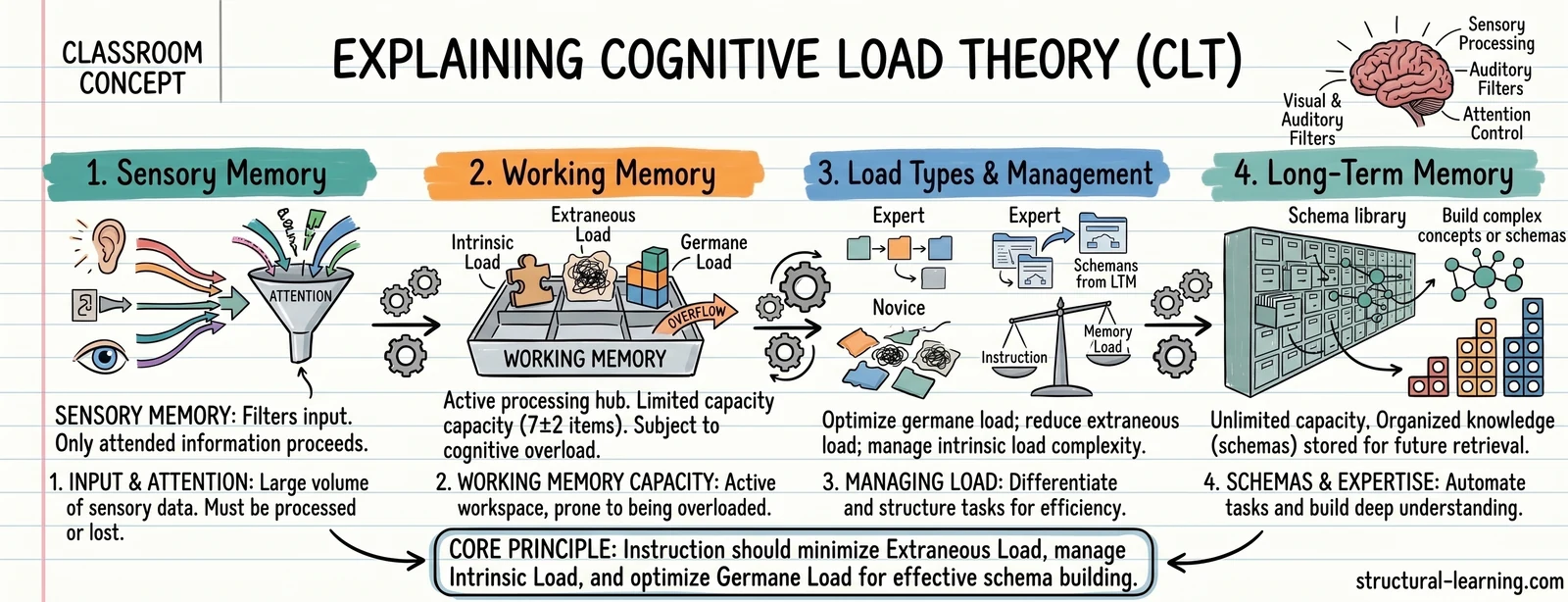
Cognitive load theory explains how the limits of working memory affect learning. When learners meet new information, they must hold and connect its parts before useful knowledge can be stored in long-term memory. A lesson can overload that temporary workspace when it introduces too many interacting elements, makes learners search between sources, or asks novices to solve a problem before they have a usable model.
John Sweller developed the theory while studying problem solving. His early experiments found that conventional means-ends problems could consume attention that learners needed for noticing the structure of a solution (Sweller, 1988). The practical lesson is not that thinking should be easy. It is that effort should be spent on the idea being learned, not on avoidable features of the task.
Working memory is especially constrained when information is new. Familiar knowledge held in long-term memory can be treated as one organised unit, or schema. That is why the same equation, text or diagram may overwhelm a novice but feel straightforward to an expert. For fuller accounts, see our guides to working memory and schema building.
Cognitive load theory is therefore an instructional design framework. It helps teachers decide what to explain, what to show together, when to provide an example and when to remove support. It does not provide a reliable meter for reading cognitive load from a learner's face or behaviour.
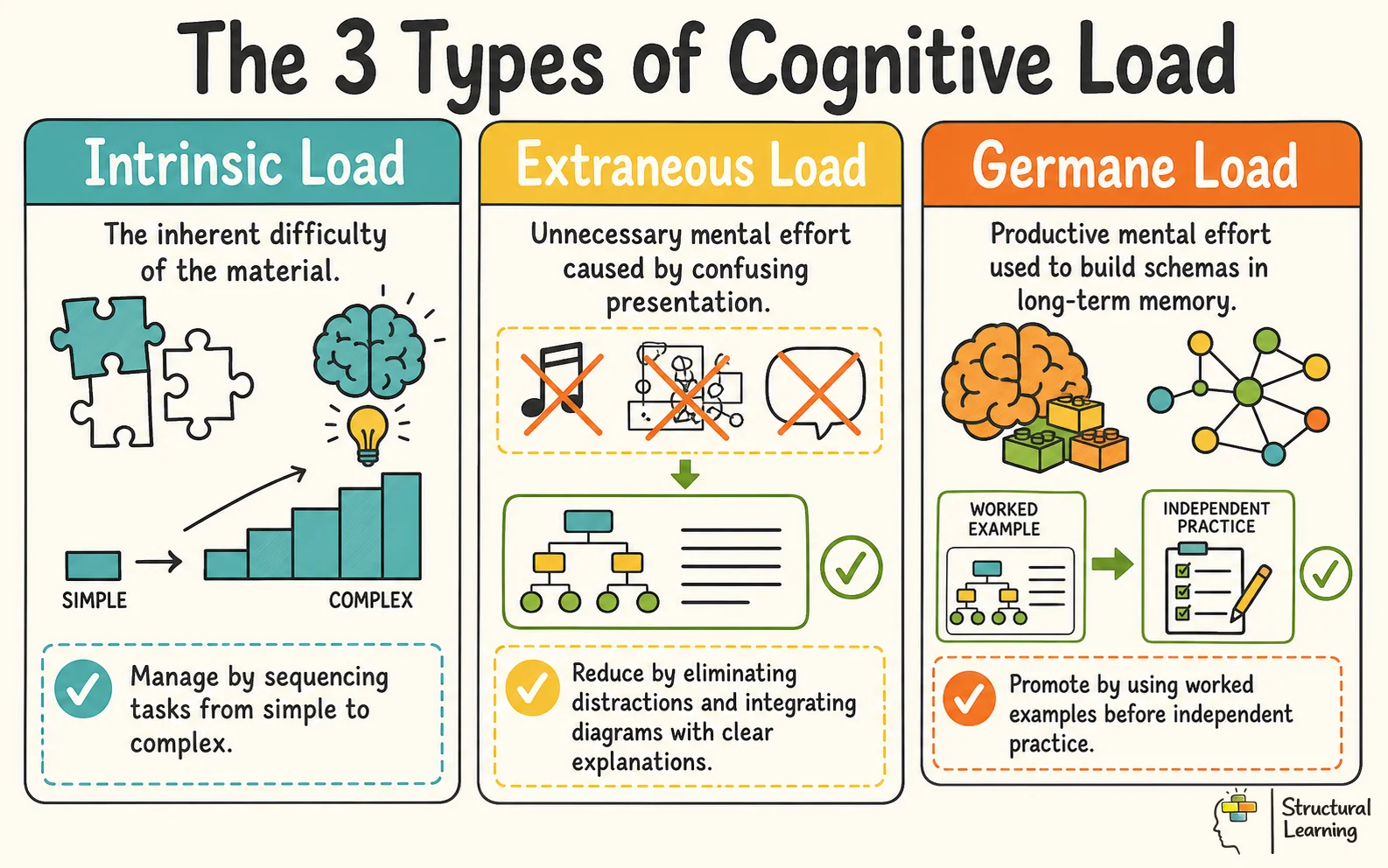
The traditional account uses three labels: intrinsic, extraneous and germane load. Intrinsic load concerns necessary complexity, extraneous load concerns avoidable design demands, and germane load describes processing that contributes to learning. These labels can help teachers, but they need careful use.
The third category is disputed. Kalyuga argued that germane load does not need to be treated as a separate load because productive processing is part of dealing with the task itself (Kalyuga, 2011). The later review by Sweller, van Merrienboer and Paas also describes a revised model rather than a simple set of three independent gauges (Sweller, van Merrienboer and Paas, 2019).
For teachers, the safer question is: which parts of this lesson are necessary for understanding, and which parts make learners work without helping them learn? This avoids pretending that a classroom checklist can calculate three precise quantities.
These strategies are design decisions rather than fixed rules. Their value depends on the knowledge learners already have and the material they are learning. Start with novices, then adapt as performance becomes more secure.
List the facts, vocabulary and procedures that the new material assumes. Ask a small number of diagnostic questions before adding new content. If learners cannot retrieve a required idea, restore it first. This is different from filling the start of every lesson with a generic quiz.
The retrieval must support the next step. Our retrieval practice guide explains how to choose useful prompts.
Break complex material into parts, but keep the relationships visible. In science, learners may meet phloem and xylem separately before explaining the transport system. In history, they may secure the meaning of a cause before comparing how several causes interact. Segmentation should prepare learners to assemble the whole, not leave them with disconnected fragments.
Show a complete model when a procedure or form is new. Make the decisions visible, not only the final answer. Worked examples can reduce unproductive search and direct attention to the structure that should be learned. A review of worked-example research found that examples are most useful when their design prompts learners to process the underlying principles (Atkinson et al., 2000).
This principle also supports the modelling and guided-practice sequence in Rosenshine's Principles of Instruction.
Do not jump straight from watching to solving alone. Remove the final step from an example and ask learners to complete it. Next, remove two steps. Completion tasks preserve a model while requiring increasingly independent decisions.
In a study of statistics problems, worked and completion approaches supported transfer more effectively than conventional problem solving (Paas, 1992).
Support that helps a novice can become redundant for a more knowledgeable learner. Use accurate performance to decide when to remove prompts, steps or examples. Do not fade support because a timetable says it is time. The expertise reversal effect is well established across instructional conditions, but the point at which it appears depends on the learner and task (Kalyuga, 2007).
Avoid making learners search between a diagram and a separate key, or between a task and instructions on another slide. Put labels where they are used. Keep the relevant worked example visible beside the new problem. This reduces split attention when the sources cannot be understood independently.
A graphic organiser helps only when it clarifies relationships rather than becoming another source to decode.
Delete repeated explanations, ornamental images and animation that competes with the content. Keep a story, image or demonstration when it carries meaning. Cognitive load theory does not require sterile lessons. It asks whether each element helps learners make the next connection or decision.
The target is avoidable processing, not interest, talk or rich subject knowledge.
Complex visual information can be easier to process when the teacher explains it aloud instead of adding dense written text. This does not mean that every slide needs narration or that two channels create unlimited capacity. The visual and spoken information must refer to the same idea and occur at the right time. See our guide to dual coding for the differences between useful representation and decoration.
Reading a paragraph from the screen while learners read the same paragraph can create redundant processing. Let learners read, or replace the paragraph with a diagram that the spoken explanation helps them interpret. Short labels and essential terminology may remain visible. The decision should follow the material, not a rule that text and speech can never appear together.
A narrow goal can make novices work backwards through many possible moves. A broader prompt can instead focus attention on the relationships available. In geometry, ask learners to calculate as many angles as they can and explain each choice before asking for one target angle. Goal-free tasks are most useful during early learning.
They are not a reason to avoid purposeful problems once a method is established.
Ask learners why a step follows, what changed between two examples, or which principle justifies a decision. A prompt is useful when it directs attention to structure. It becomes extra load when learners lack the knowledge needed to explain. Model a good explanation first, then reduce the prompt as the language and reasoning become familiar.
One sign of overload is poor performance on a task that learners could complete after a clearer example or a better sequence. Mental-effort ratings can add context, but they remain self-report and should not stand alone. Researchers have developed multi-item measures for different kinds of load, which underlines why a single classroom score should be treated cautiously (Klepsch, Schmitz and Seufert, 2017).
Start with one lesson and one point where learners get stuck. Ask what they must hold in mind at that point. Put labels next to the diagram.
Show the first choice in a worked model. Remove a repeated line of text. Check one answer before the next step begins.
After the lesson, look at what learners could explain and do. Keep the change if it helped. Restore or revise it if it did not.
On a smaller screen, swipe across to read all columns.
| Lesson problem | First design move | Evidence to check |
|---|---|---|
| Learners cannot start | Retrieve prerequisites and model the first decision | Can they explain why the first step is appropriate? |
| Learners keep looking between sources | Integrate labels, instructions and examples | Can they follow the material without searching? |
| Learners copy but cannot continue | Use completion tasks and self-explanation | Can they finish the next step and justify it? |
| Secure learners disengage from support | Fade prompts and move to independent problems | Does accuracy remain secure after support is removed? |
| Slides feel busy | Remove repeated and decorative material | Can learners identify the information needed for the task? |
Imagine a Year 8 science lesson on photosynthesis. The original opening slide contains a labelled leaf diagram, a paragraph defining photosynthesis, the word equation and five instructions. The teacher reads the paragraph aloud. Learners then turn to a worksheet where the same diagram uses numbered labels and a key on another page.
The content is not inherently unnecessary. The problem is its timing and arrangement. Learners must coordinate several new terms, listen while reading, remember the instructions and search between the diagram and its key.
The redesign keeps the scientific goal and may make the thinking more demanding. It removes searching and duplication so that attention can be spent on explaining the system. The same sequence can be adapted for an equation, a paragraph model, a practical procedure or a source analysis.

Use this mini app before teaching a lesson with substantial new material. It does not diagnose a learner or calculate cognitive load. It turns six design questions into a short list of changes to test.
Mini app · Build It · Lesson design
Review six design decisions. This does not measure a learner's cognitive load. It identifies changes you can test before teaching.
Use the result as a planning hypothesis. Learner performance, errors and explanations after teaching provide the better test.
Researchers have tested worked examples, split attention, redundancy, modality and expertise reversal. They have also refined the account of how limited working memory works with knowledge in long-term memory (Sweller, van Merrienboer and Paas, 1998).
The effects are not interchangeable. Worked examples reduce search for novices. Split-attention and redundancy findings concern the presentation of essential information.
Expertise reversal concerns what happens after knowledge changes. These effects do not merely make a lesson easier. Each one changes a source of processing so learners can attend to a useful relationship, decision or procedure.
The evidence does not turn these effects into context-free recipes. A 2021 Education Endowment Foundation review drew on 295 studies of cognitive science approaches, but noted that many were small or conducted under tightly controlled conditions. Evidence from everyday classrooms, younger learners and subjects beyond maths and science is less secure. Teachers should therefore connect a principle to a specific problem, make one observable change and examine what learners can do afterwards.
Use the theory most directly when learners are meeting complex new material, when several representations must be coordinated, or when novices are expected to solve an unfamiliar problem. It has less to say about whether a topic deserves curriculum time, how relationships shape participation, or what motivates a class.
Those decisions still matter. A technically tidy explanation can fail if learners do not understand its purpose or cannot enter the discussion. Subject knowledge and responsive teaching remain essential. Teachers still need to notice misconceptions, listen to explanations and decide what the class is ready to learn next.
Measurement remains difficult. Mental effort, task difficulty and prior knowledge can be hard to separate. De Jong argued that cognitive load theory has been productive while also raising problems of measurement, terminology and educational transfer (de Jong, 2010). A learner who looks hesitant may be thinking carefully, confused by the instruction, worried about an answer or simply tired.
Cognitive load theory is also not a complete account of motivation, emotion, collaboration or classroom culture. It works best as one part of a wider pedagogical judgement. Use it to improve the design of instruction, then use learner explanations and performance to test that design.
Cognitive load theory says that learning becomes harder when working memory must deal with too many new, interacting elements at once. Teachers can help by sequencing new information, modelling unfamiliar processes and removing avoidable sources of confusion. The aim is not to remove challenge. It is to make sure that the challenge comes from the idea learners need to understand.
There is no single classroom number that applies to every kind of information and every learner. Research on simple memory tasks often finds a capacity of about four chunks, but a chunk can contain much more for someone with relevant knowledge (Cowan, 2001). In lessons, the number of interacting elements and the learner's existing schemas matter more than a slogan about four or seven items.
Intrinsic load concerns the elements that must be understood together for a particular learner. Extraneous load comes from the way the instruction is designed. A ratio problem has necessary mathematical relationships, but a confusing diagram or separated instruction adds work that does not help learners understand those relationships. Prior knowledge can reduce intrinsic load because several familiar elements can be handled as one schema.
Explicit instruction can reduce unnecessary search when material is new. A teacher can model a process, check understanding and guide practice before learners work independently. This does not mean that explanation should continue unchanged after learners become fluent. Guidance must respond to expertise, and learners still need opportunities to retrieve, explain, practise and transfer what they know.
Teachers can simplify the wrong thing. Removing the relationships, language or disciplinary detail that learners need may lower immediate effort while weakening the learning goal. Breaking content into small steps can also become fragmentation if learners never reconnect the parts. Reduce avoidable processing, preserve the important complexity and plan how learners will assemble the whole.
Choose an observable outcome before changing the lesson. Check whether learners can explain the first decision, complete a new problem or identify the relationship in a diagram. Compare their responses before and after the design change. Ask about effort if it helps interpret the result, but do not treat confidence or a rating as proof.
The strongest classroom check combines what learners say with what they can do.
Atkinson, R. K., Derry, S. J., Renkl, A. and Wortham, D. (2000). Learning from Examples: Instructional Principles from the Worked Examples Research. Review of Educational Research, 70(2), 181-214.
Cowan, N. (2001). The Magical Number 4 in Short-Term Memory: A Reconsideration of Mental Storage Capacity. Behavioral and Brain Sciences, 24(1), 87-114.
de Jong, T. (2010). Cognitive load theory, educational research, and instructional design: some food for thought. Instructional Science, 38, 105-134.
Education Endowment Foundation (2021). Cognitive Science Approaches in the Classroom: A Review of the Evidence.
Kalyuga, S. (2007). Expertise Reversal Effect and Its Implications for Learner-Tailored Instruction. Educational Psychology Review, 19, 509-539.
Kalyuga, S. (2011). Cognitive Load Theory: How Many Types of Load Does It Really Need? Educational Psychology Review, 23, 1-19.
Klepsch, M., Schmitz, F. and Seufert, T. (2017). Development and Validation of Two Instruments Measuring Intrinsic, Extraneous, and Germane Cognitive Load. Frontiers in Psychology, 8, 1997.
NSW Department of Education (2018, updated 2026). Cognitive Load Theory in Practice.
Paas, F. (1992). Training Strategies for Attaining Transfer of Problem-Solving Skill in Statistics: A Cognitive-Load Approach. Journal of Educational Psychology, 84(4), 429-434.
Sweller, J. (1988). Cognitive Load During Problem Solving: Effects on Learning. Cognitive Science, 12(2), 257-285.
Sweller, J., van Merrienboer, J. J. G. and Paas, F. G. W. C. (1998). Cognitive Architecture and Instructional Design. Educational Psychology Review, 10, 251-296.
Sweller, J., van Merrienboer, J. J. G. and Paas, F. (2019). Cognitive Architecture and Instructional Design: 20 Years Later. Educational Psychology Review, 31, 261-292.