Adlerian Psychology in Education: Belonging
Adlerian psychology puts belonging at the centre of motivation. See how encouragement and democratic classrooms shape learners’ behaviour day to day.


Adlerian psychology puts belonging at the centre of motivation. See how encouragement and democratic classrooms shape learners’ behaviour day to day.
Adlerian psychology is a belonging-first view of behaviour. Alfred Adler argued that people seek significance, connection and contribution. For example, a Year 7 learner who argues during group work may be trying to gain status, avoid shame or test whether the class still has a place for them.
For teachers, the useful move is practical: build a classroom where learners feel useful, known and able to repair mistakes. The approach connects behaviour, social-emotional learning and child development, but it should not be treated as a stand-alone evidence base.
A Year 7 class is starting a group poster task. One learner keeps saying, "This is pointless." He pushes the paper away and tells others what to do. A punishment-only response would treat this as defiance. An Adlerian response asks what the behaviour may be trying to achieve.
The teacher says, "You want the group to listen to you. I can see that. You can choose one useful role: timekeeper, materials lead or question checker." The learner still has a boundary, but he also has a safe way to gain status. The group gets a job that helps the task.
After the lesson, the teacher speaks to him in private. They agree one cue for next time: ask for a role before taking over. The learning gain is simple. The learner practises belonging through contribution, while the teacher avoids a public power struggle.
A quick teacher check can keep the response calm: What is the learner trying to gain? What safe role can I offer? What small repair will help tomorrow? Keep the talk brief. Speak in private. Name the next step. Praise less. Encourage more. The aim is not to win the clash. The aim is to bring the learner back into the group.
Adlerian psychology focuses on belonging, social interest, encouragement and purpose. Learners often act from a wish to feel capable and valued. When that need is blocked, behaviour can become attention-seeking, controlling, avoidant or hostile. Teachers can respond by asking what goal the behaviour may be serving.
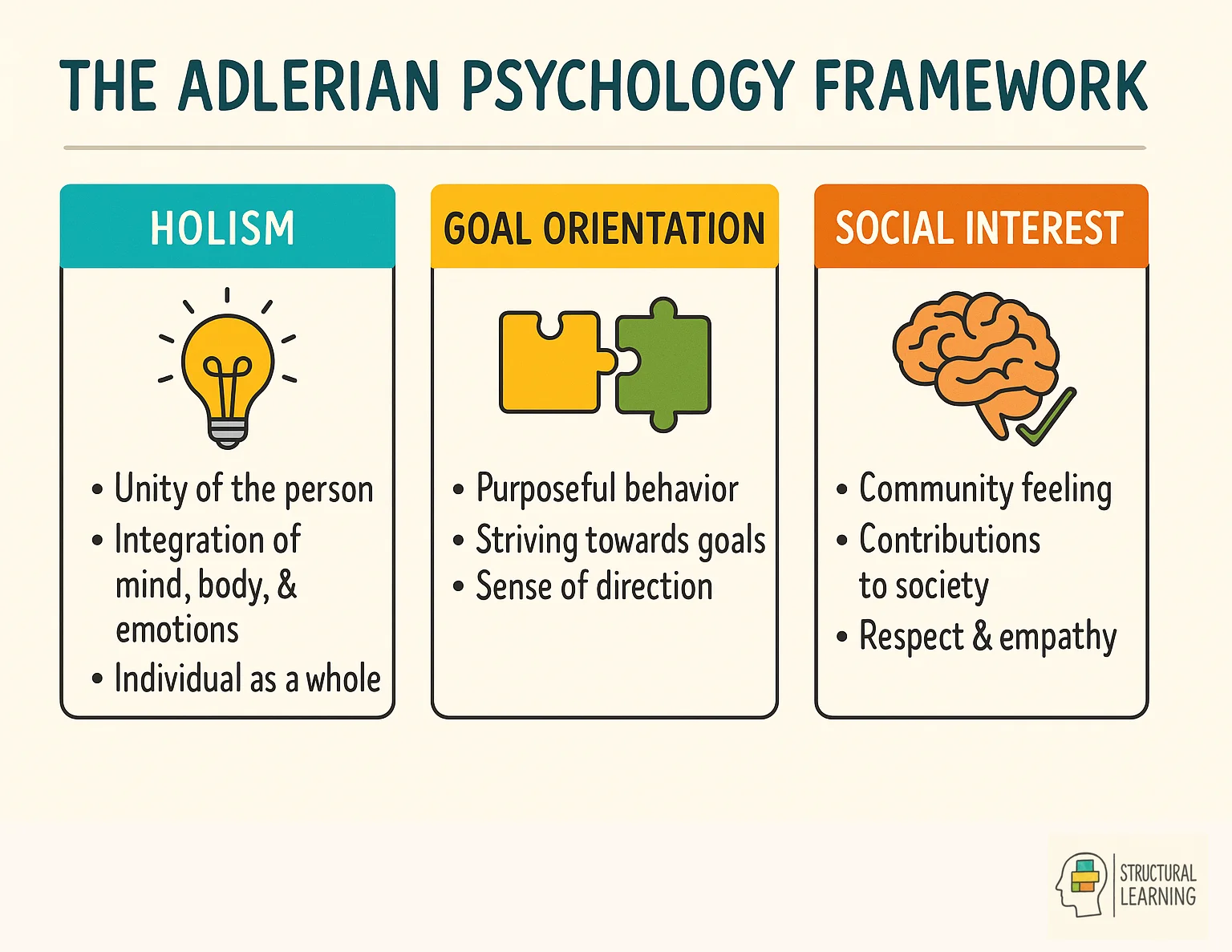
Adlerian Psychology, from Alfred Adler, focuses on individual feelings. Learners often feel inferior, Adler noted. They then act to manage those feelings (Adler, 1927).
Evidence overview
Dreikurs described four mistaken goals of children's misbehaviour: attention, power, revenge and assumed inadequacy; teachers can use these as interpretive clues in classroom practice (Dreikurs & Soltz, 1964, Children: The Challenge). Hattie (2009) says relationships matter (d = 0.72), backing Adler's focus on belonging. Behaviour interventions that build positive relationships and a sense of belonging share principles with Adlerian psychology, and the EEF reports such approaches can support learner progress (Education Endowment Foundation, 2021).
Adler (1927) thought inferiority feelings push learners to seek superiority. This ambition shapes a learner's behaviour and personality. These feelings give learners motivation, according to Adler.
Adlerian psychology values social feeling and community. Adler (1927) said interactions shape how learners behave. Childhood memories strongly impact adult behaviour, Adler proposed. Counselling uses this idea (Adler, 1927).
This exploration aims to build self-awareness and encourage a sense of belonging (Adler, 1927). The therapist helps the learner understand their unique life goals and how these goals influence their behaviour. They address mistaken beliefs that hinder growth, aiming for positive change (Dreikurs, 1950). Adlerian therapy helps learners find meaning and purpose (Ansbacher & Ansbacher, 1956).
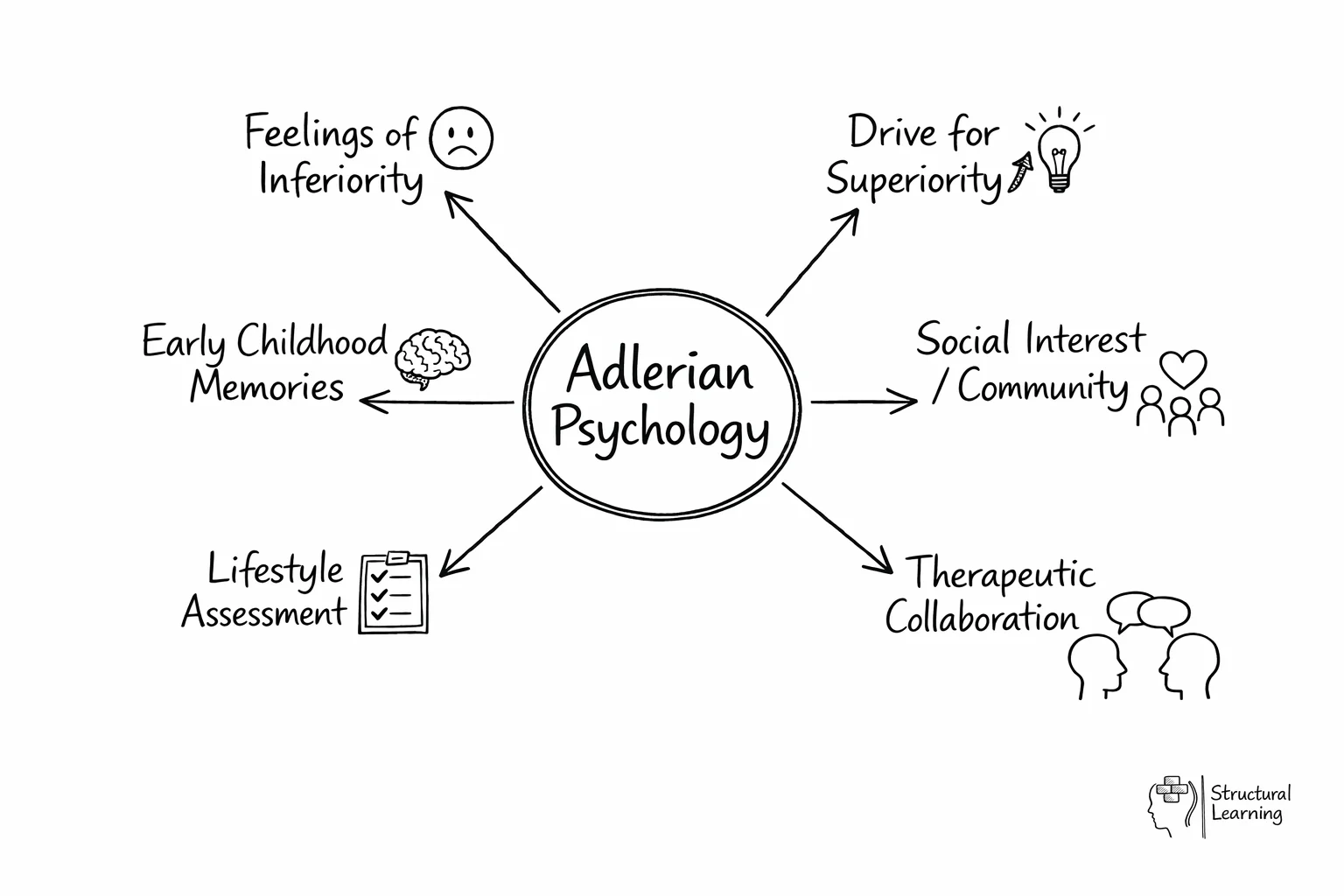
Adlerian counselling aims to build social interest in learners. It helps them develop healthier coping strategies (Corey, 2017). This encourages movement toward a more meaningful life (Watts, 2003; Feltham & Dryden, 1993).
Adler's ideas (1927, 1930) help with therapy, counselling and education. He shaped object relations theory. Functionalism in psychology is associated mainly with William James, John Dewey and James Rowland Angell; Adler's influence is better stated as influencing individual psychology, Adlerian counselling and Dreikursian classroom practice.
Here are some key insights:
Adlerian therapy can support mental health and helps learners facing different challenges (Adler, 1927; Carlson, Watts & Maniacci, 2006).
Osterman (2000) reviewed the importance of school belonging for engagement and participation, though this is not direct evidence for the effects of Adlerian counselling.
"The only normal people are the ones you don't know very well.", Alfred Adler
Adler treated early memories as clues to the story a learner tells about themselves. A memory does not need to be fully accurate to matter. It can still shape confidence, risk-taking and trust. Teachers should treat these patterns as prompts for support, not proof of hidden causes.
Adler believed early memories shape a learner's beliefs and behaviour. These memories significantly impact their sense of self (Adler, 1927). Early memories can help explain current issues (Adler, 1927).
Adlerian therapy uses early memories. Therapists explore and confront these memories (Adler, 1927). This task can be hard for learners. They must examine their past and face painful experiences (Dreikurs, 1967).
Rogers (1961) and Maslow (1943) showed that facing struggles builds self-understanding. Learners gain rewards when they tackle problems head-on. This approach mirrors ideas in Humanistic Psychology.
Adlerian therapy is used to support people facing mental health difficulties. This approach helps learners facing anxiety, depression, or eating issues. It supports those with substance abuse (Adler, 1963; Dinkmeyer & Dreikurs, 2000). Therapy aims to build learner resilience.
Addressing the beliefs and experiences causing issues helps learners gain insight. They can build resilience and make positive changes. This involves improving attention to internal and external patterns.
Adler (1927) showed early memories affect current issues. With trained support, learners can explore these memories. This helps with healing and growth (Adler, 1927). Doing so can improve well-being (Adler, 1927).

Adlerian practice uses encouragement, goal review, early-memory work and careful attention to the purpose of behaviour. In school, teachers do not provide therapy. They can still use the same spirit: name effort, offer useful roles and help learners choose a better next action.
Adlerian therapists use techniques for learner understanding and better behaviour. Adler used lifestyle assessment (date not provided). Therapists explore early memories, family, and beliefs. This exploration shows each learner's approach to life.
Adler saw encouragement as vital. It values effort and growth, not just results. Learners gain real confidence (Adler). Goal setting helps learners understand their actions. Behaviour analysis reveals the purpose of actions (Adler; Mosak & Maniacci, 2011).
'Acting as if' helps learners behave like they have desired qualities. (Adler, 1927). This bridges the gap between limitations and growth. Paradoxical intention can help too (Frankl, 1960). Learners exaggerate behaviours, gaining insight and reducing them.
Adlerian techniques help teachers support learners' behaviour. Teachers use lifestyle assessment (Adler) to understand behaviour. A learner's family background helps teachers understand difficulties. Encouragement builds learner resilience and motivation (Adler, 1930s).
Adler thought social interest was a key therapy (Individual Psychology). Help learners see their connection with others and develop cooperation. Community projects or group work help, (Adler). Explore how goals match wider social contributions. This approach helps teachers greatly.
In classrooms, Adlerian psychology helps teachers ask what a behaviour is trying to achieve. A learner may seek attention, control, revenge or escape from failure. The response should meet the need safely: connection for attention, choice for power and small steps for avoidance.
Dreikurs (date missing) suggested logical consequences, not punishment. Learners see how choices affect results. If a learner disrupts group work, they work alone. This continues until they are ready to rejoin the team.
Adlerian theory emphasises social interest and cooperation as foundations for community life (Adler, 1964). Problem-solving meetings help. Dreikurs (1968) said teachers build belonging by valuing each learner's strengths. This prevents behaviour issues.
Social interest means feeling part of a group and wanting to contribute to it. In class, this looks like helping peers, taking shared responsibility and seeing mistakes as repairable. It matters because belonging can reduce defensive behaviour and make challenge feel safer.
Social interest builds psychological safety, improving learning. Learners connecting with peers and teachers easily ask questions (Adler, 1930). This encourages learners, preventing discouragement (Adler, 1930). Learners then see mistakes as learning opportunities (Adler, 1930).
Adler (1956) said teachers build social interest with respect. Dreikurs (1968) valued responsibility and problem-solving in classrooms. Mosak & Maniacci (2011) found peer support and group work built learner skills.
Adler used lifestyle to describe a person's learned pattern of beliefs, goals and coping habits. In school, a learner may seek attention, resist control or avoid hard work because these moves have protected them before. Teachers can change the pattern by changing the classroom response.
Adlerian psychology helps teachers understand learner behaviour patterns. Dreikurs found learners misbehave for attention, power, revenge, or avoidance. Teachers can identify these goals by watching learner behaviour (Dreikurs et al.).
Look for patterns in learner behaviour across situations. Learners who argue about instructions, deadlines, or group work may seek power (Dreikurs, 1968). Offer choices and leadership instead of power struggles (Adler, 1927). This meets their needs constructively and maintains order (Albert, 2003).
These foundational works explore Adlerian psychology and its classroom applications: For related guidance, see our article on Counselling Theories.
Understanding Human Nature View study ↗
Classic text
Adler, A. (1927)
Adler (1927) argues that a sense of belonging and social interest underpin healthy development. Teachers can use this lens to understand pupil motivation: behaviour often reflects an attempt to find a place in the group rather than wilful defiance.
Psychology in the Classroom View study ↗
~500 citations
Dreikurs, R. (1968)
Dreikurs (1968) found encouragement and consequences help learners succeed. Adler (1930) showed that knowing why learners misbehave is important. These ideas improve classroom management and raise learner achievement.
Adlerian counseling and psychotherapy: A practitioner's approach View study ↗
~400 citations
Sweeney, T.J. (2009)
Adlerian theory helps learners feel socially connected. We offer practical techniques for classrooms. These help promote belonging (Adler, 1956; Dinkmeyer & Dreikurs, 1963). This guide assists teachers in building learner social interest.
Adler's original contributions regarding the need to belong View study ↗
~300 citations
Ferguson, E.D. (2010)
Adler (1930) saw social interest as key for learners' sense of belonging. This belonging helps create inclusive classrooms where all learners feel valued.
Adlerian therapy: Theory and practise View study ↗
~600 citations
Carlson, J. et al. (2006)
Adlerian ideas encourage teachers to support learners. Understanding lifestyles improves classroom relationships. This aids classroom management (Adler). Dinkmeyer & Dreikurs (1963) and Grunwald & McAbee (1998) support this research.
Free for teachers. The platform builds a classroom-ready lesson plan from your topic in under two minutes.
Adlerian psychology highlights a learner's need for belonging and social connection. It suggests behaviour aims to overcome feelings of inadequacy (Adler). This helps teachers understand learner motivations and interactions (Adler, 1927).
Teachers use these principles to build fair classrooms. Every learner should feel important (Adler, 1964). Staff encourage effort instead of just praising outcomes (Dweck, 2006). Learners understand consequences, not punishments, for better choices (Dreikurs, 1968).
Rudolf Dreikurs identified four mistaken goals that drive challenging behaviour: attention, power, revenge, and assumed inadequacy. Teachers can use these categories to diagnose why a learner is acting out and provide more constructive ways for them to find a sense of belonging. By identifying the specific goal, staff can respond with targeted strategies that address the root cause of the disruption.
Belonging boosts learner engagement, research shows (Goodenow, 1993). Connected learners risk more and collaborate better, say Osterman (2000) and Finn (1989). Meeting needs early may reduce disruptions (Maslow, 1943).
School counselling that draws on Adlerian principles can support learner attitudes and mental health. Adler (1927) argued that community focus benefits both learners and teachers.
Researchers Dreikurs and Cassel (1972) found consequences differ from punishment. Ignoring a learner's need for belonging also creates problems (Mosak & Maniacci, 2011). Schools need a consistent behaviour policy, say Charles et al. (2018).
Encouragement names effort, strategy and contribution. Praise often judges the finished product or the learner's ability. In Adlerian terms, encouragement is safer because it helps learners feel capable without making approval depend on being the best, quickest or most compliant.
Praise can create learner reliance on others and fear of mistakes, says Adlerian psychology. Learners praised for "smarts" may avoid tough tasks. Encouragement builds resilience by valuing effort, aligning with Adler's focus on responsibility.
Give learners descriptive feedback showing effort. Praising colour use, not ranking artists, is better. Dweck (2006) showed a growth mindset builds confidence. Adlerian theory says this develops "social interest" in learners.
Adlerian psychology gives teachers useful language for belonging, purpose and encouragement, but it is not a full behaviour policy or a diagnostic system. Many classroom claims come from theory, counselling practice and later Adlerian writers rather than large modern trials.
The strongest current evidence supports the broader idea that school belonging matters. Recent belonging research often uses socio-ecological models, not Adlerian theory alone. Teachers should therefore use Adlerian ideas as a practical lens, while still relying on safeguarding, SEND processes and school-wide behaviour systems.
Adler, A. (1927). Understanding human nature. Greenberg.
Adler, A. (1930). The education of children. Gateway Editions.
Ansbacher, H. L., & Ansbacher, R. R. (1956). The individual psychology of Alfred Adler. Basic Books.
Dreikurs, R. (1968). Psychology in the classroom. Harper & Row.
Dreikurs, R., & Soltz, V. (1964). Children: The challenge. Hawthorn Books.
Goodenow, C. (1993). The psychological sense of school membership among adolescents. Psychology in the Schools, 30(1), 79-90.
Nelsen, J. (1981). Positive discipline. Ballantine Books.
Theory grounded. Classroom workable. Free for teachers.