Widgit Symbols: A Teacher's Guide to Visual
Widgit Symbols help teachers create visual resources for SEND learners. This guide covers setup, classroom use, and alternatives for visual communication.

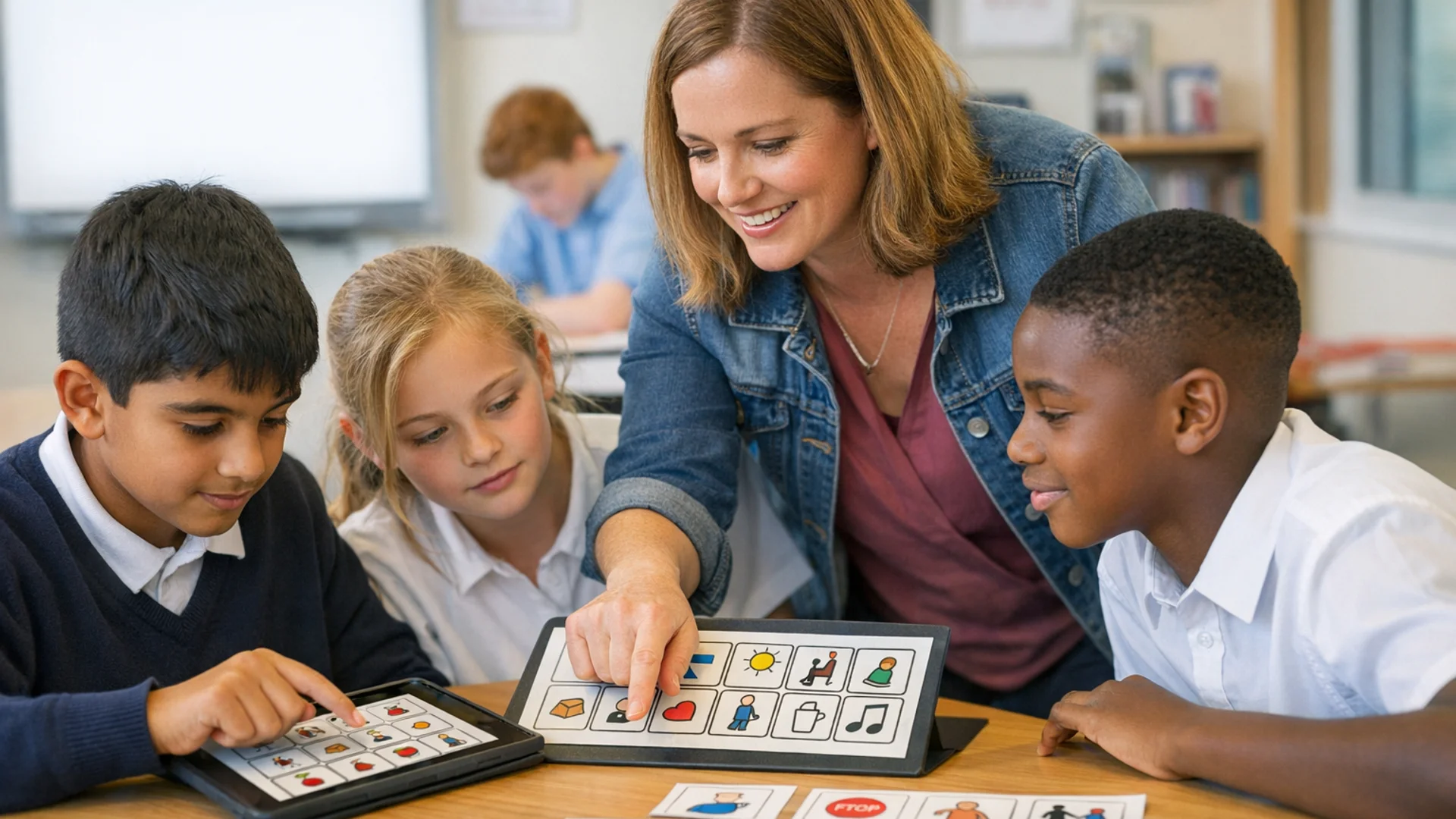
Widgit Symbols help teachers create visual resources for SEND learners. This guide covers setup, classroom use, and alternatives for visual communication.
Widgit Symbols: A Teacher's Guide to Visual helps teachers use Widgit Symbols in class. These graphic symbols make spoken language, written text, routines and curriculum words easier to access for learners who need visual communication support. Graphic symbols are part of augmentative and alternative communication, or AAC. In AAC, signs, symbols, speech and technology can help learners express themselves and understand others (Light and McNaughton, 2014).
In a Year 3 science lesson, for example, a teacher might pair the words evaporate, condense and predict with consistent symbols on the board, then remove some symbol prompts as learners begin to read the terms independently. The aim is not to decorate worksheets. It is to provide a shared visual language that helps learners follow instructions, join discussion and move towards less supported reading.
Widgit Symbols support communication and literacy. A UK company developed its 20,000+ images (Widgit, n.d.). Use it as a starting point for professional discussion: identify the learner's current need, record evidence from more than one lesson, and agree the next classroom adjustment with the SENCO or family.
A Year 2 teacher uses Widgit Online to print word mats. The software suggests symbols for 'character' or 'setting'. The teacher then uses these with learners.
Widgit Symbols aid learners with SEND needs, as the UK SEND Code of Practice defines. Learners on the autism spectrum often understand visuals better than spoken instructions.
Research shows that it supports comprehension (Clark & Paivio, 1991). Carney and Ray (2010) found that images help learners recall information. Dwyer (1972) also noted that visuals improved learner achievement, so visual grammar can support language development for all.

Widgit symbols help learners with text communication. Clicking symbols builds a visual sentence to show this (Widgit, n.d.). The activity supports learners experiencing literacy challenges (Wright & Kersner, 2018).
From Structural Learning | structural-learning.com
Paivio's (1971) Dual Coding Theory says humans use verbal and visual channels. Using both words and symbols in learning helps learners remember facts. This engages both channels and supports long-term encoding.
Cognitive Load Theory explains this. SEND learners often find complex text hard to process. Hurtado et al. (2014) found that symbols help.
A teacher saw a Year 4 learner with dyslexia struggle. They used a checklist, and the learner started quickly.
Visual aids need a standard place in teaching for success. A SENCO can audit the school's visuals.
Staff training helps teachers design clear resources. It covers software use and teaching methods. Teachers learn to pick key words for support and use colour for grammar. This boosts learner understanding.
A SENCO leads a staff meeting where teachers create visual timetables using a standardised template. The SENCO explains that PE must always use the same symbol of a child running across every year group. This consistency helps a learner with an Education, Health and Care Plan feel secure as they move between different rooms.
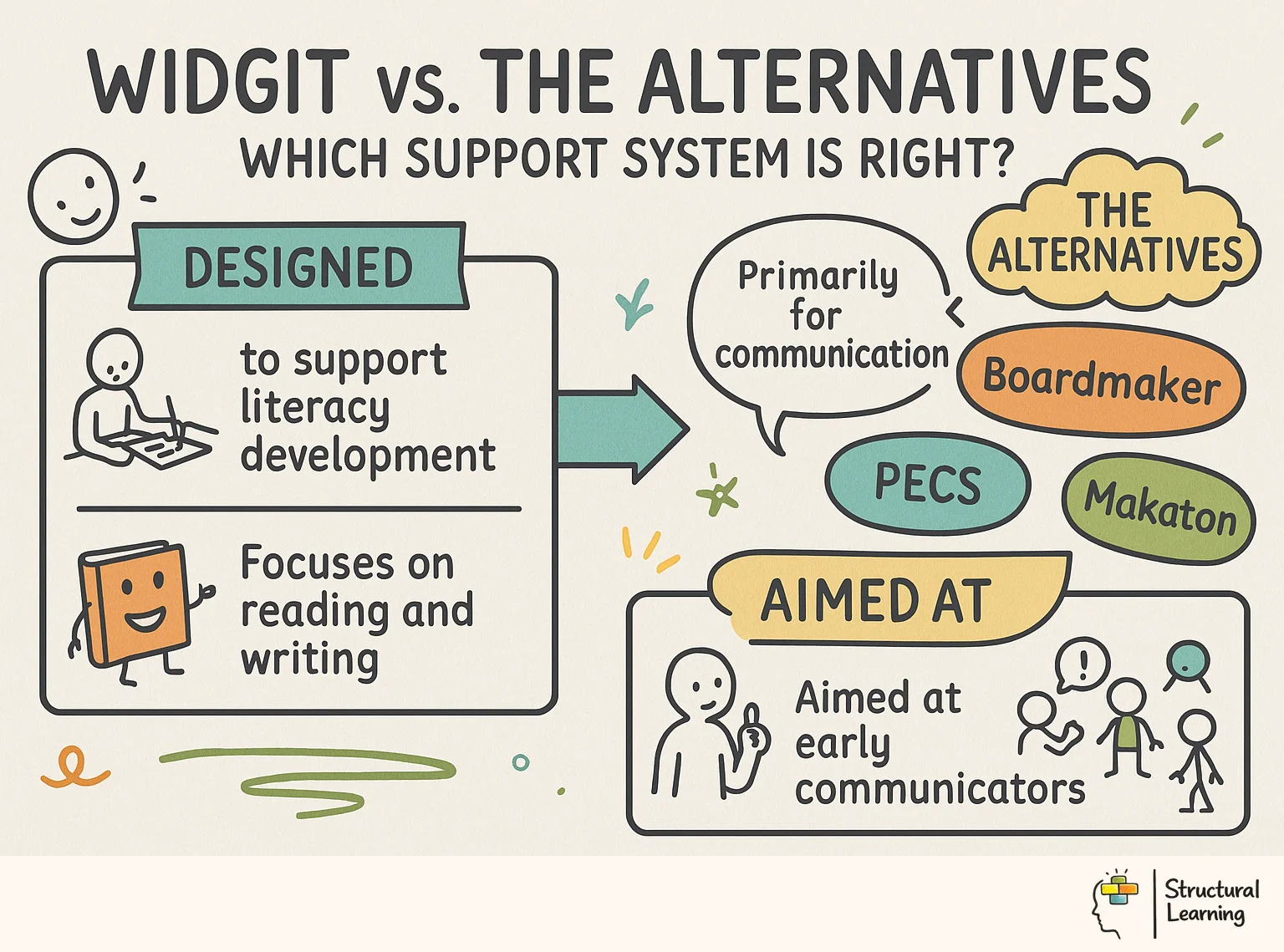
Schools often compare Widgit with other established programmes. Each system suits different types of learners and environments. A SENCO must match the right tool to the specific needs of each learner.
| Feature | Widgit Symbols | Boardmaker (PCS) | PECS | Makaton |
|:--- |:--- |:--- |:--- |:--- |
They share key learner details fast (Copley & Ziviani, 2004). Teachers can use them to understand needs more clearly (Porter & Lacey, 2005).
, 2020).
| Core Audience | Schools, literacy and general SEND | Special schools and complex AAC | Non-verbal and autistic learners | SLCN,
Research shows Widgit Symbols support learners' routines and curriculum access. Learners use them on timetables and word mats. They help learners who struggle with auditory processing stay engaged (Hetzroni & Tannous, 2004). Symbols visually support verbal language, benefiting many learners (Goodman & Mirenda, 2002).
Costs vary depending on the number of users and the software version. Schools typically pay a subscription for Widgit Online, priced across Standard, Plus and Pro school plans, with Enterprise pricing for MATs and larger organisations. Check Widgit's current 2026 plan page before publication because VAT treatment and licence limits vary by plan (Widgit Software, 2026). InPrint 3 is available as a perpetual licence per computer for schools that do not require cloud access.
Makaton supports early communication through signs, symbols, and speech. Neither system is better.
Widgit helps autistic learners by making the school day more predictable. 'Now and next' boards and visual timetables can support them (Hetzroni & Harris, 1996). When symbols stay consistent, learners face less uncertainty. This can improve focus in school (Gray & Garrood, 2009).
The company often offers free, ready-made resource packs for events. Paid subscriptions are also common.
Some UK councils hold central licenses, so schools can use the software freely.
PECS helps non-verbal learners begin to communicate. Widgit's symbol library supports literacy and classroom management. Learners may also use Widgit symbols in their PECS folder (Bondy & Frost, 1994; Lloyd & Blischak, 2009).
Print out a Widgit 'Now and Next' board today and use it with a learner during your next lesson to manage a transition.
Widgit Symbols should not be treated as a neutral cure for every communication barrier. Research on graphic symbol use shows that iconicity is uneven: some symbols look obvious to adults but are not transparent to learners with severe intellectual disabilities, younger learners or learners with limited cultural access to the pictured concept (Stephenson, 2009). This means teachers still need explicit teaching, checking and learner choice, not just symbol labels on every worksheet.
A second limit is the risk of a symbol plateau. If every keyword remains permanently paired with a symbol, some learners may rely on the prompt rather than building independent word recognition. Scaffolding is strongest when support is adjusted and faded as competence grows (Wood, Bruner and Ross, 1976; Collins et al., 1989). Schools should plan when symbols stay for access and when they are gradually withdrawn for reading practice.
Third, dual coding should be applied carefully in SEND settings. Paivio's account of verbal and visual channels is useful, but it does not prove that simultaneous speech, text and images reduce load for every autistic learner. Monotropism research suggests that some autistic learners may process a narrower field of attention, so busy symbol rich pages can increase demand rather than lower it (Murray, Lesser and Lawson, 2005).
There are also cultural and technical limits. Studies of graphic symbol perception across cultures show that symbol meaning can vary by lived experience (Huer, 2000). In 2026, AI-generated classroom images add further risks because they may be inconsistent, biased or visually plausible but semantically unclear (Porayska-Pomsta, Holmes and Nemorin, 2024). Used with assessment, consistency and planned fading, Widgit Symbols remain a valuable route into language, curriculum access and participation.
These peer-reviewed studies provide the evidence base for the strategies discussed in this article.
, 2021). Pictures improve understanding and recall (Houts et al., 2006). Visuals help learners engage with health information (Dowse & Ehlers, 2013)., 2010). More research must examine image effectiveness ( ফ্রাঙ্কেল & ফ্রেন্ডেনবার্গার, 2008).
Free for teachers. Visual schedules, sensory adaptations, low-demand routines, built into the plan.
Widgit Symbols aid communication and literacy with 20,000+ images. Schools use them for timetables, boards, and tailored worksheets. They offer visuals that help learners process instructions and boost independence.
Dual coding theory (Paivio, 1971) shows visuals and words boost memory. Learners process information via two paths when hearing instructions and seeing symbols. This lowers cognitive load, letting learners engage faster (Sadoski, 2005; Clark & Paivio, 1991).
Worksheets often have too many symbols, overloading the learner (Hattie, 2009). Teachers, symbolise only key words and verbs (Archer & Hughes, 2011). Inconsistent symbol use hinders learners' visual vocabulary (Snowling & Hulme, 2011).
Njabulo Mbanda et al. (2020)
Searches of peer-reviewed and grey literature were conducted between January 2000 and March 2024. Data charting was performed using a pre-determined template based on Arksey and O'Malley's (2005) framework. RESULTS Key themes were synthesised and are presented narratively. DISCUSSION Visual aids show promise for health education with low-literacy learners. More research is needed (Nutbeam, 2000; Sorensen et al., 2012).
Common ground in AAC: how children who use AAC and teaching staff shape interaction in the multimodal classroom View study ↗
17 citations
Seray B. Ibrahim et al. (2023)
Researchers explore communication for learners using AAC. Mutual understanding can be hard in classrooms (Light, 1989). Staff may struggle to understand a learner's unaided AAC attempts (Iacono et al., 2016; Soto & Clarke, 2009). Task goals become difficult to achieve with AAC (Cress & Marvin, 2003).
Visual schedules, sensory adaptations, low-demand routines. Built in.
Open a free account and help organise learners' thinking with evidence-based graphic organisers. Reduce cognitive load and guide schema building dynamically.
Cummings (2000).
Goodman (1996).
Gray and Chappell (1998).
Griffin et al. (2006).
Gross (2018).
Grove (2023).
Hattie (2009).
Houts et al. (2006).
Huer (2000).
Johnson et al. (2020).
Light (1989).
Light and McNaughton (2014).
Paivio (1971).
Soares et al. (2021).
Stephenson (2009).
Wright (2010).