Updated on
September 17, 2026
White Rose Maths Review 2026: Costs, Mastery, Free Access
Independent White Rose Maths review covering the mastery approach, small steps, resources, costs and classroom implementation for UK primary teachers.


Updated on
September 17, 2026
Independent White Rose Maths review covering the mastery approach, small steps, resources, costs and classroom implementation for UK primary teachers.
What is White Rose Maths?
White Rose Maths is a widely used UK maths curriculum and resource programme built around mastery, small sequenced steps, the concrete-pictorial-abstract approach, and regular assessment. For teachers, it provides a coherent scheme of learning with planning and resources, though it works best when teachers adapt its small steps to their own class.
White Rose Maths Review 2026 is an evaluation for teachers of White Rose Maths. White Rose Maths is a UK maths curriculum and resource programme built around mastery, small steps, concrete-pictorial-abstract representation and regular assessment. The review matters because many primary, secondary and post-16 settings now use White Rose as a planning spine, but the evidence base is mixed. NFER's evaluation of Reception Jigsaw found one extra month of maths progress on average, but the result was not statistically significant (Tang et al., 2023).
In a Year 4 fractions lesson, this means checking what learners need before they move to abstract notation. Some may need counters and bar models. Others may need a paired explanation or a harder comparison task. The review helps teachers keep the useful structure while protecting time for reasoning, SEND adaptation, retrieval practice and teacher judgement.
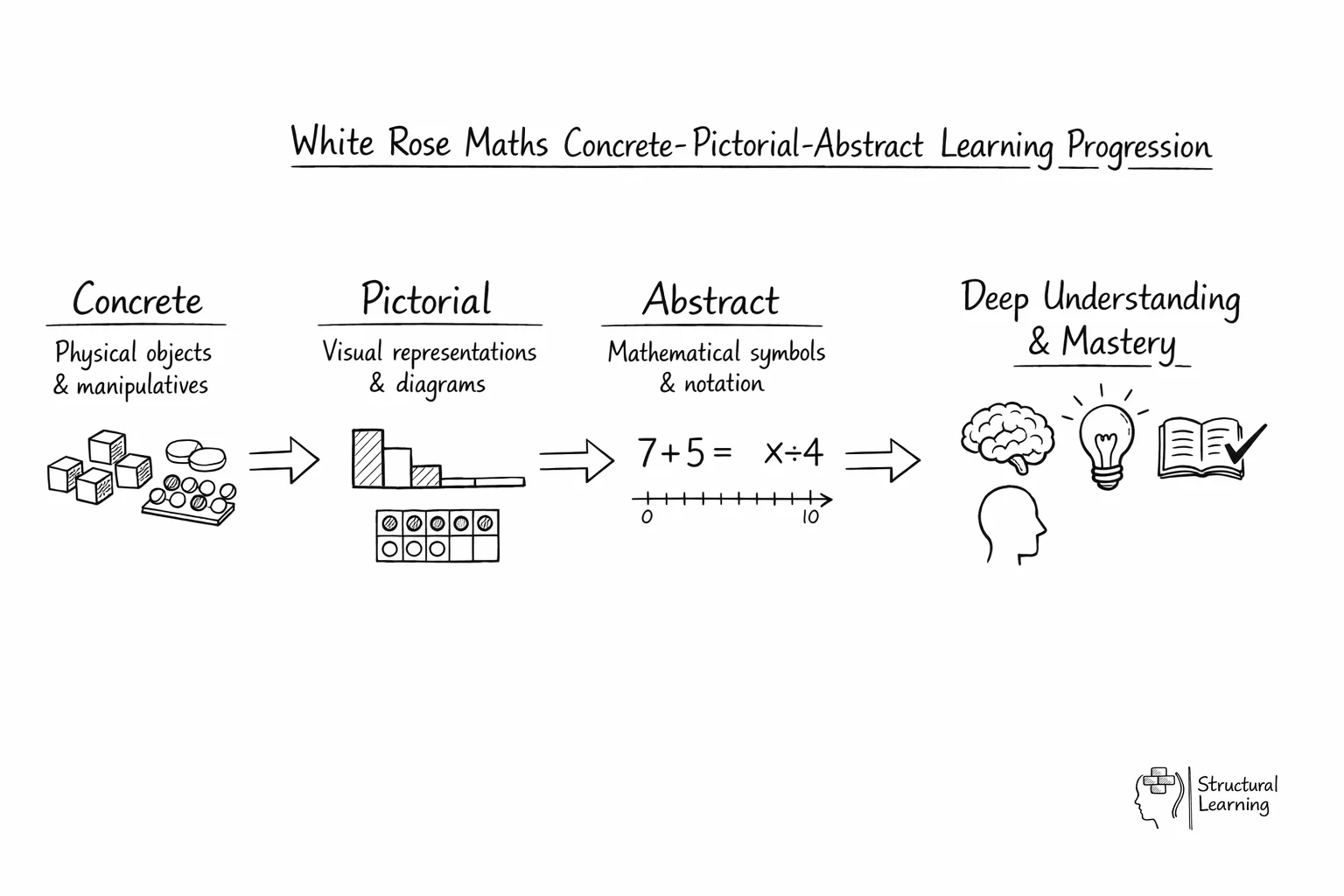
White Rose Maths uses small steps for deep understanding. Learners use objects, then pictures, then symbols. This approach, for ages 3 to 18, builds problem-solving skills. Research by supports this method.
White Rose Maths helps learners understand maths fully. Primary and secondary schools use this approach. It improves maths skills and problem-solving for learners.
The core of White Rose Maths is the maths mastery approach, which focuses on depth rather than acceleration, ensuring that key concepts are fully grasped before moving on. For more on this topic, see Maths curriculum review questions. This approach aligns with the Learning Objectivesof a range of school years, providing a coherent and connected curriculum.
Researchers suggest this is effective scaffolding (Wood et al., 1976). Primary schools use methods like White Rose Maths for fraction introduction. They use visuals and activities before abstract ideas. This helps learners build firm foundations, as Bruner (1960) argued when describing how learners move from action and imagery towards symbolic thinking.
White Rose Maths is best used as a planning spine, not a script. In a Year 5 fractions unit, a teacher might keep the small-step sequence but add a comparison problem that makes learners choose between a bar model, number line or written method. That preserves productive struggle, which build (2019) treats as part of serious mathematical task design.
White Rose Maths helps learners build fluency, reasoning, and problem-solving. Learners need to understand concepts fully before they move on. In this mastery approach, depth matters more than speed. This builds understanding and mathematical confidence.
White Rose Maths aims to make teaching mathematics easier and more effective.
White Rose Maths gives learners a strong maths foundation. This curriculum helps learners deeply understand and enjoy maths problems. Sequencing content well builds depth, as Boaler (2009) and Hattie (2008) found.
Many schools do not have time to write a coherent maths sequence from scratch. White Rose reduces that workload, but implementation still carries costs: subject-leader release time, staff CPD, intervention staffing, assessment moderation and cover for teachers learning the model. Across a multi-academy trust, those costs matter more than the headline price of worksheets.
This programme is not just about teaching maths, it is about developing mathematical thinking skills. The aim of this programme is to ensure that learners are able to think mathematically and solve problems with confidence.
"Our aim is for young mathematicians to become:
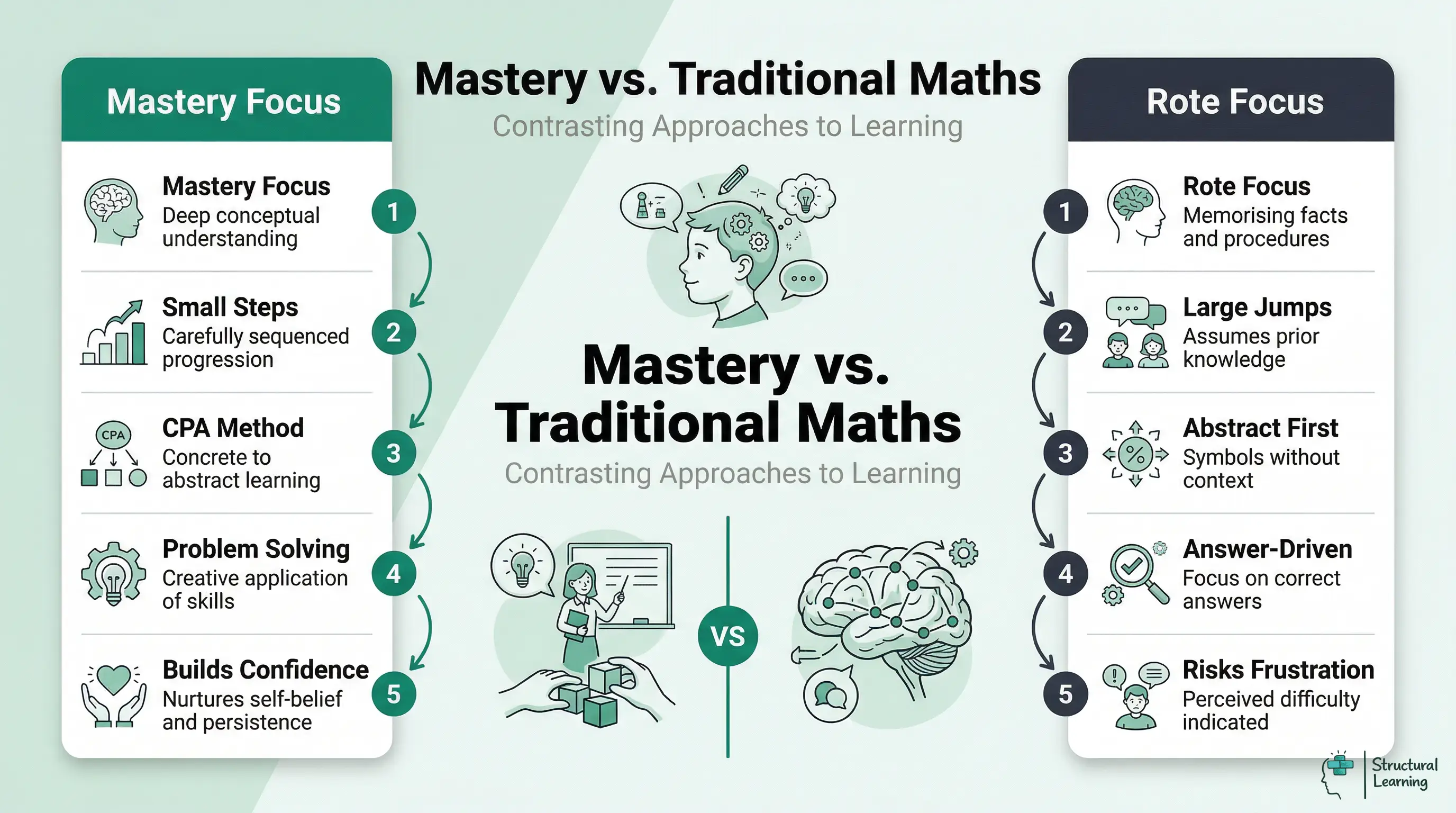
Mastery aims to make maths enjoyable and to address concerns about abstract teaching. Learners build deep understanding instead of relying on memorisation. This approach also builds self-belief, persistence and resilience.
White Rose Maths offers a 'small steps' progression and yearly frameworks, which allow children to learn at their ownpace while still achieving high standards.
White Rose Maths helps learners understand maths by moving from objects to pictures and then to abstract ideas. This works best when teachers add guided talk, peer explanation and clear modelling at the right time. Vygotsky (1978) described this as socially mediated learning, where learners build knowledge through interaction.
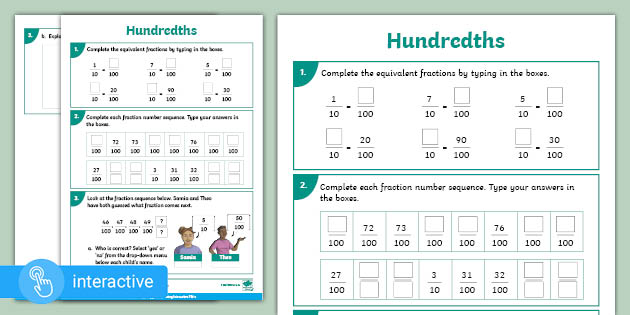
White Rose Maths (ages 3-18) structures learning across key stages. Each year group follows small, sequenced steps building on prior learning. This ensures mathematical concepts progress through concrete, pictorial, and abstract representations (White Rose Maths).
White Rose Maths breaks content into small steps for learners aged 3-18. Each year group follows a clear progression, revisiting topics. Teachers can adapt pacing to suit learners' needs, in line with national standards.
The White Rose Curriculum covers Early Years, Years 1 to 11, Post 16 and mixed-age planning. Autumn, Spring and Summer blocks give teachers a shared sequence, while Version 3.0 revised the order and timing of some blocks so earlier learning is revisited more directly after the pandemic (White Rose Education, n.d.).
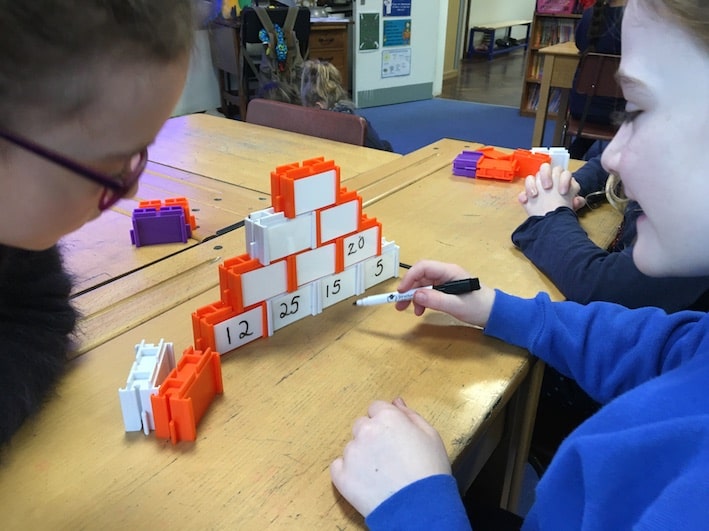
In Early Years, each term is split into sub-terms with up to 15 sessions. A shape unit might begin with sorting real objects, move to pictures of shapes, then ask learners to explain why a triangle is still a triangle when it is rotated. The free and premium resources give teachers a starting point, but classroom talk and observation still decide the pace.
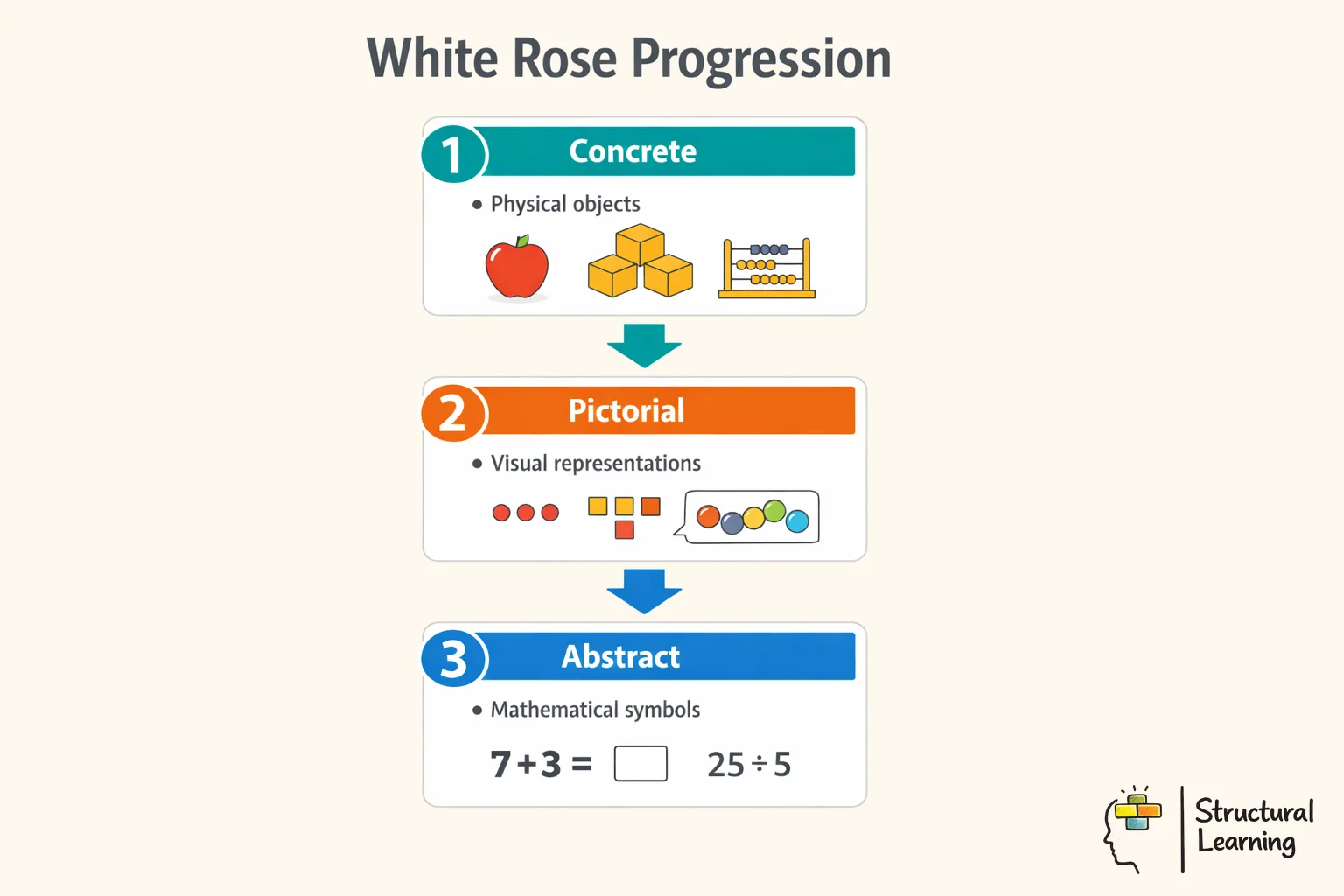
Shape schemes can start a sub-term. Worksheets guide learners to recognise basic shapes. Activities help them understand properties (Piaget, 1954; Bruner, 1966). This builds a good grasp of the concept (Vygotsky, 1978).
White Rose Curriculum aims for complete learner development. It nurtures curiosity, creativity and critical thinking,. This goes beyond simple maths teaching. Learners gain wider skills,.
Downloading resources from their website makes it easier for teachers. This allows educators to smoothly integrate materials into their lessons.
White Rose Curriculum blends teaching theory with real classroom use. It acknowledges learning is complex, aiming to engage each learner in a valuable education.
Key Insights and Important Facts:
White Rose Maths premium resources include plans, assessments and varied practice. Leaders still need to cost the full implementation model. The real budget includes CPD time, subject-leader coaching, assessment moderation, cover and staff retention. Premium access saves planning time only when teachers can adapt the materials for their own classes.
Mastery approaches in mathematics are explained in our guide. Read it for a full picture of this method.
White Rose Education now separates free resources from premium subscription options. Exact costs depend on the selected resource package, year group, subject and licence needs, so schools should use the official White Rose Package Builder guidance or the White Rose subscription flow for current 12-month pricing.
For classroom planning, leaders should budget beyond the subscription line: teacher CPD, assessment moderation, subject-leader coaching and time to adapt materials for pupils with different prior knowledge all affect the real implementation cost.
Each term has been designed to cover the same content and assessment requirements as the previous term. The workbooks are available in two formats, print and digital. Print books are delivered via post within 5 working days of ordering. Digital books are delivered instantly via email.
White Rose Maths starts with free scheme downloads; adapt lessons to your class. Teachers use objects first, then pictures, finally abstract ideas. Training helps you teach for mastery (White Rose Maths, n.d.).
Know your small steps progression and use the free scheme to plan. Use concrete, pictorial and abstract representations only when they clarify the idea. Digital manipulatives, such as virtual ten frames or bar models, can help when physical equipment is limited, but teachers should still ask learners to explain the mathematical structure. Use assessment checkpoints as Wiliam (2011) recommends: identify misconceptions, adjust pacing and do not rush content.
These teacher notes tackle common misconceptions. They also cover key vocabulary and instructions, helping learners think critically. The notes are provided in English.
Teachers can print the PDF files and use them with their learners. Or they can order the more cost-effective printed workbooks.
The workbooks contain all the required maths worksheets for the whole term. They come in a handy format so that you can easily carry them around. The worksheets are printed in full colour and are easy to read.
The workbooks are designed to be used by both teachers and learners. They contain exercises, lessons and activities that cover a wide range of mathematical topics, including fractions, decimals, algebra and more.
Free learning audit
Two quick ratings and two questions. We'll show you where your school sits and give you the learner observation toolkit (PDF).
White Rose Maths offers free parent resources, like videos and worksheets. These support home learning. Families can find age-appropriate materials on their website. The structure aids parents with clear paths and daily lessons (White Rose Maths).
White Rose offers free home learning for parent educators. Videos and worksheets match each curriculum step. Parents follow the sequence easily; videos explain maths clearly. Resources include answer keys and guidance notes for effective support.
A lot of parents are wondering how to help their kids with their math education. There is a lot of information out there, and it can be difficult to know where to start. White Rose Maths has created a roadmap that will help you through the complicated learning steps and blocks of learning.
White Rose Maths is an online resource for parents looking for advice on how to support their child's math education. The site provides a roadmap with all the important learning steps and blocks of learning so you can understand what your child should be doing at each stage in order to succeed in math.
Homeschooling families have many challenges to face when trying to get their child(ren) ready for the first day of school. These challenges include finding suitable materials, getting organised and keeping up with the changing demands of the curriculum.
With White Rose Maths, this is no longer an issue. You can simply download the relevant workbook for the current term and start using it straight away.
White Rose Maths uses Singapore mastery and Bruner's (1966) CPA. The programme also includes cognitive load theory and spaced practice research. Concepts build through careful sequencing, which helps avoid overload. Learners gain deeper understanding (Sweller, 1988; Rohrer, 2006).
White Rose Maths brings together mastery learning and Bloom's taxonomy of cognitive demand (Bloom, 1956). It also uses cognitive load theory, retrieval practice and concrete-pictorial-abstract representation. It draws on Singapore and Shanghai teaching traditions, but schools cannot simply import these approaches. Culture, tutoring, curriculum time and teacher development all affect how they work (Jerrim & Vignoles, 2016; Boylan & Adams, 2023).
White Rose Maths links to many educational ideas, not just lesson instructions. One link is Piaget's (1936) work on cognitive development. It also connects with Vygotsky's (1978) social constructivism. Bruner's (1966) scaffolding theory is another useful link.
White Rose Maths blends education theories and practices. It actively recognises learning's many sides and provides a framework for engaging learners. (White Rose Maths, n.d.; Skemp, 1976; Bruner, 1966; Vygotsky, 1978)
White Rose provides free schemes of learning alongside premium subscription resources. Because current costs depend on the package, user licence and resource mix, avoid relying on old price lists; use the official White Rose Package Builder guidance or subscription checkout for the current 12-month price breakdown.
White Rose Maths offers both free and premium resources, which can make it accessible for schools with different budgets.
The White Rose Maths scheme and structured small-steps progression include free resources that primary teachers can use for planning.
Premium access may include editable teaching slides, assessments, worksheets and related support materials. Check White Rose Education directly for current availability and pricing for your school size.
White Rose Maths works in over 15 countries, including Australia and New Zealand. The programme adapts to varied curriculum needs, keeping its mastery principles. International schools report learners achieve better maths results (White Rose Maths).
White Rose Maths is used beyond the UK. However, this does not prove that mastery works in the same way across cultural and language barriers. East Asian systems combine curriculum design with different lesson-study traditions, parental expectations and out-of-school tutoring. In UK schools, the model needs local adaptation, especially for multilingual learners and learners whose prior knowledge is uneven (Jerrim & Vignoles, 2016; Boylan & Adams, 2023).
Yes. White Rose Maths has been developed by a team of educational experts and teachers to be used in any country. Even if you follow a different scheme in your country or curriculum, you will still be able to use the same books.
White Rose Maths is a flexible, standalone resource that can be used with any curriculum or teaching style. It can be used as additional support for teaching and learning, wherever you are in the world.
The White Rose Maths workbooks have been developed to make it easier for children to learn maths at home, while still being able to use their school textbooks.
White Rose Maths offers free resources and paid subscription options. Teachers and leaders should check the official White Rose subscription flow for current prices, because package costs depend on resource selection and licence requirements.
Free resources can support planning and sequencing, while premium access may add editable worksheets, assessments and related support materials. Year 6 teachers, for example, may use diagnostic materials to identify gaps before SATs revision.
Schools often mix free resources with paid subscriptions for key year groups or intervention priorities. The strongest budgeting decision considers teacher workload, CPD time and adaptation needs, not just the listed subscription price.
White Rose Maths uses blocks each year, giving teachers a clear path (Reception to Year 13). About 12 to 14 blocks fill each year. Autumn, spring, and summer terms map to the National Curriculum. Schools can still meet their specific needs (White Rose Maths).
In Reception and Key Stage 1, the blocks focus on number sense and place value, taking up roughly 50% of teaching time. For instance, Year 1 autumn term begins with 'Place Value within 10', dedicating four weeks to ensure learners develop secure foundations. This transitions into 'Addition and Subtraction within 10', where concrete resources like counters and ten frames support understanding. By Year 2, these concepts expand to numbers within 100, maintaining the same careful progression.
Key Stage 2 teaches more complex ideas while still reviewing the basics. In Year 3, learners meet formal methods after using mental maths strategies. Multiplication and division get three weeks each term. This spaced practice helps learners remember, says research (Ebbinghaus, 1885).
Year 6 spends six weeks on fractions, decimals, and percentages. The Education Endowment Foundation (EEF, 2017) calls these vital for later maths.
Secondary provision follows a five-year scheme from Years 7-11, with each block lasting 2-3 weeks. The spiral curriculum ensures topics like algebra appear multiple times with increasing complexity. Year 7 might spend two weeks on basic algebraic notation, whilst Year 9 extends this to quadratic expressions over three weeks. This structure allows teachers to address gaps whilst maintaining appropriate challenge for all learners.
These peer-reviewed studies provide the research foundation for the strategies discussed in this article.
H. E. Putri et al. (2020), Indonesian Journal of Primary Education
Research shows that using the Concrete-Pictorial-Abstract (CPA) approach significantly improves mathematical reasoning skills in primary school children. This suggests that White Rose Maths' CPA backbone can lead to measurable gains in pupils' reasoning abilities, not just their procedural fluency.
Research trends on learning mathematics with the CPA (Concrete-Pictorial-Abstract) approach
2 citations
Jasmine Salsabila Lutfi et al. (2024), PRISMA
A systematic review of 39 studies found that the CPA approach, originating in Singapore, positively impacts maths learning for all pupils. This research highlights the evidence base supporting White Rose Maths' CPA framework, particularly for teachers seeking to understand its wider application.
Enhancing Elementary Students' Numeracy Skills Through The Concrete Pictorial Abstract (CPA) Approach
6 citations
Tri Suryaningsih et al. (2025), Journal of Integrated Elementary Education
A 2025 study found that using the Concrete Pictorial Abstract (CPA) approach significantly improved Year 5 pupils' numeracy skills compared to traditional methods. This research reinforces the effectiveness of the CPA progression used in White Rose Maths, highlighting the importance of faithful implementation for optimal results.
White Rose Maths uses small steps to help learners understand concepts. Learners move from objects to pictures, then symbols (concrete-pictorial-abstract). This approach helps learners improve their problem-solving skills and build confidence.
The curriculum covers early years, primary, secondary and post-16 pathways, including GCSE resit planning. Content is split into Autumn, Spring and Summer terms, with sub-terms that revisit topics across the year. This structure gives teachers flexible pacing, but it still needs adaptation for SEND, mixed-age classes and learners with large gaps in prior knowledge.
White Rose Maths schools find better learner engagement and problem-solving (White Rose Maths, various dates). This method boosts maths confidence using mastery. It grows fluency, reasoning, and problem-solving. White Rose Maths closes learning gaps that other curricula miss.
White Rose Maths provides free resources and paid subscription options. Because current prices are handled through White Rose Education's subscription and package-builder process, schools should check the official site before quoting costs in budgets or parent communications.
Learners often benefit from moving from objects to visuals and then symbols, but CPA should not become a fixed ritual. For example, a dyscalculic learner may need ten frames for longer, while an autistic learner who already sees the numerical structure may find repeated concrete tasks distracting. Teachers should remove representations once they stop reducing cognitive load (Bruner, 1960; Sweller, 1988).
Schools often lack time to create maths materials. White Rose Maths provides well-sequenced resources for curriculums. Teachers should move to mastery approaches. This may mean changing topic pacing (White Rose Maths).
White Rose Maths offers ready-made resources that save time on material creation. Its schemes and small steps help teachers see the curriculum route, but speed should not be the goal. Teachers still need time to select tasks, check misconceptions and decide when learners need more practice, more representation or more challenge.
Bloom (1968).
Bloom (1956).
Bruner (1966).
Ebbinghaus (1885).
EEF (2017).
Schoenfeld (1985).
Sweller (1988).
Tang et al. (2023).
Vygotsky (1978).
Wiliam (2011).
Wood et al. (1976).