Updated on
September 9, 2026
What Is Inclusion in Education? Definition & Examples
What is inclusion in education? A clear definition with classroom examples, the benefits for learners, and the strategies teachers use to support it.

Updated on
September 9, 2026
What is inclusion in education? A clear definition with classroom examples, the benefits for learners, and the strategies teachers use to support it.
What is Inclusion? describes a planned way to help every learner belong, take part and learn well. It does this by removing barriers to participation, not by waiting for a diagnosis or lowering expectations. In education, this means designing teaching, assessment and classroom routines for learners with different abilities, languages, backgrounds and life circumstances. These learners can then work alongside their peers (Department for Education and Department of Health and Social Care, 2026).
For a Year 5 fractions lesson, inclusion could mean clear worked examples, vocabulary on the board, manipulatives on tables, a quiet choice for recording answers and live checks for understanding before independent practice. The aim is not to make thirty separate lessons, but to plan one shared route with enough access points for learners who need different forms of support.
Inclusion means that all learners take part fully and feel equally valued (Frederickson & Cline, 2002). It also means removing barriers, so everyone can contribute and succeed. Ainscow and Booth (2009) argue that diversity strengthens communities. Florian (2014) shows how education can transform lives through inclusion.
All learners benefit when an inclusive environment is developed in the classroom. This involves creating a safe and supportive learning space where differences are valued, respected, and celebrated.
Inclusive teaching gives learners varied routes into the same learning. It helps them access the curriculum through clear explanation, flexible materials, structured talk, movement, assistive technology and planned peer support. Every learner should feel welcome, accepted and valued. At the same time, teachers should still teach demanding knowledge and skills (Florian & Black-Hawkins, 2011; Ainscow & César, 2006).
True inclusion starts by finding barriers in the system before they block a learner's access to teaching, belonging or safety. For more on this topic, see Co teaching models inclusion. The emphasis is on adapting classroom routines, resources and adult support so the setting meets the learner, rather than expecting the learner to fit the setting.
Inclusive education gives children a fair route into school, knowledge and wider life. It is not only about sitting in the same classroom. It means that children who have often been excluded, including disabled learners, neurodivergent learners, children in poverty, young carers and speakers of minority languages, can access real learning opportunities with their peers.
Inclusive systems value the contributions learners of all backgrounds bring to the classroom and allow diverse groups to learn side by side. In UK schools, this also means recognising that need is fluid. Poverty, bereavement, trauma, caring responsibilities, language development or a delayed assessment can all create barriers before any formal SEND label is in place.
Researchers highlight key actions for inclusion. Schools need teacher training, building upgrades, and accessible materials (UNICEF). Communities should also tackle stigma and teach people why inclusive education matters (UNICEF).
Thomas and Loxley (2001) found that inclusive education works best when teachers accept learner differences. Teachers should support each learner's growth. This means considering physical, cognitive, academic, social, and emotional aspects.
Researchers have found that learners with disabilities can improve academically in inclusive settings when support is planned well. They can make gains in reading, writing, maths and social studies. They can also develop communication, self-regulation and peer relationships. Brown (1987) is useful here because metacognition, or thinking about learning, and executive control, or managing actions, help teachers plan prompts, routines and reflection so learners can take part with growing independence.
Including different learning modes helps all learners. Teachers can reach diverse learners more effectively with visual, auditory, and kinaesthetic methods.
Inclusive education occurs in shared classrooms (Inclusive Education Canada, 2020). These spaces improve inclusion because they provide benefits. Research shows the advantages of inclusive approaches for every learner.
Research by Thomas and Loxley (2001) shows that inclusive education helps every learner reach their potential. Careful planning in schools supports this process. Ainscow (2020) also highlights how inclusion benefits all learners.
Inclusion helps learners, communities, and society. Learners with disabilities gain belonging, improve social skills, and learn better. They learn with peers, build friendships, and join in fully. Inclusive education builds empathy and respect in all learners.
Inclusion helps teachers build skills and try new methods. It asks them to differentiate instruction, so they adapt teaching to meet all learners' needs. Teachers also work with specialists. Inclusive classrooms help every learner, whatever their background.
Problem-solving in inclusive settings is key. Learners build creative thinking by working together. Peer support helps all learners (Vygotsky, 1978).
Learners gain knowledge from diverse views. They share useful strategies, like for autism (Baron-Cohen, 2008). Peers use new methods to improve learning.
| Examples (This IS Inclusion) | Non-Examples (This is NOT Inclusion) |
|---|---|
| A classroom where a wheelchair user participates fully because the teacher has rearranged furniture and activities to ensure accessibility for all learners | A learner with disabilities placed in a regular classroom without any support or modifications, expected to keep up on their own |
| Teachers providing materials in multiple formats (visual, auditory, and hands-on) supports diverse learners through multisensory instruction, which research shows benefits all learners | Pulling learners with learning differences out of class for separate instruction in a resource room for most of the day |
| A school that renovates bathrooms, installs ramps, and trains all staff in inclusive practices to remove barriers for everyone | Having a special education wing where learners with disabilities attend separate classes with only other learners who have disabilities |
| Learners working in diverse groups where differences in ability, language, and background are seen as strengths that benefit everyone's learning | Allowing a learner with autism to sit in the back of the room but not participating in group activities or discussions with peers |
Inclusive classrooms improve attendance. Teachers also see learner engagement rise when they use these methods. Diverse strategies create active learning and help maintain learner interest. They engage learners of all abilities.
Inclusive classrooms value varied learner needs. Tomlinson (2014) found that differentiated instruction improves learner results. Assess each learner's strengths and needs quickly. Then use this information to shape your daily teaching (Tomlinson, 2014).
Flexible teaching methods and varied assessment help. Learners benefit from working together, as supported by Rose and Meyer (2002). Present content visually and verbally.
Give learners assessment choices. Accessible lessons help all learners when flexibility is designed from the start (Rose & Meyer, 2002).
Regularly reflect on strategies that help learners, then adapt your teaching. Simple changes can greatly improve learner engagement and achievement (Hattie, 2012). Allow extra time, use visual aids, or create quiet spaces (Willingham, 2009; Christodoulou, 2017).
Florian and Black-Hawkins highlight the need to plan inclusion, but planning alone cannot solve underfunded provision. Warnock (2005) later warned that mainstream placement without enough specialist support can fail the very learners it claims to include. During the EHCP crisis, placing a high-needs learner in a crowded mainstream classroom without staffing, training or timely advice is not inclusion. It is unmanaged risk for that learner, their peers and the teacher.
Leaders can reduce that risk by building Universal Design for Learning into day-to-day teaching. They should not rely on a one-to-one TA model that is hard to sustain. Rose and Meyer (2002) argue for several ways to access information, show understanding and stay engaged. In practice, this means shared planning time, common scaffolds, visual routines, assistive technology, flexible grouping and targeted specialist input for the learners who need it most.
Schools also need honest habits when they use evidence. Farrell (2000) and Lindsay (2007) both questioned how far positive inclusion findings transfer from well-supported research settings into standard state classrooms. A strategy that works in a funded pilot with specialist coaching may look very different in a Year 8 class of 32 learners with high absence, limited space and delayed external services. Leaders should judge inclusion through attendance, participation, curriculum access, wellbeing and progress, not placement data alone.
To make inclusion work, teachers need to understand barriers to learning. Learners with dyslexia may need multimodal teaching, using more than one way to learn, and extra time. Learners with ADHD often do well with routines, movement breaks and short task steps, while autistic learners may need clear, predictable systems and sensory adjustments. Post-pandemic attendance patterns also mean schools must plan for Emotionally Based School Avoidance, where belonging cannot depend only on whether the learner can enter the building every day (Education Policy Institute, 2025).
Learners benefit from Universal Design for Learning when it is specific enough to shape the lesson. CAST describes varied options for representation, engagement and expression. Sweller (1988) showed that working memory has limits. Clear instructions, worked examples and less visual clutter help learners process new information, which aligns with cognitive load theory.
Understanding each learner's strengths matters more than disability labels. Simple changes like written instructions boost learner progress. Flexible seating helps some learners, as do varied assessments. Work with SENCOs and reflect to improve inclusion.
Wiliam (2011) argued that formative assessment helps teachers respond while learning is still in progress. Adapt assessments to remove barriers, but keep the learning goal clear. Try presentations, projects, oral explanations, practical demonstrations or written options. Black and Wiliam (1998) showed that assessment supports learning when teachers use evidence to adjust teaching.
High expectations are key, with flexible routes to success. Assessment changes should remove barriers, not lower standards. A learner with dyslexia could get extra time on maths (e.g., same problems, assistive tech).
Learners from different cultures may have relatable assessment contexts. Learning objectives remain the same.
Ongoing feedback and learner self-evaluation are key in inclusive assessment. Teach learners assessment criteria, so they can monitor progress, building confidence (Black & Wiliam, 1998). Regular reviews, peer work, and clear rubrics make assessment a growth tool (Shepard, 2000).
Inclusion values each learner. It lets every learner reach their potential and contribute (Frederickson & Cline, 2009). Inclusive learning helps all learners grow (Florian & Black-Hawkins, 2011). This ensures all learners can thrive, no matter their background (Ainscow & Booth, 2003).
The next step is to audit one barrier at a time. Start with the learners who are present but not fully participating. Check whether the barrier sits in the task, the language demand, the room, the timetable, the assessment format, the peer culture or the lack of specialist support. Then change the system before blaming the learner.
Teaching teams plan together and create varied resources. Specialist staff support learners with targeted help. Families share insights on learning, building support beyond school. Leaders provide time for teamwork and train staff in inclusive methods. (Vygotsky, 1978; Bronfenbrenner, 1979).
Inclusive education helps everyone, not just individual learners. Schools model acceptance when they meet diverse needs. Learners build empathy and learn to value varied views, which are skills for life. Teachers gain job satisfaction, grow professionally and work together to improve outcomes for all learners.
Research from Slee (2011) shows inclusion values all learners in schools. Remove learning barriers, say Ainscow and César (2006). Embrace diverse abilities; do as Florian (2014) suggests. This helps every learner succeed.
Learners have different needs. Use visual, auditory, and practical resources so all learners can access the curriculum. Move furniture and adjust activities to make learning accessible (Tomlinson, 2014; Rose & Meyer, 2002).
Studies (e.g. Kalambouka et al., 2007) show inclusive education helps learners with disabilities in core subjects. Teachers use varied methods, benefiting all learners. Research also shows inclusive classrooms improve communication and friendships (e.g., Fisher & Meyer, 2002).
Inclusive settings help learners achieve better test scores and improve social skills. Research from Kalambouka, Farrell, Dyson (2007) shows this. Teachers adapt instruction for learners with diverse needs, helping all learners (Ruijs & Peetsma, 2009). Organisations like UNESCO (2005) say inclusion offers learners a fairer chance.
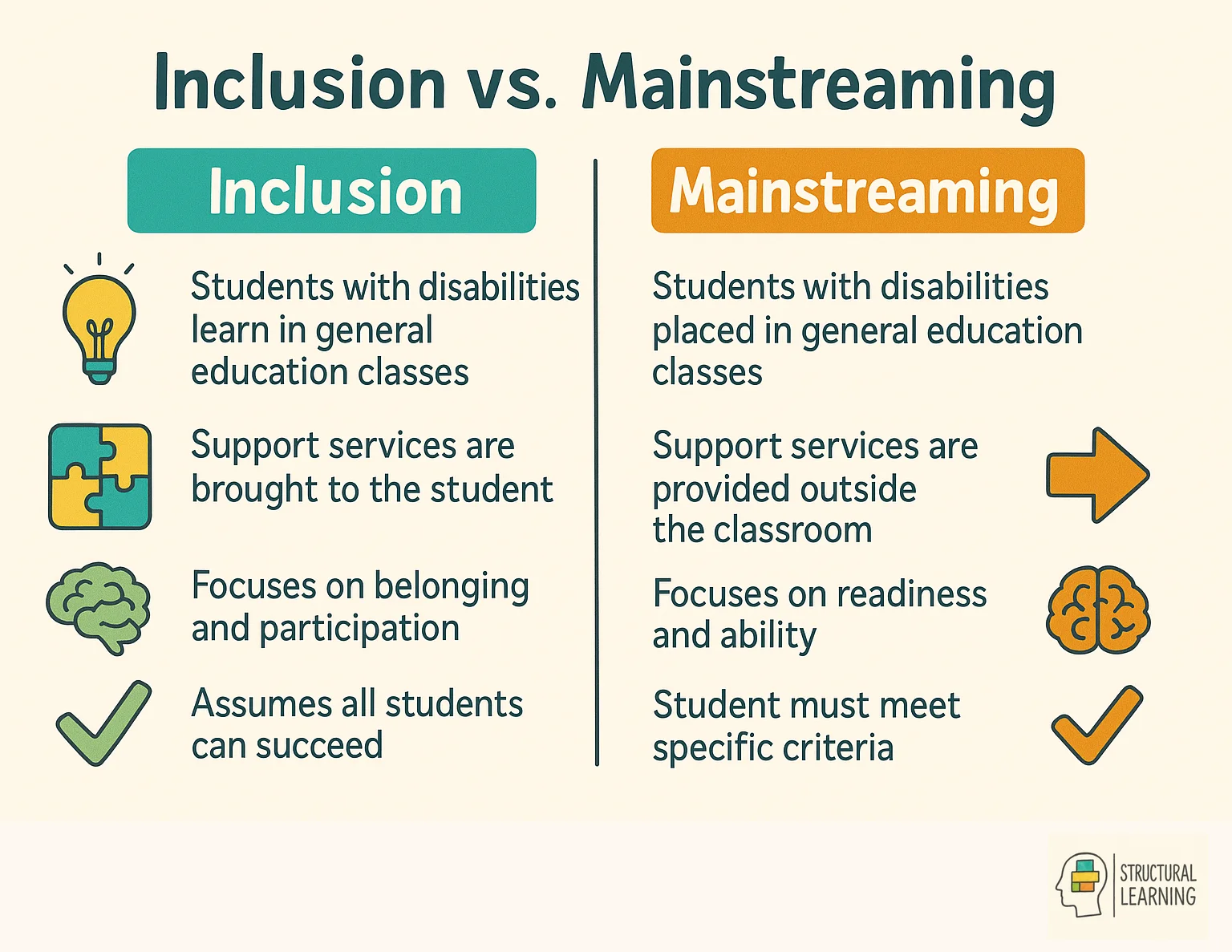
A common error is to place a learner with disabilities in a regular classroom without specific support or modifications. It is also a mistake to think that being in the room means being included in learning. True inclusion means adapting the system and removing barriers in the system. It should not expect the learner to keep up on their own.
Mainstreaming checks if learners fit the curriculum. Inclusion, however, adapts the school for every learner's needs. Changes are needed at all levels, including staff training and accessible resources. This ensures learners actively participate in shared learning (Florian, 2014).
Inclusion is a strong principle, but it can be used badly. Warnock (2005) argued that mainstream placement alone does not guarantee belonging or learning, especially when specialist provision, staffing and funding are weak. This matters during the current EHCP backlog: a learner can be physically present in a class yet still be excluded from the curriculum, peer life and safety.
The research base also has limits. Farrell (2000) and Lindsay (2007) questioned whether studies of inclusive education give clear, generalisable evidence of academic benefit across all needs and settings. Many positive studies use small samples, trained teams or well-funded pilots. This means their findings may not transfer cleanly to a high-deprivation class of 32 learners with limited specialist support.
There are cultural and methodological concerns too. Norwich (2014) described the dilemma of difference: naming a need can secure support, but it can also mark a learner as separate. Disability studies writers such as Goodley (2014) warn that inclusion can become assimilation.
This can happen when learners are expected to mask, behave and communicate within narrow norms. These critiques do not make inclusion disposable. They show why it must be properly funded, locally adapted and judged by participation, learning and belonging, not by placement alone.
Black, P. (1998). Inside the black box.
Brown, A. (1987). Metacognition, executive control, self-regulation, and other more mysterious mechanisms.
Sweller, J. (1988). Cognitive load during problem solving.
Wiliam, D. (2011). Embedded formative assessment.