Sherborne Developmental Movement: The Complete Teacher's
Complete guide to Sherborne Developmental Movement: body awareness and relationship play activities for all abilities. Learn three key relationship types.

Complete guide to Sherborne Developmental Movement: body awareness and relationship play activities for all abilities. Learn three key relationship types.
This guide shows teachers how to plan and deliver Sherborne Developmental Movement (SDM) sessions. SDM helps learners develop body awareness and build relationships through movement activities rooted in Laban's theory. You will find practical strategies for creating safe spaces where learners build confidence and trust. Transform how learners connect with their bodies.
Researchers note SDM meets two learning objectives. It builds body awareness so learners feel at ease (Hackney, 1998). It also builds relationship skills through physical interaction (Tortora, 2006). These goals meet the need for physical confidence and social connection.
Body awareness activities help individuals feel where their body is, what it can do, and how it moves through space. This includes:
Body Part Awareness:
Physical Competence:
Spatial Awareness:
Weight Awareness:
Research from Strack, Martin, and Stepper (1988) shows learners lacking body awareness can seem clumsy. They struggle with physical tasks or personal space, as reported by Gallagher and Meltzoff (1996). SDM activities help address these issues through physical experience, supporting better learning engagement (Berninger & Wolf, 2009).
Sherborne (1990) noted three relationships: with self, another person, and a group. These interactions build trust, empathy and communication (Ayres, 1972; Goddard Blythe, 2005). Activities can improve learners’ social skills and emotional control (Wallon, 1970). Relationship activities help learners feel secure and boost wellbeing (Bowlby, 1988). Do not underestimate early movement's impact on future skills (Gerber, 1979).
"Caring" Relationships (With):
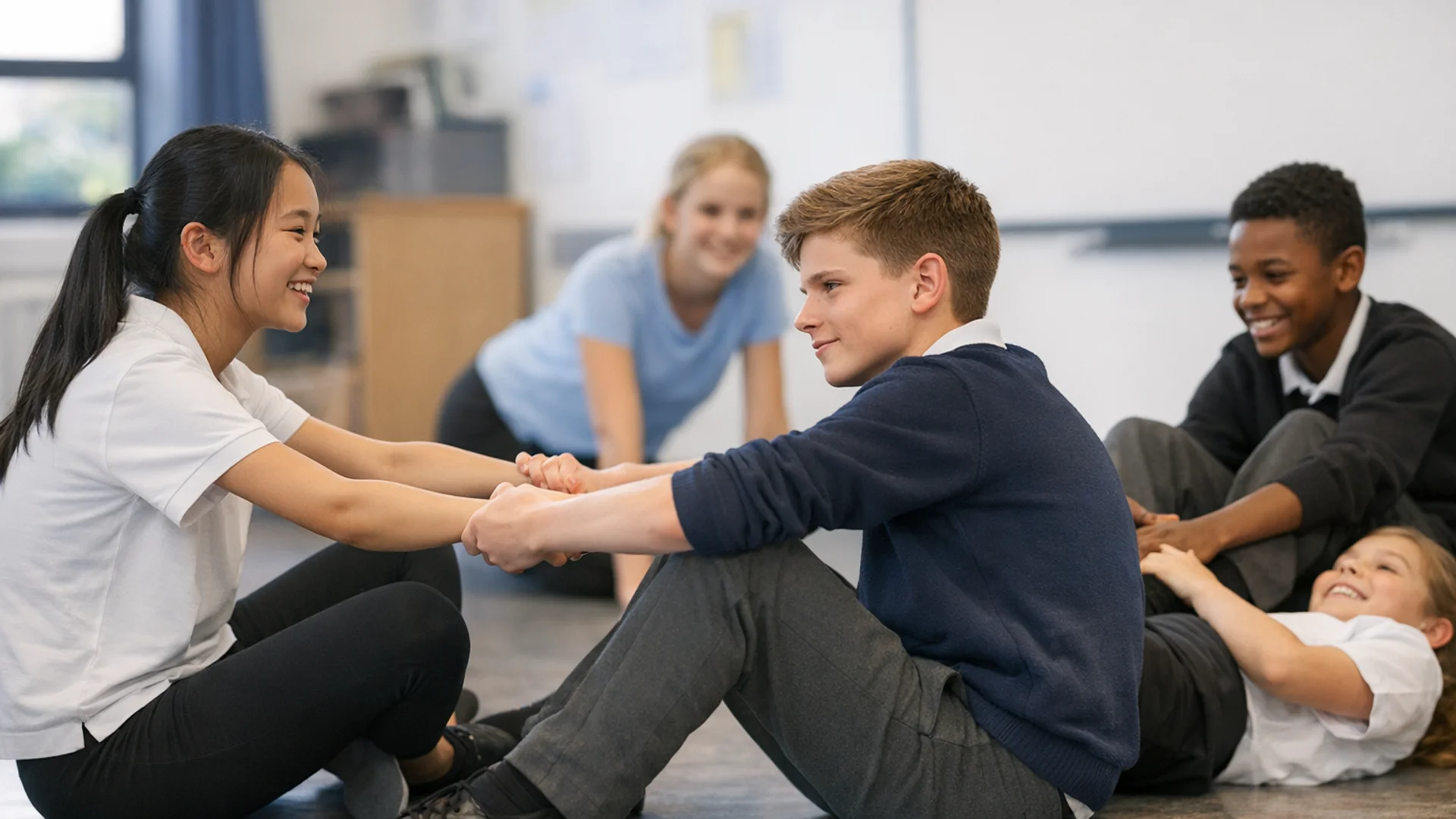
One partner takes the caring role, supporting, containing, or moving the other. The caring partner gives security and takes responsibility. The cared-for partner experiences trust and being safely held.
Examples:
"Shared" Relationships (Together):
Effective collaboration involves shared contributions. Partners move together and make joint decisions. They match each other's movements and effort (Vygotsky, 1978). This creates a shared understanding (Rogoff, 1990) where learners support each other (Bandura, 1977). Research shows collaboration boosts learning (Johnson & Johnson, 2009).
Examples:
"Against" Relationships:
According to Vygotsky (1978), playful resistance helps learners. Partners oppose each other in a safe, controlled way. This builds learner confidence, as noted by Piaget (1964). Physical awareness improves, as per Montessori (1912).
Examples:
Engage in playful opposition only when learners feel safe. Relationships of care come first to build trust (Bomber, 2015). Shared relationships help partnership grow (Hughes, 2018). This order supports self-regulation skills (Perry, 2006).
Sherborne's own writing describes a typical session structure: learners gather information (around 5 minutes), then body awareness (around 10 minutes), then caring relationships (around 10 minutes), and shared or against-relationships work (around 10 minutes) (Sherborne, 1990). Sessions may include against relationships (5-10 mins) then calming (5 mins).
A typical SDM session follows this pattern:
Researchers recommend a PhaseFocusDuration sequence. First, spend 5 minutes establishing safety and group cohesion. Next, learners spend 10 minutes on individual floor work. Then, allocate 10 minutes for partnered work with focused support. Follow this with 10 minutes for equal partner exercises. Finally, playful resistance lasts 5-10 minutes, then gentle closing activities for 5 minutes.
Adjust timing based on the group's needs. Some groups may spend entire sessions on caring relationships before progressing. This active learning approach requires careful observation and feedback to gauge student readiness.
Create a safe physical space:
Consider how SDM group work helps learners with autism and other diverse needs. These activities support learner wellbeing and self-development (Sherborne, 1990). Reflect on how your lessons can meet these goals.
Researchers suggest structured, playful activities improve attention. Embodied, movement-based learning is associated with improvements in executive function in children (Diamond and Lee, 2011). This method offers engaging, active learning for all.
Body awareness grows with solo activities first, before partnership work. Learners gain confidence working alone, and this prepares them for collaborative tasks later (Sherborne, 1990).
Pairs are useful for SDM activities. Match learners carefully, thinking about size and emotions. Development also matters. Some learners initially succeed better working alongside an adult before being asked to partner with peers (Sherborne, 1990).
Small groups: Groups of 3-4 can create rich relationship experiences, particularly for shared activities. Larger groups may overwhelm some children.
Adults actively partner learners, rather than watch them (Hughes, 2010). They show good touch, demo tasks, and offer steady care. This helps some learners before peer work (Bodrova & Leong, 2007).
This flexibility can empower learners with special needs (Loreman, 2017). SDM promotes social inclusion and gives learners agency in their own learning (Shaddock et al., 2009). Activities adapt to diverse needs and abilities (Munro, 2001; Porter, 2008).
Emotional adaptations: Create safe spaces for learners to express feelings (Blatt, 2012). Teachers should encourage learners to share experiences without judgement (Cole, 2003). Cognitive adaptations: Simplify instructions and repeat key information (Vygotsky, 1978). Offer learners varied ways to demonstrate understanding (Gardner, 1983).
Sensory considerations: Some children may need gradual introduction to touch or movement. Start with less intense activities and build slowly.
SDM's non-verbal format helps learners with limited verbal skills. Adults can still narrate the activity in simple terms to build learners' receptive language and shared attention (Fenson et al., 1993).
Use Social Decision Making with movement and relationships in mind. Introduce it carefully, with consistent routines, and watch learners' progress over time (Sherborne, 1990). Start with body awareness and positive interactions before moving to shared or against-relationship work (Sherborne, 2001).
Begin by establishing clear expectations and boundaries. Explain that SDM involves appropriate, purposeful touch and movement. Create signals for starting and stopping activities. Model how to ask permission before touching and how to say no if uncomfortable.
Researchers (Bombèr & Hughes, 2011) suggest starting slowly. Focus on body awareness before adding relationship activities. Learners may need weeks to adjust to working with a partner.
Learners show engagement with relaxed bodies and eye contact. They smile and want to keep doing activities. Watch for stress signs like tension, withdrawal, or agitation. Change activities if needed. (Adapted from researches such as Spock, 1946).
Bergin and Bergin (2009) say check learners' body awareness and relationship skills. Note changes in physical confidence, interaction, and emotional control. Watch learners during activities; Diamond and Lee (2011) say this informs assessment.
Train all staff involved in SDM principles and practices. Consistency in approach helps children feel secure and maximises benefits.
SDM assessment watches for changes in body awareness, relationship skills and emotional regulation, not milestones. Progress is individual. (van Dijk, 1966; Nielsen, 1992; Janssen, 2018) Small gains can be meaningful for each learner's development. (Dunst, 2000; McWilliam, 2010)
Consider learners' body awareness through their movement confidence. Check their spatial awareness and knowledge of their physical skills. See if learners are comfortable in their bodies. Observe improvements in their coordination and balance. (Gibson, 1979; Piaget, 1954; Vygotsky, 1978).
Monitor relationship development by watching how children engage with partners. Look for increased trust, willingness to take turns in caring roles, and ability to cooperate in shared activities. Some children may progress from needing adult partners to working successfully with peers.
Assessing learners' emotional regulation is vital. Look for less anxiety in PE, (Gross, 2015). Note improved calming after excitement, (Thompson, 1994). Observe increased resilience when learners face challenges, (Werner, 1982).
Researchers highlight the value of these approaches (e.g., Carr, 2001; Drummond, 1993). Observation sheets, videos, or photos document learner progress. Share these observations with parents and professionals to aid learner development.
Sherborne Developmental Movement aids learner progress (Sherborne, 1960s). Activities and relationships boost physical, emotional, and social learning. Sherborne's (1960s) framework builds body awareness and connection. These experiences help all learners succeed and build confidence (Sherborne, 1960s).
Structured SDM helps learners of all abilities. It supports learners with learning difficulties to feel cared for. SDM is widely reported by practitioners to support cooperation and trust between learners (Sherborne, 1990; McGreevy, 2015). The approach’s key ideas are that trust comes first, that physical connection helps relationships grow, and that learners need to feel comfortable before being asked to take risks in movement.
Learner progress in SDM can be slow and varied. A learner resisting touch might later seek it. Learners struggling with movement may find confidence with support. Small gains show big steps towards physical confidence and social skills. SDM principles, applied thoughtfully, build wellbeing and relationship skills (Sherborne, 1990; McGreevy, 2015).
Sherborne Developmental Movement, created by Veronica Sherborne, builds learners' body awareness and relationships. This play-based physical approach uses structured movement, not words. It helps learners feel bodily secure and builds social skills and confidence (Sherborne, n.d.).
Body awareness exercises often begin lessons, progressing to partner tasks. A typical structure starts with calming activities, moves to individual floor work, then shared tasks. Gentle closing activities help learners regulate behaviour and calm down (Pallaro, 2007; Hartley, 2009; Batson, 2011).
Structured physical activity builds predictable communication. Learners with autism improve spatial awareness and relationships without verbal demands. These activities improve focus and self-control.
Sherborne Developmental Movement helps learners with special needs boost motor skills and social skills (Sherborne, various dates). Researchers found that progress in relationships builds trust (Sherborne, various dates). They noted improved focus after physical play (Sherborne, various dates).
Teachers often rush learners into paired tasks before building trust. Ensure learners develop individual body awareness and caring skills first. Too much verbal instruction can hinder learning; physical experience should guide them (Hackney, 1998; Eddy, 2009).
You do not need any specialised equipment to run these sessions. The activities rely entirely on the children using their own bodies and interacting with their partners. You only require a clear, safe floor space, preferably carpeted or matted, where children can comfortably roll, slide and support each other.
Free for teachers. The platform builds a classroom-ready lesson plan from your topic in under two minutes.
Sherborne Developmental Movement papers offer key understanding. Wrigglesworth (2011) and Kalambouka, et al. (2007) provide useful insights for teachers. Look at these publications by Ayres (1972) and Knickerbocker (1980) to support learners.
Sherborne (2001) offers guidance on Developmental Movement for children. The book covers mainstream, special needs, and pre-school settings. Sherborne's text gives practical advice and theoretical background for teachers.
Payne (2006) states body work helps therapy. This paper examines movement's impact. Research backs movement activities. These activities boost a learner's growth.
McGreevy (2015) showed Sherborne Developmental Movement aided autistic learners' social communication. The British Journal of Special Education published the research. It found engagement skills improved for learners.
Tortora (2019) found movement helps learners manage emotions and build relationships. The study focuses on non-verbal communication's power, as noted in the Journal of Applied Arts & Health.
Diamond and Lee (2011) reviewed interventions that support executive function in children aged 4-12 and found that structured physical activity is one route to gains in attention and self-regulation. Activities of this kind can also assist learners socially.
Developmentally grounded. EYFS to KS3. Free for teachers.