Quality First Teaching for SEN: Strategies, Checklists and Examples
Quality First Teaching (QFT) is the foundation of SEND provision. This guide covers Wave 1 strategies, classroom environment.


Quality First Teaching (QFT) is the foundation of SEND provision. This guide covers Wave 1 strategies, classroom environment.
Quality First Teaching for SEN: Strategies, Checklists and Examples describes inclusive classroom teaching that meets learners' needs before a separate intervention is added. QFT is an older short term. Current English guidance more often says High Quality Teaching and adaptive teaching. Even so, the teacher's classroom duty is the same (Department for Education, 2024; Department for Education and Department of Health, 2015).
In a Year 5 fractions lesson, the teacher models one worked example, checks mini-whiteboards, gives a stem sentence for explanation, and offers manipulatives or speech-to-text where these remove barriers. Rosenshine (2012) supports small steps and guided practice, but the class teacher still records what was tried, what changed, and what the learner produced before moving to targeted SEN support.
Quality First Teaching means planning the first classroom offer so most learners can access the same ambitious curriculum. It uses clear goals, structured explanation, active checks for understanding, and feedback that changes the next step (Rose & Meyer, 2002; Florian & Black-Hawkins, 2011).
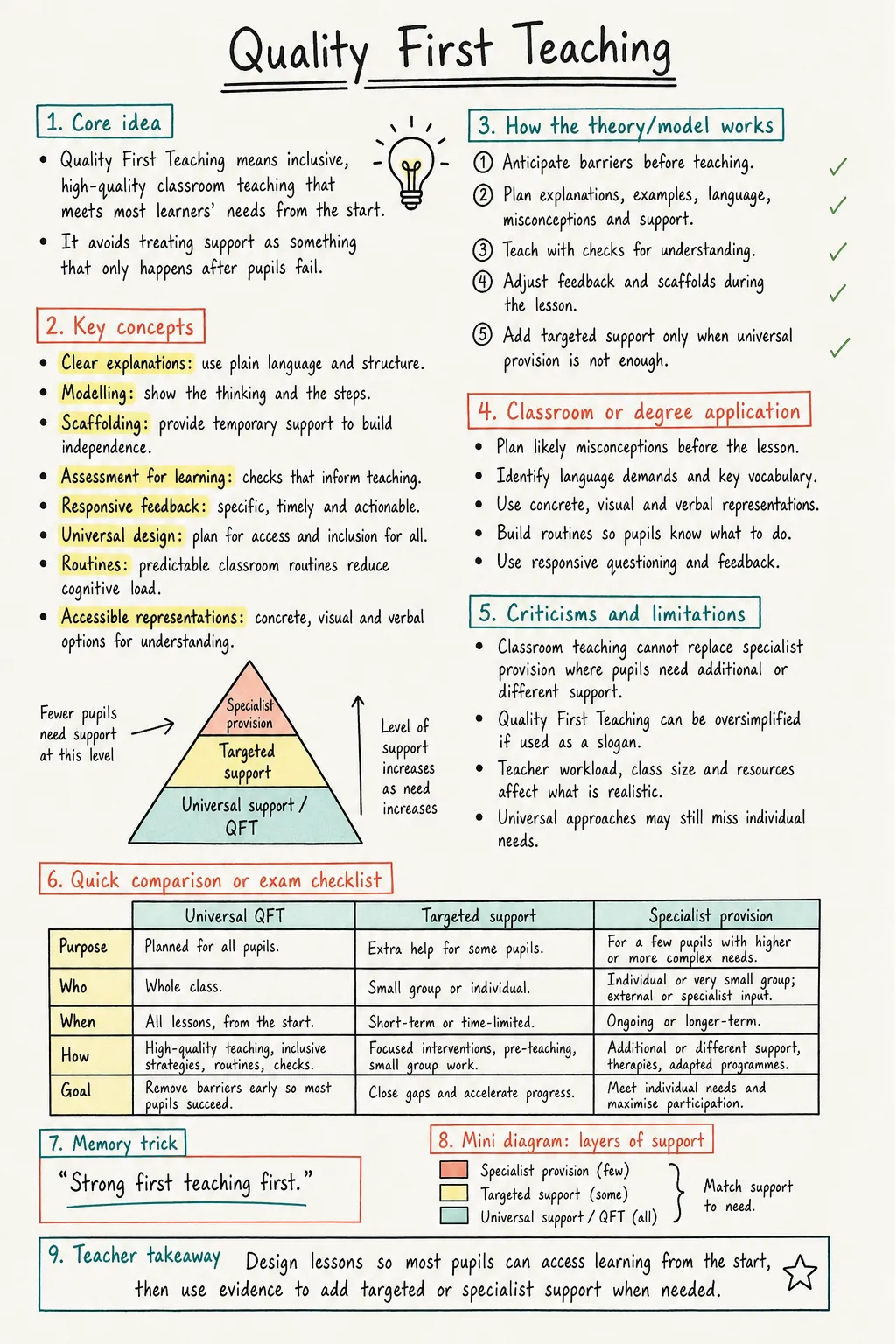
Download a one-page study note for Quality First Teaching, with the key ideas, limitations and classroom links in one place.
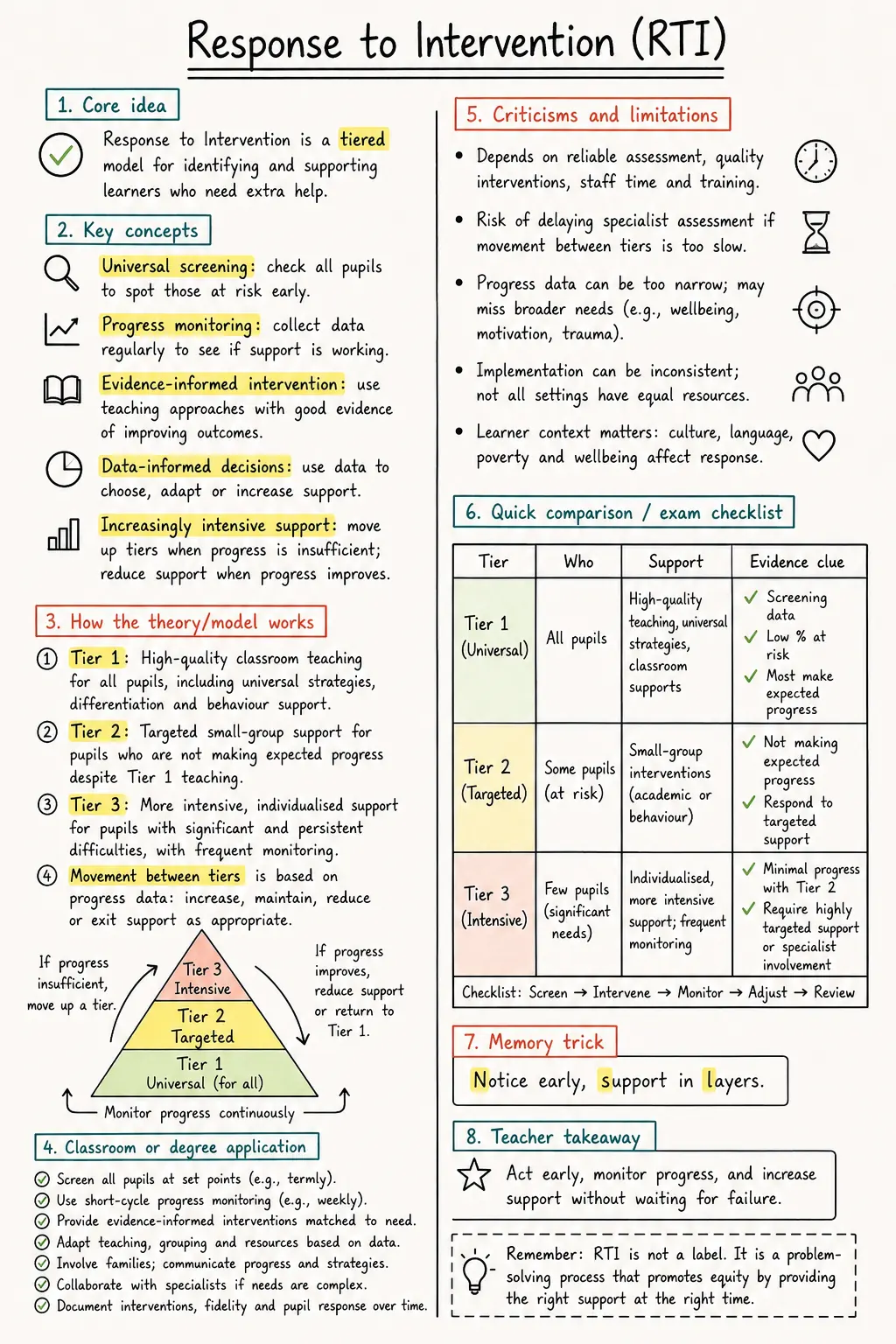
Download a one-page study note for Response to Intervention (RTI), with the key ideas, limitations and classroom links in one place.
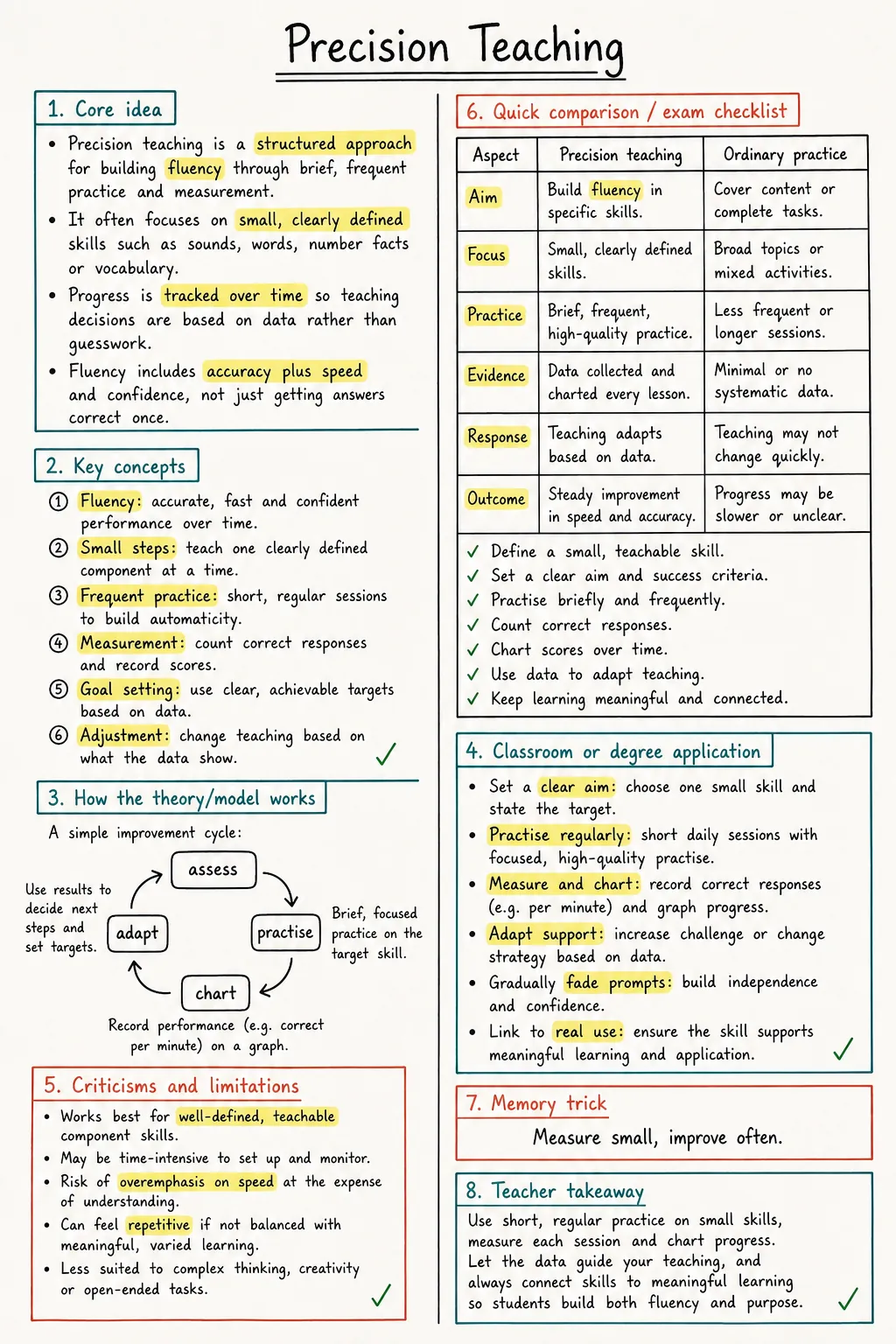
Download a one-page study note for Precision Teaching, with the key ideas, limitations and classroom links in one place.
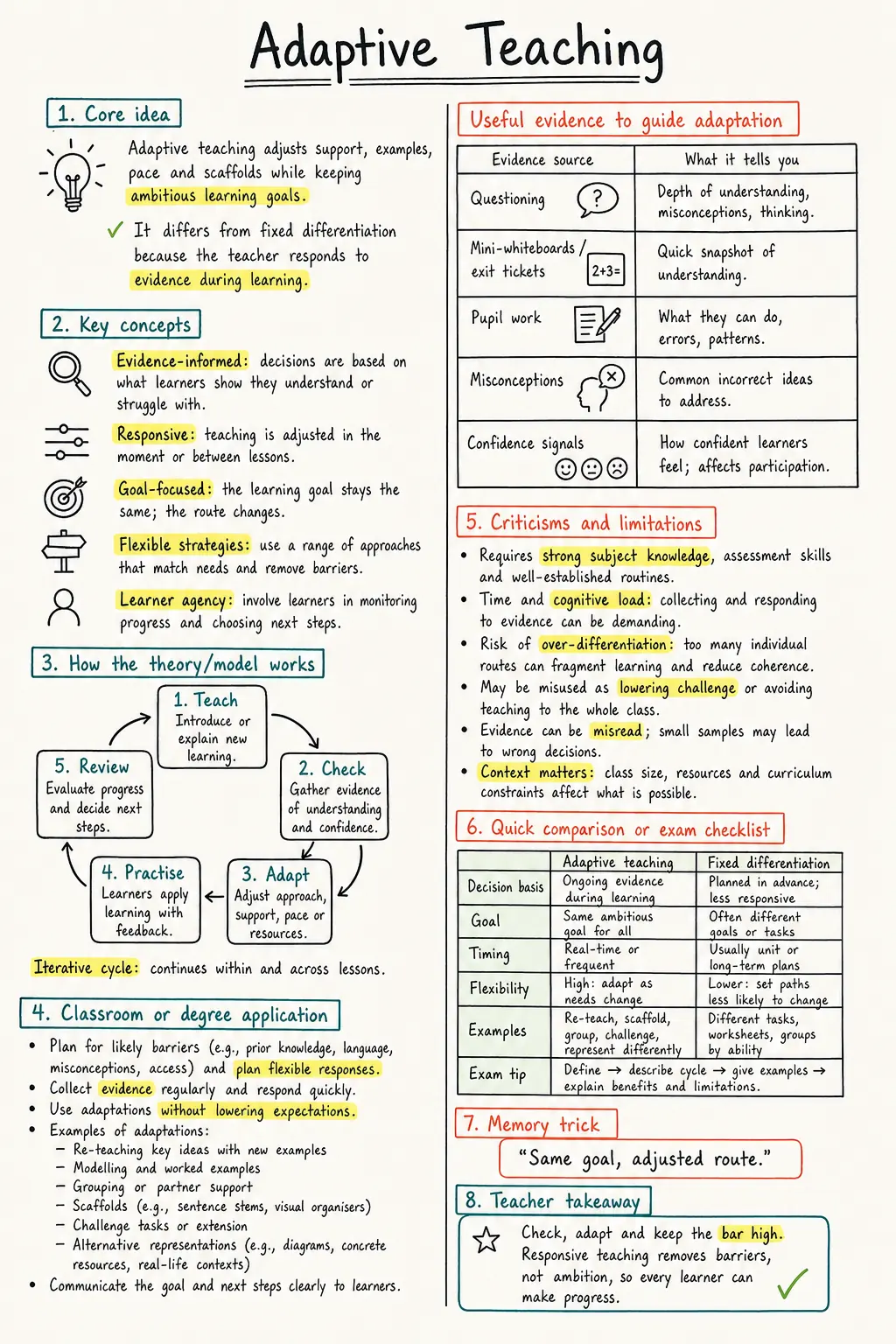
Download a one-page study note for Adaptive Teaching, with the key ideas, limitations and classroom links in one place.
For SEND, QFT is not a separate worksheet or a lower target. It is whole-class teaching adapted in real time: a teacher rephrases vocabulary, changes the representation, adds a scaffold, or gives extra guided practice while keeping the learning goal intact.
Evidence overview
Tomlinson (2014) highlights Quality First Teaching as key. Teachers should support each learner's needs and notice their differences. Wiliam (2011) argues that formative assessment helps teachers adjust teaching while learning is still happening.
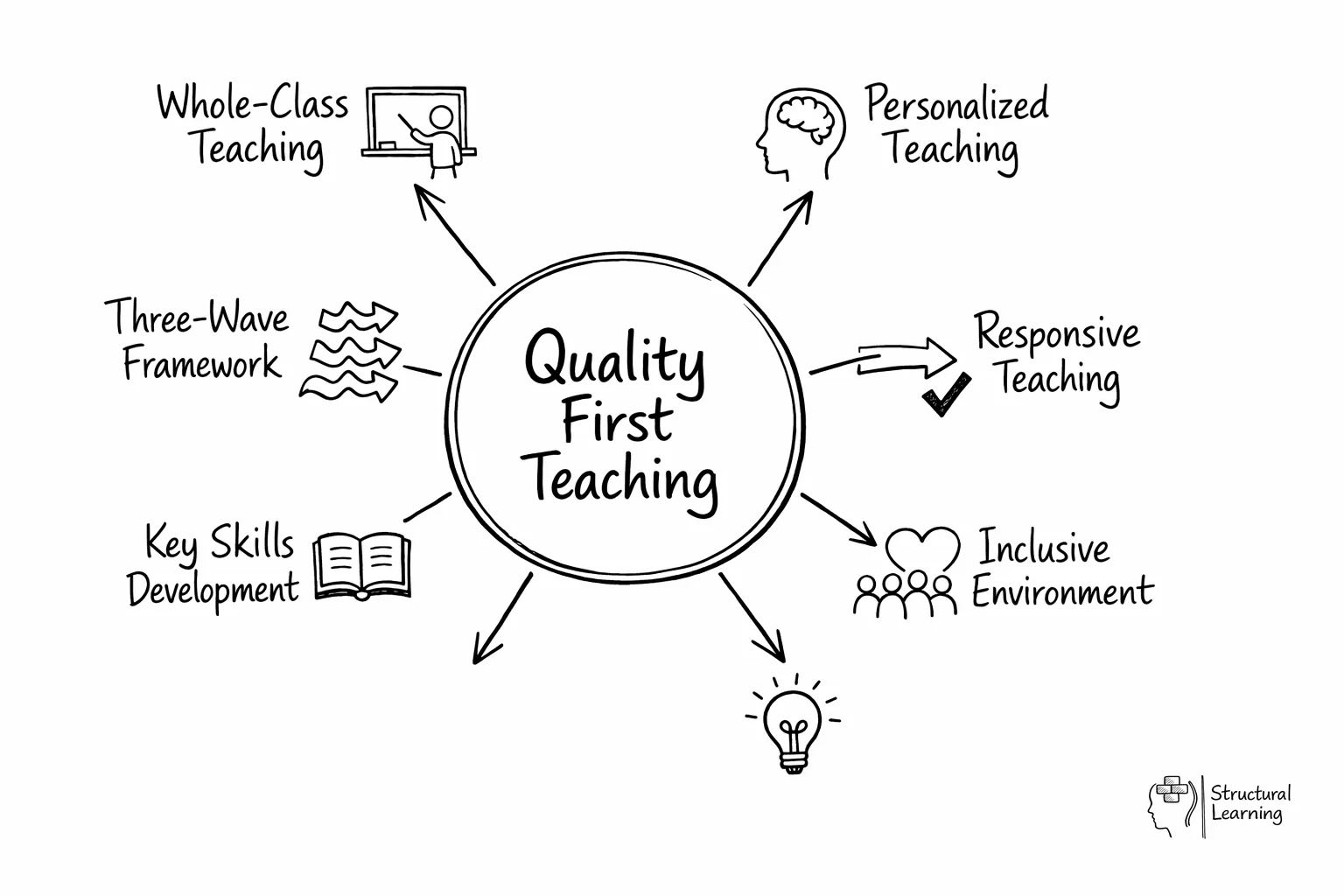
QFT means teachers introduce maths concepts to all learners initially. They then give individual learners different tasks or support depending on their needs (Vygotsky, 1978; Rogoff, 1990; Lave & Wenger, 1991).
QFT helps all learners and supports their needs, reducing your planning. The Three-Wave Framework (National Strategies) raises standards. This framework helps learners achieve (Westwood & Graham, 2003) through staged support. Inclusive teaching is consistent in QFT (Florian & Black-Hawkins, 2011).
QFT means strong classroom teaching for all learners, including neurodivergent learners and learners with dyslexia. Responsive teaching is central, but broad effect-size claims need care: Hattie (2009) reports averages across varied studies, and Snook et al. (2009) argue that the method can hide context, sample quality, and implementation differences. For ADHD, PDA profiles, complex trauma, or sensory needs, check whether the strategy reduces barriers for this learner before treating it as a solution for everyone.
Retrieval practice can support durable recall, which means remembering learning for longer. It works when learners bring information back from memory rather than simply rereading it (Karpicke, 2008). For a learner with dyslexia, the teacher can rehearse key vocabulary orally before writing; for dysgraphia, speech-to-text can remove the handwriting barrier while the learner still works on the same concept. Treat the National Strategies legacy as useful routines, not as evidence for a fixed 20% gain.
Quality First Teaching means teachers meet diverse learner needs through tailored instruction. We ask effective questions to engage all learners, (Black & Wiliam, 1998). Feedback should support learner progress, as Hattie and Timperley (2007) suggest. This creates a supportive environment, regardless of challenges (Ainscow, 2020).
Researchers Black and Wiliam (1998) found feedback engages learners. Teachers change lessons to meet diverse learner needs. This provides quality teaching, like modelling (Hattie, 2012). Feedback also boosts learner confidence and exam scores (Yorke, 2003).

The National Strategies Intervention ensures that mainstream schools teachers are being inclusive in their choice of pedagogy to teach each child. These teachers must support all the children, irrespective of circumstances, to learn to the best of their ability. This often involves implementing direct instruction methods alongside more flexible approaches to meet diverse learning needs. This program was dropped by the UK's department for education and skills in 2010 but its legacy lives and can be accessed via the.gov archive.
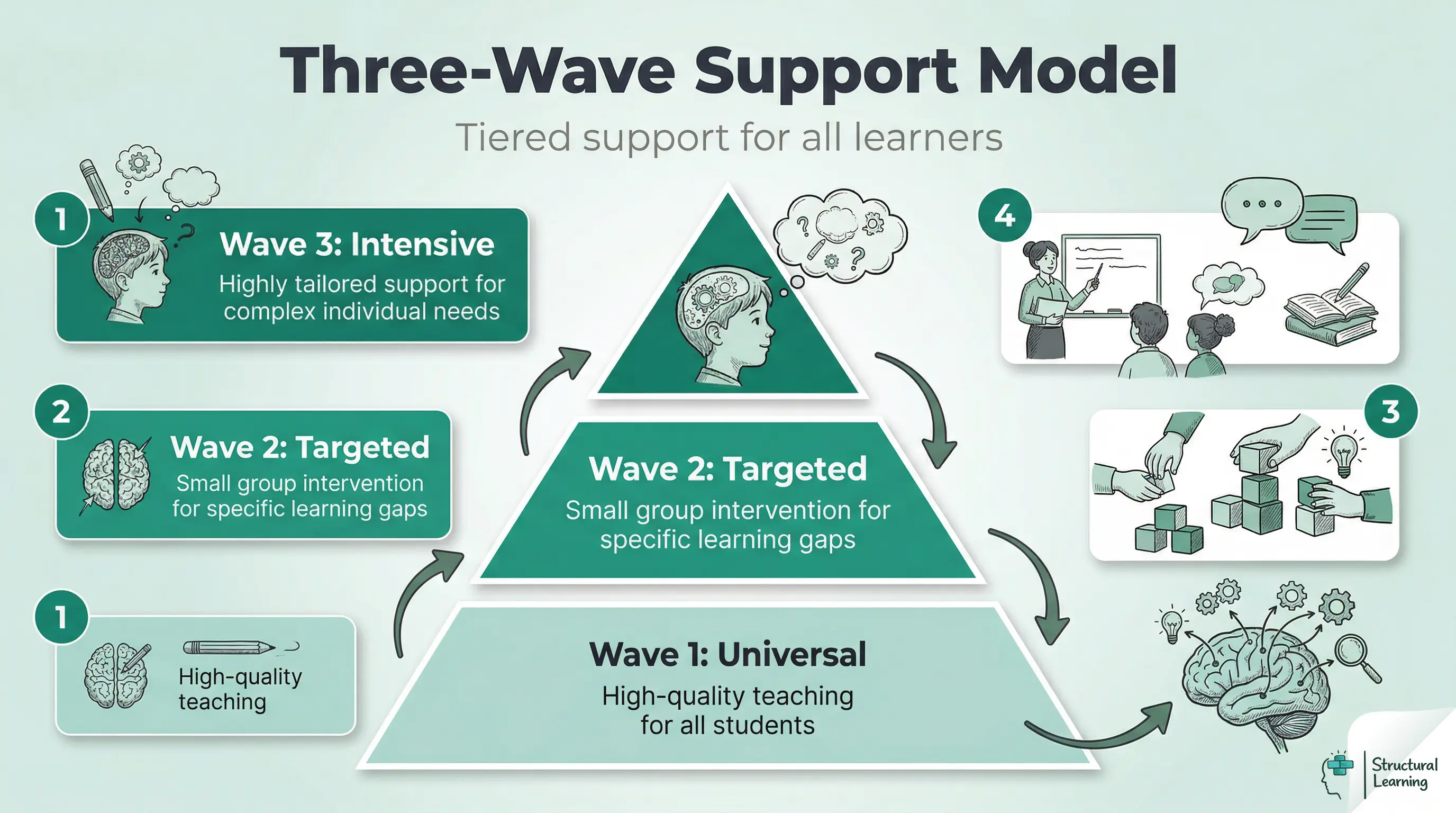
The practical legacy is the Three-Wave model. This means strong classroom teaching first, targeted small-group support next, and specialist support when needs remain significant.
Whole-class teaching, then group work, guided practice. This influenced Quality First Teaching later. Teachers learnt to adapt lessons (Tomlinson, 1999).
They supported all learners. Structured differentiation is key for inclusive classes (Westwood, 2001; Ainscow & Booth, 2003).
Slavin (2008) noted that some criticised interventions for limiting teacher choices, yet they created standards. Frequent checks and targeted support helped learners, research shows. Hattie (2012) found interactive whiteboards, phonics, and maths talks boost inclusion.
National Strategies influenced UK schooling. They promoted personalised learning (Hillage et al., 1998). Teachers still use effective methods in class (Slavin, 2020). Use it as a starting point for professional discussion: identify the learner's current need, record evidence from more than one lesson, and agree the next classroom adjustment with the SENCO or family.
The National Strategies Intervention helped education. It still inspires teachers to create great learning. Teachers can use these ideas to help every learner succeed (Hillage et al., 1998; Slavin, 2020).
National Strategies shaped teaching around 2000. Differentiation meets each learner's needs well. Planning uses assessment to track learner progress (Black & Wiliam, 1998; Hattie, 2008).
Success criteria, structured talk, and targeted questions still work well. Three-part lessons, though less strict now, guide effective teaching (Bennett, 2006). Clear objectives and summaries help learners consolidate knowledge (Wiliam, 2011; Hattie, 2012).
Teachers must engage in education changes (Fullan, 2007). Quality First Teaching asks that teachers understand *why* strategies succeed. This knowledge helps them adapt methods, not just follow steps (Timperley, 2011; Black & Wiliam, 1998).
The Three-Wave model supports all learners while you teach. National Strategies created it. It helps teachers spot learning needs early through the assess-plan-do-review cycle (DfES, 2004). Address needs before they become big problems for learners.
Wave 1 means good teaching for all learners. Teachers should use clear goals, different methods, and assess often. For example, when teaching fractions in Year 5, teachers could use visuals (Bruner, 1966), objects, and examples (Willingham, 2009). This ensures all learners grasp the main idea (Hattie, 2008).
Wave 2 gives extra help in small groups to learners needing it. This may mean teaching new topics beforehand or fixing errors the same day. A teaching assistant could help four learners understand place value while the class practises alone (Ainscow & Booth, 2003).
Wave 3 gives learners focused, individual help. This support aids strong classroom teaching. For example, Thomson and Johnston (2008) suggest coloured overlays for learners with dyslexia. Singleton (1999) advises larger fonts or recording written work.
Plan and monitor work carefully. Map which learners need Wave 2 and 3 support and track their progress regularly. Weekly team meetings will coordinate year group support, helping classroom teaching (Ainscow & Booth, 2003; Hattie, 2009).
Assessment helps teachers understand learners' knowledge, informing QFT. Ongoing assessment guides teaching, not just unit tests (Wiliam, 2011; Leahy et al., 2005). This informs decisions in real time. Use it as a starting point for professional discussion: identify the learner's current need, record evidence from more than one lesson, and agree the next classroom adjustment with the SENCO or family.
Mini-whiteboards give fast feedback. Learners show column addition on the board (Black, 2004; Wiliam, 2011). Teachers can spot common mistakes quickly. They can then correct misunderstandings straight away (Sadler, 1998; Christodoulou, 2017).
Exit tickets give teachers helpful lesson feedback. Asking learners "What challenged you today?" helps planning (Black & Wiliam, 1998). Use Microsoft or Google Forms for fast response analysis and streamlined marking. (Dylan Wiliam, 2011; Christodoulou, 2017).
Use assessment during lessons. Wiliam (2011) found group observation showed learner progress clearly. Black and Wiliam (1998) suggested coding systems with symbols to track learner understanding.
Self-assessment helps learners take charge of their learning. Traffic lights quickly show how confident learners feel (Andrade & Brookhart, 2016). Ladders and checklists help learners work with more independence.
Use assessment data to adapt teaching during the lesson. If half the class shows amber or red on traffic lights, pause for extra modelling or paired discussion before moving on. This keeps challenge in place while giving learners enough support to continue.
Share learning objectives and success criteria with each learner. This helps learners grasp what they learn and why. Sweller (1988) argued that cognitive load affects how learners process new information, so clear purpose supports attention. Learners process information better when expectations are clear.
Effective questioning builds learner thinking. Use both targeted and open questions. Mary Budd Rowe (1986) found 3-5 seconds wait time improves responses. It benefits learners needing more processing time.
Learning goal groups help, not ability ones. Vary group tasks with individual work, and change groups often for different subjects. This prevents rigid groups and aids peer learning (Vygotsky, 1978). Give different tasks so every learner finds a suitable challenge (Tomlinson, 2014).
Adaptive teaching is the current policy language for much of what older QFT guidance called differentiation. It means adjusting teaching, resources, scaffolds, grouping, or technology so learners can work towards the same curriculum goal. It does not mean thirty lesson plans or lower expectations for learners with SEND (Tomlinson, 2001; Rose & Meyer, 2002; Department for Education, 2024).
Dweck (2006) argued that learners' beliefs about ability shape motivation and persistence. Offer choices so learners see intelligence as changeable, and effort helps them grow.
Try simpler or harder tasks. Let learners choose how they show understanding. Tailor support as needed.
Tomlinson (2001) said some learners need harder tasks. Pritchard (2005) suggests teachers change tasks using different methods. Vygotsky (1978) noted varied teaching helps learners. Black and Wiliam (1998) advise regular learner assessment.
Sweller's (1988) cognitive load theory shows how we teach new learners. Working memory can only hold a small amount of information. Overloading it blocks learning and transfer (Chandler & Sweller, 1991). Sweller found three types of cognitive load.
Quality First Teaching cuts distractions. Worked examples help learners grasp solutions instead of searching (Sweller, van Merriënboer & Paas, 1998). Plain language with matching diagrams uses both visual and verbal pathways. This boosts memory without overload (Paivio, 1991).
Chandler and Sweller (1991) showed classroom setup affects learning. Learners use working memory to link diagrams and text. Integrated formats, like labels on diagrams, prevent overload. A geography teacher can explain river meanders, using this idea.
Cognitive load theory helps teachers make informed choices. Splitting complex topics aids learning, as Sweller et al. (1998) showed. Giving learners part-filled notes and removing distracting images can reduce workload.
Expert learners don't need supports; expertise reversal exists (Sweller et al., 1998). Teachers should adjust support levels as learners gain knowledge.
Classrooms affect how learners progress, meeting their needs. Organised spaces help learners and reduce mental stress. Sweller found clutter overloads the working memory. Calm, structured rooms help learners to focus well (Sweller).
Routines help when they are predictable and humane. Zero-tolerance routines can increase anxiety for autistic learners, learners with ADHD, and learners with trauma histories. This is especially true when routines demand eye contact, quick public answers, or silent compliance. Milton's double empathy problem (Milton, 2012) reminds teachers to adjust communication both ways: offer a private response option, name sensory choices, and treat regulated participation as learning behaviour.
Classroom layouts help learners collaborate or work alone. Labelled resources develop learner independence (Vygotsky, 1978). Visual aids reinforce learning goals and expected behaviours (Skinner, 1953).
Review your classroom and ask learners for feedback (Piaget, 1936; Bruner, 1966). This ensures the space meets learner needs.
Teachers find adaptive teaching hard when it feels like thirty separate tasks. The ITTECF now frames this work as adaptive teaching: understand barriers, keep expectations high, and adjust explanations, scaffolds, grouping, technology, or practice without creating lower-status work for named learners (Department for Education, 2024). In Year 8 science, this means teaching the same particle model to the class. Learners who need it can also use a labelled diagram, a vocabulary bank, and extra guided practice.
QFT also becomes unsafe when schools use it as a funding argument. The SEND and Alternative Provision Improvement Plan aims to improve earlier support. But schools should not let QFT become a reason to delay specialist assessment, refuse EHCP evidence, or remove effective teaching assistant support (Department for Education, 2023). Leaders need a short Graduated Approach record for each learner: assess the barrier, plan the classroom adaptation, do it consistently, review the work sample, then decide whether targeted or specialist provision is still needed.
Some learners are not in the room often enough for a traditional QFT checklist to work. Severe absence and children missing education have risen sharply. SEND is also over-represented in missing education data (Children's Commissioner for England, 2024). For EBSA, QFT needs an accessible home route: short recorded explanations, predictable tasks, one trusted adult check-in, assistive technology where needed, and a return plan that reduces sensory and social threat rather than forcing immediate full attendance.
For a comprehensive exploration of this approach in practice, see our Ofsted's detailed look process guide.
Next lesson, choose one learner who often needs additional support and plan the first classroom offer before the intervention. Write the learning goal, the barrier you expect, the scaffold you will use, and the evidence you will collect from the learner's work.
After the lesson, keep the record short: what you taught, what changed during the lesson, what the learner produced, and what you will review next. This turns QFT from a slogan into evidence for the Graduated Approach.
The Education Endowment Foundation offers five key teaching strategies for all learners. These strategies, from EEF (no date given), support learners with SEND. They are part of regular classroom practice, not separate plans. These strategies help most learners with SEND access lessons before needing additional support.
| Strategy | What It Means | SEN Application | Example in Practice |
|---|---|---|---|
| 1. Explicit Instruction | Teaching new concepts and skills clearly and directly, with step-by-step explanations, worked examples and guided practice before independent work. Nothing is left to chance or assumed to be understood. | Learners with cognition and learning needs benefit from clear, unambiguous instruction rather than discovery-based approaches. For learners with SLCN or autism, explicit instruction removes the need to infer meaning from context. Reduces cognitive load for all SEN learners. | A teacher introduces column addition by modelling the full process on the board, narrating each step aloud ("First I look at the ones column. 7 plus 5 is 12. I write 2 and carry 1"). Learners then complete a guided example together before working independently with a worked example displayed alongside. |
| 2. Cognitive and Metacognitive Strategies | Teaching learners how to plan, monitor and evaluate their own thinking and learning. Includes self-questioning, graphic organisers, retrieval practice and reflection on what strategies worked and why. | Learners with SEMH and ADHD benefit from structured self-monitoring (checklists, traffic light systems). Learners with cognition and learning difficulties need explicit teaching of strategies they will not develop independently. Metacognitive talk supports language development for SLCN learners. | Before writing, learners use a planning frame with three questions: "What do I already know? What do I need to find out? How will I organise my ideas?" After writing, they use a self-assessment checklist. A learner with ADHD uses a "focus tracker" card, marking every 5 minutes whether they were on task. |
| 3. Scaffolding | Providing temporary support structures that enable learners to access tasks beyond their current independent ability. Scaffolds are gradually removed as competence grows, following a model of "I do, we do, you do." | Essential for all four areas of need. Visual scaffolds support autism and SLCN. Procedural scaffolds support cognition and learning. Physical scaffolds support sensory and physical needs. The key is matching the scaffold type to the learner's specific barrier (see scaffolding types table above). | In a Year 5 science lesson on forces, the teacher provides three levels of recording sheet: Level 1 has sentence starters and a labelled diagram to annotate. Level 2 has key vocabulary and a blank diagram. Level 3 is an open page. All learners answer the same investigative question. |
| 4. Flexible Grouping | Grouping learners in different ways for different purposes, avoiding fixed ability groups that limit expectations. Includes mixed-attainment groups, paired work, expert groups and strategic seating. | Avoids the stigma of permanent "bottom groups" that damages self-esteem for SEMH learners. Mixed grouping provides language models for SLCN learners. Strategic pairing gives peer support for cognition and learning needs. Allows pre-teaching groups to be formed temporarily without labelling. | During a reading comprehension lesson, the teacher groups learners by the strategy being practised (inference, prediction, summarising) rather than reading level. A learner with dyslexia who has strong verbal comprehension is placed in the inference group, where the text is read aloud and the focus is on reasoning skills. |
| 5. Using Technology | Using digital tools purposefully to reduce barriers, provide alternative access to content and enable learners to demonstrate learning in different ways. Technology is a means, not an end. | Text-to-speech and speech-to-text remove literacy barriers for cognition and learning needs. Communication apps (Proloquo2Go, Grid 3) enable non-verbal learners to participate. Audio recording allows learners with physical difficulties to demonstrate understanding without writing. Screen readers support visual impairment. | A learner with dyslexia uses the Immersive Reader feature in Microsoft Teams to have a history text read aloud, with syllable highlighting and a picture dictionary. They then record their response as a voice note rather than writing it. The teacher assesses the same learning objective through a different output mode. |
Westwood (2017) states Quality First Teaching means high standards for all learners. Teachers deliver effective lessons and respond to each learner's needs. This reduces reliance on extra support, benefitting all learners.
Kirschner et al. (2006) found modelling, scaffolding, and retrieval help learners recall information. Clark & Lyons (2004) say graphic organisers show thinking and give feedback fast. Wiliam (2011) urges teachers to check learners understand the lessons fully.
Strategies help learners with SEND feel included in their class. Structured routines and tools aid neurodiverse learners. Good teaching helps dyslexic learners in class through structured literacy, coloured overlays where they help, and tools that bypass writing barriers (Thomson & Johnston, 2008; Singleton, 1999). Schools should use these methods.
Responsive teaching helps vulnerable learners. Hattie (2009) stressed that teachers need to focus on critical thinking skills. Gorard (2010) and Allen (2011) found good teaching narrows attainment gaps.
Single plans work better than many (Wiliam, 2011). Schools need systems supporting learners consistently (Hattie, 2012). Avoid thinking this cancels all support for learners (Black & Wiliam, 1998).
Differentiation in tasks is vital. Quality First Teaching adapts lessons for all learners. Teachers group learners flexibly based on their insights, avoiding labels. Varied support lets each learner access the curriculum (Tomlinson, 2014; EEF, 2021).
Researchers (Coe et al., 2020) show evidence strength matters. Answer five questions about your school.
Then, get EEF strategy suggestions. These are ranked by impact and cost. They help every learner.
Researchers (Coe et al., 2020; EEF, 2021) found schools need easy budget tools. These tools help teachers choose the best learning strategies. They show which approaches improve learner progress most efficiently for the money spent. This aids better resource allocation.
EEF guidance helps assess TA impact. See if your current TA use aligns with the seven recommendations. Pinpoint key areas where you can improve support for learners. (Education Endowment Foundation).
Use your PP budget to pick strategies ranked by evidence across three tiers. This will generate a full strategy plan, including ROI analysis. (Kraft, 2016; Slavin, 2020). Use it as a starting point for professional discussion: identify the learner's current need, record evidence from more than one lesson, and agree the next classroom adjustment with the SENCO or family.
Free for teachers. Visual schedules, sensory adaptations, low-demand routines, built into the plan.
Quality First Teaching is strongest as a universal classroom entitlement, but it has limits. First, large evidence syntheses can hide variation. Effect sizes from Visible Learning (Hattie, 2009) are useful for discussing teacher clarity and feedback, yet critics argue that combining diverse studies can blur sample quality, context, and cost (Snook et al., 2009). This matters for SEND because studies often underrepresent learners with complex trauma, PDA profiles, ADHD, autism, or co-occurring needs.
Second, structured instruction can become compliance if schools confuse clarity with control. Rosenshine (2012) supports modelling, guided practice, and checking understanding. But these routines need adaptation for sensory load, communication differences, and anxiety. A cold call, demand for eye contact, or fast public response can block learning for some neurodivergent learners.
Third, inclusion carries the dilemma of difference. Norwich (2008) and Florian and Black-Hawkins (2011) show that naming need can secure support, but it can also separate learners from ordinary classroom life. Slee (2011) adds that inclusive policy can look tidy on paper while budgets, assessment pressures, and behaviour systems still exclude learners in practice.
Finally, QFT evidence has cultural and method limits. Classroom studies from one country, phase, or accountability system may not fit every UK SEND context. The lasting value of Quality First Teaching is clear. It keeps responsibility with the class teacher, while still making specialist support available when universal provision is not enough.
Dweck, C. (2006). Mindset: The new psychology of success.
Hattie, J. (2009). Visible learning.
Karpicke, J. (2008). The critical importance of retrieval for learning.
Rosenshine, B. (2012). Principles of instruction.
Sweller, J. (1988). Cognitive load during problem solving.
Vygotsky, L. (1978). Mind in society: The development of higher psychological processes.
Wiliam, D. (2011). Embedded formative assessment.
Ainscow and César (2006) showed inclusive education goals affect policy. Their article offers teachers useful inclusive practice ideas. Use this research to shape practices for each learner.
Florian (2014) questions evidence for inclusive education. See *European Journal of Special Needs Education* 29(3): 286-294. The article encourages busy teachers to reflect on their work with each learner.
Mortimore, P. (1999). Understanding pedagogy and its impact on learning. *Paul Chapman Publishing*.
Westwood (2017) helps teachers adapt lessons for diverse learners. The book aids inclusion and addresses classroom issues. It offers usable strategies; find them in *Inclusive and Adaptive Teaching*.
Visual schedules, sensory adaptations, low-demand routines. Built in.
Open a free account and help organise learners' thinking with evidence-based graphic organisers. Reduce cognitive load and guide schema building dynamically.