Problem-Based Learning: A Complete Guide for Teachers
Explore how problem-based learning engages students with real-world challenges, enhances critical thinking, and fosters collaboration in the classroom.


Explore how problem-based learning engages students with real-world challenges, enhances critical thinking, and fosters collaboration in the classroom.
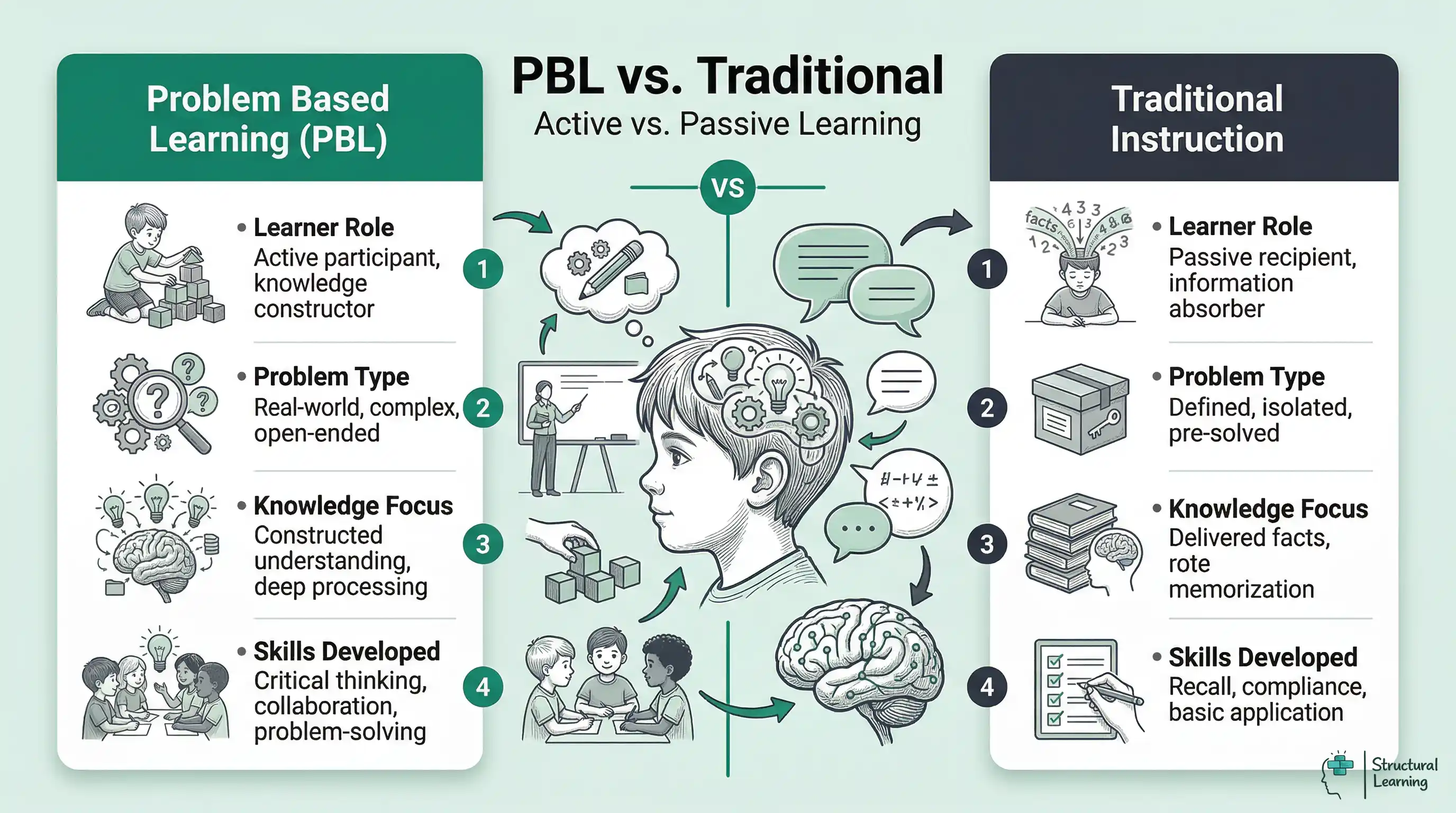
Problem-based learning (PBL) is an instructional approach where students learn by actively working on complex, real-world problems. Rather than receiving information passively, learners investigate meaningful questions, collaborate with peers, and construct their own understanding. Originating in medical education, PBL has spread across disciplines because it develops the critical thinking, problem-solving, and collaboration skills that employers consistently demand. This guide explains how to implement PBL effectively in your classroom.
Embracing this pedagogical approach enables schools to balance subject knowledge acquisition with a skills agenda. Often used in medical education, this approach has equal significance in mainstream education where pupils can apply their knowledge to real-life problems.

PBL is not only helpful in learning course content, but it can also promote the development of problem-solving abilities, critical thinking skills, and communication skills while providing opportunities to work in groups, find and analyse research materials, and take part in life-long learning.
PBL is a student-centred teaching method in which students understand a topic by working in groups. They work out an open-ended problem, which drives the motivation to learn. These sorts of theories of teaching do require schools to invest time and resources into supporting self-directed learning. Not all curriculum knowledge is best acquired through this process, rote learning still has its place in certain situations. How we can equip our students to take more ownership of the learning process and utilise more sophisticated ways for the integration of knowledge.
Problem-Based Learning (PBL), with its roots in the philosophies of John Dewey, Maria Montessori, and Jerome Bruner, aligns closely with the social constructionist view of learning. This approach positions learners as active participants in the construction of knowledge, contrasting with traditional models of instruction where learners are seen as passive recipients of information.
Dewey, a seminal figure in progressive education, advocated for active learningand real-world problem-solving, asserting that learning is grounded in experience and interaction. In PBL, learners tackle complex, real-world problems, which mirrors Dewey's belief in the interconnectedness of education and practical life.

Montessori also endorsed learner-centric, self-directed learning, emphasising the child's potential to construct their own learning experiences. This parallels with PBL's emphasis on self-directed learning, where students take ownership of their learning process.
Jerome Bruner's theories underscored the idea of learning as an active, social process. His concept of a 'spiral curriculum', where learning is revisited in increasing complexity, can be seen reflected in the iterative problem-solving process in PBL.
Webb's Depth of Knowledge(DOK) framework aligns with PBL as it encourages higher-order cognitive skills. The complex tasks in PBL often demand analytical and evaluative skills (Webb's DOK levels 3 and 4) as students engage with the problem, devise a solution, and reflect on their work.
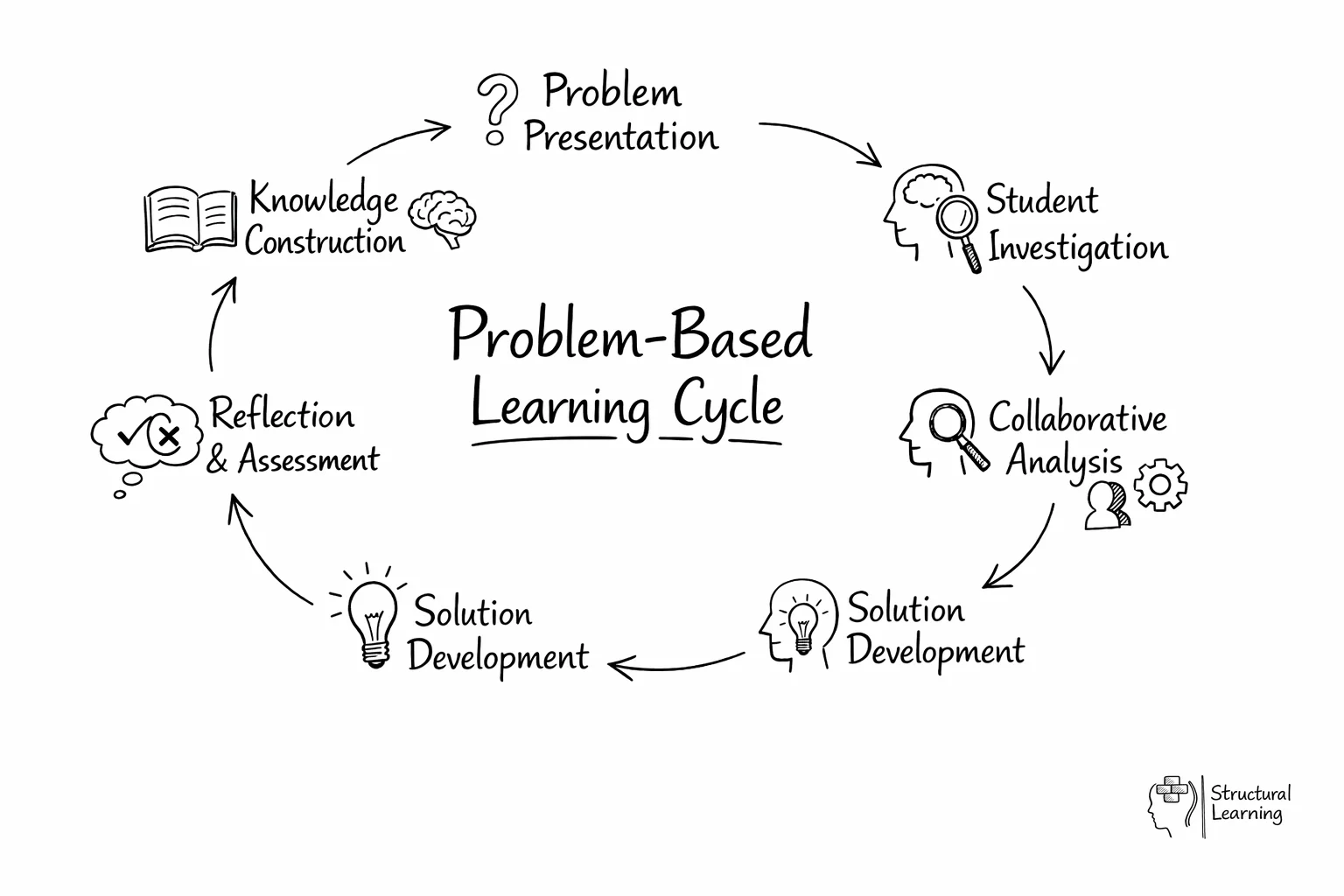
The effectiveness of PBL is supported by psychological theories like the information processing theory, which highlights the role of active engagement in enhancing memory and recall. A study by Strobel and Van Barneveld (2009) found that PBL students show improved retention of knowledge, possibly due to the deep cognitive processing involved.
As cognitive scientist Daniel Willingham aptly puts it, "Memory is the residue of thought." PBL encourages learners to think critically and deeply, enhancing both learning and retention.
Here's a quick overview:
This deep-rooted philosophical and psychological framework strengthens the validity of the problem-based learning approach, confirming its beneficial role in promoting valuable cognitive skills and developing positive student learningoutcomes.
| Phase | Purpose | Student Activities | Teacher Facilitation |
|---|---|---|---|
| 1. Problem Presentation | Encounter an ill-structured, authentic problem | Read/view problem scenario; clarify terms | Present engaging problem without giving solutions |
| 2. Identify Learning Needs | Analyse what knowledge is needed | List "What we know" and "What we need to learn" | Guide discussion; help students recognise gaps |
| 3. Self-Directed Research | Independently acquire needed knowledge | Research using varied sources; take notes | Provide resource guidance; support struggling learners |
| 4. Knowledge Sharing | Pool individual research | Share findings; teach peers; integrate information | Facilitate discussion; correct misconceptions |
| 5. Solution Development | Apply learning to generate solutions | Brainstorm solutions; evaluate options | Encourage multiple solutions; prompt critical thinking |
| 6. Presentation & Reflection | Communicate solution and reflect | Present solution; justify reasoning; reflect on learning | Assess both product and process; guide metacognition |
Based on the Maastricht "Seven Jump" model and Barrows' original PBL framework (1986).
Adding a little creativity can change a topic into a problem-based learning activity. The following are some of the characteristics of a good PBL model:
The teacher's role shifts from information deliverer to facilitator, using modelling techniques to demonstrate problem-solving approaches and providing support when students encounter challenges. This approach particularly benefits students with diverse learning needs as it allows for multiple pathways to understanding.
Visual tools like mind maps and graphic organisers can help students organise their thinking and make connections betw een different aspects of the problem. This emphasis on active learning ensures students remain engaged throughout the problem-solving process.
Another defining characteristic is the emphasis on metacognitive awareness. Students regularly reflect on their learning process, identifying what they know, what they need to discover, and how they might approach finding solutions. This metacognitive component helps learners develop self-directed learning skills that extend far beyond the immediate problem at hand.
The collaborative nature of problem-based learning also distinguishes it from traditional approaches. Students work in small groups, sharing responsibilities and learning from diverse perspectives. This collaboration mirrors real-world problem-solving environments where teamwork and communication skills are essential. For instance, a group tackling an environmental science problem might include students with different strengths in research, data analysis, and presentation skills, creating a rich learning environment where peer teaching occurs naturally.
Finally, PBL is characterised by its assessment methods, which focus on both process and product. Rather than relying solely on end-of-unit tests, teachers evaluate students' problem-solving approaches, collaboration skills, and ability to justify their solutions. This authentic assessment aligns with the real-world applications that form the foundation of problem-based learning, providing a more comprehensive picture of student understanding and capability.
Designing effective problem-based learning scenarios requires careful attention to authenticity and complexity. The most successful PBL problems mirror real-world challenges that professionals actually face, giving students genuine motivation to engage with the material. These problems should be ill-structured by nature, meaning they lack obvious solutions and require students to identify what information they need before they can begin solving. Research by Hmelo-Silver demonstrates that this ambiguity is crucial for developing critical thinking skills and encouraging deep learning.
The challenge level must be precisely calibrated to your students' abilities and prior knowledge. Problems should stretch learners without overwhelming them, following Vygotsky's concept of the zone of proximal development. Consider implementing scaffolding strategies such as providing guiding questions, relevant resources, or structured reflection prompts. Additionally, ensure problems require collaborative investigation rather than simple information retrieval, as the social construction of knowledge is fundamental to effective problem-based learning.
Start by identifying your key learning objectives, then work backwards to create scenarios that naturally require students to master these concepts. Test your problems with colleagues first, asking whether they would genuinely engage learners and whether the complexity feels appropriate. Remember that successful PBL problems often connect multiple disciplines, encouraging students to think across traditional subject boundaries whilst developing transferable problem-solving skills.
Managing a problem-based learning classroom requires a fundamental shift from traditional authoritarian control to what facilitative leadership demands. Unlike conventional teaching where teachers direct every activity, PBL environments thrive when educators step back to become learning facilitators, allowing student-centred exploration whilst maintaining purposeful structure. This delicate balance means establishing clear expectations for collaborative behaviour whilst giving learners sufficient autonomy to tackle authentic problems independently.
Effective group dynamics form the cornerstone of successful PBL implementation. Teachers must proactively address potential challenges such as social loafing, unequal participation, and conflicting working styles before they derail collaborative learning. Jerome Bruner's constructivist principles suggest that students learn most effectively when they can build knowledge together, but this requires explicit teaching of collaboration skills. Establishing group contracts, rotating leadership roles, and implementing peer accountability systems helps maintain productive teamwork throughout extended problem-solving cycles.
The physical classroom environment should reflect PBL's collaborative nature through flexible seating arrangements that facilitate easy regrouping and resource sharing. Consider creating designated spaces for different activities: quiet reflection zones, collaboration areas with moveable furniture, and presentation spaces where groups can share findings. This adaptive learning environment supports the fluid nature of problem-based learning whilst providing teachers with clear sightlines to monitor progress and intervene when necessary.
Assessment in problem-based learning requires a fundamental shift from traditional testing towards authentic evaluation methods that capture the complexity of student learning. Unlike conventional approaches that rely heavily on summative examinations, PBL assessment must evaluate both the process of problem-solving and the quality of final outcomes. This dual focus aligns with constructivist learning theory, which emphasises that knowledge construction occurs through active engagement with authentic problems rather than passive consumption of information.
Effective PBL assessment strategies combine multiple evaluation methods to provide a comprehensive picture of student achievement. Formative assessment techniques such as peer evaluation, self-reflection journals, and regular check-ins allow teachers to monitor student progress throughout the problem-solving process. Portfolio assessment proves particularly valuable, as it documents the evolution of student thinking and demonstrates growth over time. Ruth Garner's research on metacognitive awareness highlights how these reflective practices enhance student learning by making thinking processes visible.
Practical implementation requires careful consideration of assessment criteria and rubrics that clearly articulate expectations for both collaborative skills and content mastery. Teachers should develop scoring guides that address critical thinking, communication, teamwork, and subject-specific knowledge. Additionally, involving students in the assessment design process increases buy-in and helps them understand learning objectives more clearly, ultimately supporting their development as independent learners.
Successful problem-based learning implementation begins with careful problem selection that aligns with curriculum objectives whilst engaging students in authentic, real-world scenarios. Start by identifying a complex problem that requires multiple disciplines and cannot be solved through simple recall of facts. Jerome Bruner's constructivist theory supports this approach, emphasising that learners build understanding through active exploration rather than passive reception of information.
The facilitation process requires a fundamental shift from traditional teaching roles. Teachers must become learning coaches who guide student inquiry through strategic questioning rather than direct instruction. Barrows and Tamblyn's research demonstrates that effective PBL facilitators use scaffolding techniques, gradually reducing support as students develop problem-solving confidence. Begin each session by helping students define the problem clearly, then encourage them to identify what they already know and what they need to discover.
Structure your classroom environment to support collaborative learning with flexible seating arrangements and easy access to research resources. Establish clear protocols for group work, assign rotating roles within teams, and implement regular reflection sessions where students evaluate both their learning progress and group dynamics. This student-centred approach requires patience as learners adapt to increased responsibility for their own learning journey.
These practical PBL strategies help teachers design learning experiences where real-world problems drive student inquiry.
While problem-based learning offers tremendous educational benefits, teachers frequently encounter three primary challenges during implementation. Time management tops the list, as authentic problems require extended exploration periods that don't align with traditional lesson structures. Students may struggle initially with the open-ended nature of real-world problems, particularly those accustomed to direct instruction methods. Additionally, assessment becomes more complex when evaluating collaborative learning processes alongside content mastery.
John Sweller's cognitive load theory demonstrates why scaffolding is essential when introducing PBL to novice learners. Begin with structured problem scenarios that gradually increase in complexity, providing clear success criteria and regular check-in points. Establish consistent group roles and protocols to streamline collaborative learning, reducing organisational cognitive burden. Create assessment rubrics that explicitly outline both individual accountability and group contribution expectations, making evaluation criteria transparent from the outset.
Successful PBL implementation requires patience and systematic preparation. Develop a bank of problems aligned with curriculum objectives, each with varying complexity levels to accommodate different student readiness. Consider hybrid approaches that blend direct instruction with student-centred exploration, particularly when introducing foundational concepts. Most importantly, communicate the rationale behind PBL to students, parents, and administrators, helping stakeholders understand how this approach develops critical thinking and real-world application skills that traditional methods often miss.
Problem based learning is a student centred teaching method where students learn about a subject through the experience of solving an open ended problem. Instead of being told what to do, learners work in groups to identify what they already know and what they need to learn to handle the task. This approach encourages students to take responsibility for their own learning and adjust their behaviour to work effectively in a team.
To start, teachers should present a complex, authentic problem that allows students to practise their research skills. These problems can be presented using different media to add colour and engagement to the lesson. Students then work together to research the topic, share their findings, and develop a potential solution or response. The teacher acts as a facilitator who guides the process and provides resources rather than delivering a traditional lecture.
This approach helps students develop critical thinking and communication skills while working in collaborative groups. Research suggests that students who engage with these tasks show better long term retention of knowledge compared to those using rote learning methods. It also prepares learners for the types of complex challenges they will face in their future careers.
Academic studies indicate that this method is effective for improving student engagement and the application of knowledge. Evidence shows that students often perform better in practical assessments and retain information for longer periods. However, the research also highlights that it works best when students already have a baseline of subject knowledge to build upon.
One common challenge is providing a problem that is too simple or has a predefined correct answer, which limits student investigation. Teachers also sometimes find that students require more structure or support during the research phase than initially expected. It is essential to recognise that a balance between student independence and teacher guidance is needed to ensure the learning objectives are met.
While it originated in medical education, this strategy works well in subjects like science, geography, and design technology where real life applications are clear. It can be used in almost any discipline where students need to apply theoretical knowledge to solve practical or ethical dilemmas. Teachers should choose topics that naturally lead to debate and require multiple perspectives to understand fully.
Problem-based learning transforms across disciplines by anchoring abstract concepts in authentic, real-world challenges that students genuinely care about solving. In science classrooms, students might investigate local water quality issues, collecting samples, analysing data, and presenting findings to environmental agencies. Mathematics comes alive when pupils design sustainable housing projects, calculating costs, dimensions, and energy efficiency whilst collaborating with local architects. History students can examine primary sources to solve mysteries about their local community's past, developing critical thinking skills that extend far beyond memorising dates.
Language arts and social studies naturally integrate through PBL scenarios such as students creating documentary films about social justice issues or developing persuasive campaigns for community improvements. These cross-curricular approaches reflect how Hmelo-Silver's research demonstrates that authentic problems help students develop both content knowledge and essential 21st-century skills simultaneously. Even traditionally challenging subjects like foreign languages flourish when students plan international exchange programmes or create cultural guides for visiting students.
The key to successful implementation lies in selecting problems that balance curriculum requirements with genuine student interest. Start small with single-lesson challenges before progressing to week-long investigations, ensuring each problem requires collaborative inquiry rather than simple information gathering. Remember that effective PBL scenarios have multiple viable solutions, encouraging diverse thinking pathways whilst maintaining clear assessment criteria.
These studies provide the evidence base for problem-based learning and its effectiveness across educational settings.
Problem-Based Learning: An Approach to Medical Education View study ↗ 1,701 citations
Barrows, H. S. and Tamblyn, R. M. (1980)
This foundational text from McMaster University describes the original PBL model developed for medical education. Barrows and Tamblyn demonstrate that presenting students with authentic, ill-structured problems before teaching content produces deeper understanding and better knowledge transfer. The principles they established apply directly to primary and secondary classroom contexts where teachers seek to develop problem-solving capabilities.
When Is PBL More Effective? A Meta-Synthesis of Meta-Analyses Comparing PBL to Conventional Classrooms View study ↗ 850 citations
Strobel, J. and van Barneveld, A. (2009)
This meta-synthesis compares PBL with conventional instruction across multiple studies, finding that PBL produces superior long-term retention, skill development, and student satisfaction, though traditional methods may produce marginally better short-term test performance. For teachers, this confirms that PBL is most valuable when the goal is deep understanding and application rather than surface-level recall.
Problem-Based Learning: What and How Do Students Learn? View study ↗ 4,824 citations
Hmelo-Silver, C. E. (2004)
Hmelo-Silver provides a comprehensive model of PBL learning processes, explaining how students construct knowledge through collaborative problem-solving, self-directed learning, and reflection. The research identifies five key PBL goals: flexible knowledge, effective problem-solving, self-directed learning, collaboration, and intrinsic motivation. Teachers can use these goals as a framework for designing and assessing PBL activities.
Scaffolding Problem-Based Learning: The Role of Expert Facilitation View study ↗ 0 citations
Hmelo-Silver, C. E., Duncan, R. G. and Chinn, C. A. (2007)
This study addresses a common criticism of PBL by demonstrating that appropriate scaffolding enables students of varying abilities to benefit from problem-based approaches. The research shows that the teacher's role as facilitator is critical: well-designed scaffolds help students manage cognitive load whilst maintaining the authentic problem-solving experience that drives deep learning.
Does Problem-Based Learning Work? A Meta-Analysis of Evaluative Research View study ↗ 1,602 citations
Dochy, F. et al. (2003)
This meta-analysis of 43 empirical studies finds robust positive effects of PBL on skill development and moderate effects on knowledge acquisition. The research notes that PBL students demonstrate stronger application of knowledge to new situations. For classroom teachers, this evidence supports using PBL to develop transferable skills that students can apply across subjects and real-world contexts.
Problem-based learning (PBL) is an instructional approach where students learn by actively working on complex, real-world problems. Rather than receiving information passively, learners investigate meaningful questions, collaborate with peers, and construct their own understanding. Originating in medical education, PBL has spread across disciplines because it develops the critical thinking, problem-solving, and collaboration skills that employers consistently demand. This guide explains how to implement PBL effectively in your classroom.
Embracing this pedagogical approach enables schools to balance subject knowledge acquisition with a skills agenda. Often used in medical education, this approach has equal significance in mainstream education where pupils can apply their knowledge to real-life problems.

PBL is not only helpful in learning course content, but it can also promote the development of problem-solving abilities, critical thinking skills, and communication skills while providing opportunities to work in groups, find and analyse research materials, and take part in life-long learning.
PBL is a student-centred teaching method in which students understand a topic by working in groups. They work out an open-ended problem, which drives the motivation to learn. These sorts of theories of teaching do require schools to invest time and resources into supporting self-directed learning. Not all curriculum knowledge is best acquired through this process, rote learning still has its place in certain situations. How we can equip our students to take more ownership of the learning process and utilise more sophisticated ways for the integration of knowledge.
Problem-Based Learning (PBL), with its roots in the philosophies of John Dewey, Maria Montessori, and Jerome Bruner, aligns closely with the social constructionist view of learning. This approach positions learners as active participants in the construction of knowledge, contrasting with traditional models of instruction where learners are seen as passive recipients of information.
Dewey, a seminal figure in progressive education, advocated for active learningand real-world problem-solving, asserting that learning is grounded in experience and interaction. In PBL, learners tackle complex, real-world problems, which mirrors Dewey's belief in the interconnectedness of education and practical life.

Montessori also endorsed learner-centric, self-directed learning, emphasising the child's potential to construct their own learning experiences. This parallels with PBL's emphasis on self-directed learning, where students take ownership of their learning process.
Jerome Bruner's theories underscored the idea of learning as an active, social process. His concept of a 'spiral curriculum', where learning is revisited in increasing complexity, can be seen reflected in the iterative problem-solving process in PBL.
Webb's Depth of Knowledge(DOK) framework aligns with PBL as it encourages higher-order cognitive skills. The complex tasks in PBL often demand analytical and evaluative skills (Webb's DOK levels 3 and 4) as students engage with the problem, devise a solution, and reflect on their work.
The effectiveness of PBL is supported by psychological theories like the information processing theory, which highlights the role of active engagement in enhancing memory and recall. A study by Strobel and Van Barneveld (2009) found that PBL students show improved retention of knowledge, possibly due to the deep cognitive processing involved.
As cognitive scientist Daniel Willingham aptly puts it, "Memory is the residue of thought." PBL encourages learners to think critically and deeply, enhancing both learning and retention.
Here's a quick overview:
This deep-rooted philosophical and psychological framework strengthens the validity of the problem-based learning approach, confirming its beneficial role in promoting valuable cognitive skills and developing positive student learningoutcomes.
| Phase | Purpose | Student Activities | Teacher Facilitation |
|---|---|---|---|
| 1. Problem Presentation | Encounter an ill-structured, authentic problem | Read/view problem scenario; clarify terms | Present engaging problem without giving solutions |
| 2. Identify Learning Needs | Analyse what knowledge is needed | List "What we know" and "What we need to learn" | Guide discussion; help students recognise gaps |
| 3. Self-Directed Research | Independently acquire needed knowledge | Research using varied sources; take notes | Provide resource guidance; support struggling learners |
| 4. Knowledge Sharing | Pool individual research | Share findings; teach peers; integrate information | Facilitate discussion; correct misconceptions |
| 5. Solution Development | Apply learning to generate solutions | Brainstorm solutions; evaluate options | Encourage multiple solutions; prompt critical thinking |
| 6. Presentation & Reflection | Communicate solution and reflect | Present solution; justify reasoning; reflect on learning | Assess both product and process; guide metacognition |
Based on the Maastricht "Seven Jump" model and Barrows' original PBL framework (1986).
Adding a little creativity can change a topic into a problem-based learning activity. The following are some of the characteristics of a good PBL model:
The teacher's role shifts from information deliverer to facilitator, using modelling techniques to demonstrate problem-solving approaches and providing support when students encounter challenges. This approach particularly benefits students with diverse learning needs as it allows for multiple pathways to understanding.
Visual tools like mind maps and graphic organisers can help students organise their thinking and make connections betw een different aspects of the problem. This emphasis on active learning ensures students remain engaged throughout the problem-solving process.
Another defining characteristic is the emphasis on metacognitive awareness. Students regularly reflect on their learning process, identifying what they know, what they need to discover, and how they might approach finding solutions. This metacognitive component helps learners develop self-directed learning skills that extend far beyond the immediate problem at hand.
The collaborative nature of problem-based learning also distinguishes it from traditional approaches. Students work in small groups, sharing responsibilities and learning from diverse perspectives. This collaboration mirrors real-world problem-solving environments where teamwork and communication skills are essential. For instance, a group tackling an environmental science problem might include students with different strengths in research, data analysis, and presentation skills, creating a rich learning environment where peer teaching occurs naturally.
Finally, PBL is characterised by its assessment methods, which focus on both process and product. Rather than relying solely on end-of-unit tests, teachers evaluate students' problem-solving approaches, collaboration skills, and ability to justify their solutions. This authentic assessment aligns with the real-world applications that form the foundation of problem-based learning, providing a more comprehensive picture of student understanding and capability.
Designing effective problem-based learning scenarios requires careful attention to authenticity and complexity. The most successful PBL problems mirror real-world challenges that professionals actually face, giving students genuine motivation to engage with the material. These problems should be ill-structured by nature, meaning they lack obvious solutions and require students to identify what information they need before they can begin solving. Research by Hmelo-Silver demonstrates that this ambiguity is crucial for developing critical thinking skills and encouraging deep learning.
The challenge level must be precisely calibrated to your students' abilities and prior knowledge. Problems should stretch learners without overwhelming them, following Vygotsky's concept of the zone of proximal development. Consider implementing scaffolding strategies such as providing guiding questions, relevant resources, or structured reflection prompts. Additionally, ensure problems require collaborative investigation rather than simple information retrieval, as the social construction of knowledge is fundamental to effective problem-based learning.
Start by identifying your key learning objectives, then work backwards to create scenarios that naturally require students to master these concepts. Test your problems with colleagues first, asking whether they would genuinely engage learners and whether the complexity feels appropriate. Remember that successful PBL problems often connect multiple disciplines, encouraging students to think across traditional subject boundaries whilst developing transferable problem-solving skills.
Managing a problem-based learning classroom requires a fundamental shift from traditional authoritarian control to what facilitative leadership demands. Unlike conventional teaching where teachers direct every activity, PBL environments thrive when educators step back to become learning facilitators, allowing student-centred exploration whilst maintaining purposeful structure. This delicate balance means establishing clear expectations for collaborative behaviour whilst giving learners sufficient autonomy to tackle authentic problems independently.
Effective group dynamics form the cornerstone of successful PBL implementation. Teachers must proactively address potential challenges such as social loafing, unequal participation, and conflicting working styles before they derail collaborative learning. Jerome Bruner's constructivist principles suggest that students learn most effectively when they can build knowledge together, but this requires explicit teaching of collaboration skills. Establishing group contracts, rotating leadership roles, and implementing peer accountability systems helps maintain productive teamwork throughout extended problem-solving cycles.
The physical classroom environment should reflect PBL's collaborative nature through flexible seating arrangements that facilitate easy regrouping and resource sharing. Consider creating designated spaces for different activities: quiet reflection zones, collaboration areas with moveable furniture, and presentation spaces where groups can share findings. This adaptive learning environment supports the fluid nature of problem-based learning whilst providing teachers with clear sightlines to monitor progress and intervene when necessary.
Assessment in problem-based learning requires a fundamental shift from traditional testing towards authentic evaluation methods that capture the complexity of student learning. Unlike conventional approaches that rely heavily on summative examinations, PBL assessment must evaluate both the process of problem-solving and the quality of final outcomes. This dual focus aligns with constructivist learning theory, which emphasises that knowledge construction occurs through active engagement with authentic problems rather than passive consumption of information.
Effective PBL assessment strategies combine multiple evaluation methods to provide a comprehensive picture of student achievement. Formative assessment techniques such as peer evaluation, self-reflection journals, and regular check-ins allow teachers to monitor student progress throughout the problem-solving process. Portfolio assessment proves particularly valuable, as it documents the evolution of student thinking and demonstrates growth over time. Ruth Garner's research on metacognitive awareness highlights how these reflective practices enhance student learning by making thinking processes visible.
Practical implementation requires careful consideration of assessment criteria and rubrics that clearly articulate expectations for both collaborative skills and content mastery. Teachers should develop scoring guides that address critical thinking, communication, teamwork, and subject-specific knowledge. Additionally, involving students in the assessment design process increases buy-in and helps them understand learning objectives more clearly, ultimately supporting their development as independent learners.
Successful problem-based learning implementation begins with careful problem selection that aligns with curriculum objectives whilst engaging students in authentic, real-world scenarios. Start by identifying a complex problem that requires multiple disciplines and cannot be solved through simple recall of facts. Jerome Bruner's constructivist theory supports this approach, emphasising that learners build understanding through active exploration rather than passive reception of information.
The facilitation process requires a fundamental shift from traditional teaching roles. Teachers must become learning coaches who guide student inquiry through strategic questioning rather than direct instruction. Barrows and Tamblyn's research demonstrates that effective PBL facilitators use scaffolding techniques, gradually reducing support as students develop problem-solving confidence. Begin each session by helping students define the problem clearly, then encourage them to identify what they already know and what they need to discover.
Structure your classroom environment to support collaborative learning with flexible seating arrangements and easy access to research resources. Establish clear protocols for group work, assign rotating roles within teams, and implement regular reflection sessions where students evaluate both their learning progress and group dynamics. This student-centred approach requires patience as learners adapt to increased responsibility for their own learning journey.
These practical PBL strategies help teachers design learning experiences where real-world problems drive student inquiry.
While problem-based learning offers tremendous educational benefits, teachers frequently encounter three primary challenges during implementation. Time management tops the list, as authentic problems require extended exploration periods that don't align with traditional lesson structures. Students may struggle initially with the open-ended nature of real-world problems, particularly those accustomed to direct instruction methods. Additionally, assessment becomes more complex when evaluating collaborative learning processes alongside content mastery.
John Sweller's cognitive load theory demonstrates why scaffolding is essential when introducing PBL to novice learners. Begin with structured problem scenarios that gradually increase in complexity, providing clear success criteria and regular check-in points. Establish consistent group roles and protocols to streamline collaborative learning, reducing organisational cognitive burden. Create assessment rubrics that explicitly outline both individual accountability and group contribution expectations, making evaluation criteria transparent from the outset.
Successful PBL implementation requires patience and systematic preparation. Develop a bank of problems aligned with curriculum objectives, each with varying complexity levels to accommodate different student readiness. Consider hybrid approaches that blend direct instruction with student-centred exploration, particularly when introducing foundational concepts. Most importantly, communicate the rationale behind PBL to students, parents, and administrators, helping stakeholders understand how this approach develops critical thinking and real-world application skills that traditional methods often miss.
Problem based learning is a student centred teaching method where students learn about a subject through the experience of solving an open ended problem. Instead of being told what to do, learners work in groups to identify what they already know and what they need to learn to handle the task. This approach encourages students to take responsibility for their own learning and adjust their behaviour to work effectively in a team.
To start, teachers should present a complex, authentic problem that allows students to practise their research skills. These problems can be presented using different media to add colour and engagement to the lesson. Students then work together to research the topic, share their findings, and develop a potential solution or response. The teacher acts as a facilitator who guides the process and provides resources rather than delivering a traditional lecture.
This approach helps students develop critical thinking and communication skills while working in collaborative groups. Research suggests that students who engage with these tasks show better long term retention of knowledge compared to those using rote learning methods. It also prepares learners for the types of complex challenges they will face in their future careers.
Academic studies indicate that this method is effective for improving student engagement and the application of knowledge. Evidence shows that students often perform better in practical assessments and retain information for longer periods. However, the research also highlights that it works best when students already have a baseline of subject knowledge to build upon.
One common challenge is providing a problem that is too simple or has a predefined correct answer, which limits student investigation. Teachers also sometimes find that students require more structure or support during the research phase than initially expected. It is essential to recognise that a balance between student independence and teacher guidance is needed to ensure the learning objectives are met.
While it originated in medical education, this strategy works well in subjects like science, geography, and design technology where real life applications are clear. It can be used in almost any discipline where students need to apply theoretical knowledge to solve practical or ethical dilemmas. Teachers should choose topics that naturally lead to debate and require multiple perspectives to understand fully.
Problem-based learning transforms across disciplines by anchoring abstract concepts in authentic, real-world challenges that students genuinely care about solving. In science classrooms, students might investigate local water quality issues, collecting samples, analysing data, and presenting findings to environmental agencies. Mathematics comes alive when pupils design sustainable housing projects, calculating costs, dimensions, and energy efficiency whilst collaborating with local architects. History students can examine primary sources to solve mysteries about their local community's past, developing critical thinking skills that extend far beyond memorising dates.
Language arts and social studies naturally integrate through PBL scenarios such as students creating documentary films about social justice issues or developing persuasive campaigns for community improvements. These cross-curricular approaches reflect how Hmelo-Silver's research demonstrates that authentic problems help students develop both content knowledge and essential 21st-century skills simultaneously. Even traditionally challenging subjects like foreign languages flourish when students plan international exchange programmes or create cultural guides for visiting students.
The key to successful implementation lies in selecting problems that balance curriculum requirements with genuine student interest. Start small with single-lesson challenges before progressing to week-long investigations, ensuring each problem requires collaborative inquiry rather than simple information gathering. Remember that effective PBL scenarios have multiple viable solutions, encouraging diverse thinking pathways whilst maintaining clear assessment criteria.
These studies provide the evidence base for problem-based learning and its effectiveness across educational settings.
Problem-Based Learning: An Approach to Medical Education View study ↗ 1,701 citations
Barrows, H. S. and Tamblyn, R. M. (1980)
This foundational text from McMaster University describes the original PBL model developed for medical education. Barrows and Tamblyn demonstrate that presenting students with authentic, ill-structured problems before teaching content produces deeper understanding and better knowledge transfer. The principles they established apply directly to primary and secondary classroom contexts where teachers seek to develop problem-solving capabilities.
When Is PBL More Effective? A Meta-Synthesis of Meta-Analyses Comparing PBL to Conventional Classrooms View study ↗ 850 citations
Strobel, J. and van Barneveld, A. (2009)
This meta-synthesis compares PBL with conventional instruction across multiple studies, finding that PBL produces superior long-term retention, skill development, and student satisfaction, though traditional methods may produce marginally better short-term test performance. For teachers, this confirms that PBL is most valuable when the goal is deep understanding and application rather than surface-level recall.
Problem-Based Learning: What and How Do Students Learn? View study ↗ 4,824 citations
Hmelo-Silver, C. E. (2004)
Hmelo-Silver provides a comprehensive model of PBL learning processes, explaining how students construct knowledge through collaborative problem-solving, self-directed learning, and reflection. The research identifies five key PBL goals: flexible knowledge, effective problem-solving, self-directed learning, collaboration, and intrinsic motivation. Teachers can use these goals as a framework for designing and assessing PBL activities.
Scaffolding Problem-Based Learning: The Role of Expert Facilitation View study ↗ 0 citations
Hmelo-Silver, C. E., Duncan, R. G. and Chinn, C. A. (2007)
This study addresses a common criticism of PBL by demonstrating that appropriate scaffolding enables students of varying abilities to benefit from problem-based approaches. The research shows that the teacher's role as facilitator is critical: well-designed scaffolds help students manage cognitive load whilst maintaining the authentic problem-solving experience that drives deep learning.
Does Problem-Based Learning Work? A Meta-Analysis of Evaluative Research View study ↗ 1,602 citations
Dochy, F. et al. (2003)
This meta-analysis of 43 empirical studies finds robust positive effects of PBL on skill development and moderate effects on knowledge acquisition. The research notes that PBL students demonstrate stronger application of knowledge to new situations. For classroom teachers, this evidence supports using PBL to develop transferable skills that students can apply across subjects and real-world contexts.
<script type="application/ld+json">{"@context":"https://schema.org","@graph":[{"@type":"Article","@id":"https://www.structural-learning.com/post/problem-based-learning-a-teachers-guide#article","headline":"Problem-Based Learning: A Complete Guide for Teachers","description":"Explore how problem-based learning engages students with real-world challenges, enhances critical thinking, and fosters collaboration in the classroom.","datePublished":"2021-12-10T12:34:13.361Z","dateModified":"2026-03-02T11:01:36.658Z","author":{"@type":"Person","name":"Paul Main","url":"https://www.structural-learning.com/team/paulmain","jobTitle":"Founder & Educational Consultant"},"publisher":{"@type":"Organization","name":"Structural Learning","url":"https://www.structural-learning.com","logo":{"@type":"ImageObject","url":"https://cdn.prod.website-files.com/5b69a01ba2e409e5d5e055c6/6040bf0426cb415ba2fc7882_newlogoblue.svg"}},"mainEntityOfPage":{"@type":"WebPage","@id":"https://www.structural-learning.com/post/problem-based-learning-a-teachers-guide"},"image":"https://cdn.prod.website-files.com/5b69a01ba2e409501de055d1/696a34a2180ac52eff0aea5c_696a349c3dd12120d962591e_problem-based-learning-a-teachers-guide-illustration.webp","wordCount":3108},{"@type":"BreadcrumbList","@id":"https://www.structural-learning.com/post/problem-based-learning-a-teachers-guide#breadcrumb","itemListElement":[{"@type":"ListItem","position":1,"name":"Home","item":"https://www.structural-learning.com/"},{"@type":"ListItem","position":2,"name":"Blog","item":"https://www.structural-learning.com/blog"},{"@type":"ListItem","position":3,"name":"Problem-Based Learning: A Complete Guide for Teachers","item":"https://www.structural-learning.com/post/problem-based-learning-a-teachers-guide"}]}]}</script>