Updated on
September 18, 2026
Live Modelling Examples: I Do, We Do, You Do in Practice
Live modelling examples: think-aloud scripts, the I do, we do, you do handover, what it looks like from Reception to KS4, mistakes and a printable table.

Updated on
September 18, 2026
Live modelling examples: think-aloud scripts, the I do, we do, you do handover, what it looks like from Reception to KS4, mistakes and a printable table.
Live modelling is a teacher working through a task in front of the class while saying the thinking out loud, then handing the task over in stages: I do, we do, you do. The point is not the finished answer. It is the decisions, false starts and checks that a learner never sees in a textbook example. In a Year 7 English lesson, the teacher drafts an opening sentence on the visualiser, rejects it, explains why, and writes a second; learners then draft their own opening on whiteboards and hold them up.
The sequence comes from Pearson and Gallagher (1983), who called it the gradual release of responsibility. It matters because novices learn faster from a worked example with the reasoning exposed than from unguided practice (Sweller, 1988). This guide gives you scripts for the I do, a way to stop the we do collapsing into more teacher talk, and the checks that tell you when the class is ready for you do.
Modelling shows learners teacher thinking and skill performance (Collins, Brown, & Newman, 1989). Think-alouds and examples reveal how thinking works. Learners then solve problems, spot errors, and gain fluency (Anderson, Greeno, Kline, & Neves, 1981; Pirolli & Anderson, 1985).
Modelling helps learners most when you plan the lesson around it. In a Year 5 maths lesson, the teacher works one long multiplication on the board before anyone opens a book. That way, every learner has seen the whole method once.
Verbal modelling shows your thinking (Bruner, 1961). Explicit instruction names the decisions you make (Kirschner, 2009; Sweller, 1988). Together, they make the goal clear and boost learner confidence.
Modelling saves teacher time and builds skills. Teachers explain ideas clearly to each learner. Learning together deepens understanding (Vygotsky, 1978). Working with others improves teaching practice (Bandura, 1977).
Bandura's (1977) Social Learning Theory builds on behaviourism. Bandura (1977) stated thoughts and rewards shape learner development. Learners copy behaviours, then change them, he noted.
Learners understand ideas by building mental models, which are pictures of how something works in their heads (Johnson-Laird, 1983). They build these models to check what they understand (Gentner & Stevens, 1983). Building with blocks helps learners reach key insights (Piaget, 1954).
Modelling lets learners see their own thinking and change it (Norman, 1983). This helps learning and encourages thinking about thinking (Flavell, 1979).
Giving time to teaching methods like this lets children play with their new ideas. The social side of these activities helps children explain their thinking to one another. This sets up better writing, because learners get time to rehearse what they are going to write.
The approach fits with constructivism, where learners build their own understanding through hands-on experience. For more guidance, see our article on talk for writing.
Bandura's Social Learning Theory (1977) shows that learners copy what they have watched. They watch a role model and then repeat the actions or words. Bandura (1977) described how learners use these role models.
Baddeley and Hitch (1974) proposed a working-memory model. It explains how we hold and work with information for a short time. Sweller (1988) applied the limits of working memory to lesson design.
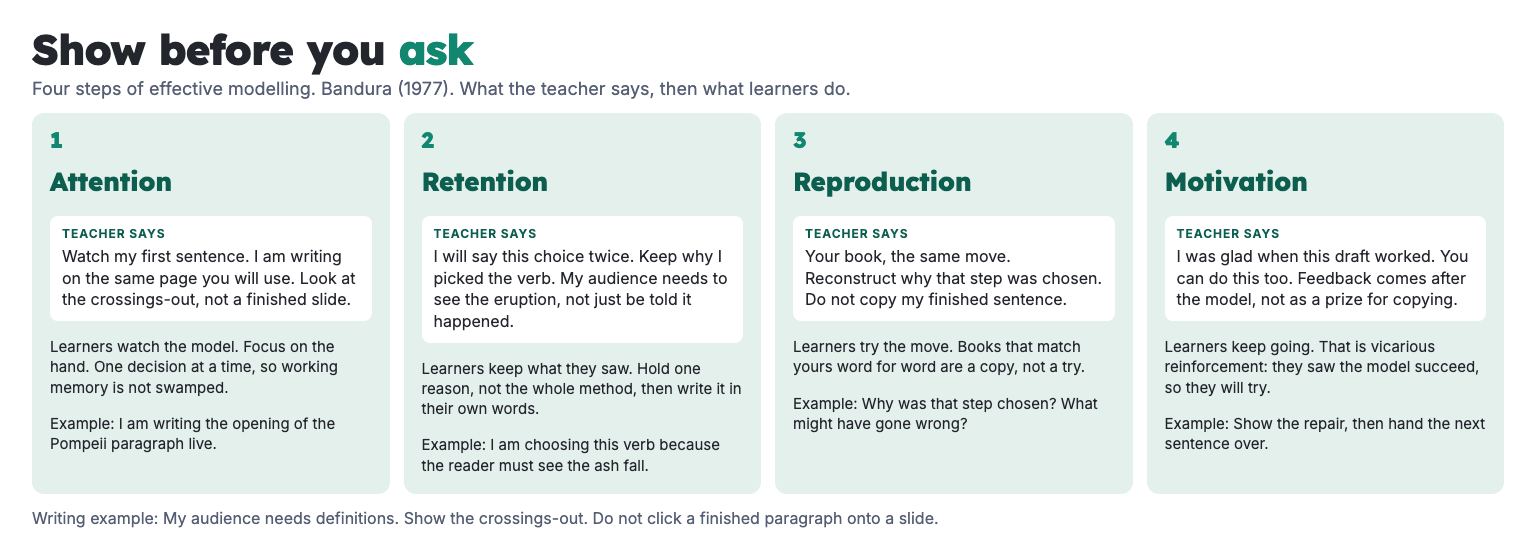
Here are some examples of how modelling can be used in the classroom:
In maths, model problem solving by sharing your thinking aloud (Schoenfeld, 1985). For writing, demonstrate the whole process, not just final products (Flower & Hayes, 1981). Say your plans: 'My audience needs definitions.' Show learners how you revise and rethink writing (Sommers, 1980). This shows writing takes drafts.
Zimmerman (2007) taught learners scientific thinking by letting them watch it being done. Klahr (2000) showed learners how to control variables in experiments. Wineburg (1991) had learners question bias in sources when studying history.
Eight routines from teachers on social media. Each row is a claim, labelled reported practice, practitioner claim or objection. The evidence column is a fetched page or a named paper, not the post. This page already covers think-alouds, worked examples and the I do, we do, you do handover. These rows add the visualiser versus the finished slide, copying the product, fading the last step, and the US kindergarten three-beat.
| Routine, as teachers describe it | What you would notice | What the evidence says |
|---|---|---|
| Live under the visualiser reported practice Write or draw in real time on the page the class will use. Narrate the choice. Leave crossings-out visible. Do not click a finished paragraph onto a slide.
|
A camera on an exercise book or a hand on the page. The teacher is talking through a decision, not presenting a deck. | EEF Metacognition and Self-Regulated Learning, second edition, published 13 Nov 2025, Recommendation 3 (fetched): model your own thinking; verbalise as you work through the task. A tweet is not a trial of visualisers. The article already names think-alouds. This row is the live page versus the finished slide. |
| Same medium as the book reported practice Model the maths on paper under the camera so the worked example matches the exercise book, then hand the next one over.
|
Lined paper under the lens, not a polished slide. The next question sits beside the model. | Bradford Research School, 20 Mar 2025 (fetched from the 16 Apr 2026 post): script the think-aloud on a percentage decrease and on comparing fractions, then ask whether the class can apply it. Classroom claim about the medium, not a trial of paper versus board. |
| Reconstruct the thinking practitioner claim After the live write, make the class rebuild the decisions. If they can only copy the finished product, the thinking still belongs to the teacher. |
Books that do not match the model word for word. A second pass that names why a sentence was cut. | A classroom claim, not a trial. EEF, 20 Jun 2022 (fetched): after a think-aloud worked example, fade backwards so the leap to independent practice is not one jump. Renkl and Atkinson (2003), DOI 10.1207/S15326985EP3801_3, is the fading paper that blog cites. |
| Stop the pre-written rehash objection Do not put a finished scheme paragraph on the screen and ask the class to rewrite it. That is not a live model. |
Every book holding the same setting. No crossings-out. No window into a learner’s choices. | Writing for Pleasure Centre, 16 Jul 2025 (fetched): names this pattern elaborate dictation, copying or lightly adapting a teacher- or scheme-generated text. That is a centre claim. This listen corroborated it with one visiting writing lead. How widespread it is remains unverified. |
| Shared write on the flip chart reported practice Build a class paragraph on the flip chart or board, with substitutions in a second colour, while the class writes in books. |
A Year 3 to Year 5 board the class owns. Word-class colour. Vocabulary swaps, not a downloaded WAGOLL. | A photographed classroom scene, not a trial. EEF Recommendation 3 (2025, fetched) still wants the thinking named out loud. Year 2 appeared only for maths explanations under a visualiser. |
| Show getting stuck practitioner claim US literacy: the I-do includes an expert getting stuck and rereading. Script one stuck line, then the repair.
|
The adult pausing, rereading, and saying what is not working, before the class is asked to try. | Douglas Fisher’s claim, 17 Sep 2026. EEF Recommendation 3 (2025, fetched) asks teachers to verbalise questions such as “What do I know about problems like this?” It does not trial a stuck-and-reread script. Not a UK classroom post. |
| Fade the last steps reported practice After a full worked example, give a twin with the later steps blank. Maths-specific. Do not call this a generic I do, we do, you do overlay.
|
Two examples side by side. The second one stops short. Learners complete the end, not the whole method. | EEF, 20 Jun 2022 (fetched): fade backwards after a think-aloud. Renkl and Atkinson (2003), DOI 10.1207/S15326985EP3801_3. One UK head of maths describes a dissertation trial, not a department routine, so how common fading is remains unverified. |
| US kindergarten three-beat reported practice Name I do, we do, you do on a short blending move, then hand over the mouth or the pen. UK trainers in the posts we read reject a whole-school I, We, You regime. |
A short I-do of three phonemes, then a we-do, then the child. Not a long teacher monologue. | US school name for gradual release. Pearson and Gallagher (1983) coined gradual release of responsibility, already on the article. Anita Archer’s three-beat is what US kindergarten posts used. UK classroom teachers almost never described their own lesson as I do, we do, you do. Keep the countries apart. |
| What we did not find: no sixth-form, Year 12 or A-level essay-paragraph modelling; no Year 2 shared writing (Year 2 appeared only for maths under a visualiser); no UK classroom teacher describing their own lesson as I do, we do, you do; no “they just copy the WAGOLL” as a set phrase; no “the confident ones switch off”; no “too much teacher talk” as a modelling complaint; no US post that modelling eats the period; no named 9th to 12th grade English teacher modelling a full essay live (8th grade Texas ECR was the nearest). | ||
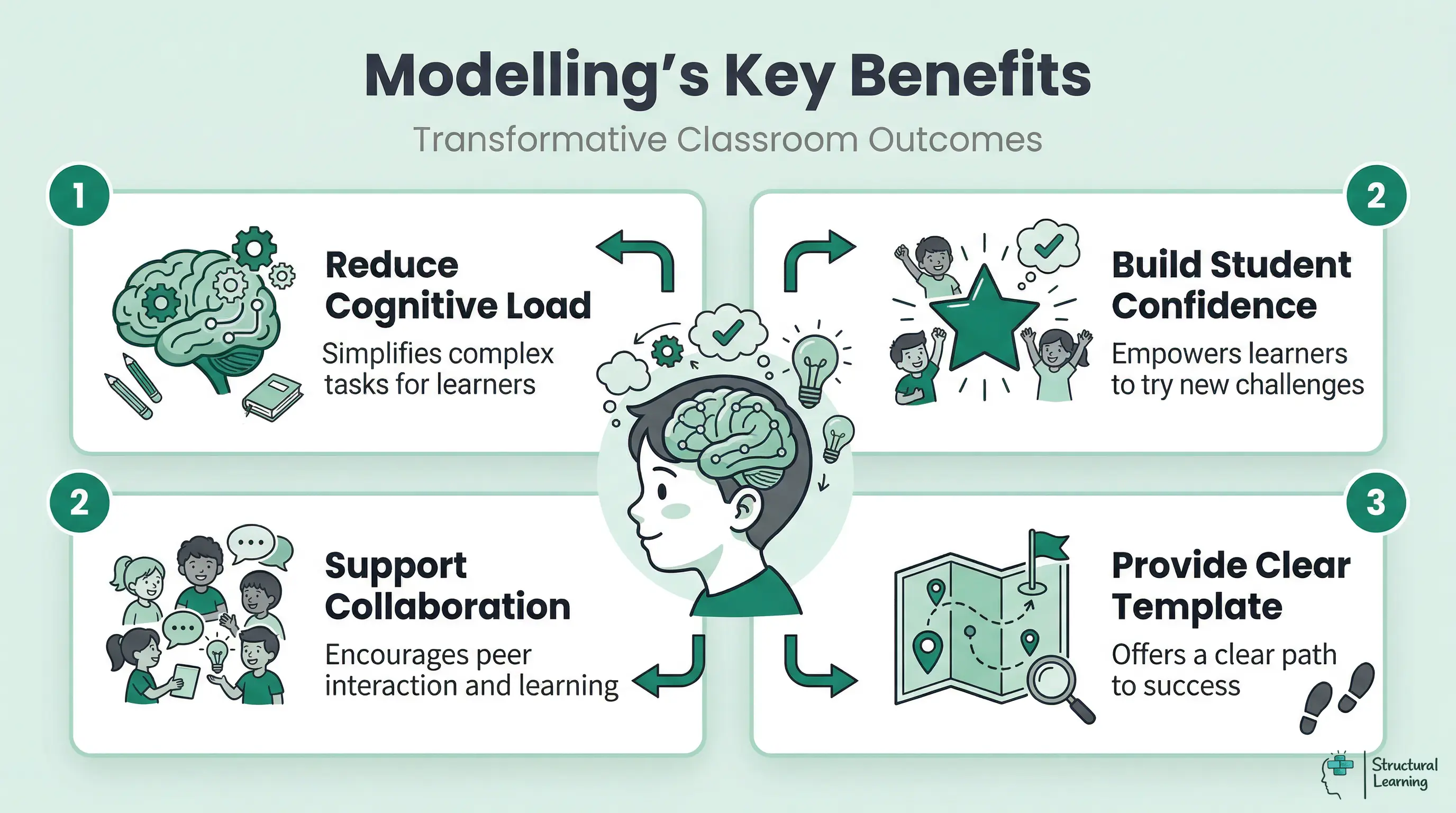
Modelling is a highly effective teaching strategy for several reasons:
In the end, good modelling helps learners work on their own and succeed.
Explicit modelling boosts learning (Hattie, 2009). Teachers show an expert example before learners practise, which reduces cognitive load, the mental effort a task demands. This helps new learners build confidence.
Showing both the steps and the mistakes gives learners a clear path to success. Hattie (2009) reports large effects for worked examples and direct instruction. Both depend on a clear model.
Bruner (1966) argued that modelling helps learners understand. Watching someone do a task helps learners grasp the process. Piaget (1936) said that structured movement supports learners. Bandura (1977) explained that clear modelling helps learners who are struggling.
Learners gain lasting benefits beyond finishing tasks. Seeing experts think helps learners adopt useful methods (Collins et al., 1991). This knowledge transfer is education's key aim. It helps learners face new challenges confidently (Bransford et al., 2000; Brown et al., 1989).
What live modelling looks like when a post names the year, grade or phase. US band names and US-only variants sit in the last column, never mixed into a UK cell.
| Phase | What the teacher does | What you would notice | The trap at that age |
|---|---|---|---|
| Reception and KS1 ages 4 to 7 US: K to 2 |
Put Year 2 addition under the visualiser so classmates hear tens and ones explained, not a Year 2 shared write. Reception itself is not named in the posts we read.
|
Year 2 voices explaining a method on camera. The post is maths, not writing. | Inventing a Year 2 shared-writing scene from this clip. Year 2 shared writing was not found. |
| KS2 ages 7 to 11 US: Grades 3 to 5 |
Build a class paragraph on the flip chart or board. Year 3 weaves a spine poem into a story. Year 4 describes Pompeii. Year 5 writes a setting for The Promise.
|
A board the class owns. Colour for substitutions. Learners writing in books while the shared text grows. | Putting a finished scheme paragraph on the screen and asking the class to rehash it. That is the pre-written model, not this board. |
| KS3 ages 11 to 14 US: Grades 6 to 8 |
English: a text or poem plus the visualiser, about 60 percent of lessons. Ditch the PowerPoint. Talk, annotate, then write. | No deck. A camera or visualiser and a text. The class is annotating, not watching a finished model appear. | Turning 60 percent visualiser use into a whole-school I, We, You playbook. Generic PD on modelling fails because We do differs by subject. |
| KS4 ages 14 to 16 US: Grades 9 to 12 |
Keep the visualiser for most English lessons, and live-model a GCSE RE response step by step before independent application.
|
A handwritten GCSE-style answer on the class screen. Expert thinking named before the class writes alone. | Treating the visualiser as the whole two-year course. A PE teacher in the posts we read said a two-year GCSE taught only under the camera would take five years. That is coverage fear, not a short I-do. |
The we do phase is where most modelling quietly fails. Watch a typical guided-practice segment and you will often see the teacher still doing the reasoning while learners chorus the answers. That is an I do with a call-and-response soundtrack. It tells you nothing about who can do the task alone (Kirschner, Sweller and Clark, 2006).
The scripts below do two things about that. Each one shows a decision being made and a mistake being caught. A flawless model teaches almost nothing that an AI-generated worked example could not; the human value in 2026 is the visible recovery from being stuck. And each script ends with something every learner must produce before you move on.
"I want to open with the character's fear, so I'll start with 'The corridor smelt of damp.' Hmm. That gives you the setting, not the fear. Let me cross it out. 'Ellie counted her steps so she would not have to look up.' Better, because the action shows the fear without naming it. Now I need a second sentence that brings in the smell, but as something she notices rather than the narrator telling you." Year 7 learners write the second sentence on whiteboards and hold them up; the teacher reads three aloud and asks which one keeps the fear in the action.
"I'm solving 3x + 7 = 22. I want x on its own, so I take 7 from both sides. That gives 3x = 15. Divide by 3, so x is 5."
"Wait, let me check by substituting: 3 times 5 is 15, add 7 is 22. Good. If I had taken 7 from one side only I would have 3x = 22, and the check would have failed straight away. That is why the substitution is not optional."
Year 8 learners then solve 4x + 5 = 29 on whiteboards and show the check line. The teacher scans for anyone who skipped it.
"Why does the ice melt faster on the metal tray than the plastic one? My first instinct is to say the metal is colder. But both trays sat in the same room, so they are at the same temperature. So that cannot be it."
"What differs is how fast each tray passes heat into the ice. Metal conducts heat well, so it feeds energy into the ice quickly. I'll write: the metal tray conducts heat to the ice faster."
Year 9 learners then predict what happens on a wooden tray. They write one sentence using the word 'conducts', and pairs compare predictions before the demonstration.
These are the questions teachers ask when the idea meets a classroom, quoted as posted, not the article’s verdict on the idea. Each two-sentence answer is grounded in the replies on that thread and in fetched pages. Where the replies disagree, the disagreement is the finding.
Question
“I visited a school recently and spoke to their writing lead. They show them pre written models on the screen and get the kids to basically rehash them. Zero live modelling.”
What the replies and the evidence say. @WritingRocks_17, same day: What an insult to children and childhood.
@teachingwrens, 22 Feb 2026, names the same trap when TAs hand over sentences to copy. The Writing for Pleasure Centre, 16 Jul 2025 (fetched), calls this elaborate dictation. That is a centre claim plus one visiting lead. How widespread it is remains unverified.
Question
“If they can only copy the finished product, the important thinking is still owned by the teacher.”
What the replies and the evidence say. The same post asks the class to reconstruct why a step was chosen. @BarryNSmith79, 12 Feb 2026, worries about illegible live writing that learners then copy with little thought as to meaning. EEF, 20 Jun 2022 (fetched), answers with a faded twin after the think-aloud, not with dropping the model.
Question
“whenever I see a generic T&L policy or playbook or similar in a school it makes me wince a bit. Subject, age, stage, room & even time of day can affect how a lesson should be structured”
What the replies and the evidence say. @teacherhead, 23 Nov 2025: ... you can't get far with generic PD on modelling and scaffolding - because how you do it depends entirely on what you're teaching.
@CathyPotter24, 24 Nov 2025: I personally think maths particularly suffers from mechanistic structures in primary.
The replies agree the overlay is the problem, not the live model.
Question
“How can the students do it if they don't know the method? Only a tiny number of top tier students can make headway by their intuition...”
What the replies and the evidence say. This is a reply to @ShakinthatChalk, 21 Nov 2025: Pupils do the question *followed* by the teacher modelling the solution. - you do (student) followed by I do (teacher)
The disagreement is the finding. EEF fading (EEF, 20 Jun 2022) sits in the middle: a full worked example first, then a twin with the last steps blank, not a cold you-do.
Question
“A visualiser is great for certain things and subjects such as maths but how do you teach a whole course under a visualiser? A two year GCSE would take about five years!!”
What the replies and the evidence say. Keyword searches for “too long” and “takes the whole lesson” as teachers’ own words about live modelling returned nothing. @Bloomgabs still uses the visualiser for 60 percent of KS3 and 80 percent of KS4, not for every minute of a two-year course. Coverage fear is whole-course evangelism, not a short I-do.
Question
“Recent pd session from my district's math curriculum coordinator: ... “We know that gradual release of responsibility doesn't work in math””
What the replies and the evidence say. This is one first-year teacher’s report of unnamed district PD, not a named policy. @Jasma_Hayes, 7 Mar 2026, still models the work and thinks aloud, then releases to productive struggle. @cheesemonkeysf, 23 Mar 2026: Worked examples are a PARTICIPATORY structure, not a passive one.
The US fight is I-do versus struggle, and the posts we read did not settle it.
Modelling often fails because teachers rush, hurting learner progress. They move too fast, not letting learners process each step. This breaks Sweller's (1988) cognitive load theory: learners only manage some new information at once. Skipping steps or thinking aloud creates gaps, confusing learners (Clark, 1989; Paivio, 1986).
Teachers often assume learners have knowledge they lack. Skipping steps creates understanding barriers (Kirschner, 2002). Many model tasks without showing pitfalls or better methods (Bjork, 1994). This reduces learner independence (Brown, 1987).
Flavell (1979) said that knowing how you think helps learners grow. Zimmerman's (2002) model shows teachers how to teach learners to manage their own learning. Both Flavell (1979) and Zimmerman (2002) give teachers useful tools for this work.
Demonstrate clearly: go slowly and explain each choice you make. Check each learner's understanding as you work. Record yourself so you can spot the shortcuts you take without noticing.
Think aloud so learners can hear your reasoning (Clark, 1983; Kirschner, 2006). This helps them succeed.
The original stays on social media. The useful bit is lifted into our type, in their words, so a teacher can print it and pin it.
Simple spine poem describing a cat - then weaving the ideas into the story. One way of strengthening writing. Straight off the flip chart - year 3 shared writing.
@PieCorbett
The useful bit is the Year 3 flip-chart sequence: spine poem, then weave it into the story.
Had a great day modeling an Extended Constructed Response (ECR) with some 8th graders. We broke down the prompt, crafted a thesis, drafted, and revised.
@and_mrsharris
The useful bit is the four ECR moves on the handwritten response.
Teacher think-aloud. Board-to-paper modeling. Students encoding steps.
@Alaina_Boaz
The useful bit is the three labels on the I Do screen.
Modelling works best with a structured shift of control to the learner. Pearson and Gallagher (1983) set out the gradual release of responsibility, which Fisher and Frey (2014) summarise as I do, we do, you do. This framework gives support as learners build independence, towards mastering the skill.
Give feedback while learners practise the task. Watch them closely and offer help that is specific to what you see. Misconceptions will crop up, so use them to model the step again.
Sweller (1988) shows why worked examples help new learners. They build confidence and stop the mind from being overloaded.
Learners do independent work after showing success with support. Teachers check readiness using exit tickets. Learners progress at different speeds. Give extra help or more guided work if needed (Bruner, 1966).
Researchers have found that teachers can model tasks for learners. They think aloud and show steps (Bandura, 1977). This clarifies learning and reduces the load on working memory (Sweller, 1988). Modelling builds learner confidence.
Modelling means showing learners how to do a task. Think aloud while you demonstrate, step by step. Guide learners as they try it themselves and ask questions. Then let them practise on their own.
Research shows that modelling helps learners get to grips with hard tasks. It breaks the task into steps, so the mind has less to hold at once. This builds confidence and helps learners work together (e.g.
Bandura, 1977; Vygotsky, 1978). In short, modelling gives learners a clear route to success.
Fisher and Frey (2018) show visible thinking matters. Teachers, explain demonstrations clearly. Hattie (2012) says learners need practice. Wiliam (2011) advises that you ensure learners focus.
Modelling works if learners engage and understand the demo. Check recall: ask them to repeat steps. See if they apply it successfully in solo tasks.
Bandura (1977) showed that modelling reveals thought processes to the learner. Explain actions clearly; Vygotsky (1978) felt this made ideas concrete. Wood et al. (1976) found modelling provides tools for independent learner thought.
Modelling supports learners in lessons for better achievement. It builds skills beyond school (Bandura, 1977). Active modelling boosts learning results (Vygotsky, 1978; Wood et al., 1976).
Start modelling with a lesson where you show your entire thought process. Explain your reasoning, not just your actions, following research by Collins et al. (1991). When modelling, like essay writing, explain how you choose evidence and structure arguments. This explicit teaching helps learners understand complex tasks, based on research from Zimmerman (2002).
Watch a colleague model a task, then swap tips. Use a simple checklist to judge each session, such as whether learners followed the steps. Ask: Could learners see the thinking?
Which questions show where more modelling is needed? Regular practice sharpens this key teaching strategy (Fisher & Frey, 2018; Hattie, 2012).
Modelling shows learners how experts think and work, changing teaching. It bridges the gap between teacher knowledge and learner understanding. This strategy creates clearer pathways for learning success (Collins et al., 1989).
Written by the Structural Learning Research Team
Reviewed by Paul Main, Founder & Educational Consultant at Structural Learning
The gradual release model was built for reading comprehension strategies. Pearson and Gallagher (1983) described how a teacher hands over skills like summarising or predicting. They were not describing how a learner masters a multi-step algebra method or a scientific explanation.
Applying the same step-by-step release to procedural and conceptual subjects goes beyond what the original evidence shows. The We do phase in particular can hide passivity. Learners chorus agreement while the teacher still carries the reasoning (Kirschner, Sweller and Clark, 2006).
Cognitive load theory cuts the other way too. Worked examples help novices. But the expertise reversal effect shows they hold back learners who already have the schema, because those learners gain more from solving than from watching (Kalyuga, Ayres, Chandler and Sweller, 2003). A teacher who models every task for a mixed-attainment class is slowing the top third.
Bandura's (1977) account of observational learning was also built mostly on laboratory studies of imitation. Critics have asked how far it explains learning that depends on hidden reasoning rather than visible behaviour.
The cultural evidence is thin. Alexander (2001) found that classroom talk and the balance between demonstration and dialogue vary sharply across national systems, so a sequence that suits an English Year 6 may not transfer to classrooms where learners expect to reason aloud from the start. Most of the effect sizes cited for explicit instruction come from North American and UK schools.
Even so, the practical core survives every one of these objections: novices learn faster when they can see and hear an expert decide, check and recover, then attempt the task with support that is deliberately withdrawn. The critiques tell you when to stop modelling, not whether to start.
Bandura, A. (1977). Social learning theory.
Bruner, J. (1960). The process of education.
Hattie, J. (2009). Visible learning.
Kirschner, P. (2006). Why minimal guidance during instruction does not work.
Rosenshine, B. (2012). Principles of instruction.
Sweller, J. (1988). Cognitive load during problem solving.
Vygotsky, L. (1978). Mind in society: The development of higher psychological processes.
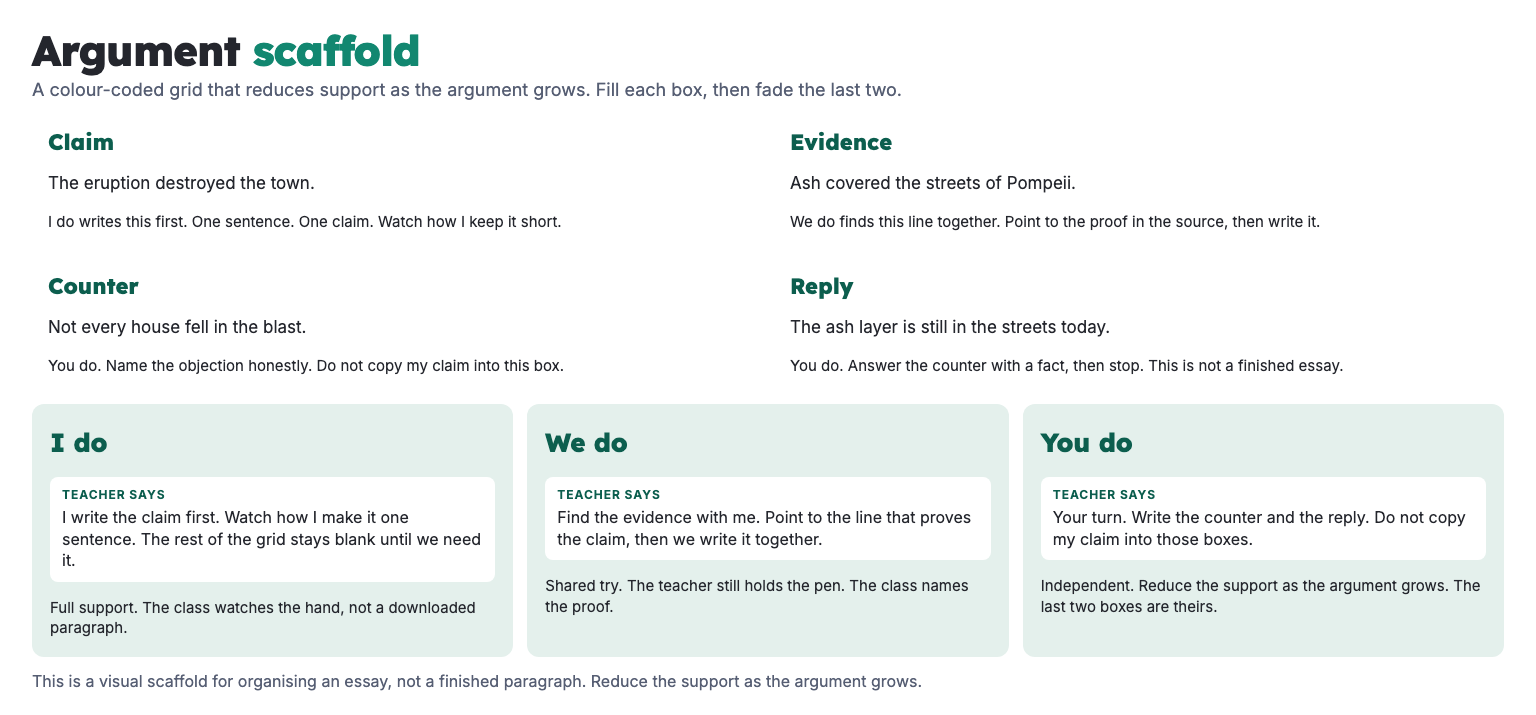
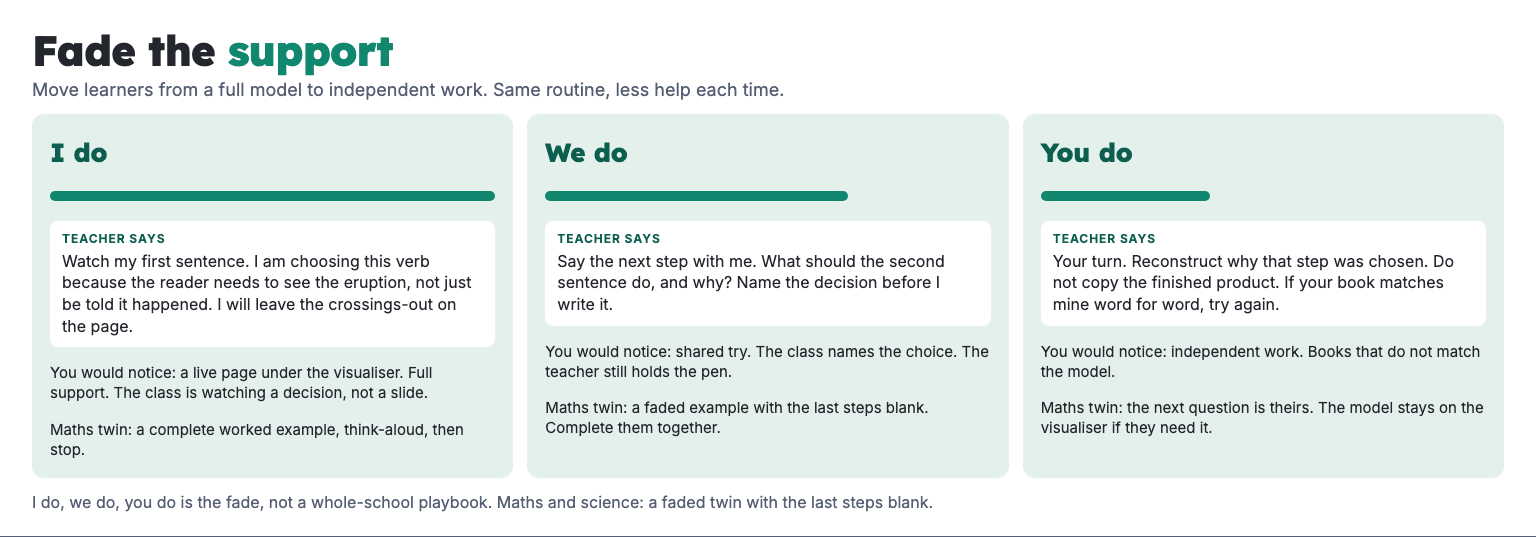
Consider learner needs and prior knowledge to build a helpful framework. This framework should gradually remove support as learners gain mastery. Researchers like Vygotsky (1978) and Wood et al (1976) inform this process. Focus on moving learners towards independent work.
Metacognition strategies boost learning. For more on this topic, see Metacognition mathematics. Download our free resource pack for classrooms and staff rooms. It contains posters, desk cards, and CPD materials. (Winne & Hadwin, 1998; Zimmerman, 2000; Dweck, 2006; Hattie, 2008)
Brown et al. (1989), Collins (1991) and Atkinson (2008) studied modelling. Teachers demonstrate and use worked examples. Research shows modelling helps learning (Klahr & Nigam, 2004; van Gog et al., 2006).
Modelling-Based Teaching in Science Education 226 citations
Gilbert, J. and Justi, R. (2016)
Gilbert and Justi (2016) offer guidance on using models in science. Teach with models by explaining ideas using representations. Teach about models, helping learners see them as tools. Modelling works best when learners build, test, and change models (Gilbert & Justi, 2016). Avoid passive observation of teacher examples.
Bandura (1977) found learners build character by watching others. Good teacher role models help learners adopt values, says Berkowitz (2012). Narvaez (2006) thinks moral examples inspire ethical action. Lickona (1991) states this builds a strong moral compass.
Sanderse, W. (2013)
Sanderse (2015) studied role modelling for character. Learners watch teachers, even unplanned actions. Intentional modelling shows values and thinking. Sanderse (2015) found it more useful. Teachers must explain reasons; learners should not just mimic habits. It works in all subjects.
Mediated Modelling in Science Education 175 citations
Halloun, I. A. (2007)
Halloun (1996) created "mediated modelling". Teachers use model sequences to connect learners' ideas to science. They start with a simple model, then test it using evidence and find limits. A better model follows, reflecting scientific work (Halloun, 1996). This builds knowledge and thinking skills.
Research shows principal leadership impacts classroom teaching and learner progress (View study). Studies by Robinson et al. (2008) and Leithwood et al. (2006) support this. Waters, Marzano, and McNulty (2003) also found links between leadership and outcomes.
Sebastian, J. and Allensworth, E. (2012)
Sebastian and Allensworth (2012) found leaders model teaching well. Principals improve lessons by modelling, observing, and giving feedback. Learners benefit from staff development through modelling (Sebastian & Allensworth, 2012). Showing lessons works better than just telling teachers what to do.
Multimedia learning helps learners. Mayer (2009) found words and images aid learning. Hattie (2009) and Schroeder et al. (2010) reviewed these benefits. Teachers can use this overview of findings.
Noetel, M. and Griffith, S. (2021)
Mayer (2021) said multimedia helps learners learn. Worked examples help learners understand content better. Modelling helps learners more than just instructions. Sweller (1988) and Clark & Mayer (2016) found narration is important in modelling.