Updated on
October 8, 2026
Mastery Learning: Definition, Examples and Evidence (2026)
Mastery learning explained for teachers. Use clear goals, formative checks, corrective teaching and retesting, with classroom examples and evidence.


Updated on
October 8, 2026
Mastery learning explained for teachers. Use clear goals, formative checks, corrective teaching and retesting, with classroom examples and evidence.
What is mastery learning?
Mastery learning, developed by Benjamin Bloom, is an approach in which learners must demonstrate secure understanding, often around 80-90% accuracy, before moving on to harder content, with extra support and reteaching for those who need it. For teachers, it means prioritising depth and firm foundations over pace, so gaps do not accumulate.
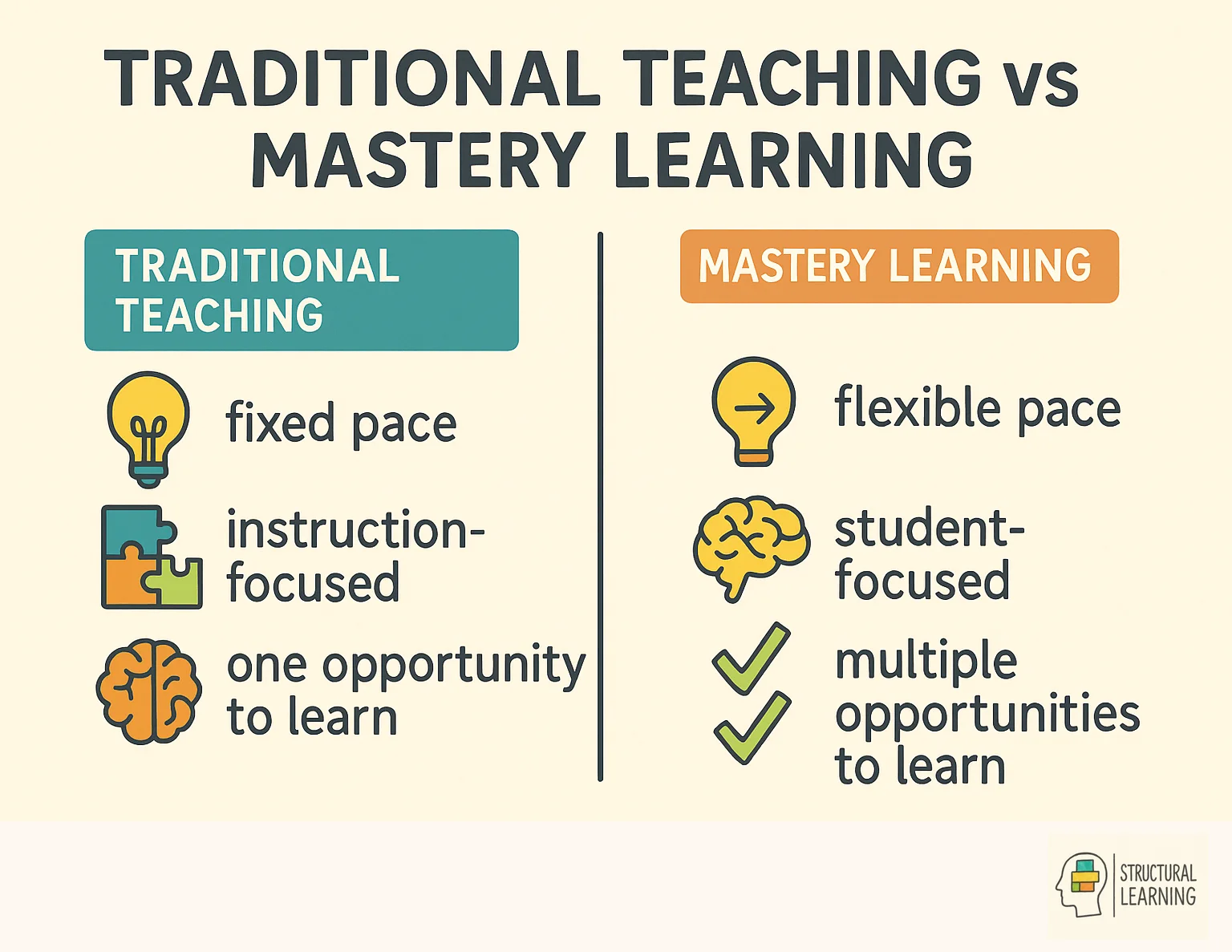
Mastery Learning: Definition, Examples & Strategies is a guide for teachers. It explains a model where learners show secure understanding, usually around 80 to 90 per cent accuracy, before they move to harder content (EEF, 2023). The aim is simple but hard to manage: keep the standard fixed, vary the time and support, and stop small gaps becoming permanent gaps.
In a Year 5 fractions lesson, this means using a short formative assessment after equivalent fractions. Teachers then group learners by misconception and use a different representation, such as fraction bars or number lines. They check again before adding unlike denominators. Used well, mastery learning is not slower teaching; it is a tighter feedback loop between teaching, evidence and corrective instruction.
Bloom (1956) gave teachers a taxonomy for learning objectives; his later mastery model (Bloom, 1968) required learners to secure prerequisite knowledge before moving on. Criterion-referenced assessment and clear goals help learners progress. Formative checks let learners work at their own speed (Block, 1971). This fixes standards, varies time, and aims for learner proficiency (Carroll, 1963).
Mastery learning uses tests to check learners understand key knowledge (Bloom, 1968). Learners must show understanding before moving on. Content is split into clear learning goals with set criteria (Carroll, 1963). Learners progress at their own speed, with regular checks (Guskey, 1997).
Bloom (1984) showed mastery learning with tutoring gains two standard deviations over normal teaching. Guskey and Pigott's (1988) study found moderate to large effects (d = 0.52-0.94). The EEF says mastery approaches add five months' progress for the learner. Formative assessment and fixing problems had the best results.
Bloom (1968) found diagnostic teaching helps learners. Teachers change support because learners progress at different rates. Educators use approaches like feedback so each learner grasps the content.
Mastery learning focuses on learners understanding content well, not just covering topics. Learners then keep knowledge longer and use skills better (Bloom, 1956). Time varies so learners meet a set standard, unlike usual teaching (Carroll, 1963). Guskey (1997) said all learners can pass with the right help.
Mastery learning recognises learners learn at different speeds. Learners need varied teaching time to master concepts (Bloom, 1968). Research shows 80% reach high grades with fixed goals, flexible time (Block, 1971). This contrasts with fixed time, variable results in bell-curve grading (Carroll, 1963).
Bloom (1968) found learners need different times to master concepts. Carroll (1963) showed learners can grasp content deeply with the right help. Carroll (1963) defined aptitude as the amount of time a learner needs to attain mastery under suitable instruction; Guskey later used this idea in explaining mastery learning.
The framework combines behaviourism and cognitive learning theories. Carroll (1963) said learning depends on time spent versus time needed. Bloom used this to create instructional methods. Teachers can use these ideas to adapt mastery learning (Bloom) in classrooms.
Carroll's (1963) model links aptitude, teaching, and understanding for learners. Persistence and opportunities help learners develop. These factors show when learners have grasped concepts. Consider learner workload when you plan lessons (Carroll, 1963).
Keller (1968) created Personalised System of Instruction (PSI). This was separate from Bloom's work. Keller aimed to address university course failure.
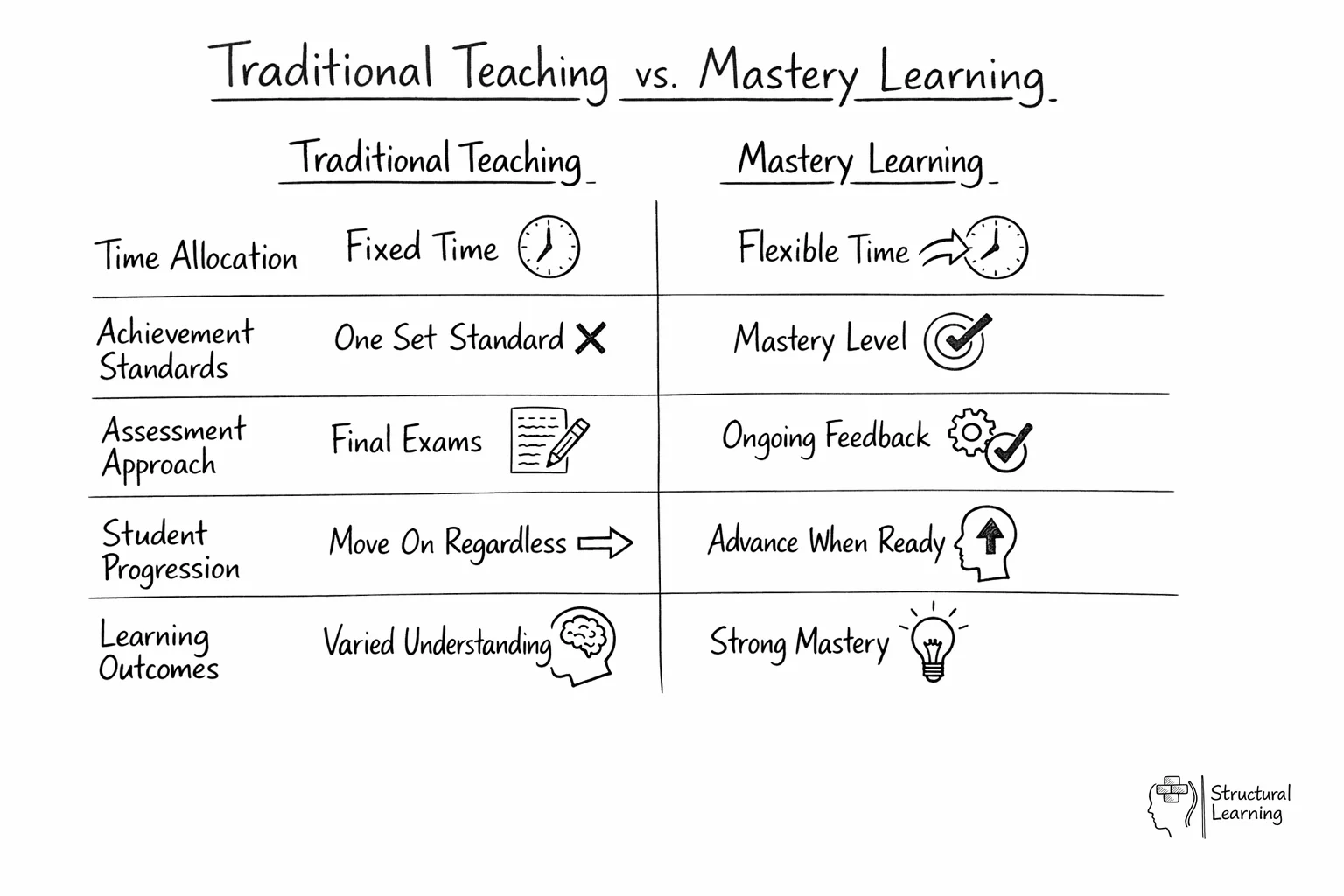
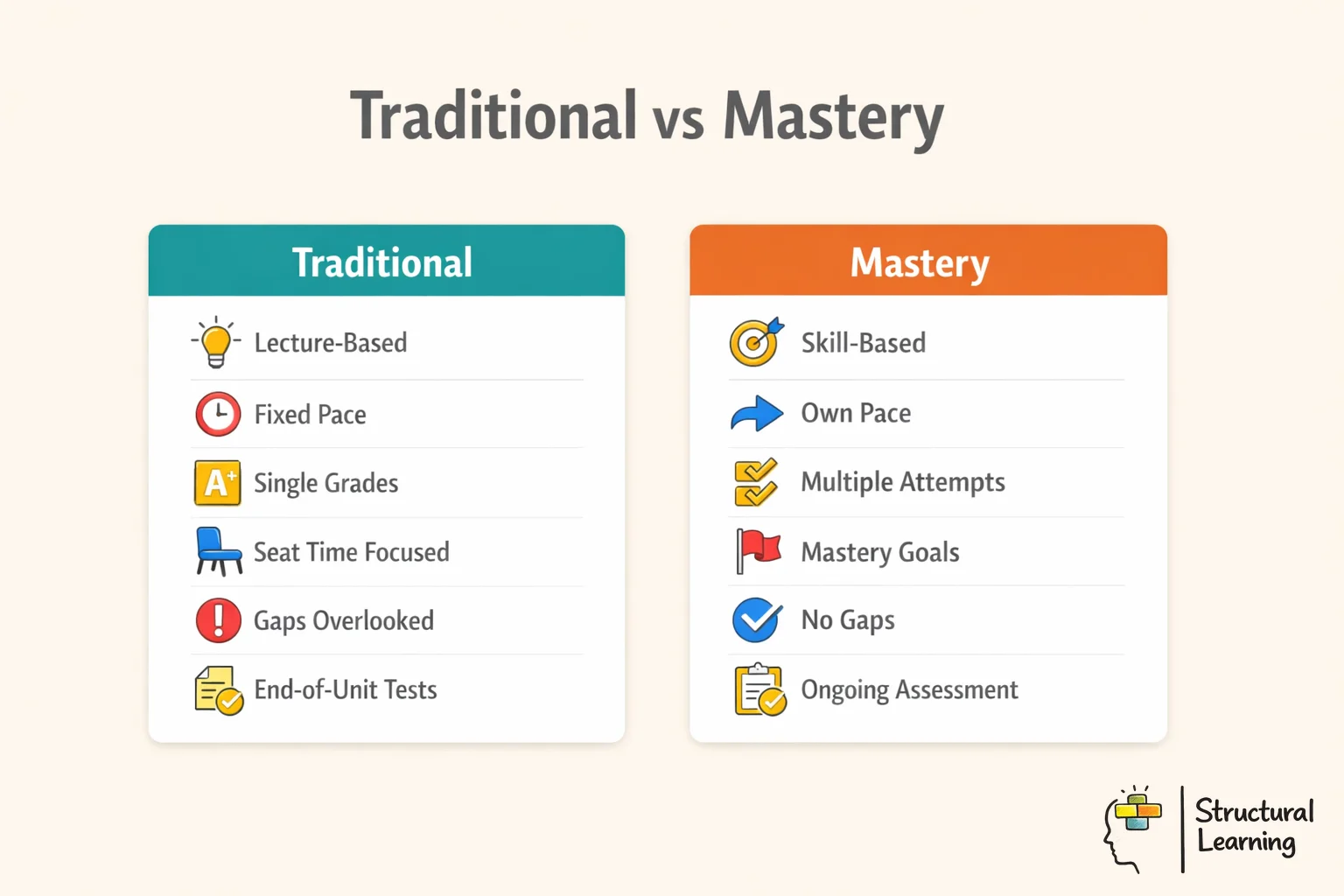
| Aspect | Traditional Approach | Mastery Learning | Impact |
|---|---|---|---|
| Pacing | Fixed timeline for all | Flexible based on mastery | Better individual outcomes |
| Assessment | Summative, end of unit | Formative, ongoing | Earlier intervention possible |
| Success Criteria | Grades on curve | 80-90% mastery threshold | Higher achievement for all |
| Remediation | Move on regardless | Corrective instruction | Fills learning gaps |
| Learning Outcome | Variable achievement | Consistent mastery | Reduced achievement gaps |
PSI replaced lectures with study guides. Learners had to master each unit before moving on. They progressed at their own pace.
Keller (1968) defined five parts of PSI. Learners used study guides and had to master each unit before moving on. Peer proctors marked tests and gave quick feedback.
Lectures motivated advanced learners rather than teaching the main content. Tutors communicated with learners in writing. Proctoring helped feedback reach more learners while saving staff time (Keller, 1968).
Bloom's approach keeps learners together. Teachers move on once enough learners show mastery, and correctives run alongside the main lessons. Keller's PSI lets learners progress at their own speed.
Both approaches require mastery before progression. Bloom uses enrichment (Block, 1971), while PSI lets quick learners advance. PSI had better gains in higher education because it removed limits for quick learners.
PSI's pure form is hard for UK teachers to use (Keller, 1968). Curricula are tight, and assessments are external. Even so, PSI principles offer useful classroom structures. Teachers can give test versions with quick feedback on errors and offer resits before moving on.
Also, lectures should motivate learners more than instruct (Keller, 1968). Teachers can move instruction to video, then use class time for discussion. This split reduces learner cognitive load.
Bloom (1968) created mastery learning where learners must reach set standards. Learners progress only after they master earlier content, Bloom argued. Bloom's taxonomy helps teachers define these mastery criteria (Bloom, 1968).
Bloom (1968) challenged the idea that learner success follows a bell curve. He showed most learners can achieve highly with good teaching. Bloom's work justified setting fixed achievement goals, not just time spent learning. (Bloom, 1968).
Bloom (1968) challenged the idea that varied attainment was natural in "Learning for Mastery". He said the bell curve reflected teaching, not fixed ability. Bloom argued that with time and good support, 90-95% of learners could master content. This figure was his intended design target.
Bloom's cycle uses formative assessment. Teachers give initial lessons and then a "formative test" (Bloom, n.d.). This test shows which learners need more help.
Corrective teaching, such as tutoring, fills gaps for these learners. Learners who understand the topic complete enrichment tasks. The cycle then repeats with another test before moving on.
Carroll (1963) said learning depends on time spent versus time needed. Learners need different times to learn, not different abilities. Bloom said teachers should give learners the time they need. For example, for simultaneous equations, add a ten-minute help slot (Bloom, n.d.) for learners who need it.
Bloom (1968) suggests grouping impacts attainment. Setting based on prior attainment may cause gaps. Guskey (2010) found mastery learning reduced gaps. It challenged quicker learners without holding them back. Bloom's cycle helps teachers design assessments.
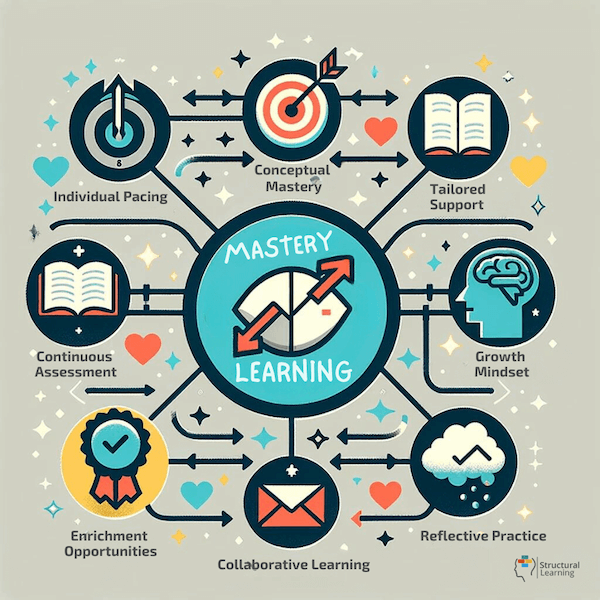
Key components include:
Mastery learning uses instruction, assessment, and fixes to help learners. It seeks to close gaps in achievement and create confident, self-regulated learners. (Bloom, 1968; Guskey, 1997; Kulik, Kulik & Bangert-Drowns, 1990).
Mastery learning has several clear strengths. These strengths stand out when it is compared with traditional teaching models:
The strongest benefit is diagnostic precision. The mastery learning model uses formative assessment to identify the exact point where a learner has lost the thread, then uses corrective instruction before the next unit. The EEF reports an average of five months additional progress for mastery learning, with stronger results when teachers keep the standard high and provide targeted support (EEF, 2023).
For learners, the benefit is not simply higher scores. Learning mastery builds confidence because assessment becomes a route back into the work, not a final judgement. For teachers, it gives a clearer link between learning goals, formative assessments, summative assessment and standards-based grading.
Mastery learning means changing assessments to formative types. Bloom (1968) said learners must understand before moving on. Use frequent checks, not rankings, to find gaps. Replace unit tests with shorter checks and set clear goals.
Flexible pacing and support help classroom success. If learners struggle, use varied teaching and peer support. Break topics into sequential units with clear prerequisites. Assess each unit; learners need 80-90% to move on. Offer corrective teaching with new methods and examples, then reassess learners.
UK teachers often meet mastery learning through maths, but the terms need care. The mastery approach in the EEF Toolkit keeps learning outcomes fixed while the time and support vary (EEF, 2023). Teaching for mastery in English maths usually means teacher-led, whole-class work on the same content, influenced by Singapore and Shanghai practice. The two overlap, but they are not the same learning model.
Bruner (1966) described three representation modes: enactive, iconic, and symbolic. The CPA sequence follows this in maths mastery. Learners use objects first to understand the concept. Next, they draw diagrams such as bar models, and only then use abstract notation.
For example, Year 3 adds with counters, then drawings, then algorithms. Teachers revisit concrete steps if learners struggle (CPA).
Marton and Booth (1997) developed variation theory as a theory of learning; later mathematics educators applied structured variation to sequencing examples and questions. Learners grasp concepts by seeing key feature changes while others stay the same. Practising 23 + 14, 23 + 24, 23 + 34 varies the tens digit. This highlights the tens digit's impact on the sum, unlike mixed exercises. Watson and Mason (2006) found structured variation builds better understanding than random practice.
Mastery maths affects class setup through its "everyone can" idea. In setted classes, lower sets often get easier work, which can affect attainment. Mastery teaching reverses this: all learners do the same core work (NCETM, 2016).
Secure learners then explain and extend their thinking, rather than simply moving on. Learners must explain their methods to achieve mastery, as Singapore and Shanghai models expect. See CPA evidence for concrete-pictorial-abstract sequence application.
Mastery learning works, but teachers find it challenging. Time limits and fixed curricula are a problem. Schools want set pacing, yet mastery needs flexibility. Limited resources hinder learner support (Bloom, 1968; Guskey, 1997; Kulik, Kulik & Bangert-Drowns, 1990).
Plan changes and address issues. Know curriculum well and define learner goals. Share resources with colleagues and plan timelines. Hattie (2009) and Hattie and Timperley (2007) link high-quality feedback with stronger learner results.
Share learner data with leaders; cut admin tasks. Bloom (1968) found smaller learning units build teacher confidence. Mastery learning focuses on initial learning, improving later progress (Carroll, 1963). Guskey (1997) says invest time now; reduce catch-up later.
In Year 4 multiplication, a teacher might set a short check on 6, 7 and 8 times tables, then group learners by error pattern. One group uses arrays to rebuild the sixes; another practises retrieval with missing-factor questions; secure learners explain why 7 x 8 links to 7 x 4 doubled. All learners then complete a second formative assessment before the class moves to division facts.
In GCSE chemistry, the mastery learning model can split atomic structure into nucleus, electron shells, ions and bonding. Learners who confuse atoms and ions receive a different model before the next summative assessment, such as labelled diagrams and counter examples. This is corrective instruction, not repetition of the original explanation.
These examples show the practical logic of the mastery approach. Learners move on when evidence shows they are ready. Quicker learners do not wait passively. Instead, they deepen the same content through explanation, application and standards-based grading evidence.
Mastery learning needs formative feedback, not just summative tests. Frequent, low stakes checks find learning gaps early. Black (1998) and Wiliam (2011) show that regular assessment points matter only when the information changes the next teaching move.
Use exit tickets, quizzes, peer assessment and conferences to check understanding now. Design these checks to show what the learner needs help with, and why. This clear feedback supports targeted teaching, not general review.
Use assessment data to shape lessons. If formative tests show gaps, change your plans. Black and Wiliam (1998) suggest new explanations. Responsive teaching supports learner success, say Hattie and Timperley (2007).
Start with a small unit where the prerequisite chain is clear. Define the learning goals, set a mastery threshold, teach the first block, use a formative assessment, then plan corrective instruction for named misconceptions. Reassess before the summative assessment so that standards-based grading reflects current understanding rather than a first attempt.
Protect quick learners from drift. Use enrichment that deepens the same content through explanation, transfer tasks, peer tutoring or worked-example comparison. For learners who need more time, change the representation or scaffold. The corrective phase is where mastery learning succeeds or fails.
The hardest criticism is practical. Mastery learning sets fixed standards but allows time to vary. UK schools, however, usually work to fixed timetables, exam specifications and curriculum maps. Arlin (1984) called this the time-achievement equality dilemma: if achievement stays fixed, time must vary, but if time is fixed, achievement varies.
That creates a headteacher problem, not just a classroom problem. A whole-school mastery model needs intervention slots and staff for corrective teaching. It also needs shared formative assessments, enrichment tasks for learners who achieve mastery early, and a curriculum sequence that still satisfies external accountability. Without that leadership work, the mastery approach becomes a slogan.
Slavin (1987) also questioned the evidence. He argued that some large effect sizes came from studies using tests close to the taught material, while effects were smaller on broader standardised tests. Kulik, Kulik and Bangert-Drowns (1990) found stronger results, but the debate shows why mastery learning should not be treated as a single causal ingredient. Formative assessment, feedback, extra time and corrective teaching are tightly mixed.
The 2026 update is AI. Adaptive platforms such as Khanmigo can now provide instant hints, quiz questions and summaries of learner work (Khan Academy, 2026). That may reduce one old barrier in the mastery learning model: giving differentiated feedback at scale. It does not remove the teacher's role. Teachers still need to check accuracy, bias, curriculum fit and whether learners are thinking rather than copying.
There is also a cultural critique. A fixed mastery standard can make expectations clear. But it can reward one canonical version of knowledge if examples, language and assessments ignore learners' cultural, linguistic or neurodivergent ways of showing understanding. Mastery learning is strongest when teachers keep the standard clear while offering more than one valid route to show understanding.
Mastery learning's focus on depth clashes with the breadth of the national curriculum. Some criticised England's maths approach (Brown et al., 2016). Deepening tasks can use time needed for GCSE topics. This is a structural issue, not just theory.
It raises the question of whether mastery is better than structured teaching. Formative assessment offers a middle ground. Use quizzes to check learner understanding and guide instruction.
Mastery learning is most useful when teachers begin with one tightly defined unit, not a whole-school relaunch. Choose a topic with clear prerequisite knowledge, write the learning goals, agree what it means to achieve mastery, then build formative assessments that reveal the reason for errors.
For leaders, the next step is to build the system around the classroom promise. Plan time for corrective instruction, protect enrichment for learners who reach mastery early, and decide how standards-based grading will record current understanding. Used with this discipline, mastery learning keeps attention on evidence, support and readiness to move on.
Mastery learning has a strong classroom logic, but its evidence should be read carefully. Slavin (1987) argued that many positive effect sizes came from studies using teacher-made tests closely aligned to the taught units. On broader standardised tests, gains were smaller. Kulik, Kulik and Bangert-Drowns (1990) found positive effects, but their review also included varied models, older studies and different definitions of mastery learning.
A second limitation is time. Arlin (1984) described the time-achievement equality dilemma: if all learners must reach the same standard, the amount of time must vary. UK schools often work under fixed exam dates, curriculum maps and staffing limits. The EEF (2023) therefore treats mastery learning as promising but difficult to implement well.
There is also a cultural critique. A fixed standard can make success criteria clear. But it can favour a narrow view of valued knowledge if curriculum content, examples and assessment language ignore learners' cultural, linguistic or neurodivergent ways of showing understanding. Culturally responsive teaching research warns against treating one canonical route as neutral (Ladson-Billings, 1995; Gay, 2010).
Finally, mastery learning may bring together several active ingredients: formative assessment, feedback, corrective instruction and extra time. Black (1998), Wiliam (2011) and Hattie (2009) suggest those elements can improve learning without a full mastery model. Even so, mastery learning remains valuable because it keeps teachers focused on clear standards, evidence of understanding and planned support before learners move on.
Black, P. (1998). Inside the black box.
Bloom, B. (1956). Taxonomy of educational objectives.
Hattie, J. (2009). Visible learning.
Wiliam, D. (2011). Embedded formative assessment.
Some learning strategies work better than others, and impact, cost, and evidence vary by approach. Implementation differences matter. Compare two to four strategies using these points.
Choose your subject, topic, and key stage to surface common misconceptions. Diagnostic questions and interventions then appear. Support learners effectively using these targeted strategies.

Bloom's framework and later work form the basis of mastery learning (Bloom, 1968). These studies explore the evidence (Bloom, 1968; Kulik, Kulik & Bangert-Drowns, 1990; Guskey, 1997). Each paper gives teachers useful classroom design ideas for mastery learning.
How Mastery Learning Works at Scale 81 citations
Ritter, S. and Yudelson, M. (2016)
Ritter and Yudelson's research shows adaptive software helps learners master skills. They found mastery-based progression works better than set time limits. Help your learners achieve success: adapt learning time, don't use rigid pacing.
Mastery learning means learners show understanding before new topics. Fixed standards are key, but learning time varies (Bloom, 1968). This guarantees learners reach a set level (Block, 1971; Carroll, 1963). They are ready for harder work when ready.
Teachers break down the curriculum using clear aims. They assess learners often, giving quick feedback (Black & Wiliam, 1998). Those not meeting targets get extra support until they understand fully (Bloom, 1984).
Bloom (1968) showed mastery learning closes achievement gaps for struggling learners. It ensures learners grasp basics before moving forward, boosting later learning. Guskey's (1997) research found learners gain extra months of progress with it. Kulik and Kulik's (1985) meta-analysis supports these findings.
Bloom's 1984 paper reported comparisons of conventional classes, mastery-learning classes and tutoring with formative feedback and corrective work. Across four samples in probability and cartography, learners in the tutoring condition achieved substantially higher scores than those in conventional classes. These short studies do not establish the same effect in every subject or setting.
Mastery learning needs teacher input, not just solo work. Some don't plan good support activities, so learners get stuck (Bloom, 1971). Plan initial teaching and later help carefully (Guskey, 1997; Kulik, Kulik, & Bangert-Drowns, 1990).
Mastery learning helps learners reach a set standard, adjusting time as needed. Bloom (1968) and Block (1971) argue this builds firm knowledge. Usual lessons progress all learners together, despite different understanding levels.
Grading reform should include fairness, say Brookhart and Guskey (2019). Reeves (2011) thinks grading needs clear learning goals. McMillan (2011) advises using varied assessment. Marzano (2010) suggests grades show what each learner knows.
Feldman, J. (2019)
Feldman says fair assessment is key to mastery grading. His work (Feldman, 2019) shows traditional grades can harm improving learners. Feldman backs retakes for mastery. He suggests weighting recent mastery higher (Feldman, 2019). He also advises keeping grades separate from behaviour (Feldman, 2019).
Learner Anxiety in Standards-Based Grading in Mathematics Courses 25 citations
Lewis, D. (2020)
Lewis (2020) saw mastery grading cut learner anxiety. Explain expectations clearly; this is very important. Show learners examples of great work, too. Let learners adjust to the new grading system.
Mastery learning, like Bloom's model, can boost skills. CBRN preparedness program effects are worth noting. Researchers studied this, see citation details.
Aslan Huyar, D. and Esin, M. (2023)
Huyar and Esin (2023) tested Bloom's mastery model. They found mastery learning gives learners better skills than standard teaching. The study shows the mastery cycle improves learning (instruction, feedback, reassessment). This cycle is worth the time for better, lasting results.