Teaching and Learning INSET daysSixth form students in maroon sweatshirts having group discussions in a modern study space with teacher support

Updated on  

January 3, 2026

Teaching and Learning INSET days

|

May 11, 2021

Rethinking teaching and learning INSET days to promote better teacher professional development.

Course Enquiry
Copy citation

Romanelli, G (2021, May 11). Teaching and Learning INSET days. Retrieved from https://www.structural-learning.com/post/lets-rethink-inset-days

What is an Inset Day?

An Inset Day, or in-service training day, is a fixed date in the school calendar dedicated to the professional development of school staff. Typically occurring at the beginning or end of a school term, these days are designed to give teachers and staff the opportunity to reflect, plan, and enhance their practice in line with the school curriculum and overarching goals. For primary school teachers and staff across English schools, this often means stepping away from the demands of the school day to focus on training aimed at improving the development in schools.

Key Takeaways

  1. Beyond PowerPoint Purgatory: Discover why traditional INSET days fail and how collaborative, action-based approaches transform professional development into meaningful classroom change
  2. The Three-Stage Revolution: Master the Explore, Design, Change framework that turns teachers into action researchers, solving real classroom challenges through evidence-based experimentation
  3. From Passive to Practice: Learn why one-size-fits-all training wastes precious development time and how personalised, school-specific approaches create lasting pedagogical improvements
  4. Your Hidden Research Lab: Transform your classroom into a professional learning laboratory where daily teaching becomes the foundation for continuous, measurable improvement

However, despite their intended purpose, the traditional format of Inset Days frequently falls short of expectations. The sessions often rely heavily on outdated methods, such as lengthy PowerPoint presentations, top-down lecturing, and minimal time for collaboration or dialogue. These approaches fail to meet the needs of today’s inclusive school environments, where professional learning should be dynamic, engaging, and tailored to the unique challenges of each institution.

The reality is that days per school year dedicated to professional learning are scarce, and the structure of Inset Days has become a missed opportunity to truly embed meaningful change in schools. For a school headteacher tasked with leading staff, this poses a particular challenge: How can these vital moments be transformed into meaningful, impactful experiences at the very heart of school leadership?

Why Do INSET Days Need to Be Rethought?

Traditional INSET days often rely on outdated methods like lengthy PowerPoint presentations and top-down lecturing that fail to engage teachers effectively. These approaches waste precious professional development time and don't address the unique challenges facing individual schools. Modern professional learning requires dynamic, collaborative formats that create meaningful classroom improvements.

It is high time to reimagine the structure and purpose of Inset Days. While the traditional approach has long been accepted as part of the school calendar, it is no longer fit for purpose in the ever-evolving world of education. Modern approaches to development for schools should focus on more personalised, flexible, and collaborative methods that go beyond a "one-size-fits-all" model.

Schools are unique, with distinct priorities, challenges, and needs. Academy schools, for instance, may need a different focus than community or voluntary-controlled schools. A "cookie-cutter" approach to professional learning undermines the potential for curriculum for schools to be tailored effectively, especially as demands on educators grow. Instead, schools should embrace models that allow for peer-to-peer learning, practical workshops, and facilitated discussions that address specific issues relevant to their context.

For example, instead of relying on outdated presentations, schools might explore collaborative learning sessions where primary school teachers work in small groups to co-construct solutions. Similarly, learning walks, team planning, and coaching from external experts could provide more actionable insights, embedding professional learning directly into the day of the school term rather than isolating it.

Rethinking Inset Days is not just about making them less tedious but about aligning them with the purpose of creating development in schools that is impactful, sustainable, and tied directly to student outcomes. The future of professional development lies in designing sessions that inspire educators, empower teams, and genuinely improve teaching and learning.

What Are the Main Problems with INSET Days?

The primary problems include over-reliance on passive PowerPoint presentations, lack of collaboration time, and one-size-fits-all training approaches. Many INSET sessions fail to provide actionable strategies that teachers can immediately implement in their classrooms. The traditional format often leaves teachers feeling disengaged and without practical solutions to their daily challenges.
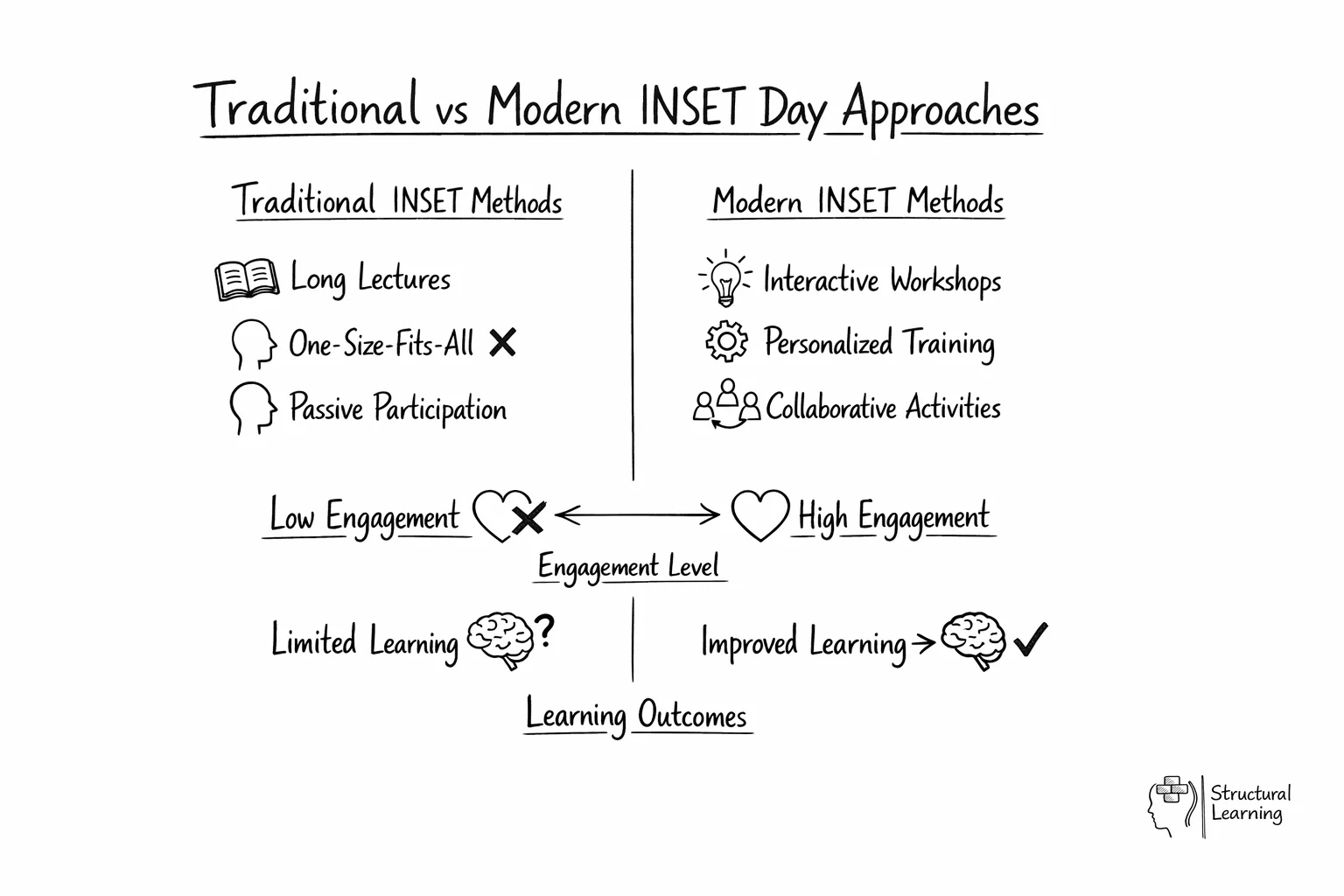
School leaders have a responsibility to move the learning on not just for their students but their colleagues too. CPD is an activity within school that often gets overlooked or put at the bottom of the pile of the things to do list. An inset day usually involves the closing of schools which means for some, an unwelcome disruption to school life.

In recent years we have seen more teach coaching and other professional development choices for teachers. Overall, the development of teacher training has remained fairly stagnant. After the early careers framework, school systems are free to support their staff as they see fit. Professional learning activities requires dedication from teachers who are more often not pushed for time. Unless teacher coaching and action research can be seamlessly built into the day-to-day running of a school then institutions run the risk of leaving their staff to fall behind.

Being in a classroom for the majority of your time does provide hands-on learning opportunities. Educators have the perfect opportunity to implement active learning strategies and measure their impact. This form of CPD enables teaching staff to improve their pedagogical skills in meaningful ways. With a traditional inset activity, professional knowledge is positioned as 'one size fits all' and more often than not doesn't provide staff with time to practice their new pedagogical skills. To make to make a confession learning experience worthwhile, teachers need to have adequate resources and a company with an excellent training experience.

Teacher professional development with action research

An alternative to teacher Inset days?

At Structural Learning, we have been re-imagining inset days and have developed a well-received method for these professional development opportunities for teachers. Their method, called the Professional Practice Program, is based on the school development plan. This continuing professional development (CPD) program is based on three simple stages: explore, design, and change. Each of these three stages is then broken into two actions for teachers to complete.

The Explore stage consists of understanding and defining. First, school staff unravel the learning challenges their students are experiencing in order to understand the root of the problem. This provides a rich topic for discussion. Then, teachers will clearly define the issue and explore any research that has been done on it. The explore stage is similar to the beginning of an experiment, where scientists have made an observation and look to see what others in their community are saying about this topic. 

Next is the Design stage. This stage consists of ideating and experimenting. In order to ideate, teachers are essentially forming a hypothesis or a guess about what they think might work in their classroom to solve the problem they defined. In order to experiment, teachers implement their ideations, make observations, and complete iterations. In other words, try it, watch it, try it again. We always turn to an evidence base of materials to make sure our ideas are grounded by research, you can have a look through some of these materials here.

 The final stage is the Change stage. This stage consists of reflecting and implementing. When reflecting, which is second nature to most educators, teachers will be considering what they have learned based on their experimentation and what it could mean for their practice as a whole. Finally, teachers will implement by bringing all the pieces of this process together into one documented final solution that they will then bring into their classroom as a regular part of their practice. Taking excellent ideas and moving them into classroom habits is part of the biggest challenge. The research into practice program is as much an experience for the students as it is for teaching staff.

Teachers collaborating at the start of term in an INSET day

What Makes This Process Different to traditional INSET days?

All too often, teachers are presented with strategies and tools that are demonstrated for them, and then they are told to take it back to their classroom without any follow up. Our professional practice Program seeks to intentionally disrupt this cycle of passive learning for teachers. We want teachers to feel comfortable experimenting and re-iterating possible solutions in their classrooms. Furthermore, we want teachers to become highly skilled at this process of exploring, designing, and changing their professional practices for the benefit of their students.

Rather than just telling teachers to try things out until they find something that works, we support teachers in developing a meaningful solution that is based on research and cognitive science. Then, we support teachers throughout the process of trying the solutions they have developed and tracking and analysing data to determine whether or not their solution is working. Then, we support teachers as they finalise their solution and ensure that it is a regularly integrated part of their classroom practice that can be shared with other educators because it is evidence-based.

We strongly believe that teachers are some of the most creative problem-solvers out there, and have built our approach to capitalise on this quality. Rather than providing an antiquated set of steps that claim to guarantee some sort of ideal outcome in the classroom, we have sought to support teachers in designing practical, logical, and implementable educational change that works for their classroom.


Engaging Inset Days
Engaging Inset Days

What Mindset Shift Is Needed for Better INSET Days?

Schools need to shift from passive information delivery to active, collaborative professional learning that treats teachers as action researchers. The new mindset focuses on solving real classroom challenges through evidence-based experimentation rather than generic training sessions. This approach transforms teachers from passive recipients into active participants who drive their own professional development.

We invest in our teachers, and in doing so, we have consistently seen a notable mindset shift among the educators who participate in our Professional Practice Program. While traditional inset Days tend to breed feelings of resentment and lead to teachers shutting down and participating to the bare minimum extent, our program has shown markedly different and positive results among our participants.

We have consistently noticed six shifts within our participants: a newfound openness to sharing, measurable learning and collaborating, an optimism that seeks out positive opportunities during challenging times, a new vantage point through the lens of cognitive science, bravery to explore and experiment with new and unfamiliar strategies; and a willingness to understand the ‘why’ behind the ‘what’.

We believe that the above mindset shifts are the result of our efforts to move away from the development of professional learning communities or professional learning discussions. We seek to introduce and practice professional learning activities with our participating educators that are centred around the task of problem-solving. Often, teachers are steered away from identifying problems within their classrooms. They are told to have a more positive outlook, to give the benefit of the doubt, and to speak on solutions only.

However, the fact of the matter is that there will always be challenges in any given classroom. Challenges can only be overcome when they are recognised and seen for what they are as well as the effect they have. Our approach allows for honest conversations that lead to solutions through experimentation that is born from the brains of teachers themselves. When teachers are treated like the experts they are within their classrooms, rather than as the students of someone who has never been in their classroom, mindset shifts are inevitable.

International Schools engaging in classroom INSET activities

How Can Schools Replace Traditional INSET Days?

Schools can replace traditional INSET days with a Professional Practice Program that embeds continuous learning into daily teaching practice. This approach uses the three-stage framework of Explore, Design, and Change to turn classrooms into professional learning laboratories. Teachers engage in ongoing action research that addresses specific school needs rather than attending isolated training sessions.

Each session will begin with the introduction and discussion of a new idea within the domain of cognition and learning. Understanding how the mind works is always a lucrative starting point for discussion amongst educators and can be adapted to any classroom since it is research-based fact.

After the introduction, the session will jump into one of the three stages of the program, depending on where the group is within the process. The Explore Stage is focused on identifying learner needs in each teacher’s classroom. There is not meant to be a group consensus here, as each teacher could be experiencing different challenges. Once learner needs are identified, recent research is consulted for the purpose of building an effective research project. Consulting the research that has been done can either confirm or refute assumptions, and will aid in the design of an effective classroom experiment.

Teachers collaborating in a special school


The second stage is the Design Stage. The first part of this stage is ensuring that each educator knows exactly what they are going to do in their classroom. We aid our participants in breaking down their research projects into manageable, realistic, and clearly actionable steps. Without this critical first part of the stage, our teachers’ experimentation would quickly become overwhelming. Given an overarching classroom research project without smaller daily steps to take, it becomes difficult to effectively implement and track all at once.

It is our mission that every teacher has a clear path forward to implement their ideas little by little while tracking the progress of this gradual implementation in a meaningful and logical way. In this stage, we provide tools for teachers to measure behaviours and outcomes so that as they look at the effect of their chosen interventions, they have a deeper understanding of whether or not these interventions are productive. Finally, we continue to incorporate cognitive science in this stage by looking at the data gathered through multiple cognitive lenses in order to get a robust understanding of the results.

 Remote teacher development sessions
Remote teacher development sessions


The third and final stage of the program is the Change Stage, so named because it is meant to define the necessary change in each teacher’s classroom based on the results of their experiment. This stage can be thought of as the conclusion to the experiment. This should be a fairly succinct explanation of the change that needs to be made to meet the defined learner needs.

Inset vs Action Research?

Throughout our session introductions and three stages of our program, we seek to cover eight research areas with our participants. We believe this leads to more thorough and sustainable results for our participants. The eight areas are as follows:

1. Introduction to facilitating classroom-based research

2. Designing a classroom experiment
3. Gathering background research
4. Deciding on a focus

5. Collecting data
6. Collating data
7. Making meaning of the experiment8. Sharing your learning

One thing to note about our program is that it is not meant to be completed within one yearly session. Rather, ours are meant to be periodic meetings so that constant support can be provided for our participants through every stage and every research area.

Rethinking your INSET?

Ultimately, the key to what our program provides is personalisation for every one of our participants and the learner needs of their specific class. We seek to roll out consistently engaging professional development sessions that lead to real change within the classroom that can be shared with others. Through the recognition of learner needs and the encouragement of intentional classroom experimentation that is based on cognitive science, we believe that our program affects lasting change.

The classrooms that our teachers manage see the immediate benefit of our process, and the mindset shift that our participants experience will continue to benefit their future classrooms. Whether you are an individual school rethinking your INSET activities or a Multi-Academy Trust wanting a range of different options, please don't hesitate to get in contact.

To arrange to have an informal and informative conversation with Paul Main, please reach out to him at paul@structural-learning.com. Additionally, feel free to browse through the program in greater detail by visiting www.structural-learning.com/cpd.

Teaching and Learning Conversations

What Are the Best Tips for Effective Teacher Development?

Effective teacher development focuses on personalized, school-specific approaches that address real classroom challenges through collaborative problem-solving. Key strategies include using evidence-based experimentation, providing time for meaningful teacher collaboration, and creating actionable learning experiences. The most successful programs treat teachers as professionals who can research and improve their own practice.

Teachers play the most essential role in our schools and yet, teachers often lack training and support. As a result, they struggle to develop themselves professionally.

In this article, we'll share 9 tips for effective teacher development. We hope these tips will help you improve your teaching practice.

1. Be Open to Feedback

Feedback is one of the most valuable tools available to teachers. If you don't receive feedback, you won't learn anything. So ask yourself, “What am I doing right? What am I doing wrong? How can I improve my teaching?”

It may seem intimidating to hear negative comments, especially when you're trying to improve your teaching. But remember, every comment has value. Take notes on any feedback you receive. Write down the things you liked and didn't like about the feedback. This will help you identify areas for improvement.

2. Take Time Off

Taking time off from teaching can be difficult. However, taking time off helps you recharge and reenergize. Make sure you schedule regular breaks throughout the week. Schedule a lunch break once a month. Set aside time to relax and unwind. This will allow you to return refreshed and ready to teach again.

3. Place an emphasis on Teaching Students Who Need Help

Think about how you can make your classroom more inclusive and what sort of scaffolds could be incorporated into whole class teaching.

4. Learn About Different Learning Styles

Some students learn best by listening, others by reading and still others by writing. Providing a multimodal learning environment might immediately make learning more accessible. We're not just talking about learning styles (VAK), this has limited evidence, but there are implications for using imagery and concrete objects.

5. Use Technology Wisely

Technology can be a powerful tool for education. However, technology should not replace face-to-face interaction between students and teachers. Use technology wisely. For instance, video conferencing allows students to interact with teachers remotely. However, it doesn't replace face-to-face time interactions. Video conferencing is useful for small group discussions, but it isn't ideal for larger groups.

6. Develop Professional Relationships

Developing professional relationships with colleagues and administrators is crucial to your success as a teacher. These relationships can help you access resources, such as books, materials, and equipment. They can also help you find out about upcoming events and conferences.

7. Build Confidence

Confidence is key to becoming a successful teacher. Build self-confidence by reflecting on what you've accomplished. Think about the successes you've had. Think about the challenges you overcame.

Remember, you're a leader. You set the tone for your classroom.

8. Practice Self-Care

Self-care is vital to your well-being. Practice self-care by eating nutritious foods, exercising regularly, sleeping soundly, and enjoying quality time with loved ones.

9. Seek Support

Finally, seek support from experienced educators. Ask your principal, mentor, or supervisor for advice. Ask fellow teachers for suggestions. Asking for guidance will help you grow as a teacher.

Where Can Teachers Find More Resources About INSET Days?

Teachers can access additional resources through educational research databases, professional development organizations, and specialized teaching publications. Many education authorities also provide guidelines and best practice examples for improving INSET day effectiveness. Online professional learning communities offer practical insights from teachers who have successfully transformed their school's approach to professional development.

1. A Cross-Sectional Study of Pre-Service Teacher Efficacy Throughout the Training Years by Stuart Woodcock (2011)

Summary: This study examined changes in teacher efficacy levels among pre-service teachers. Findings indicated that while primary school training programs did not influence teacher efficacy, secondary school training enhanced general efficacy but reduced personal efficacy. This suggests curriculum design in government and community schools needs inclusive improvement strategies to better support teachers.

2. Improving Teachers’ Self-Efficacy in Applying Teaching and Learning Strategies by Chih Nuo Grace Chao et al. (2017)

Summary: This research analyzed the impact of a one-week training course on teaching strategies and classroom management for primary school teachers in Hong Kong. The study emphasized the importance of inclusive education and curriculum adaptation in government and community schools to support diverse learners effectively.

3. Teacher Education Programmes and Their Contribution to Student Teacher Efficacy by Knut-Andreas Christophersen et al. (2016)

Summary: This study showed that primary school teacher training programs emphasizing practical application and collaboration increased teacher efficacy in classroom management and pupil engagement. Support from school headteachers and peers in inclusive improvement settings was a critical factor.

4. Examining Connections Between Teacher Collaboration, Differentiated Instruction, and Teacher Efficacy by Y. Goddard and Minjung Kim (2018)

Summary: This study found that collaborative practices among teachers significantly boosted the use of differentiated instruction, which in turn strengthened teacher efficacy. These findings underscore the role of school-wide and government-supported curriculum development in fostering teacher confidence and inclusive practices.

5. Classroom Behaviour Management The Effects of In-Service Training on Elementary Teachers’ Self-Efficacy Beliefs by Nancy Gaudreau et al. (2013)

Summary: This quasi-experimental study showed that in-service training improved teachers' self-efficacy in managing difficult behaviors. The study highlighted that inclusive teacher training programs significantly benefit teacher-student interactions and curriculum implementation in primary schools.

Frequently Asked Questions

What exactly is an INSET day and when do they typically occur in the school calendar?

An INSET day (in-service training day) is a dedicated date in the school calendar specifically for professional development of teaching staff. These days typically occur at the beginning or end of a school term, allowing teachers and staff to step away from regular classroom duties to focus on training, reflection, and planning to enhance their practice in line with school curriculum and goals.

Why are traditional INSET days considered ineffective and what are the main problems?

Traditional INSET days often rely on outdated methods such as lengthy PowerPoint presentations, top-down lecturing, and minimal collaboration time. These one-size-fits-all approaches fail to engage teachers effectively, don't provide actionable strategies for immediate classroom implementation, and waste precious professional development time without addressing the unique challenges facing individual schools.

What is the Professional Practice Program and how does it work as an alternative to traditional INSET days?

The Professional Practice Program is a three-stage approach consisting of Explore, Design, and Change phases. In the Explore stage, teachers understand and define learning challenges their students face; in the Design stage, they ideate solutions and experiment with implementations; and throughout the process, they use evidence-based research to ground their classroom interventions and measure impact.

How can schools make INSET days more personalised and relevant to their specific needs?

Schools should embrace collaborative learning sessions where teachers work in small groups to co-construct solutions, utilise learning walks and team planning, and invite coaching from external experts. Rather than generic presentations, schools can focus on peer-to-peer learning, practical workshops, and facilitated discussions that address their specific contextual challenges and curriculum needs.

What are the benefits of transforming classrooms into 'professional learning laboratories'?

When classrooms become professional learning laboratories, teachers can implement active learning strategies and measure their impact in real-time, providing hands-on learning opportunities. This approach enables teaching staff to improve their pedagogical skills in meaningful ways through continuous, evidence-based experimentation rather than passive, theoretical training sessions.

How can school leaders ensure INSET days create lasting pedagogical improvements rather than just fulfilling calendar requirements?

School leaders should design sessions that inspire educators and align directly with student outcomes, moving away from passive formats to collaborative, action-based approaches. They need to ensure professional development is seamlessly built into day-to-day school operations, providing adequate resources and creating experiences that empower teams to implement and sustain meaningful classroom changes.

What role does action research play in modern teacher professional development?

Action research transforms teachers into researchers who solve real classroom challenges through evidence-based experimentation and observation. This approach allows educators to systematically investigate their own practice, test hypotheses about what might work in their specific context, and make data-driven improvements to their teaching methods based on measurable classroom outcomes.

Loading audit...

What is an Inset Day?

An Inset Day, or in-service training day, is a fixed date in the school calendar dedicated to the professional development of school staff. Typically occurring at the beginning or end of a school term, these days are designed to give teachers and staff the opportunity to reflect, plan, and enhance their practice in line with the school curriculum and overarching goals. For primary school teachers and staff across English schools, this often means stepping away from the demands of the school day to focus on training aimed at improving the development in schools.

Key Takeaways

  1. Beyond PowerPoint Purgatory: Discover why traditional INSET days fail and how collaborative, action-based approaches transform professional development into meaningful classroom change
  2. The Three-Stage Revolution: Master the Explore, Design, Change framework that turns teachers into action researchers, solving real classroom challenges through evidence-based experimentation
  3. From Passive to Practice: Learn why one-size-fits-all training wastes precious development time and how personalised, school-specific approaches create lasting pedagogical improvements
  4. Your Hidden Research Lab: Transform your classroom into a professional learning laboratory where daily teaching becomes the foundation for continuous, measurable improvement

However, despite their intended purpose, the traditional format of Inset Days frequently falls short of expectations. The sessions often rely heavily on outdated methods, such as lengthy PowerPoint presentations, top-down lecturing, and minimal time for collaboration or dialogue. These approaches fail to meet the needs of today’s inclusive school environments, where professional learning should be dynamic, engaging, and tailored to the unique challenges of each institution.

The reality is that days per school year dedicated to professional learning are scarce, and the structure of Inset Days has become a missed opportunity to truly embed meaningful change in schools. For a school headteacher tasked with leading staff, this poses a particular challenge: How can these vital moments be transformed into meaningful, impactful experiences at the very heart of school leadership?

Why Do INSET Days Need to Be Rethought?

Traditional INSET days often rely on outdated methods like lengthy PowerPoint presentations and top-down lecturing that fail to engage teachers effectively. These approaches waste precious professional development time and don't address the unique challenges facing individual schools. Modern professional learning requires dynamic, collaborative formats that create meaningful classroom improvements.

It is high time to reimagine the structure and purpose of Inset Days. While the traditional approach has long been accepted as part of the school calendar, it is no longer fit for purpose in the ever-evolving world of education. Modern approaches to development for schools should focus on more personalised, flexible, and collaborative methods that go beyond a "one-size-fits-all" model.

Schools are unique, with distinct priorities, challenges, and needs. Academy schools, for instance, may need a different focus than community or voluntary-controlled schools. A "cookie-cutter" approach to professional learning undermines the potential for curriculum for schools to be tailored effectively, especially as demands on educators grow. Instead, schools should embrace models that allow for peer-to-peer learning, practical workshops, and facilitated discussions that address specific issues relevant to their context.

For example, instead of relying on outdated presentations, schools might explore collaborative learning sessions where primary school teachers work in small groups to co-construct solutions. Similarly, learning walks, team planning, and coaching from external experts could provide more actionable insights, embedding professional learning directly into the day of the school term rather than isolating it.

Rethinking Inset Days is not just about making them less tedious but about aligning them with the purpose of creating development in schools that is impactful, sustainable, and tied directly to student outcomes. The future of professional development lies in designing sessions that inspire educators, empower teams, and genuinely improve teaching and learning.

What Are the Main Problems with INSET Days?

The primary problems include over-reliance on passive PowerPoint presentations, lack of collaboration time, and one-size-fits-all training approaches. Many INSET sessions fail to provide actionable strategies that teachers can immediately implement in their classrooms. The traditional format often leaves teachers feeling disengaged and without practical solutions to their daily challenges.

School leaders have a responsibility to move the learning on not just for their students but their colleagues too. CPD is an activity within school that often gets overlooked or put at the bottom of the pile of the things to do list. An inset day usually involves the closing of schools which means for some, an unwelcome disruption to school life.

In recent years we have seen more teach coaching and other professional development choices for teachers. Overall, the development of teacher training has remained fairly stagnant. After the early careers framework, school systems are free to support their staff as they see fit. Professional learning activities requires dedication from teachers who are more often not pushed for time. Unless teacher coaching and action research can be seamlessly built into the day-to-day running of a school then institutions run the risk of leaving their staff to fall behind.

Being in a classroom for the majority of your time does provide hands-on learning opportunities. Educators have the perfect opportunity to implement active learning strategies and measure their impact. This form of CPD enables teaching staff to improve their pedagogical skills in meaningful ways. With a traditional inset activity, professional knowledge is positioned as 'one size fits all' and more often than not doesn't provide staff with time to practice their new pedagogical skills. To make to make a confession learning experience worthwhile, teachers need to have adequate resources and a company with an excellent training experience.

Teacher professional development with action research

An alternative to teacher Inset days?

At Structural Learning, we have been re-imagining inset days and have developed a well-received method for these professional development opportunities for teachers. Their method, called the Professional Practice Program, is based on the school development plan. This continuing professional development (CPD) program is based on three simple stages: explore, design, and change. Each of these three stages is then broken into two actions for teachers to complete.

The Explore stage consists of understanding and defining. First, school staff unravel the learning challenges their students are experiencing in order to understand the root of the problem. This provides a rich topic for discussion. Then, teachers will clearly define the issue and explore any research that has been done on it. The explore stage is similar to the beginning of an experiment, where scientists have made an observation and look to see what others in their community are saying about this topic. 

Next is the Design stage. This stage consists of ideating and experimenting. In order to ideate, teachers are essentially forming a hypothesis or a guess about what they think might work in their classroom to solve the problem they defined. In order to experiment, teachers implement their ideations, make observations, and complete iterations. In other words, try it, watch it, try it again. We always turn to an evidence base of materials to make sure our ideas are grounded by research, you can have a look through some of these materials here.

 The final stage is the Change stage. This stage consists of reflecting and implementing. When reflecting, which is second nature to most educators, teachers will be considering what they have learned based on their experimentation and what it could mean for their practice as a whole. Finally, teachers will implement by bringing all the pieces of this process together into one documented final solution that they will then bring into their classroom as a regular part of their practice. Taking excellent ideas and moving them into classroom habits is part of the biggest challenge. The research into practice program is as much an experience for the students as it is for teaching staff.

Teachers collaborating at the start of term in an INSET day

What Makes This Process Different to traditional INSET days?

All too often, teachers are presented with strategies and tools that are demonstrated for them, and then they are told to take it back to their classroom without any follow up. Our professional practice Program seeks to intentionally disrupt this cycle of passive learning for teachers. We want teachers to feel comfortable experimenting and re-iterating possible solutions in their classrooms. Furthermore, we want teachers to become highly skilled at this process of exploring, designing, and changing their professional practices for the benefit of their students.

Rather than just telling teachers to try things out until they find something that works, we support teachers in developing a meaningful solution that is based on research and cognitive science. Then, we support teachers throughout the process of trying the solutions they have developed and tracking and analysing data to determine whether or not their solution is working. Then, we support teachers as they finalise their solution and ensure that it is a regularly integrated part of their classroom practice that can be shared with other educators because it is evidence-based.

We strongly believe that teachers are some of the most creative problem-solvers out there, and have built our approach to capitalise on this quality. Rather than providing an antiquated set of steps that claim to guarantee some sort of ideal outcome in the classroom, we have sought to support teachers in designing practical, logical, and implementable educational change that works for their classroom.


Engaging Inset Days
Engaging Inset Days

What Mindset Shift Is Needed for Better INSET Days?

Schools need to shift from passive information delivery to active, collaborative professional learning that treats teachers as action researchers. The new mindset focuses on solving real classroom challenges through evidence-based experimentation rather than generic training sessions. This approach transforms teachers from passive recipients into active participants who drive their own professional development.

We invest in our teachers, and in doing so, we have consistently seen a notable mindset shift among the educators who participate in our Professional Practice Program. While traditional inset Days tend to breed feelings of resentment and lead to teachers shutting down and participating to the bare minimum extent, our program has shown markedly different and positive results among our participants.

We have consistently noticed six shifts within our participants: a newfound openness to sharing, measurable learning and collaborating, an optimism that seeks out positive opportunities during challenging times, a new vantage point through the lens of cognitive science, bravery to explore and experiment with new and unfamiliar strategies; and a willingness to understand the ‘why’ behind the ‘what’.

We believe that the above mindset shifts are the result of our efforts to move away from the development of professional learning communities or professional learning discussions. We seek to introduce and practice professional learning activities with our participating educators that are centred around the task of problem-solving. Often, teachers are steered away from identifying problems within their classrooms. They are told to have a more positive outlook, to give the benefit of the doubt, and to speak on solutions only.

However, the fact of the matter is that there will always be challenges in any given classroom. Challenges can only be overcome when they are recognised and seen for what they are as well as the effect they have. Our approach allows for honest conversations that lead to solutions through experimentation that is born from the brains of teachers themselves. When teachers are treated like the experts they are within their classrooms, rather than as the students of someone who has never been in their classroom, mindset shifts are inevitable.

International Schools engaging in classroom INSET activities

How Can Schools Replace Traditional INSET Days?

Schools can replace traditional INSET days with a Professional Practice Program that embeds continuous learning into daily teaching practice. This approach uses the three-stage framework of Explore, Design, and Change to turn classrooms into professional learning laboratories. Teachers engage in ongoing action research that addresses specific school needs rather than attending isolated training sessions.

Each session will begin with the introduction and discussion of a new idea within the domain of cognition and learning. Understanding how the mind works is always a lucrative starting point for discussion amongst educators and can be adapted to any classroom since it is research-based fact.

After the introduction, the session will jump into one of the three stages of the program, depending on where the group is within the process. The Explore Stage is focused on identifying learner needs in each teacher’s classroom. There is not meant to be a group consensus here, as each teacher could be experiencing different challenges. Once learner needs are identified, recent research is consulted for the purpose of building an effective research project. Consulting the research that has been done can either confirm or refute assumptions, and will aid in the design of an effective classroom experiment.

Teachers collaborating in a special school


The second stage is the Design Stage. The first part of this stage is ensuring that each educator knows exactly what they are going to do in their classroom. We aid our participants in breaking down their research projects into manageable, realistic, and clearly actionable steps. Without this critical first part of the stage, our teachers’ experimentation would quickly become overwhelming. Given an overarching classroom research project without smaller daily steps to take, it becomes difficult to effectively implement and track all at once.

It is our mission that every teacher has a clear path forward to implement their ideas little by little while tracking the progress of this gradual implementation in a meaningful and logical way. In this stage, we provide tools for teachers to measure behaviours and outcomes so that as they look at the effect of their chosen interventions, they have a deeper understanding of whether or not these interventions are productive. Finally, we continue to incorporate cognitive science in this stage by looking at the data gathered through multiple cognitive lenses in order to get a robust understanding of the results.

 Remote teacher development sessions
Remote teacher development sessions


The third and final stage of the program is the Change Stage, so named because it is meant to define the necessary change in each teacher’s classroom based on the results of their experiment. This stage can be thought of as the conclusion to the experiment. This should be a fairly succinct explanation of the change that needs to be made to meet the defined learner needs.

Inset vs Action Research?

Throughout our session introductions and three stages of our program, we seek to cover eight research areas with our participants. We believe this leads to more thorough and sustainable results for our participants. The eight areas are as follows:

1. Introduction to facilitating classroom-based research

2. Designing a classroom experiment
3. Gathering background research
4. Deciding on a focus

5. Collecting data
6. Collating data
7. Making meaning of the experiment8. Sharing your learning

One thing to note about our program is that it is not meant to be completed within one yearly session. Rather, ours are meant to be periodic meetings so that constant support can be provided for our participants through every stage and every research area.

Rethinking your INSET?

Ultimately, the key to what our program provides is personalisation for every one of our participants and the learner needs of their specific class. We seek to roll out consistently engaging professional development sessions that lead to real change within the classroom that can be shared with others. Through the recognition of learner needs and the encouragement of intentional classroom experimentation that is based on cognitive science, we believe that our program affects lasting change.

The classrooms that our teachers manage see the immediate benefit of our process, and the mindset shift that our participants experience will continue to benefit their future classrooms. Whether you are an individual school rethinking your INSET activities or a Multi-Academy Trust wanting a range of different options, please don't hesitate to get in contact.

To arrange to have an informal and informative conversation with Paul Main, please reach out to him at paul@structural-learning.com. Additionally, feel free to browse through the program in greater detail by visiting www.structural-learning.com/cpd.

Teaching and Learning Conversations

What Are the Best Tips for Effective Teacher Development?

Effective teacher development focuses on personalized, school-specific approaches that address real classroom challenges through collaborative problem-solving. Key strategies include using evidence-based experimentation, providing time for meaningful teacher collaboration, and creating actionable learning experiences. The most successful programs treat teachers as professionals who can research and improve their own practice.

Teachers play the most essential role in our schools and yet, teachers often lack training and support. As a result, they struggle to develop themselves professionally.

In this article, we'll share 9 tips for effective teacher development. We hope these tips will help you improve your teaching practice.

1. Be Open to Feedback

Feedback is one of the most valuable tools available to teachers. If you don't receive feedback, you won't learn anything. So ask yourself, “What am I doing right? What am I doing wrong? How can I improve my teaching?”

It may seem intimidating to hear negative comments, especially when you're trying to improve your teaching. But remember, every comment has value. Take notes on any feedback you receive. Write down the things you liked and didn't like about the feedback. This will help you identify areas for improvement.

2. Take Time Off

Taking time off from teaching can be difficult. However, taking time off helps you recharge and reenergize. Make sure you schedule regular breaks throughout the week. Schedule a lunch break once a month. Set aside time to relax and unwind. This will allow you to return refreshed and ready to teach again.

3. Place an emphasis on Teaching Students Who Need Help

Think about how you can make your classroom more inclusive and what sort of scaffolds could be incorporated into whole class teaching.

4. Learn About Different Learning Styles

Some students learn best by listening, others by reading and still others by writing. Providing a multimodal learning environment might immediately make learning more accessible. We're not just talking about learning styles (VAK), this has limited evidence, but there are implications for using imagery and concrete objects.

5. Use Technology Wisely

Technology can be a powerful tool for education. However, technology should not replace face-to-face interaction between students and teachers. Use technology wisely. For instance, video conferencing allows students to interact with teachers remotely. However, it doesn't replace face-to-face time interactions. Video conferencing is useful for small group discussions, but it isn't ideal for larger groups.

6. Develop Professional Relationships

Developing professional relationships with colleagues and administrators is crucial to your success as a teacher. These relationships can help you access resources, such as books, materials, and equipment. They can also help you find out about upcoming events and conferences.

7. Build Confidence

Confidence is key to becoming a successful teacher. Build self-confidence by reflecting on what you've accomplished. Think about the successes you've had. Think about the challenges you overcame.

Remember, you're a leader. You set the tone for your classroom.

8. Practice Self-Care

Self-care is vital to your well-being. Practice self-care by eating nutritious foods, exercising regularly, sleeping soundly, and enjoying quality time with loved ones.

9. Seek Support

Finally, seek support from experienced educators. Ask your principal, mentor, or supervisor for advice. Ask fellow teachers for suggestions. Asking for guidance will help you grow as a teacher.

Where Can Teachers Find More Resources About INSET Days?

Teachers can access additional resources through educational research databases, professional development organizations, and specialized teaching publications. Many education authorities also provide guidelines and best practice examples for improving INSET day effectiveness. Online professional learning communities offer practical insights from teachers who have successfully transformed their school's approach to professional development.

1. A Cross-Sectional Study of Pre-Service Teacher Efficacy Throughout the Training Years by Stuart Woodcock (2011)

Summary: This study examined changes in teacher efficacy levels among pre-service teachers. Findings indicated that while primary school training programs did not influence teacher efficacy, secondary school training enhanced general efficacy but reduced personal efficacy. This suggests curriculum design in government and community schools needs inclusive improvement strategies to better support teachers.

2. Improving Teachers’ Self-Efficacy in Applying Teaching and Learning Strategies by Chih Nuo Grace Chao et al. (2017)

Summary: This research analyzed the impact of a one-week training course on teaching strategies and classroom management for primary school teachers in Hong Kong. The study emphasized the importance of inclusive education and curriculum adaptation in government and community schools to support diverse learners effectively.

3. Teacher Education Programmes and Their Contribution to Student Teacher Efficacy by Knut-Andreas Christophersen et al. (2016)

Summary: This study showed that primary school teacher training programs emphasizing practical application and collaboration increased teacher efficacy in classroom management and pupil engagement. Support from school headteachers and peers in inclusive improvement settings was a critical factor.

4. Examining Connections Between Teacher Collaboration, Differentiated Instruction, and Teacher Efficacy by Y. Goddard and Minjung Kim (2018)

Summary: This study found that collaborative practices among teachers significantly boosted the use of differentiated instruction, which in turn strengthened teacher efficacy. These findings underscore the role of school-wide and government-supported curriculum development in fostering teacher confidence and inclusive practices.

5. Classroom Behaviour Management The Effects of In-Service Training on Elementary Teachers’ Self-Efficacy Beliefs by Nancy Gaudreau et al. (2013)

Summary: This quasi-experimental study showed that in-service training improved teachers' self-efficacy in managing difficult behaviors. The study highlighted that inclusive teacher training programs significantly benefit teacher-student interactions and curriculum implementation in primary schools.

Frequently Asked Questions

What exactly is an INSET day and when do they typically occur in the school calendar?

An INSET day (in-service training day) is a dedicated date in the school calendar specifically for professional development of teaching staff. These days typically occur at the beginning or end of a school term, allowing teachers and staff to step away from regular classroom duties to focus on training, reflection, and planning to enhance their practice in line with school curriculum and goals.

Why are traditional INSET days considered ineffective and what are the main problems?

Traditional INSET days often rely on outdated methods such as lengthy PowerPoint presentations, top-down lecturing, and minimal collaboration time. These one-size-fits-all approaches fail to engage teachers effectively, don't provide actionable strategies for immediate classroom implementation, and waste precious professional development time without addressing the unique challenges facing individual schools.

What is the Professional Practice Program and how does it work as an alternative to traditional INSET days?

The Professional Practice Program is a three-stage approach consisting of Explore, Design, and Change phases. In the Explore stage, teachers understand and define learning challenges their students face; in the Design stage, they ideate solutions and experiment with implementations; and throughout the process, they use evidence-based research to ground their classroom interventions and measure impact.

How can schools make INSET days more personalised and relevant to their specific needs?

Schools should embrace collaborative learning sessions where teachers work in small groups to co-construct solutions, utilise learning walks and team planning, and invite coaching from external experts. Rather than generic presentations, schools can focus on peer-to-peer learning, practical workshops, and facilitated discussions that address their specific contextual challenges and curriculum needs.

What are the benefits of transforming classrooms into 'professional learning laboratories'?

When classrooms become professional learning laboratories, teachers can implement active learning strategies and measure their impact in real-time, providing hands-on learning opportunities. This approach enables teaching staff to improve their pedagogical skills in meaningful ways through continuous, evidence-based experimentation rather than passive, theoretical training sessions.

How can school leaders ensure INSET days create lasting pedagogical improvements rather than just fulfilling calendar requirements?

School leaders should design sessions that inspire educators and align directly with student outcomes, moving away from passive formats to collaborative, action-based approaches. They need to ensure professional development is seamlessly built into day-to-day school operations, providing adequate resources and creating experiences that empower teams to implement and sustain meaningful classroom changes.

What role does action research play in modern teacher professional development?

Action research transforms teachers into researchers who solve real classroom challenges through evidence-based experimentation and observation. This approach allows educators to systematically investigate their own practice, test hypotheses about what might work in their specific context, and make data-driven improvements to their teaching methods based on measurable classroom outcomes.

CPD

Back to Blog