Updated on
September 22, 2026
Getting Started with Metacognition in the Classroom
New to metacognition? A step-by-step guide for teachers introducing metacognitive thinking to learners, with lesson starters and planning frameworks.


Updated on
September 22, 2026
New to metacognition? A step-by-step guide for teachers introducing metacognitive thinking to learners, with lesson starters and planning frameworks.
To get started with metacognition, teach one routine rather than the word: think aloud on a real task, saying what you notice, which knowledge you need, what you do first and how you will check. Keep it inside subject content, then fade the support.
Getting Started with Metacognition shows how teachers can help learners plan, monitor, and evaluate their thinking in real classroom tasks. Metacognition means being aware of your own thinking and managing it. This includes choosing a strategy, checking if it works, and changing approach when needed (Flavell, 1979). The current EEF Teaching and Learning Toolkit links metacognition and self-regulation with an average of about eight months' additional progress when these strategies are taught clearly and carefully.
In a Year 8 history lesson, this might mean asking learners to choose evidence before writing, pause halfway to check whether each paragraph answers the question, then write one sentence explaining what they will change next time. The aim is not extra reflection paperwork. It is better judgement during the task, so learners can spot confusion early and ask for the right support.
Metacognition means being aware of your own thinking and managing it (Flavell, 1979). For the full definition, and the difference between cognition and metacognition, start with the hub guide. Learners notice how they are tackling a task. They judge whether the strategy is working. They change course when it is not. A learner with metacognitive skills can say, 'I am rereading but still not remembering this vocabulary, so I need to test myself instead.'
The strongest classroom claim is not that metacognition guarantees higher GCSE grades. The EEF Teaching and Learning Toolkit reports a more careful finding. It links metacognition and self-regulation with about eight months' extra progress. That gain comes when teachers explicitly teach and support these strategies in curriculum tasks.
Metacognition can improve teaching. Leaders need to raise awareness of it so it does more for learning. Self-regulated learners thrive (Brown, 1987). They plan, think about their progress, and change tactics when they need to (Flavell, 1979; Metcalfe & Shimamura, 1994).
Reflection is a key component of metacognition, but it should change what learners do next. In a mathematics lesson, ask learners to identify which step failed, which cue they missed, and what they will check first in the next problem. This keeps reflection tied to strategy use rather than a general comment about confidence.
Metacognitive strategies help learners self-regulate in lessons. This means they learn how to manage their own thinking and actions. Goal-oriented teaching keeps learners engaged and can improve their attainment. Awareness and reflection can help learners achieve more.
Metacognition helps learners understand their own thinking. It helps teachers and leaders too. Teachers can create a supportive space through reflection and self-regulation. That boosts learning and improves results (Flavell, 1979). Teaching improves when metacognition is tied to clear feedback and careful strategy choice (Hattie, 2009; Dunlosky & Rawson, 2012).
Metacognition is knowing how you think (Flavell, 1979). Self-regulated learning is managing your learning: set a goal, pick a strategy, check progress, judge the result (Zimmerman, 2002). Put simply, one is about thinking. The other is about running the whole process. Teachers need to know the difference so they can help learners do better.
Self-regulation and metacognition are often used as if they mean the same thing. They do not, and teachers need to know the difference.
Self-regulation is a key skill for school success and for life beyond it. Zimmerman (2002) shows it works as a cycle: plan, monitor, reflect. Pintrich (2000) also stresses the role of motivation. When learners direct their own learning, self-regulation can improve results (Paris & Winograd, 1990).
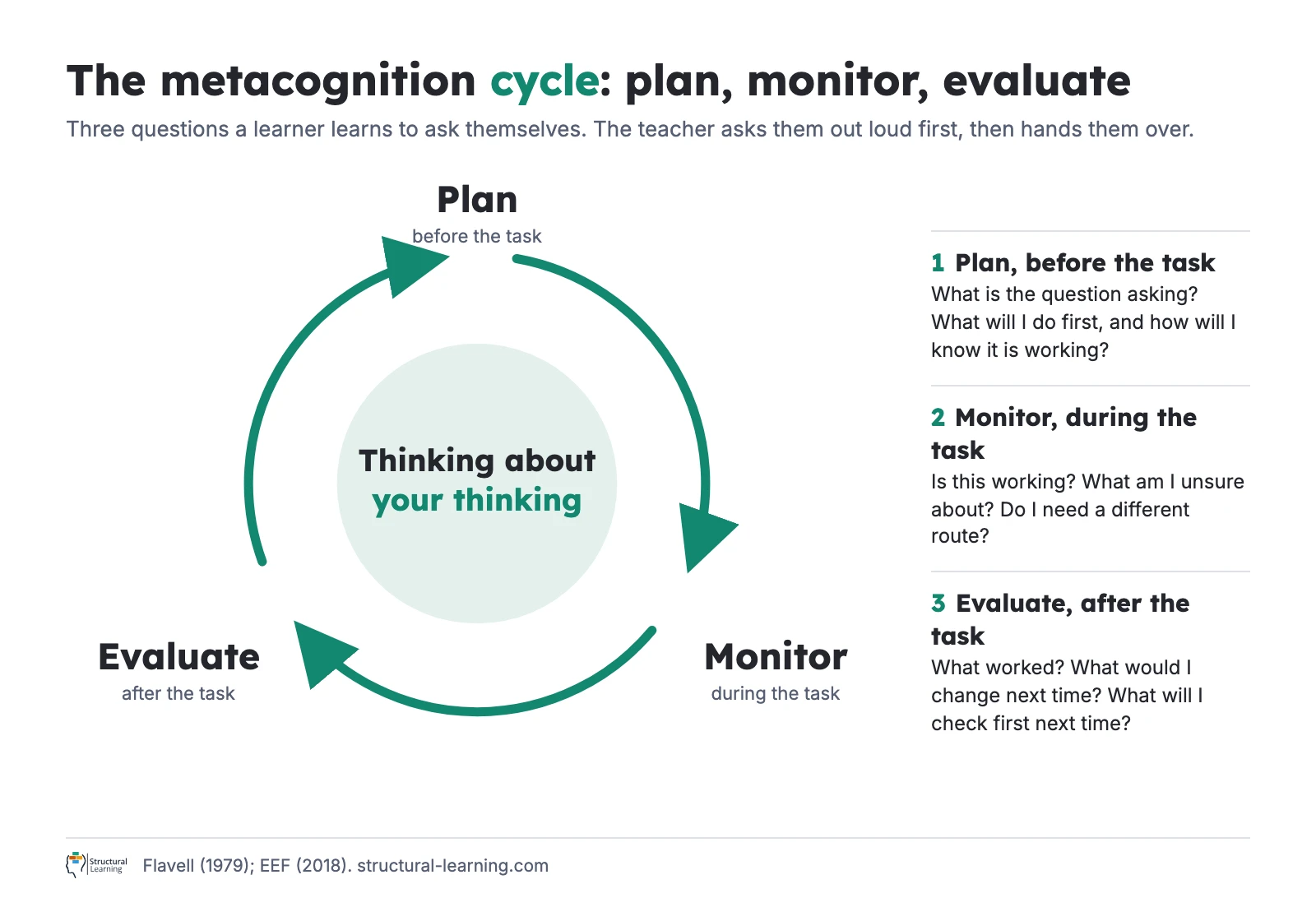
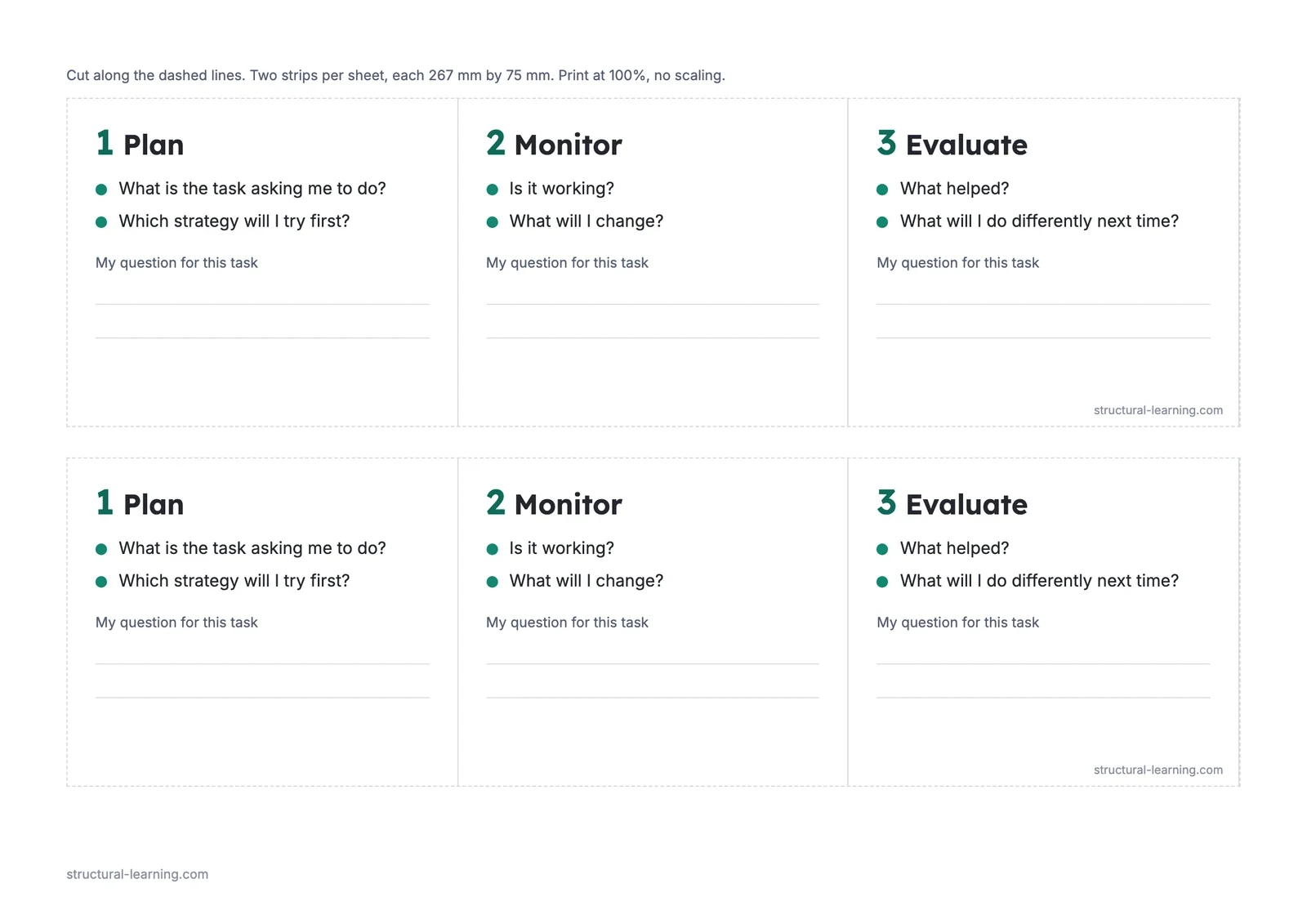
Print it for the wall or the desk: the metacognition cycle poster (A4, PDF). It carries the three questions, what a learner produces at each stage, and what you will see when the routine has landed.
Metacognition helps learners manage their own learning. Flavell (1979) described two parts. One is metacognitive knowledge. The other is cognitive monitoring.
Both underpin the classroom routine of plan, monitor and evaluate. Brown (1987) and Zimmerman (2000) found that managing behaviour matters for learners too.
The other key strategies that contribute to self-regulation are:
Self-regulated learners have the learning knowledge and self-awareness to build good study habits. When they complete assignments, they often think back to similar tasks they have done before. They use the techniques that worked well for those tasks. They also set and meet their own deadlines.
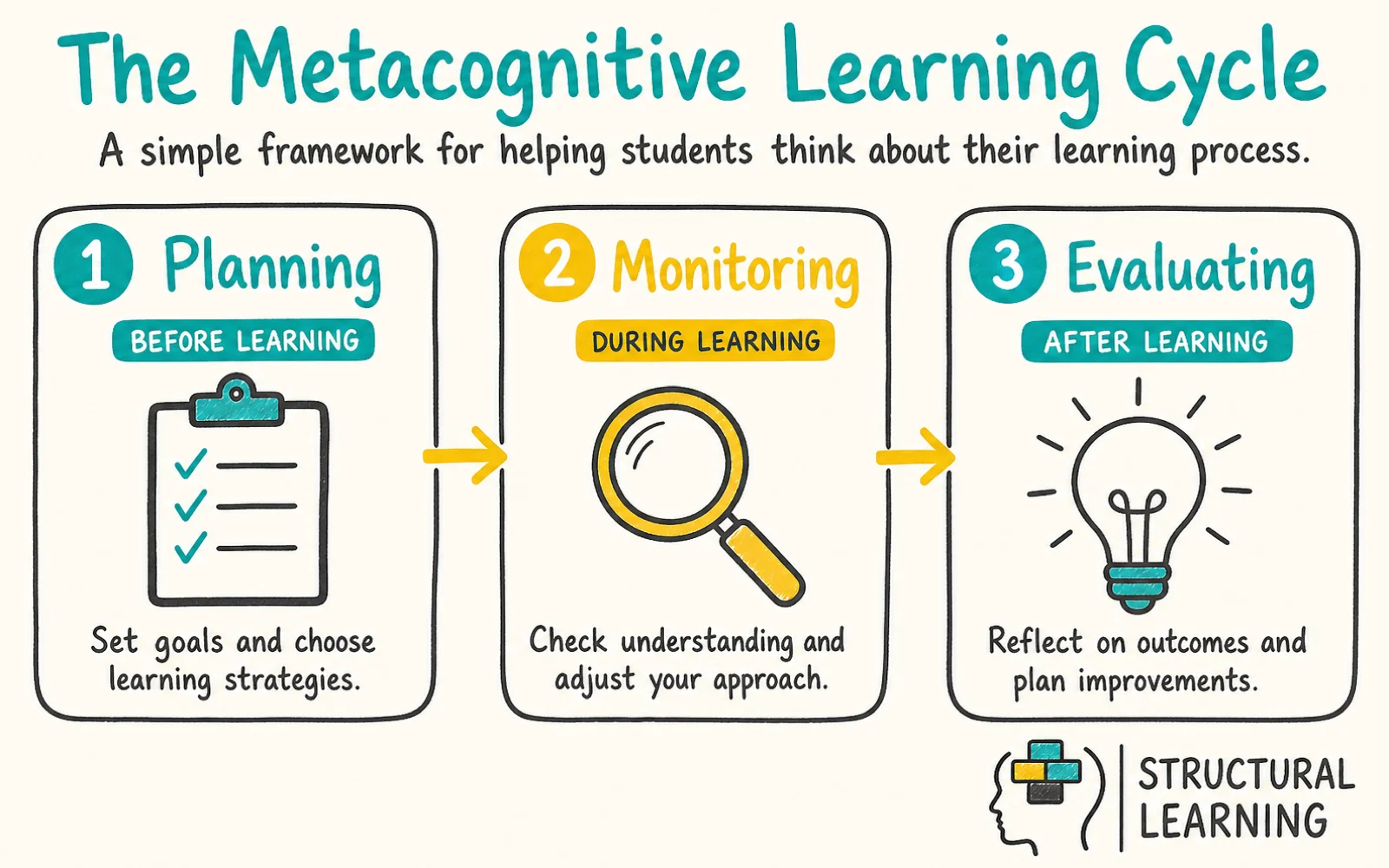
The most effective metacognitive strategies follow three stages. Planning means setting goals and choosing a strategy. Monitoring means checking progress during the task. Evaluating means reflecting on what worked and what didn't.
Learners learn to ask themselves two questions. Do I understand this? What should I do differently next time? Over time, learners who struggle become self-regulated learners who know when and how to ask for help.
Planning, monitoring and evaluating are the key metacognitive strategies. Teaching them clearly can improve learner achievement (Hattie, 2009). They also help learners manage their own learning (Flavell, 1979). Teachers need to explain each process and model it well (Bandura, 1977). That helps learners see more fully how they learn (Zimmerman, 2000).
Metacognitive learners plan ahead. They set goals before they start (Flavell, 1979). They work out what matters most. They get the resources ready for the task (Zimmerman, 2002; Pintrich, 2000).
They draw on the metacognitive knowledge they built in earlier learning. That helps them choose the best plan for the task in front of them.
For example, they may have learnt that reading before class is an effective strategy for them to absorb new material during the lesson.
As the teacher talks, learners may start to build a mental model of the new topic. They link it to what they learned before. That helps them pick the techniques most likely to work in this lesson, based on what worked on related topics.
"What do I already know?", "What am I being asked to do?", and "What strategies do I have available?" As learners face tough topics, they use metacognitive questions to plan, (Flavell, 1979). Nelson and Narens (1994) found learners check their understanding during tasks. Brown (1987) noted they also evaluate learning after task completion.

This kind of questioning helps learners see what matters most in the task. They can then plan how best to use their time.
They also monitor their progress, editing their work with care as they go. This helps them spot errors early. Research shows that learners who self-regulate their writing produce better work (Zimmerman & Risemberg, 1997).
Metacognitive learners plan their writing and set a deadline for each section. They check progress and edit with care, so they find errors early. They finish work on time more often. Flavell (1979) showed metacognition helps learners understand and solve problems.
They will also have the self-awareness to know what time of the day they work most efficiently and utilise this knowledge to make the most effective use of their time.
Metacognitive learners know which strategy to use in a memory task. For vocabulary, retrieval practice usually beats repeated study or rereading for lasting memory. Highlighting is rated low utility (Karpicke & Roediger, 2008; Dunlosky et al., 2013). In class, learners cover the word list, recall the definitions, then mark the words that need another go.
During a task, learners keep checking how they are doing. If they are off track for their goal, they adapt their approach. They use these metacognitive strategies to monitor their work:
As they monitor, learners are likely to revisit and change their plan quite often. They may switch the thinking processes they are using. They may also adjust the time given to each stage of the plan.
If they are working on their own, they may realise they need a spell of explicit instruction from their teacher before they can move on. Learners with the metacognitive knowledge to spot when they need extra help feel supported, even when the work is hard.
Metacognitive reflection helps learners understand the material more clearly. It also helps them spot weak areas or misunderstandings (Flavell, 1979). Learners look at the whole task, not just the final piece of work. They review each stage, from early planning to final submission (Zimmerman, 2000).
This builds self-awareness and can make future learning more effective (Hattie, 2009). It can also shift learners into a more active role in their education (Biggs, 1985). In this way, reflection links the learner, the task, and the learning setting.
Most importantly, they will reflect on the mental processes and study strategies they used as well as what the overall outcome was.
As part of this reflection, they will make a plan for how they will approach similar tasks in the future and may choose to write this down in a learning journal to provide quick access to their new plan when they need it.

Learners add to their metacognitive knowledge by naming the strengths and weaknesses of the approach they used. They then consider whether the same would apply in a different context.
For example, they will want to determine whether the same strategy would have the same strengths with different subject matter.
The strongest classroom claim should use the EEF's measured effect, not a promised grade rise. The current EEF Toolkit reports an average gain of about eight months' extra progress. The 2025 guidance says to teach metacognitive strategies explicitly, and to model, scaffold and practise them within subject content.
The evidence is promising but not automatic. EEF evaluations of ReflectED show that metacognition programmes can lose impact when scaled into everyday classrooms without enough time, training, or subject fit (Motteram et al., 2016; Gascoine et al., 2022). Treat the Toolkit headline as a reason to teach the approach well, not as a promise that worksheets will raise attainment.
In other words, how learners plan, check and control their thinking matters. So control over your own thinking counts.
Planning, monitoring and evaluating help learners succeed. These skills also support learning for life (Zimmerman, 2002).
Responding to what learners know about their own thinking boosts learning at the evaluation stage (Black & Wiliam, 1998). A lesson can end with metacognitive prompts for the learner.
Metacognitive prompts helped learners more than lesson summaries (Veenman et al., 2006). Learners who used prompts scored higher on two knowledge tests (Zimmerman, 2000; Dunlosky & Rawson, 2012). Prompts support better learning, according to Hattie (2009).
Guo and Wei (2019) also showed that teacher feedback can raise the attainment of metacognitive learners. Learners used more metacognitive processes when teachers gave three things often. The first was verification feedback, telling learners whether an answer was right or wrong. The second was scaffolding, breaking a complex task into small, manageable steps. The third was praise.
Metacognition measures help researchers. Flavell (1979) and Schraw and Dennison (1994) need these tools. They support learners' thinking about thinking. Brown (1987) showed this improves learning outcomes.
Pintrich and De Groot (1990) used a self-report questionnaire to assess motivational beliefs and self-regulated learning. The standard version, the Motivated Strategies for Learning Questionnaire (MSLQ), was published later by Pintrich, Smith, Garcia and McKeachie (1991). Teachers still use it often. Zimmerman (2002) shows self regulation is vital for success.
The Metacognitive Awareness Inventory comes from Schraw and Dennison (1994). It gives an accurate measure of how aware learners are of their own thinking. It has 52 statements. Learners rate each one on a Likert scale.
Flavell (1979) showed that metacognition matters. Metcalfe & Shimamura (1994) found that learners gain when they know their own thinking. Zimmerman (2000) said teaching metacognition helps learners plan more clearly. Pintrich (2000) noted that self-regulation helps learners manage hard tasks.
They are better at making decisions, coping with stress while they learn, and using their time well. These skills last beyond school and help learners keep learning for life.
Mastering a range of metacognitive approaches also gives learners more ownership of their learning. It helps them change their learning environment too.
Learners achieve more when schools let them share views on learning. Research by Whitebread et al (2009) and Hattie (2012) shows this boosts learner metacognition. Greater metacognition improves cognitive outcomes for learners and classmates.
Metacognition helps learners say what they need and take an active part in their education. When learners know how they learn best, they can tell teachers what support they need. Engagement rises, because learners feel heard and take ownership of their learning.
Learner voice means any chance learners get to say what they think. It can be formal: a school council, a focus group, a plenary or a questionnaire. It can also be informal, such as feedback to the teacher during a lesson or at the end of a sequence of lessons.
Metacognitive learners find it easy to give feedback, as researchers note (e.g. Flavell, 1979). They understand thinking about learning, as Nelson (1996) described. That helps them take part in learner voice work, as Zimmerman (2002) explained.
Learners can often tell teachers useful things about how they learn. That lets teachers adapt their teaching to fit the needs of the class.
Nelson (1996) and Flavell (1979) found that learners build metacognition when they take an active role. Teachers can support this by giving learners chances to share their voice. These opportunities help learners develop their thinking and skills.
Bjork (1994) found teacher feedback works better when learners reflect. Learners link topics to what they already know, say Chi et al. (1981). Hattie & Timperley (2007) say learners can name the activities that help. This builds metacognitive awareness (Flavell, 1979).
What teachers said, in their own words.
Independent learning is a goal, not a starting point.
Why do we gatekeep the concept of metacognition? Like learning how your brain learns is actually so helpful??
We need to stop talking about implementation, and start talking about de-implementation.
Students should hear an expert reader get stuck. That's the modeling.
The temptation is to rescue them too quickly.
Kuhn and Dean (2004) suggest teachers should reflect on what works. Leaders can build this through professional development. Modelling this thinking helps teachers pass it on to learners, according to Flavell (1979).
For leaders, the main risk is a whole-school rollout that turns metacognition into extra worksheets. Keep the system small. Agree one shared language for planning, monitoring and evaluating. Model it in departments.
Check whether learners use it in real tasks. A Year 10 science team, for example, might use one common monitoring question in practical write-ups, rather than a new reflection sheet every lesson.

Research shows that metacognition matters in teacher training (Flavell, 1979; Dunlosky & Metcalfe, 2009). Teachers can help learners think about their own thinking. Teacher CPD should cover this clearly (Hattie, 2012).
Teachers need to understand metacognition, which means thinking about learning. They also need to know how to help learners use it. Planning, monitoring and evaluating skills all help learners (Flavell, 1979). Dunlosky and Metcalfe (2009) give useful strategies. Nelson and Narens (1990) add more insight.
The nature of these skills is determined by the subject matter and learning context, which means subject specialists are best placed to teach the cognitive moves in their discipline. A history teacher teaches learners how to check a source claim; a mathematics teacher teaches them how to test whether a method fits the problem.
Flavell (1979) showed learners achieve more when teachers use metacognition. Studies by Hattie (2009) and Marzano (1998) back this up. Teachers who build these skills improve what their learners achieve.
Modelling metacognition helps learners (Flavell, 1979). Teachers also reflect on their lessons and adjust them (Schön, 1983). That builds confidence and helps them check their impact as they teach (Hattie, 2012).
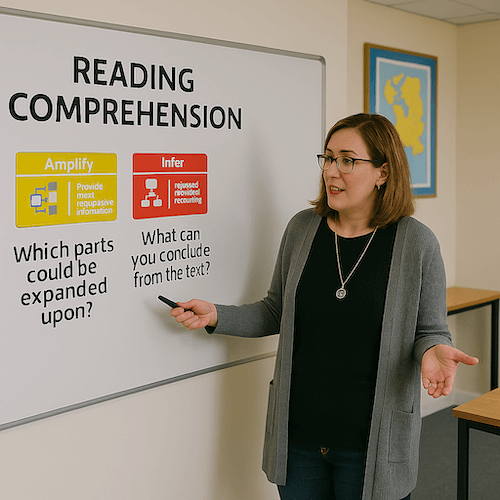
Teachers should model metacognition by showing learners how to plan, monitor, and evaluate their work. Lessons should include short reflection tasks. These help learners check what they understand and decide what to do next. With regular practice and feedback, learners slowly take more responsibility for their thinking (Flavell, 1979).
As noted above, metacognition can be taught without naming it. The teacher models planning, monitoring and evaluating as part of normal teaching. The simplest way is to think aloud in front of the class:
Subject specialists can also teach metacognitive thinking directly. The teacher introduces the idea of metacognition to the class. They then show how each of the three strategies applies to their subject.
The learning context matters a great deal. Planning an essay in English needs different thinking from planning an answer to a maths exam question. Generic reflection prompts can overload novices who have not yet secured the subject knowledge the task needs (Tricot & Sweller, 2014). Teach the content first. Then ask learners to plan, monitor or evaluate the specific move they are making in that subject.
Researchers suggest simple strategies help learners. Ask learners which step failed, which cue they missed and what they will check first next time. Exam wrappers help learners reflect, a point made by Ambrose et al. (2010). During lessons, use prompts to strengthen planning, monitoring, and evaluation, as proposed by Flavell (1979).
A document for learners to record their thoughts and reflections following a lesson or series of lessons.
It is normally used to reflect on how learning went, rather than on specific outcomes. It can also be useful for noting links between topics, or for comparing the current task with ones done before.
Learners should also identify their strengths and weaknesses and what they would do the same or differently for a similar task in the future.
A set of questions answered before and after an assessment. Before, learners reflect on how they revised. After, they reflect on how it went.
An exam wrapper helps learners see which revision techniques helped most. It also shows whether their exam technique worked.
If a learner struggled to manage their time in the exam, they note it on the wrapper. They then make a plan to manage time better in future assessments.
These questions, or question starters, help learners build metacognitive awareness before, during and after a task. Keep prompts short. Offer choices that do not depend on talking aloud: drawing, ticking, colour coding, or picking one of two strategy cards. This matters for SEND and neurodivergent learners. Differences in executive function can make spoken, step-by-step reflection look weaker than their real self-awareness.
1. Planning:
How much time should I spend on this task?
How can I ensure that I stay on track?
Have I completed a task like this before?

What do I know that will help me do this task?
2. Monitoring:
Am I on track to complete the task on time?
Have I understood what is required? How can I be sure?
Is there a more effective way for me to complete this task?
3. Evaluating:
Did I achieve what I wanted to achieve?
What approach will I take if I need to do a similar task in the future?
What do I want to learn more about?
The table below sets out the first fortnight as teachers described it on social media: routines first, one start agreed across the team, four decision lines narrated on a task, independence last. Each row says what you would notice and what the EEF guidance adds.
Eight routines from teachers on social media.
| Routine, as teachers describe it | What you would notice | What the evidence says |
|---|---|---|
| Week one is routines Start the new class with timings, transitions and shared expectations. Do not open with a definition of metacognition.
|
The same entry, the same start, every lesson. Joy at break. No poster of the word metacognition on day one. | EEF Toolkit: it can be hard to realise the average impact in practice. Week one is the behaviour the thinking will later sit inside. |
| The same routine in every class Agree the start across the team so it does not change room by room. Learners meet one pattern, not six.
|
A cover teacher can run the start. Learners stop asking how this room works. | One teacher's account of load, not a trial. EEF Rec 2, Nov 2025 edition: strategies are best taught on specific content, but the classroom conditions have to be stable first. |
| Four decision lines, in the subject Narrate reusable decisions on a real task: what I notice, which knowledge is relevant, what I do first, how I will check. Use subject words, not the word metacognition.
|
The teacher saying why before what. Learners later using the same four lines on this task. | EEF Rec 3, Nov 2025: model your own thinking. Toolkit key finding 3 (May 2025 update): teachers promote metacognition by modelling thinking aloud on curriculum tasks. |
| Independence last Do not begin the fortnight with a blank journal or a learning pit. Activate prior knowledge, model, check, then give a short independent try.
|
A modelled first attempt before anyone is left alone. No week-one independent learning hour. | Kettlewell, 28 Apr 2026: learners do not become self-sufficient by being given lots of tasks to work on alone. The seven-step model is explicit modelling, then a shift of responsibility. |
| Plan with the seven-step model Use the EEF seven-step as the planning spine: prior knowledge, strategy, model, check, guided practice, independent practice, structured reflection. It is a scaffold, not a lesson plan.
|
Prior knowledge before the model. A check before guided practice. Reflection that feeds the next similar task. | EEF seven-step practitioner tool v2.0.0 (via Kettlewell, 28 Apr 2026): activating prior knowledge through to structured reflection. Step 4 in the 2025 tool is check understanding of the strategy, not memorisation. Rec 2 says the same sequence can run across a lesson or a series of lessons. |
| US variant: how learning happens In US schools, spend the first couple of days on human cognitive architecture, then a concrete demo of long-term memory, then retrieval. Name it as the US start. Do not blend it with the UK week-one routines row.
|
A two-day crash course before the first content unit. Working memory and retrieval in teacher language, not a poster of the word metacognition. | A US classroom claim, not a UK trial. UK science teachers in the same window argued against a discrete science-of-learning unit. Toolkit key finding 2: teach the strategies on usual curriculum content, not as thinking-skills lessons. The disagreement is the finding. |
| US variant: talk is expected In US schools, spend the first three weeks making conversation and backing up answers the classroom norm. UK equivalent: the same stems, in this subject, from day one of the model.
|
Turn and talk that is required, not optional. Learners justifying a step, not only giving an answer. | Toolkit key finding 5: promoting reasoning and debate helps because it makes thinking public. EEF Rec 2 still wants that talk on this week's work, not as a generic oracy unit. |
| US variant: do not wait In US schools, talk retrieval and storage strength from the first days, not after the first assessment. In UK schools, put the four decision lines on a subject task in week one, not in a later study-skills slot.
|
Retrieval language in week one. No "we will cover how to learn in October". | Toolkit: explicitly teaching strategies to plan, monitor and evaluate specific aspects of learning can be effective, and they should sit in usual curriculum content. This row is when to start, not a new strategy list. |
The Education Endowment Foundation offers resources on metacognitive strategies. Journals and courses show how to use these approaches well. Many schools share case studies and examples through networks and online groups.
Here are four studies on metacognition and their implications. Whilst this is not an extensive list, these studies should be useful for teachers who are doing research in the area of metacognition.
1. Perry, J., Lundie, D., & Golder, G. (2019). Metacognition in schools: what does the literature suggest about the effectiveness of teaching metacognition in schools? Educational Review, 71, 483-500.
Researchers argue that learners do better when teachers teach metacognition directly. The gains include better grades and stronger well-being (e.g., Flavell, 1979; Dunlosky & Metcalfe, 2009; Hattie, 2012).
2. Kuhn, D., & Dean, Jr., D. (2004). Metacognition: A Bridge Between Cognitive Psychology and Educational Practice. Theory Into Practice, 43, 268-273.
Metacognition links how learners think and how we teach, say researchers (Brown, 1987; Flavell, 1979). Metacognition helps learners become skilled thinkers in classrooms, according to theories (Efklides, 2008; Kruger & Dunning, 1999). We should use this knowledge to improve learning strategies.
3. Gunstone, R., & Northfield, J. (1994). Metacognition and learning to teach. International Journal of Science Education, 16, 523-537.
Teacher training must focus on building metacognition. Flavell (1979) found that it helps learners and teachers. Hattie (2012) called for research on how it applies in UK classrooms.
4. Wall, K., & Hall, E. (2016). Teachers as metacognitive role models. European Journal of Teacher Education, 39, 403-418.
This link benefits learners. Teachers who develop learner metacognition also boost their own skills (Schraw, 1998). Effective teaching strategies improve learner outcomes and teacher knowledge (Hattie, 2012). This creates shared growth for teachers and learners.
Metacognition alone does not ensure a learner succeeds (Nelson & Narens, 1990; Flavell, 1979). What matters is the change in behaviour that metacognition drives. That change is what moves learner progress (Nelson & Narens, 1990; Flavell, 1979).
Four classrooms below show the first fortnight teachers described on social media. One modelled under a visualiser in GCSE RE. One made hidden thinking visible, then took the support away. One laminated help sheets for desks. One ran a first-day course on how learning happens.
Four rooms, drawn as a process. What they actually did, then what you would notice.
1 · Process
1 · Live modelling under the visualiser
2 · Making expert thinking visible
3 · Then apply it independently
They modelled a high-quality RE response live under the visualiser, then learners applied it independently.
2 · Process
1 · Hidden thinking visible
2 · Solve parts together
3 · Remove support They make the decisions
They made the hidden thinking visible, solved parts together, then asked learners to make the decisions without the model.
3 · Process
1 · Laminated class sets of help sheets
2 · Dry wipe pens write on the sheet
3 · Support their thinking
They made class sets of help sheets for the weakest learners, with dry-wipe pens, so thinking could be written on the sheet.
a number help sheet with a 12 by 12 grid, fraction-decimal-percent equivalences and a place-value grid. Number Help Sheet (PDF).
4 · Process
1 · How Learning Happens crash course, first day
2 · Make stored knowledge in long-term memory concrete
3 · New information in working memory makes sense
They spent the first day on how learning happens and made securely stored long-term memory concrete, so new information in working memory had something to attach to.
Generate an 8-week metacognition roadmap tailored to your key stage, subject, and current practice level.
The planner below stretches the first fortnight into an eight-week sequence for your key stage and subject. Choose a phase, a subject and how established metacognitive teaching already is in your room, and it sets out week-by-week moves you can print or copy into a department plan. Treat the output as a first draft and adjust the pace to the class in front of you.
The questions below are the ones teachers raised when a first fortnight met a real class. Does anyone implement more than a laminated poster? Is a science-of-learning unit worth more than twenty minutes? Is this Learning to Learn again? Each answer uses the replies.
Use the questions below to choose one metacognitive routine that can be taught, observed and reviewed during the first fortnight.
Question
“Nobody implements "metacognition". They implement something they take on trust to be metacognition, usually the cheapest and most superficially looking version: exit tickets, laminated posters of plan, monitor, evaluate, a "learning to learn" CPD session for teachers.”
What the replies and the evidence say. On the same argument, @GargeyaS says generic plan, monitor, evaluate lives as a poster on the wall. The EEF Toolkit (last updated May 2025) says the average impact is hard to realise, and that strategies should be taught on usual curriculum content, not as discrete thinking-skills lessons. Start the fortnight inside a subject task, not with a laminated display.
Question
“I don't want to get in a fight with anyone, but teaching your students about "the science of learning" as a discrete thing for any more than like 20 minutes is not a good use of time”
What the replies and the evidence say. His follow-up, same thread: @adamboxer1 says they do not spend time on this at TTA, other than a bit in the run-up to exams. A US classroom post in the same window spends the first couple of days on cognitive architecture. Teachers split two ways. The UK first fortnight on this page stays with routines and modelled subject decisions, not a standalone how-the-brain-works unit.
Question
“I've never bought into the whole "teach them about meta-cognition" package either. It always felt too much like growth mindset or Learning to Learn.”
What the replies and the evidence say. A biology head of department on a related thread, @MistypeaTam, keeps a short tutor-group mention for exam season, detached from a subject. EEF Rec 2, Nov 2025 edition: plan, monitor and evaluate can be introduced generically, but the strategies are mostly applied to specific content and are therefore best taught that way. A first-fortnight package labelled metacognition will be heard as last decade's Learning to Learn.
Question
“… when do you use visualiser and why? What are the students doing when you are modelling on the visualiser to maintain focus….”
What the replies and the evidence say. That thread did not answer the second question. @Dorastar1 feels seasick writing under the camera; @missburtenshaw_ models on a cheap tech pen so she can still look at the class. The missing week-one routine is pens down, one check question, then handover.
Question
“She knows what she needs to do. Her brain just can't organise the steps to actually do it. That's ADHD.”
What the replies and the evidence say. The post names Marion, parent of a child with ADHD, 11. The same wording sits on the page What Parents of Children with SEN Actually Say, a solicitor compilation. Among UK SEND posts we found no SENCO naming a prompt they use. A first-fortnight start that assumes the learner can sequence the whole task will miss this. Give a first step they can begin without organising the rest.
Start your next lesson with the routine, not the word. Run the same entry, timings and transitions you want every lesson, then narrate one decision on a real task: what I notice, which knowledge is relevant, what I do first, how I will check. Keep the word metacognition off the board until learners are using those four lines themselves.
Metacognition is simply thinking about your own thinking, where learners become aware of how they learn and what strategies work for them. Research shows learners with metacognitive skills make significant gains in academic performance, equivalent to several months of additional progress per year (EEF, 2025).
Research into the feeling of knowing (Hart, 1965) shows why learners can mistake familiarity for secure recall. Build calibration into the lesson: before a short quiz, ask learners to predict their score, complete the retrieval task, then compare prediction with result. This corrects the illusion of knowing without shaming the learner, because the evidence comes from the task rather than from the teacher's judgement.
Flavell (1979) said metacognitive experiences are feelings during tasks. Learners might suddenly know they don't understand something. Teachers can use these "aha" and "stuck" moments to build learner awareness.
Metacognition means that learners understand their own thinking. Flavell (1979) found that it gives learners knowledge about how they think and learn. Self-regulated learning means that learners guide their own actions. Zimmerman (2002) showed that learners do this by setting goals and changing their strategies when needed.
Flavell (1979) described metacognition. Ann Brown (1987) separated regulation from knowledge. She showed that even young learners can plan with support. Learners also monitor and evaluate their thinking (Brown, 1987).
Metacognitive knowledge has three parts: declarative, procedural, and conditional. Paris et al. (1983) found conditional knowledge, or knowing when and why, hardest to teach. They noted it is also the most high-use for knowledge transfer.
Teachers can begin by introducing the three-stage framework of planning, monitoring, and evaluating to their learners. Start by teaching learners to ask themselves questions like 'Do I understand this?' during lessons and 'What should I do differently next time?' after completing tasks.
The most effective strategies follow the planning-monitoring-evaluating cycle, where learners set goals and choose strategies, check their progress during learning, and reflect on what worked. This includes metacognitive questioning such as 'What do I already know about this topic?' and 'What has worked well for me in the past?'
Metacognitive skills help struggling learners into self-regulated learners who can identify when they're having difficulties and know specific strategies to help themselves improve. Learners with these skills feel helped even when struggling because they know exactly when and how to seek help.
Reflection helps learners judge the quality of their thinking, not just describe how they felt (Flavell, 1979). This matters more when learners use AI tools: they need to test whether an output is accurate, relevant, and based on evidence before accepting it (Lodge et al., 2023; Fan et al., 2025). In class, ask learners to annotate one AI answer with 'accurate', 'unsupported', and 'needs checking' before writing their own response.
Researchers (Bjork et al., 2013) showed clear differences. Metacognition gives the learner self-awareness. Self-regulation (Zimmerman, 2000) needs strategies. Retrieval practice and motivation (Duckworth et al., 2019) help self-regulation, researchers found. Learners must know when to ask for help (Winne, 2017).
Ambrose, S. A., Bridges, M. W., DiPietro, M., Lovett, M. C. and Norman, M. K. (2010). How Learning Works: Seven Research-Based Principles for Smart Teaching. Jossey-Bass.
Bandura, A. (1977). Social Learning Theory. Prentice Hall.
Biggs, J. B. (1985). The role of metalearning in study processes. British Journal of Educational Psychology, 55(3), 185 to 212.
Bjork, R. A. (1994). Memory and metamemory considerations in the training of human beings. In J. Metcalfe and A. P. Shimamura (eds), Metacognition: Knowing About Knowing (pp. 185 to 206). MIT Press.
Bjork, R. A., Dunlosky, J. and Kornell, N. (2013). Self-regulated learning: Beliefs, techniques, and illusions. Annual Review of Psychology, 64, 417 to 444.
Black, P. and Wiliam, D. (1998). Assessment and classroom learning. Assessment in Education: Principles, Policy and Practice, 5(1), 7 to 74.
Brown, A. L. (1987). Metacognition, executive control, self-regulation, and other more mysterious mechanisms. In F. E. Weinert and R. H. Kluwe (eds), Metacognition, Motivation, and Understanding (pp. 65 to 116). Lawrence Erlbaum.
Chi, M. T. H., Feltovich, P. J. and Glaser, R. (1981). Categorization and representation of physics problems by experts and novices. Cognitive Science, 5(2), 121 to 152.
Duckworth, A. L., Taxer, J. L., Eskreis-Winkler, L., Galla, B. M. and Gross, J. J. (2019). Self-control and academic achievement. Annual Review of Psychology, 70, 373 to 399.
Dunlosky, J. and Metcalfe, J. (2009). Metacognition. SAGE.
Dunlosky, J. and Rawson, K. A. (2012). Overconfidence produces underachievement: Inaccurate self evaluations undermine students' learning and retention. Learning and Instruction, 22(4), 271 to 280.
Dunlosky, J., Rawson, K. A., Marsh, E. J., Nathan, M. J. and Willingham, D. T. (2013). Improving students' learning with effective learning techniques: Promising directions from cognitive and educational psychology. Psychological Science in the Public Interest, 14(1), 4 to 58.
Dweck, C. S. (2006). Mindset: The New Psychology of Success. Random House.
Education Endowment Foundation (2025). Metacognition and self-regulation. Teaching and Learning Toolkit. Education Endowment Foundation.
Efklides, A. (2008). Metacognition: Defining its facets and levels of functioning in relation to self-regulation and co-regulation. European Psychologist, 13(4), 277 to 287.
Fan, Y., Tang, L., Le, H., Shen, K., Tan, S., Zhao, Y., Shen, Y., Li, X. and Gašević, D. (2025). Beware of metacognitive laziness: Effects of generative artificial intelligence on learning motivation, processes, and performance. British Journal of Educational Technology, 56(2), 489 to 530.
Flavell, J. H. (1979). Metacognition and cognitive monitoring: A new area of cognitive-developmental inquiry. American Psychologist, 34(10), 906 to 911.
Gascoine, L., Tracey, L., Fairhurst, C., Robinson-Smith, L., Torgerson, D., Torgerson, C. and Bell, K. (2022). ReflectED: Evaluation Report. Education Endowment Foundation.
Gunstone, R. F. and Northfield, J. (1994). Metacognition and learning to teach. International Journal of Science Education, 16(5), 523 to 537.
Guo, W. and Wei, J. (2019). Teacher feedback and students' self-regulated learning in mathematics: A study of Chinese secondary students. The Asia-Pacific Education Researcher, 28(3), 265 to 275.
Hart, J. T. (1965). Memory and the feeling-of-knowing experience. Journal of Educational Psychology, 56(4), 208 to 216.
Hattie, J. (2009). Visible Learning: A Synthesis of Over 800 Meta-Analyses Relating to Achievement. Routledge.
Hattie, J. (2012). Visible Learning for Teachers: Maximizing Impact on Learning. Routledge.
Hattie, J. and Timperley, H. (2007). The power of feedback. Review of Educational Research, 77(1), 81 to 112.
Karpicke, J. D. and Roediger, H. L. (2008). The critical importance of retrieval for learning. Science, 319(5865), 966 to 968.
Kruger, J. and Dunning, D. (1999). Unskilled and unaware of it: How difficulties in recognizing one's own incompetence lead to inflated self-assessments. Journal of Personality and Social Psychology, 77(6), 1121 to 1134.
Kuhn, D. and Dean, D., Jr. (2004). Metacognition: A bridge between cognitive psychology and educational practice. Theory Into Practice, 43(4), 268 to 273.
Lodge, J. M., Yang, S., Furze, L. and Dawson, P. (2023). It's not like a calculator, so what is the relationship between learners and generative artificial intelligence? Learning: Research and Practice, 9(2), 117 to 124.
Marzano, R. J. (1998). A Theory-Based Meta-Analysis of Research on Instruction. Mid-continent Regional Educational Laboratory.
Metcalfe, J. and Shimamura, A. P. (eds) (1994). Metacognition: Knowing About Knowing. MIT Press.
Motteram, G., Choudry, S., Kalambouka, A., Hutcheson, G. and Barton, A. (2016). ReflectED: Evaluation Report and Executive Summary. Education Endowment Foundation.
Nelson, T. O. (1996). Consciousness and metacognition. American Psychologist, 51(2), 102 to 116.
Nelson, T. O. and Narens, L. (1990). Metamemory: A theoretical framework and new findings. Psychology of Learning and Motivation, 26, 125 to 173.
Nelson, T. O. and Narens, L. (1994). Why investigate metacognition? In J. Metcalfe and A. P. Shimamura (eds), Metacognition: Knowing About Knowing (pp. 1 to 26). MIT Press.
Paris, S. G. and Winograd, P. (1990). How metacognition can promote academic learning and instruction. In B. F. Jones and L. Idol (eds), Dimensions of Thinking and Cognitive Instruction (pp. 15 to 51). Lawrence Erlbaum.
Paris, S. G., Lipson, M. Y. and Wixson, K. K. (1983). Becoming a strategic reader. Contemporary Educational Psychology, 8(3), 293 to 316.
Perry, J., Lundie, D. and Golder, G. (2019). Metacognition in schools: what does the literature suggest about the effectiveness of teaching metacognition in schools? Educational Review, 71(4), 483 to 500.
Pintrich, P. R. (2000). The role of goal orientation in self-regulated learning. In M. Boekaerts, P. R. Pintrich and M. Zeidner (eds), Handbook of Self-Regulation (pp. 451 to 502). Academic Press.
Pintrich, P. R. and De Groot, E. V. (1990). Motivational and self-regulated learning components of classroom academic performance. Journal of Educational Psychology, 82(1), 33 to 40.
Pintrich, P. R., Smith, D. A. F., Garcia, T. and McKeachie, W. J. (1991). A Manual for the Use of the Motivated Strategies for Learning Questionnaire (MSLQ). National Center for Research to Improve Postsecondary Teaching and Learning, University of Michigan.
Schraw, G. (1998). Promoting general metacognitive awareness. Instructional Science, 26(1-2), 113 to 125.
Schraw, G. and Dennison, R. S. (1994). Assessing metacognitive awareness. Contemporary Educational Psychology, 19(4), 460 to 475.
Schön, D. A. (1983). The Reflective Practitioner: How Professionals Think in Action. Basic Books.
Tricot, A. and Sweller, J. (2014). Domain-specific knowledge and why teaching generic skills does not work. Educational Psychology Review, 26(2), 265 to 283.
Veenman, M. V. J., Van Hout-Wolters, B. H. A. M. and Afflerbach, P. (2006). Metacognition and learning: conceptual and methodological considerations. Metacognition and Learning, 1(1), 3 to 14.
Veenman, M. V. J., Wilhelm, P. and Beishuizen, J. J. (2004). The relation between intellectual and metacognitive skills from a developmental perspective. Learning and Instruction, 14(1), 89 to 109.
Vygotsky, L. S. (1978). Mind in Society: The Development of Higher Psychological Processes. Harvard University Press.
Wall, K. and Hall, E. (2016). Teachers as metacognitive role models. European Journal of Teacher Education, 39(4), 403 to 418.
Whitebread, D., Coltman, P., Pasternak, D. P., Sangster, C., Grau, V., Bingham, S., Almeqdad, Q. and Demetriou, D. (2009). The development of two observational tools for assessing metacognition and self-regulated learning in young children. Metacognition and Learning, 4(1), 63 to 85.
Winne, P. H. (2017). Cognition and metacognition within self-regulated learning. In D. H. Schunk and J. A. Greene (eds), Handbook of Self-Regulation of Learning and Performance (2nd edition, pp. 36 to 48). Routledge.
Zimmerman, B. J. (2000). Attaining self-regulation: A social cognitive perspective. In M. Boekaerts, P. R. Pintrich and M. Zeidner (eds), Handbook of Self-Regulation (pp. 13 to 39). Academic Press.
Zimmerman, B. J. (2002). Becoming a self-regulated learner: An overview. Theory Into Practice, 41(2), 64 to 70.
Zimmerman, B. J. and Risemberg, R. (1997). Becoming a self-regulated writer: A social cognitive perspective. Contemporary Educational Psychology, 22(1), 73 to 101.