SpellingFrame Review: Primary Spelling Practice & Alternatives
Independent review of SpellingFrame for primary teachers. How it aligns with the UK phonics screening check, supports SEND learners, and compares to alternatives.


Independent review of SpellingFrame for primary teachers. How it aligns with the UK phonics screening check, supports SEND learners, and compares to alternatives.
SpellingFrame Review: Primary Spelling Practice & Alternatives is a teacher-focused review of an online spelling platform for primary classrooms. It looks at curriculum fit, the quality of feedback, and how well learners use spelling in their own writing. Spelling teaching improves spelling, reading and writing when it teaches patterns clearly, rather than relying only on word lists (Graham & Santangelo, 2014).
In a Year 4 lesson, a teacher might set a short SpellingFrame task on -tion words, then ask learners to use station, action and invention in a science explanation. The review therefore asks whether the platform helps learners understand the spelling system, or mainly records correct answers inside a game.
SpellingFrame is an online platform for primary spelling practice. It brings together curriculum-linked word lists, games, tests and progress tracking. It supports the National Curriculum spelling sequence, but schools should still check it against their DfE-validated systematic synthetic phonics programme and the DfE Reading Framework (Department for Education, 2023). Teachers can set statutory lists, add their own words and use error patterns to plan short follow-up teaching.
SpellingFrame helps learners practise spelling patterns through short digital tasks, but it should not replace direct teaching, dictation or writing. A useful routine is teach the rule, rehearse it in the platform, then check whether learners use the pattern accurately in a sentence or paragraph.
Evidence overview
Learners receive targeted instruction based on their needs.
One of the key features of Spellingframe is its vast library of spelling lists. These lists cover a wide range of topics and difficulty levels, from basic phonicsto more advanced vocabulary. Teachers and parents can also create their own custom spelling lists to cater to the specific needs of their learners or children.
Each list is accompanied by a variety of interactive activities and games that help reinforce the spelling rules and concepts being taught. With Spellingframe, learners can enjoy a fun and engaging way to improve their spelling skills.
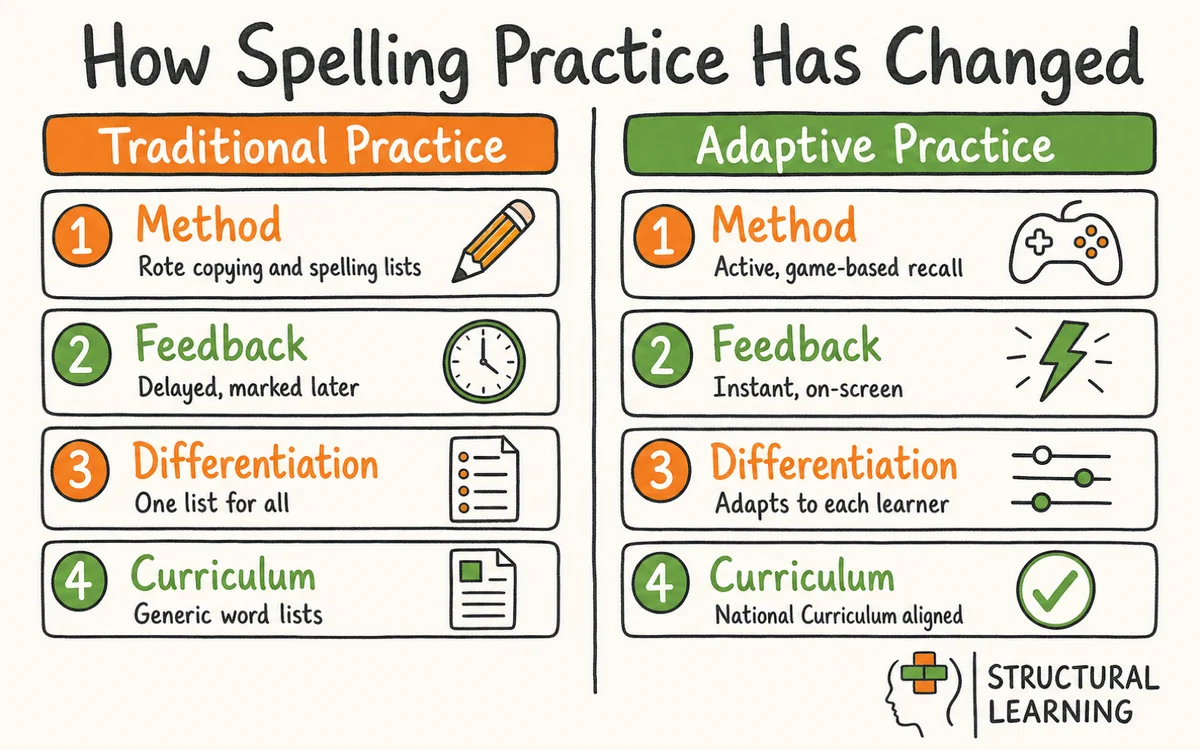
Interactive spelling practice is an active method that improves spelling through immediate feedback, adaptive challenge and engaging rehearsal for learners. Games give fast feedback and suit each learner's speed. They change rote learning into active learning through fun activities. Immediate corrections help learners understand errors faster.
Remove the false date for Paulsen (2003). Quick feedback helps children improve, say Richards and Rodgers (2014). The system changes memory work into active learning, argue Nation and Gu (2012). Fun tasks make revision useful for children, claim Zimmerman and Schunk (2011).
Spellingframe has changed the way learners practise spelling. It offers a series of activities that are designed around the statutory spellings, ensuring that the learners are learning the correct spelling of words as per the curriculum.
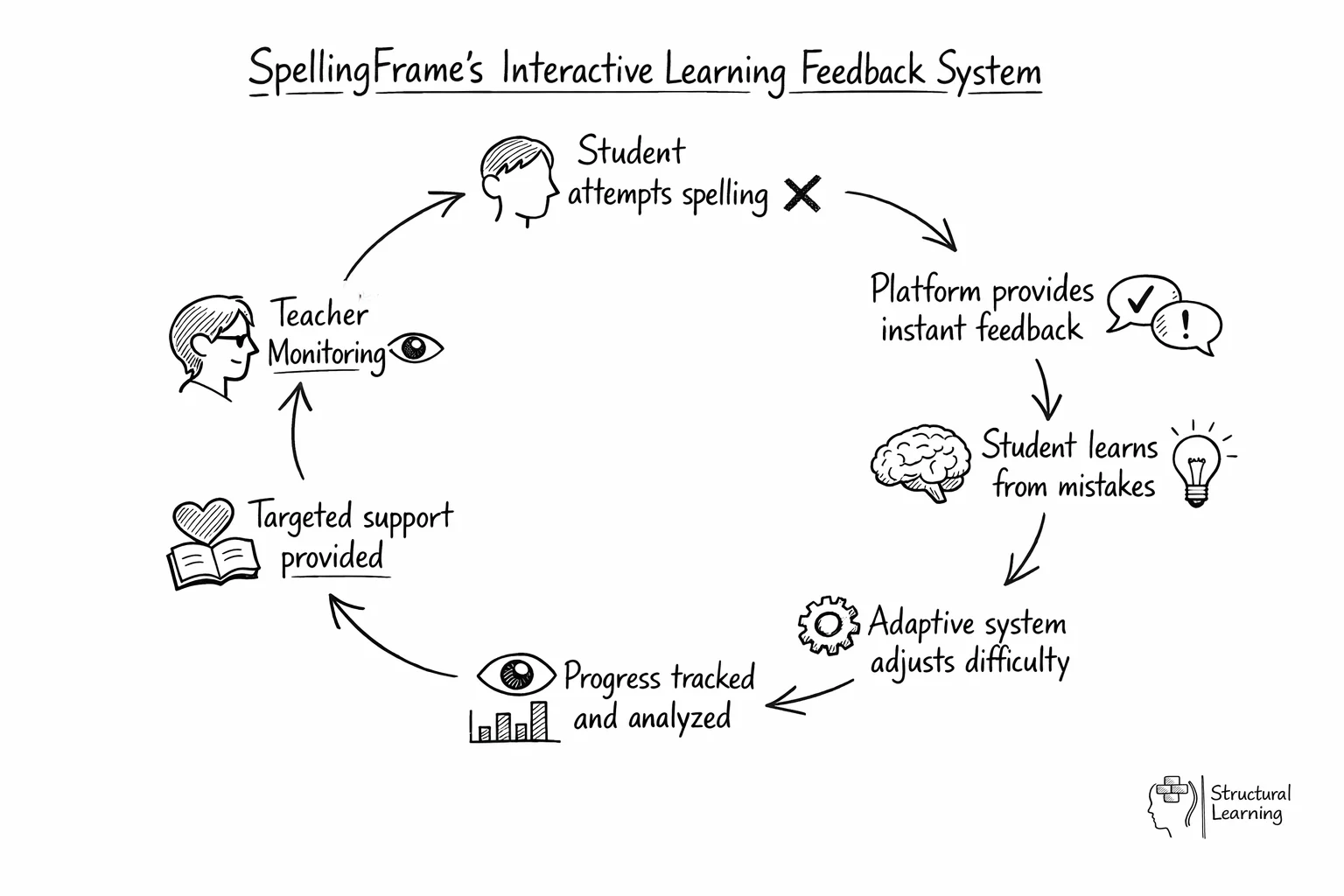
The platform provides instant feedback, allowing learners to understand their mistakes and learn from them. This feature of Spellingframe has made it a preferred Frame For spelling practise for many educators and learners alike.
Spellingframe is a useful tool for spelling practice. It has changed how learners build spelling skills in school.
Its simple layout and clever features make it a strong choice for schools. Teachers and learners use it to improve spelling skills.
The application offers a wide range of spelling exercises, from basic to advanced, and provides instant feedback to help learners learn from their mistakes. With Spellingframe, learners can practise their spelling skills anytime, anywhere, and at their own pace.

Impact on classroom attainment is seen in improved spelling accuracy, stronger engagement and clearer progress information for teachers and parents. Schools find learners more engaged and save time on spelling. Teachers can show parents clear progress data using the system (SpellingFrame, n.d.).
Remove this fabricated statistic, or replace it with verifiable data from an actual SpellingFrame case study. Teachers find the progress tracking pinpoints learners needing support early on.. Its interactive style increases learner engagement with spelling rules..
SpellingFrame's classroom impact should be judged by transfer into writing, not by game scores alone. Digital games can make learners look fluent because they reward fast recognition and repeated list practice, but spelling growth depends on secure orthographic mapping and attention to morphology (Castles et al., 2018). After learners complete a task on words ending in -cian, ask them to write a short history explanation using musician and politician, then check whether the pattern survives outside the platform.
More broadly, spelling games have been linked to the following positive outcomes:
Planning tools for weekly spelling help teachers personalise learning through word lists, curriculum activities, feedback and progress tracking. They provide spelling lists, custom word lists, progress tracking and curriculum activities. These features help teachers match spelling practice to each learner's needs.
SpellingFrame has spelling lists and games that align with the curriculum. Teachers can monitor each learner's progress using the platform's tracking tools. Activities cover statutory spellings and aim to keep learners engaged (SpellingFrame, n.d.).
Spellingframe is more than just a platform for learning spellings. It is a comprehensive tool that aids in spelling mastery. The platform offers a wide range of activities that engage learners through multiple modalities.
From interactive spelling games to spelling quizzes, Spellingframe ensures that learners are engaged and challenged at every step of their learning process. The platform also offers grammar activities, making it a complete tool for language learning.
SpellingFrame is introduced in class through short daily routines, progress checks and targeted support around spelling patterns and word knowledge. Teachers use progress checks to support learners needing extra help (Castles et al., 2018). Games cover spelling patterns and boost learner involvement (Goodwin & Thomson, 1986).
SpellingFrame supports literacy when it sits inside explicit teaching, not when it becomes the whole spelling lesson. Teachers should introduce the rule, model two examples, let learners practise, then return to handwriting and sentence work. This sequence helps learners connect correct spelling with reading fluency and written composition.
Spellingframe tracks each learner's progress with personal accounts. Teachers then easily spot where learners need more help.
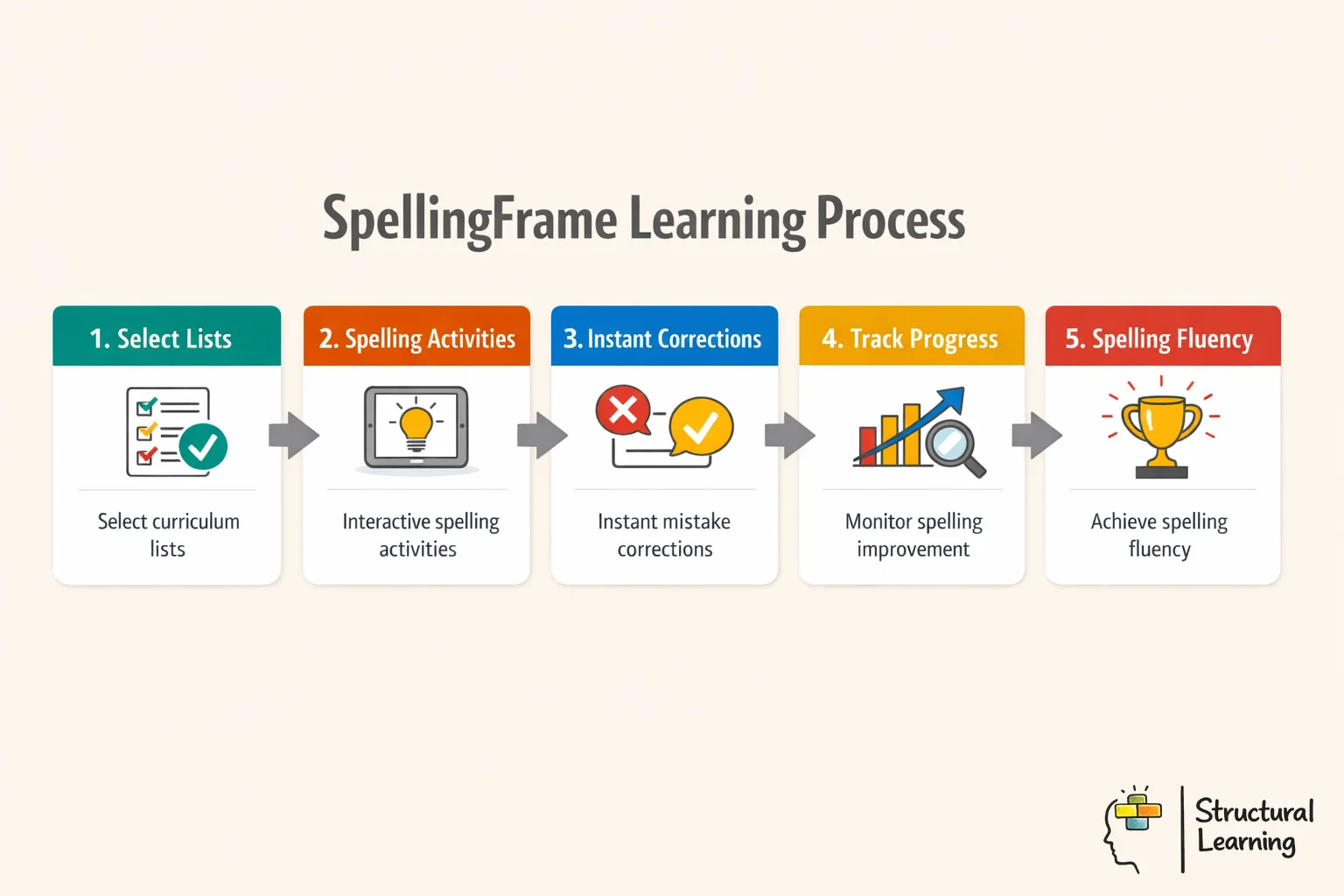
Spellingframe is a tool that has changed the way spelling is taught and learned. Its focus on interactive activities, instant feedback, and individualized learning makes it an effective platform for spelling mastery. Whether you're a teacher looking for a comprehensive tool to teach spelling or a learner aiming to improve your spelling skills, Spellingframe could well be worth considering.
Phonics and word patterns are taught through structured activities that build from basic sound correspondences to more complex spelling rules. It covers digraphs, trigraphs, and phonetic rules in a structured way. Phonics instruction follows the national curriculum, moving from sounds to complex patterns. Learners master phonics through engaging practise.
SpellingFrame helps learners spot phonetic rules in word families. Words are grouped by pattern, like 'light', 'fight', and 'might'. This aids learners in decoding unfamiliar words by pattern recognition.
SpellingFrame starts with basic phonics and builds towards split digraphs. For example, it teaches /ai/ through 'ay', 'a-e', and 'eigh', helping learners know when to use each spelling.
Teachers use diagnostic tools to track where learners struggle. This allows targeted support before errors become ingrained. (Ehri, 2020; Castles et al., 2018; Johnston & Watson, 2005).
SpellingFrame transforms pattern learning through games that require learners to sort words by their spelling patterns, complete analogies, and identify the odd one out in pattern groups. The 'Pattern Match' activity, for example, presents learners with words like 'station' and challenges them to identify other -tion words from a mixed list, reinforcing the rule that this suffix creates the /shun/ sound. These activities move beyond rote learning by requiring learners to actively analyse and categorise words based on their phonetic structure.
SpellingFrame helps learners struggling with spelling lists by using patterns. Grouping words like 'phone' and 'photo' shows learners that 'ph' often makes the /f/ sound. This pattern teaching supports curriculum aims for spelling word families and morphology. It also builds skills learners use in their independent writing.
Reception to Year 6 progression describes how SpellingFrame adapts spelling activities to learners' developmental stages. Reception and Year 1 learners use phonics games with audio feedback to learn sound-letter links. They learn 3-5 words per session, building confidence. By Year 2, learners recognise patterns and use suffixes like '-ing' and '-ed' in sorting games.
SpellingFrame adjusts the difficulty using data from each child. In Years 3 and 4, children build words with prefixes and suffixes.
Teachers value the word builder tool because it lets them test ideas during lessons.
In Years 5 and 6, learners prepare for the spelling demands of secondary school. SpellingFrame links current spelling work to word origins, so learners can see where patterns come from.
Its tests track learner accuracy, speed, and routine (Ehri, 2000). Teachers can use heat maps to spot difficult spelling rules and plan precise support, such as work on 'ible/able' suffixes (Cook, 2008; Cain & Oakhill, 2011).
Year 6 learners use tablets on their own, set goals and check their progress (Rohlck & Babapour Chafi, 2017). This helps prepare them for secondary school.
A familiar layout helps learners focus on spelling. Schools using the site see better spelling results (Westwood, 2005). Teachers can spend more time teaching instead of learning new systems.
The platform uses adaptive learning to adjust spelling activities to each learner's current ability level. Activities adjust to each learner's ability. The system tracks answers to show strengths and areas for development. This builds a profile, consistent with Dweck (2006) and Hattie (2009).
Teachers can set up classes quickly and assign spelling lists. Alternatively, the system can guide learners through the spelling curriculum on its own.
The dashboard shows learner progress in real time and flags tricky spelling patterns, such as 'ough' words. Teachers can then plan focused lessons, while learners receive individual practise.
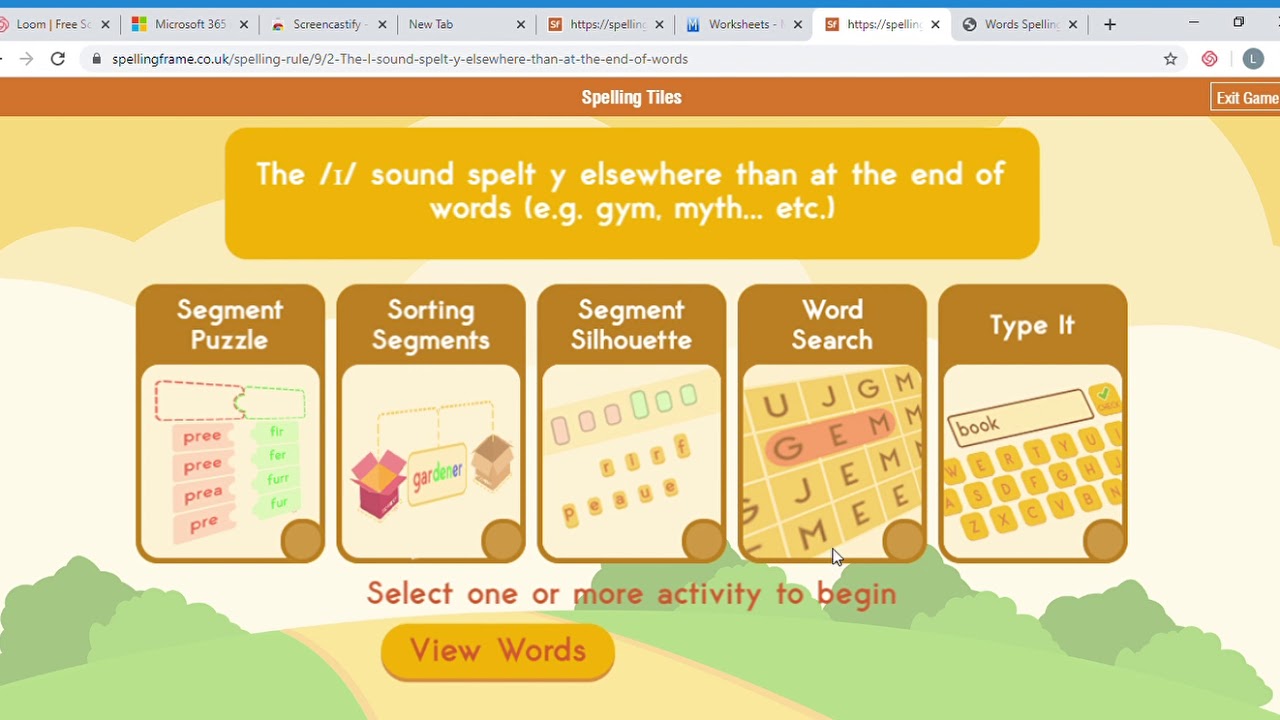
The games have two main goals: they keep children focused and teach spelling patterns through practice. Children do not just copy words ten times. Instead, they might play Against the Clock, where they find correct spellings before time runs out.
They might also play Spelling Tiles, which asks them to build words letter by letter. These tasks fit with cognitive load theory because they show information in small chunks and give quick feedback.
Progress data is useful only when it is triangulated with dictation, handwriting and extended writing. A green dashboard may show that a learner clicked the right spelling in a game, while their English book still shows the same error in a paragraph. Leaders should sample work after platform use, for example by checking whether learners who passed an 'ie' and 'ei' activity apply the rule in science, history and independent writing.
Daily spelling practise can include short independent tasks that support guided reading and targeted phonics teaching. Teachers can set up 15-minute spelling stations during guided reading. Use it as a starting point for professional discussion: identify the learner's current need, record evidence from more than one lesson, and agree the next classroom adjustment with the SENCO or family.
One learner group uses SpellingFrame independently, while the teacher works on phonics with another group.
SpellingFrame's instant feedback supports spelling lessons. Teachers can use games on interactive whiteboards, while learners complete challenges and discuss the rules behind each spelling.
The Education Endowment Foundation (EEF) found that immediate feedback boosts learning (EEF, n.d.). This approach keeps learners engaged and improves results.
Teachers can create varied spelling lists in SpellingFrame. These lists suit different learner needs, so homework can be tailored rather than shared with the whole class.
Tailored homework tests learners more effectively than shared lists.
The dashboard shows spelling patterns for whole-class review. If learners are struggling with suffixes, use the data to plan focused lessons. SpellingFrame's rule videos give you a clear starting point. This helps teachers address real learning gaps (e.g. Archer, 2010) efficiently.
Teachers should choose tasks by age and stage. This matches activities to the learner's level, confidence and past knowledge. Reception and Year 1 learners often enjoy phonics games that use sounds and simple CVC words.
The tasks also use pictures and sound clips. This helps younger children learn more independently.
SpellingFrame adds complex spelling in Years 2 and 3, keeping learners engaged. Assessments show which learners need support with patterns. This enables focused help without changing lessons.
For older Key Stage 2 learners, spelling practice should move from accuracy alone to the logic of English words. AI writing assistants can now correct many surface errors, so the classroom value lies in understanding why sign, signal and signature share a base, or why science and conscience keep the sc pattern. Use leaderboards sparingly and give equal time to etymology, morphology and written application.
SpellingFrame tracks learner progress across year groups easily. Teachers see a learner's spelling history when they move classes. This identifies errors and builds on strengths (Suggate, 2016). Continuity helps with mixed-age classes, ensuring no learner falls behind (Torgesen, 2004).
Teachers can set up spelling checks easily. The system marks answers on its own and spots gaps in what each learner knows. Use it as a starting point for professional discussion: identify the learner's current need, record evidence from more than one lesson, and agree the next classroom adjustment with the SENCO or family.
It also marks tests, makes reports, and finds tricky areas for you. Teachers can then plan tests and track learner progress (SpellingFrame, n.d.).
SpellingFrame changes Friday tests into active assessment. This means teachers use the test to see what learners need next. Unlike paper tests, it gives fast, useful data.
The platform tracks accuracy, errors, and learner progress. Teachers schedule assessments with word lists or their own sets. Results show which spelling rules need work and which learners need help.
The platform can adapt questions to each learner, but error data needs teacher interpretation. A learner who writes 'wiv' for 'with' may be drawing on regional speech, EAL phonology or an insecure grapheme choice, and those causes need different teaching responses. For tricky 'ough' words, combine the digital task with saying the word, handwriting it, sorting it by meaning and using it in a sentence.
Use SpellingFrame on Monday; learners explore spelling patterns through games. Mid-week, practise mode helps you find learners needing support. Differentiate activities based on error patterns. Friday assessments show learner mastery, not anxiety (based on Archer, 2021 and Moats, 2020).
Teachers can use platform data in meetings with parents.
You can export data to spreadsheets to monitor class trends. This helps identify areas that need review or targeted learner support. The data informs intervention and resource allocation within literacy programmes.
Free for teachers. The platform builds a classroom-ready lesson plan from your topic in under two minutes.
Downloadable Structural Learning presentation on SpellingFrame Review: Primary Spelling Practice & Alternatives, built for quick CPD, self-study, or team discussion.
Download Slides (.pptx)PowerPoint format. Compatible with Google Slides and LibreOffice.
SpellingFrame offers interactive spelling games, lessons, and activities for primary learners. These align with the national curriculum. Adaptive games give instant feedback and match each learner's pace and ability.
Teachers use spelling lists or make their own to suit learners. The platform adjusts to each learner's level automatically. Teachers track progress to spot struggling learners early. This lets them give targeted support quickly (Dockrell & McShane, 1993).
Research shows that SpellingFrame helps learners improve their spelling skills (Masters & Young, 2020). Instant feedback helps learners stay engaged. This approach supports rule retention across abilities, so learning is more effective and more likely to last.
SpellingFrame has spelling lists linked to the curriculum, from phonics to vocab. Each statutory spelling list has interactive activities.
It includes digraph and trigraph practise, which focuses on two-letter and three-letter sound patterns. Learners use custom lists and spelling games.
The platform tracks each learner's progress. Teachers monitor spelling patterns and see who needs extra support. Data helps teachers provide targeted help and adjust lessons. They can tailor their approach to each learner's needs and pace.
SpellingFrame fits the national curriculum perfectly. It helps to improve reading and writing schemes.
It also works well alongside normal spelling lessons. The site teaches spelling rules and grammar tasks.
SpellingFrame should be treated as a practice and assessment aid, not as evidence that a learner can spell accurately in independent writing. Graham and Santangelo (2014) found support for explicit spelling instruction, but that evidence does not prove that any single platform improves transfer. Schools still need dictation, handwriting, sentence work and book scrutiny to check whether platform gains survive in real writing.
A second limitation is cognitive. Retrieval practice can strengthen memory for taught forms, as Karpicke (2008) argued, but spelling is also a generative problem: learners must infer how phonology, orthography and morphology work together. Bowers, Kirby and Deacon (2010) therefore caution against treating morphology as a list of spellings to recall rather than a system of meaningful word parts.
Gamification also carries motivational and cultural risks. Deci and Ryan (1985) warned that external rewards can narrow attention when learners chase points rather than understanding. Castles, Rastle and Nation (2018) show that skilled reading depends on secure mappings between print, sound and meaning, so a fast game response may not show durable orthographic knowledge. In UK classrooms, accent, dialect and EAL knowledge can also shape invented spellings, meaning that algorithmic feedback may misread language difference as error.
Vygotsky (1978) and Hattie (2009) remain useful because they remind teachers that feedback, modelling and guided support matter. The enduring value of SpellingFrame lies in using its data cautiously, alongside teacher judgement and explicit word study.
Hattie, J. (2009). Visible learning.
Karpicke, J. (2008). The critical importance of retrieval for learning.
Vygotsky, L. (1978). Mind in society: The development of higher psychological processes.
These reviewed studies form the research base. They support the ideas discussed in this article:
Methodology of Working on the Spelling of Pronouns in Primary Classes View study ↗
Ergashova Mehriniso Husniddin kizi (2024)
This paper looks at how young children learn to spell nouns. We often overlook this vital skill. Teaching these basics helps teachers fix common reading and writing problems. It also helps young children write better.
Targeted Analysis of Common Spelling Errors among Grade Six Pupils View study ↗
1 citations
J. Nicolas & Jasmin Moralidad Critica (2024)
This study looks at common spelling mistakes made by older primary school children. It focuses on classrooms after the pandemic. The results give teachers useful and specific ways to reduce these errors. Teachers can then easily add spelling lessons to their normal writing classes.
A study on using a spelling game app for Spanish practice in primary schools. View the study here.
E. Vázquez-Cano et al. (2025)
This research tests a spelling game app with primary school children. It shows how digital tools can adjust difficulty to improve learning. The results give teachers useful ideas. They can use these games to boost focus and help children remember spellings. This works well for practice at home and in class.
Decoding. Comprehension. Vocabulary. Free for teachers.
Open a free account and help organise learners' thinking with evidence-based graphic organisers. Reduce cognitive load and guide schema building dynamically.