Updated on
August 12, 2026
Intrinsic Motivation in Learning: A Teacher's Guide
What Deci and Ryan's research actually shows about intrinsic motivation, 15 classroom strategies that build it, and what changes for learners with ADHD.


Updated on
August 12, 2026
What Deci and Ryan's research actually shows about intrinsic motivation, 15 classroom strategies that build it, and what changes for learners with ADHD.
Intrinsic motivation in education describes the drive to do a task because the task itself is interesting, satisfying or worth doing, rather than because it earns a merit, a grade or a teacher's approval (Ryan & Deci, 2000). It is observable, not mystical. Ask a Year 8 class to design a fair test for insulation materials and you will see it in the group still arguing about the method after the bell, and in the learner who redraws a results table nobody asked them to redraw.
The practical difficulty is that no classroom gets to choose between internal and external drivers. It runs on both. Merit points, deadlines and public praise are structural features of English schools, and the useful question is not how to abolish them but how to sequence them so that early compliance turns into genuine interest. That question sits inside the wider body of fundamental theories of learning, and self-determination theory answers it most directly.
Intrinsic motivation is the drive to do something for the satisfaction of doing it, not for a reward that sits outside it (Deci & Ryan, 1985). Three examples make the definition concrete. A learner keeps reading a book after the reading log has been signed. A Year 10 learner reworks a graph because the first version looked wrong to them.
A musician practises a passage forty times because the forty-first sounds better. In each case the reward is the activity itself. That is why the behaviour survives when the teacher stops watching (Ryan & Deci, 2000).
Searches for "the four C's of intrinsic motivation" usually turn up some mix of challenge, curiosity, control and cooperation. That list is not part of self-determination theory.
It sits closest to Malone and Lepper's (1987) taxonomy. That splits the individual sources of intrinsic motivation (challenge, curiosity, control, fantasy) from the ones between people (cooperation, competition, recognition). Use the four C's as a planning checklist for a lesson, and self-determination theory as the explanation for why the checklist works.
What does the research actually say? Deci, Koestner and Ryan (1999) pooled 128 studies in a meta-analysis. They found that tangible rewards, expected and tied to the task, reliably undermine intrinsic motivation for work learners already find interesting. Effect sizes sat at roughly d = -0.28 to -0.40.
This is the overjustification effect. The learner reads the reward as the reason for the behaviour, so when the reward stops, the behaviour stops with it. Lepper, Greene and Nisbett (1973) showed this in nursery-age children, who drew less freely after being given certificates for drawing.
The finding is narrower than staffroom folklore suggests. Cameron and Pierce's (1994, 2001) meta-analyses found that verbal praise and surprise rewards do not dent intrinsic motivation. Rewards tied to performance can even raise it, so long as they tell the learner something real about how well they are doing.
So the decision rule for teachers is about what a reward says, not whether rewards exist at all. A merit for finishing says: I control you. The same merit for one specific improvement in a paragraph says: you are getting better. Competence is one of the three needs the theory says learners require.
On the wider evidence base, the EEF now puts metacognition and self-regulation at an average of +7 months of extra progress for very low cost. That is revised down from the +8 months quoted in older summaries.
| Aspect | Intrinsic Motivation | Extrinsic Motivation | Educational Impact |
|---|---|---|---|
| Source | Internal interest and enjoyment | External rewards or pressure | Intrinsic leads to deeper engagement |
| Sustainability | Self-sustaining | Requires continued rewards | Intrinsic more persistent over time |
| Quality of Learning | Deep processing | Surface-level effort | Intrinsic promotes understanding |
| Creativity | Enhanced | Often diminished | Intrinsic supports innovation |
| Well-being | Associated with happiness | Can cause stress | Intrinsic linked to better outcomes |
Flow is often described as the pay-off, and it is, but it carries an entry requirement. Csikszentmihalyi (1990) defined it as full absorption in a task sitting just beyond current skill, with clear goals and immediate feedback. The clause that matters for planning is "current skill". A learner with thin prior knowledge cannot reach flow in an open-ended task, because the task is not hard for them, it is unreadable.
Deci and Ryan (1985) draw a line between two kinds of motivation in learning. Extrinsic motivation runs on outside rewards. Intrinsic motivation comes from the enjoyment of the task itself. Ryan and Deci (2000) showed that the intrinsic kind supports deeper learning.
The evidence is messier than the usual either/or. Self-determination theory does not treat all extrinsic motivation as control.
Organismic integration theory sets out a scale. It runs from amotivation, through external regulation, introjected regulation and identified regulation, up to intrinsic motivation. The freely chosen extrinsic forms act much like intrinsic motivation in their outcomes (Ryan & Deci, 2000).
Howard and colleagues' (2021) meta-analysis covered more than 200,000 learners. Autonomous motivation, meaning intrinsic and identified together, predicted both achievement and wellbeing. Purely external regulation predicted neither well.
This matters most for disadvantaged learners. Interest usually follows competence rather than preceding it, so a learner who cannot yet decode fluently will not discover a love of reading through choice alone. Structured routine and explicit teaching build the competence that later feels like interest.
For school leaders, this is a question about structure rather than motivation. Centralised merit points and tightly scripted routines can still sit alongside this theory. They just need deliberate pockets of autonomy: a weekly lesson where the class chooses the problem set, a homework menu, or one marked piece the learner selects.
The behaviour system stays in place, but you make the reasoning behind it explicit. That is what converts external regulation into identified regulation, where the learner accepts the reason as their own.
Vallerand (1997) separates three flavours of it: motivation to know, motivation to accomplish, and motivation to experience stimulation. Picture three learners. One is reading about the Roman army, one is set on landing a hard passage on the clarinet, and one is lost in a maths puzzle. Different things drive them, and they respond to different lesson design.
| Aspect | Intrinsic Motivation | Extrinsic Motivation |
|---|---|---|
| Definition | Driven by internal satisfaction, curiosity, and personal fulfilment from the activity itself | Driven by external rewards, consequences, or pressures such as grades, prizes, or praise |
| Source of Drive | Internal rewards: enjoyment, mastery, autonomy, and sense of purpose | External rewards: stickers, house points, certificates, or avoidance of punishment |
| Classroom Application | Choice-based learning, problem-solving challenges, creative projects, and self-directed exploration | Reward charts, competition, grades, deadlines, and structured incentive systems |
| Teacher's Role | Facilitator who provides autonomy, scaffolds mastery, and connects learning to personal interests | Controller who sets clear expectations, monitors progress, and delivers rewards or consequences |
| Long-term Impact | Develops lifelong learners, creativity, and self-regulation skills that persist beyond the classroom | May decrease once rewards are removed; can undermine natural curiosity if overused |
| Assessment Approach | Formative feedback, self-reflection, peer assessment, and progress tracking towards personal goals | Summative grading, standardised tests, ranking systems, and comparison with others |
| Best Used When | Building deep understanding, developing creativity, developing critical thinking, and encouraging exploration | Quick behaviour management, learning basic skills, meeting deadlines, or when intrinsic motivation is low |
Flow theory, pioneered by Mihaly Csikszentmihalyi, gives us a useful way to understand this. It argues that when a task matches our skills and interests, we drop into a state of 'flow'. In flow, focus sharpens and the work becomes enjoyable in itself.
Why does this matter in practice? Intrinsically motivated learners pick harder work when the choice is really theirs. They keep going for longer without an adult watching, and they think hard about the material rather than skimming it for the mark (Ryan & Deci, 2000; Sansone & Harackiewicz, 2000). Guay and colleagues (2010) found the same pattern across primary and secondary phases.
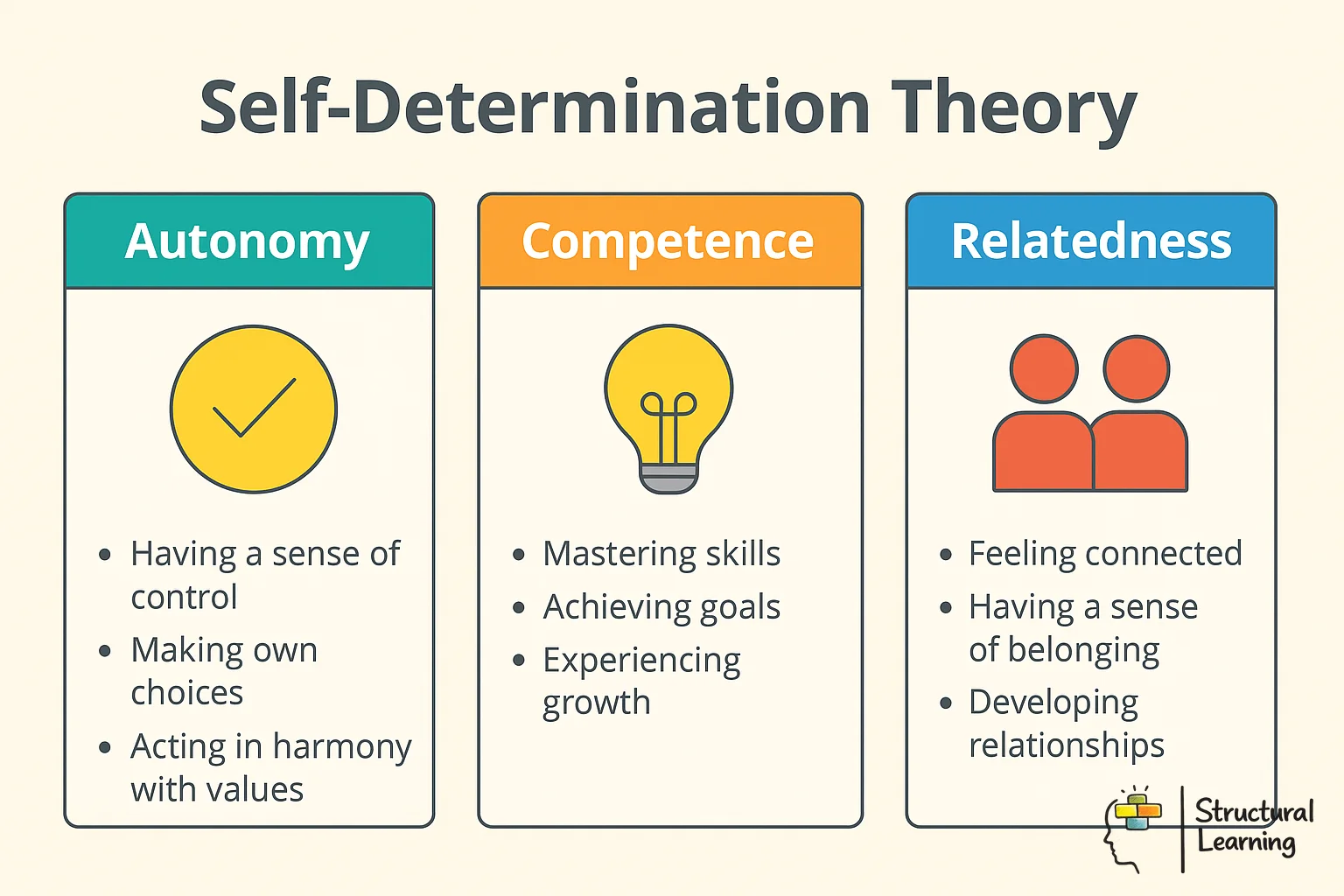
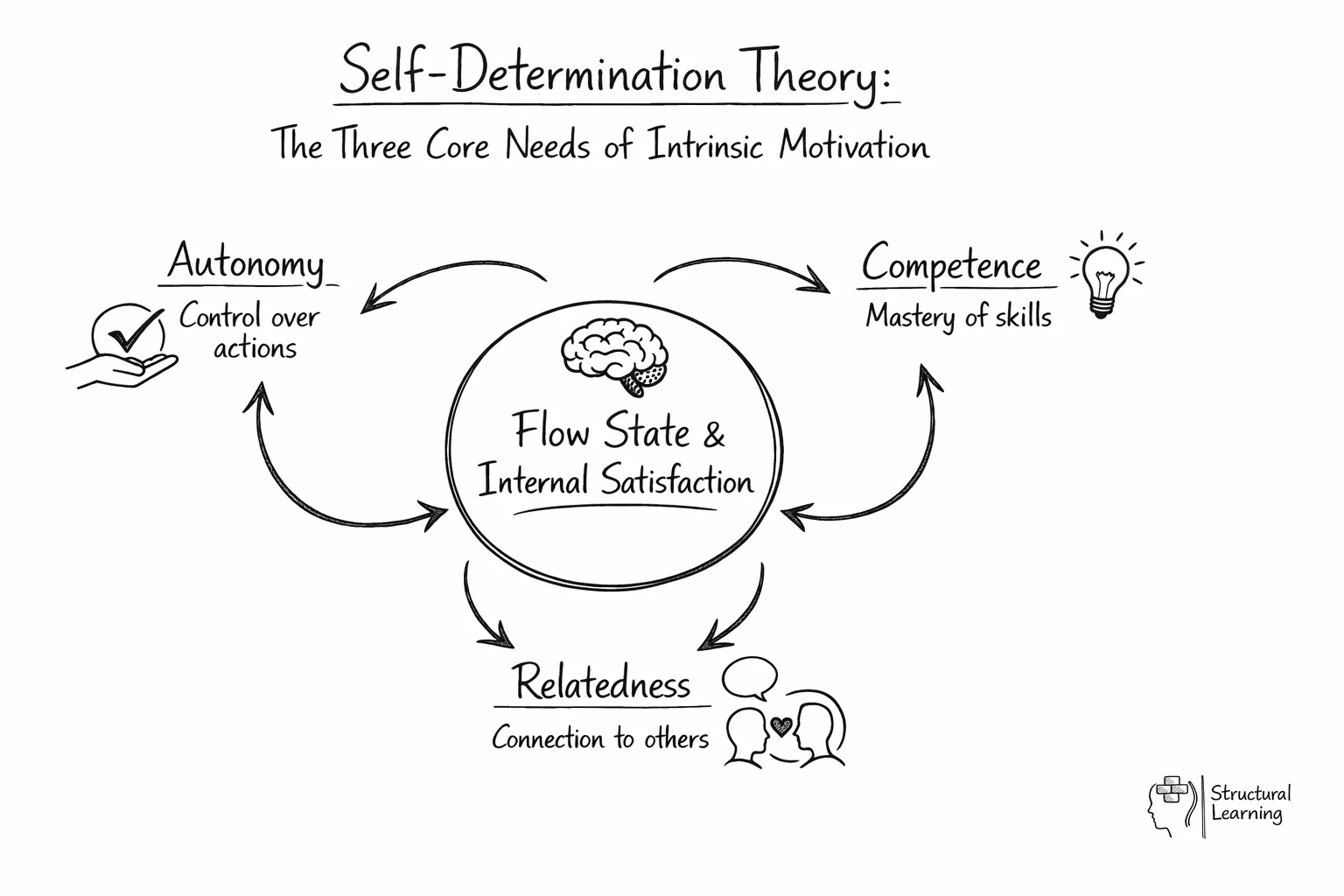
Self-determination theory names three psychological needs behind intrinsic motivation (Deci & Ryan, 1985). Autonomy is the sense that the action is your own. Competence is the sense of getting better at something. Relatedness is the sense of mattering to the people in the room.
Meet all three and motivation keeps itself going. Undercut any one of them and it does not.
Deci's (1971) experiments in the Journal of Personality and Social Psychology broke with behaviourism by showing that paying people to solve puzzles they already enjoyed reduced how long they kept working on those puzzles once the payment stopped. He described the shift as a move in perceived locus of causality, from internal to external. The learner stops experiencing the work as their own.
Ryan joined Deci in the 1980s and the two built self-determination theory around that finding. The theory now spans six mini-theories. Cognitive evaluation theory is the one teachers meet daily: it explains how a single event, such as a piece of feedback, is read as either informational or controlling, and that reading decides whether motivation rises or falls (Deci & Ryan, 1985).
The idea is older than self-determination theory. Dember and Earl (1957), Berlyne (1960) and Hunt (1965) described an optimal incongruity. Attention and effort rise when new material sits a little beyond what the learner already expects. They fall away when the material is either too familiar or impossible to make sense of.
Csikszentmihalyi (1990) later gave the same relationship its better-known shape: the balance of challenge and skill that sits behind flow.
White (1959) called the underlying urge effectance motivation, the satisfaction of having an effect on the environment, and Reeve (1996) showed that teachers can either support or suppress it inside a single lesson. The classroom version of this is unglamorous. A teacher who returns a piece of writing with a grade and the comment "more detail needed" has given no information. A teacher who circles one sentence and asks what a reader would still not know has given the learner something to do, and doing it is the reward (Deci & Ryan, 1985; Dweck, 2006).
The question then becomes how this translates to a class of thirty. It comes down to designing a learning environment that supplies autonomy, competence and relatedness without giving up structure.
Offer meaningful choice inside their learning activities. Not whether to work, but which of three sources to analyse, which method to use, or how to present the result. A Year 7 class given three routes into the same historical question still covers the same content, and the learners own the route. Ownership is what makes the effort feel theirs, and learners who feel that ownership are far more likely to be intrinsically motivated.
Build mastery deliberately. Break complex tasks into steps small enough that progress is visible inside the lesson, give feedback that names the specific improvement rather than the standard, and allow redrafting for full credit after practice and revision. Learners who can see themselves getting better will persist through difficulty. Learners who only see a grade have nothing to persist towards.
Then attend to community and connection in the classroom. Structured pair talk before whole-class questioning, shared responsibility for a group outcome, and the habit of using learners' contributions by name all raise relatedness. A learner who expects to be listened to takes more risks with an answer.
Project and inquiry approaches can carry all three needs at once. That only holds where learners already have the knowledge the task assumes. Kirschner, Sweller and Clark (2006) set out the case against minimally guided instruction for novices.
The two positions do reconcile. Give learners autonomy over how they approach a task and which examples they use. Keep worked examples and explicit instruction for anything they are meeting for the first time (Ryan & Deci, 2000).
Each of these maps onto autonomy, competence or relatedness. None of them requires a new policy. Use it as a starting point for professional discussion: identify the learner's current need, record evidence from more than one lesson, and agree the next classroom adjustment with the SENCO or family.
"Do learners with ADHD have intrinsic motivation?" is one of the most common questions asked about this topic, and the honest answer is yes, often in unusually concentrated form. What differs is not the presence of internal drive but its regulation.
Barkley's (1997) model puts the difficulty in behavioural inhibition and executive function, not in wanting. In other words, the problem is with holding back and planning, not with desire.
Sonuga-Barke (2003) adds a second route, delay aversion, where far-off rewards lose their pull much faster than they do for other learners. Hupfeld, Abagis and Shah (2019) show the other side of the same coin: long stretches of hyperfocus on tasks the learner finds genuinely interesting.
The classroom consequences are specific. Extending a deadline rarely helps, because the obstacle is not the time available but how far away the payoff feels. Break the task into steps that each end in something finished.
A Year 9 learner writing a source analysis does better with four ten-minute segments, each closed by a visible outcome, than with one forty-minute block. Offer choice within the task rather than choice about whether to start it, since open-ended choice adds a decision cost that executive function has to pay. And treat hyperfocus as a resource to route work through, not a behaviour to interrupt.
This presents a distinct challenge for 2026. Intrinsic motivation in learning depends on effort that pays off, which is why Bjork and Bjork (2011) describe certain difficulties as desirable: the struggle is what produces the sense of competence. Generative AI removes the struggle without removing the output. A learner who prompts their way to a finished essay holds the artefact and none of the internal reward that normally attaches to having made it.
The practical response is to move the assessed effort to where a model cannot stand in for it. Ask for the reasoning behind a rejected draft, the annotated changes between versions, the question the learner still could not answer. Mark the process alongside the product and the competence signal returns.
The theory is well evidenced, but it will not tell you what to do on Tuesday. One change does. Use it as a starting point for professional discussion: identify the learner's current need, record evidence from more than one lesson, and agree the next classroom adjustment with the SENCO or family.
Pick one task in your next lesson and change what the reward communicates. Instead of awarding a point for completion, name the specific thing that improved and ask the learner what they will do with it next. That single move shifts the signal from control to competence, which is the mechanism the whole literature turns on (Deci & Ryan, 1985; Howard et al., 2021).
Three caveats matter before this theory reshapes a scheme of work. Use it as a starting point for professional discussion: identify the learner's current need, record evidence from more than one lesson, and agree the next classroom adjustment with the SENCO or family.
First, the autonomy claim collides with cognitive architecture. Sweller, van Merriënboer and Paas (2019) show that novices working without guidance load working memory with search rather than with learning, which means unguided choice can starve the very competence need that autonomy is meant to feed. Autonomy over method is safe. Autonomy over content a learner cannot yet navigate is not.
Second, much of the founding evidence comes from short laboratory studies with undergraduates using free-choice behavioural measures, not from year-long classroom trials with mixed-attainment groups working under accountability pressure. Effect sizes drawn from those settings should be read as directional rather than as a dosage.
Third, autonomy support has been studied most heavily in individualist Western samples. Evidence from collectivist contexts suggests the underlying need is real but that what reads as autonomy-supportive differs, so importing a strategy without adapting it to the class in front of you carries a risk worth naming.
These studies provide deeper insights into intrinsic motivation and its role in learning.
Self-Determination Theory and the Facilitation of Intrinsic Motivation 38,534 citations
Ryan, R. M. and Deci, E. L. (2000)
Deci and Ryan (1985) found intrinsic motivation needs autonomy, competence, and relatedness. External rewards can hurt motivation if learners see them as controlling, noted Ryan and Deci (2000). Teachers boost motivation with good choices, suitable tasks, and strong relationships (Deci et al., 1991).
Intrinsic and Extrinsic Motivations: Classic Definitions and New Directions 17,553 citations
Ryan, R. M. and Deci, E. L. (2000)
Ryan and Deci (2000) propose a motivation continuum. It ranges from amotivation through extrinsic to intrinsic motivation. Teachers can help learners internalise learning's value (Ryan & Deci, 2000). This makes even dull tasks meaningful over time.
Punished by Rewards: The Trouble with Gold Stars 1,361 citations
Kohn, A. (1993)
Kohn's research (decades' worth) shows extrinsic rewards usually reduce learners' intrinsic motivation. The book suggests involving learners in choices and giving feedback. Teachers can also link learning to learners' interests (Kohn, various dates).
Flow: The Psychology of Optimal Experience 6,242 citations
Csikszentmihalyi, M. (1990)
Csikszentmihalyi's research identifies the conditions under which people become deeply absorbed in activities for their own sake. The "flow" state requires clear goals, immediate feedback, and a balance between challenge and skill. Teachers can create conditions for flow by ensuring tasks are neither too easy (causing boredom) nor too difficult (causing anxiety), and by providing clear success criteria.
Why We Do What We Do: Understanding Self-Motivation 687 citations
Deci, E. L. (1995)
Deci's theory shows controlling settings harm learner motivation, yet autonomy helps it. Teachers can use this, as Deci (various dates) shows, to check their methods. Classrooms either support or hinder learners' natural drive to learn.
Ryan and Deci (2000) found intrinsically motivated learners persevere with challenging tasks. Learners ask questions from curiosity, not just for grades, said Vallerand (1997). Deci, Koestner and Ryan (1999) noted learners work beyond the required time. Reeve (2012) suggests they engage more in open-ended activities and dislike the end of interesting lessons.
Learners work better when they get some choice over their tasks. Link the learning to their interests and to the world outside school. Set challenges that stretch them without being too hard.
Let learners rework an assignment until they master it. Keep your feedback focused on the learning itself (Deci & Ryan, 2000; Dweck, 2006).
Deci and Ryan's (1985) Self Determination Theory highlights this. Use extrinsic rewards to boost engagement, suggest Reeve (2002) and Cameron and Pierce (1994). Slowly lower reliance as learners find value in progress, say Ryan and Deci (2000). Shift focus to growth, contributing, and competence, advise Lepper et al (1973).
Watch what learners do in free choice time, and note who carries on working when it is optional. Listen for the questions they ask on their own, and look for learners sharing what they have learned.
Watch, too, for frustration when you interrupt them (Deci & Ryan, 1985). Notice who keeps going through a challenge without being prompted (Dweck, 2006; Duckworth, 2016).
Intrinsic motivation benefits learners of all ages, but adapt your methods. Young learners are naturally curious. Older learners need clear links to their identity and goals (Ryan & Deci, 2000). Adult learners respond to autonomy and relevant tasks (Knowles, 1980), which builds on experience.
Open a free account and help organise learners' thinking with evidence-based graphic organisers. Reduce cognitive load and guide schema building dynamically.
Csikszentmihalyi (1990).
Deci et al. (1991).
Knowles (1980).