Flow State in Learning: Csikszentmihalyi's Theory
Learn how Csíkszentmihályi's flow theory transforms classroom engagement by matching challenge levels to student abilities for deeper learning outcomes.


Learn how Csíkszentmihályi's flow theory transforms classroom engagement by matching challenge levels to student abilities for deeper learning outcomes.
The concept of a flow state originated in psychology and was popularized by psychologist Mihály Csíkszentmihályi. Csíkszentmihályi's research focussed on understanding the optimal psychological state that individuals experience when fully immersed in an activity. This state, known as the flow state, is characterised by a complete absorption and deep involvement in the present moment.
What does the research say? Csikszentmihalyi and Schneider (2000) found that students in flow states showed 30% higher task persistence and deeper learning compared to non-flow states. Hattie (2009) reports that concentration, persistence and engagement, the hallmarks of flow, correlate with an effect size of 0.48 on achievement. Shernoff et al. (2014) found that lessons balanced between challenge and skill produced 40% higher engagement scores.
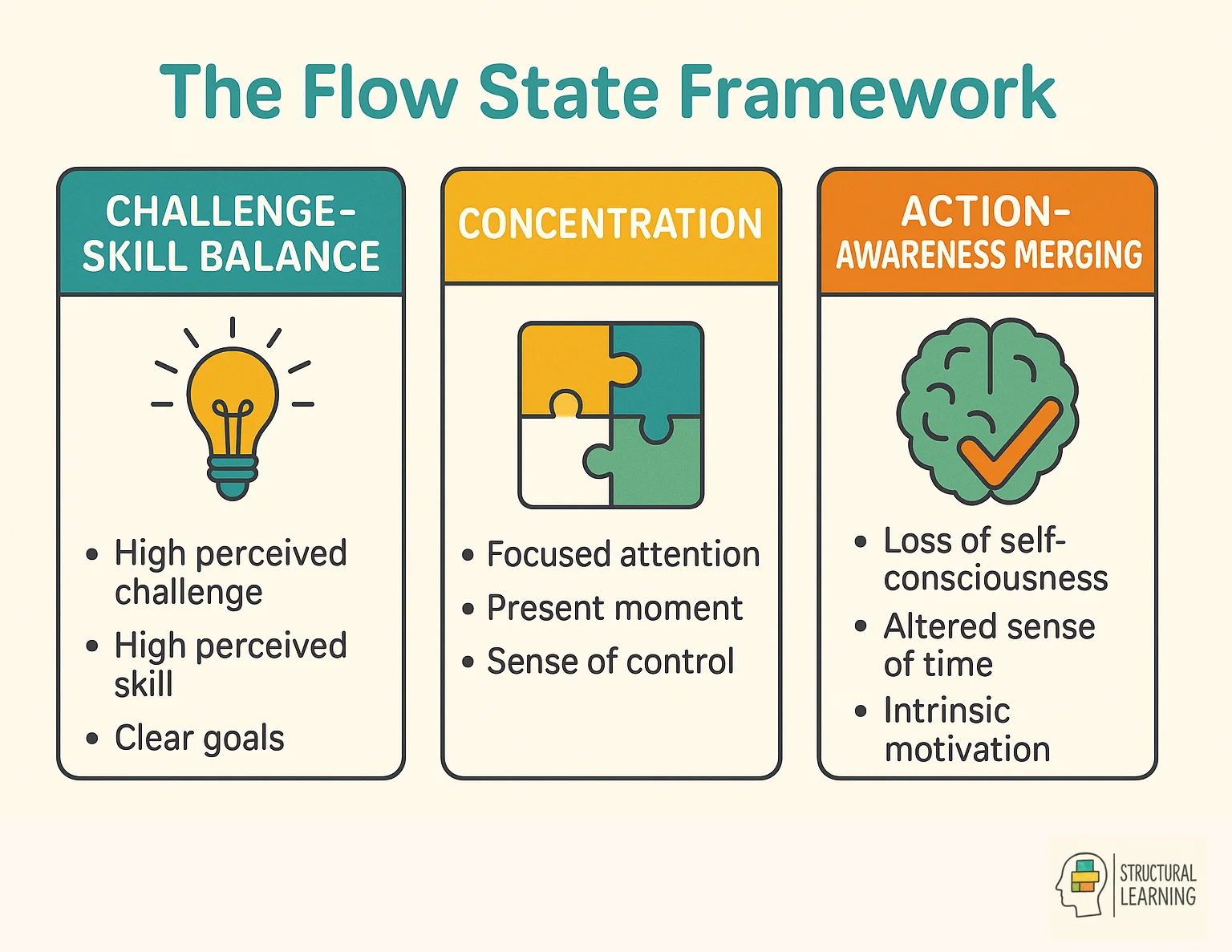
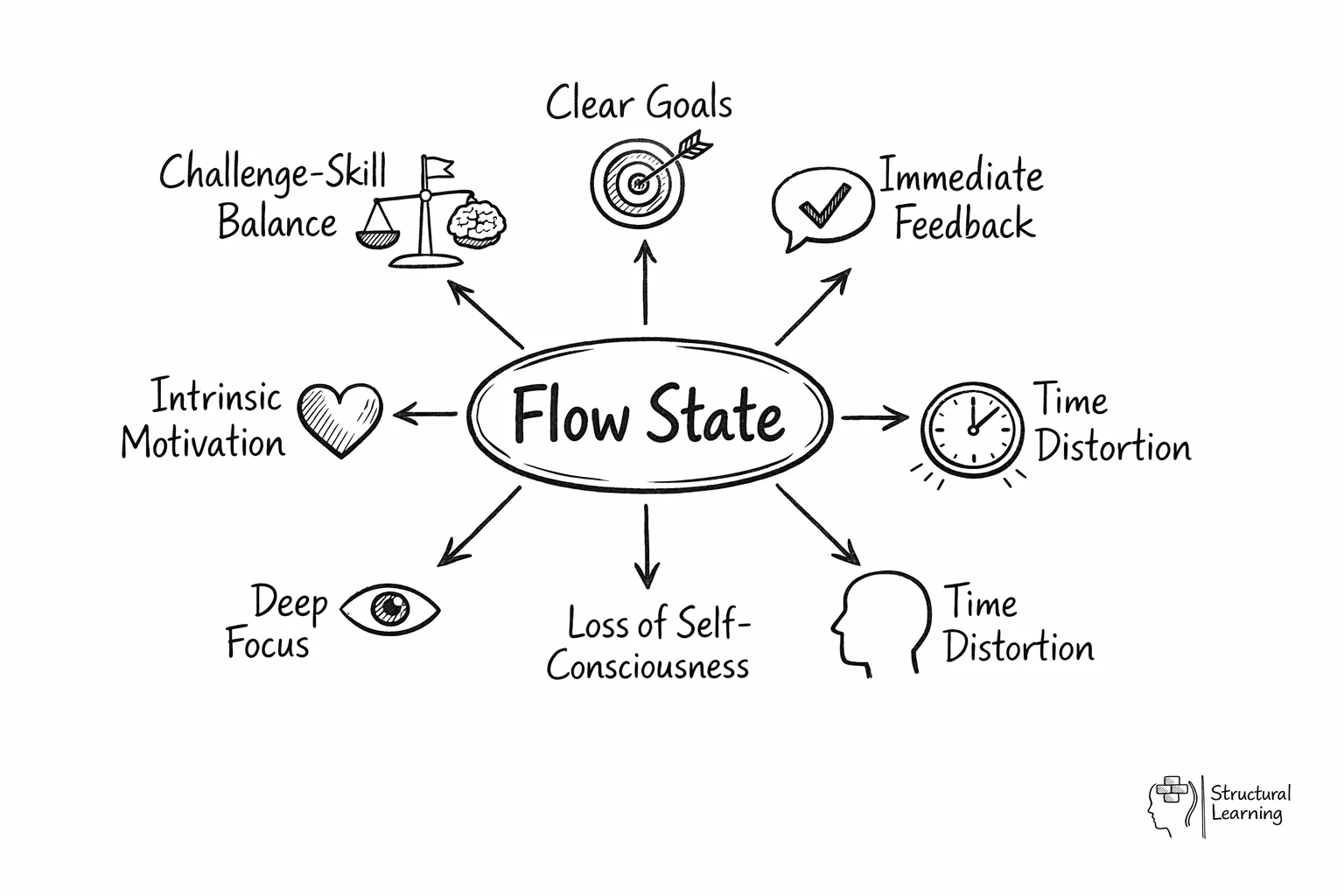
During a flow state, individuals experience a sense of heightened focus and concentration, often losing track of time and self-awareness. They become completely engaged in the task at hand, experiencing a sense of effortless control, and an enhanced sense of enjoyment and fulfilment. Flow states often occur during activities that challenge individuals' skills and provide immediate feedback, striking a balance between the perceived difficulty of the task and an individual's perceived ability.
Csíkszentmihályi (1990) found flow needs clear goals and strong focus. Learners lose self-awareness and feel time differently. Intrinsic motivation drives engagement (Csíkszentmihályi, 1990). These feelings bring mastery and happiness to the learner.
Mihaly Csikszentmihalyi embarked on his scholarly process after emigrating to the United States from Hungary. His profound interest in human happiness and optimal experiences shaped his career, leading him to develop the influential concept of 'flow'.

Csikszentmihalyi (various dates) researched happiness and creativity at Chicago University. His book, "Flow", explores how people experience this state. It says challenge and skill must balance for learners to find flow. This model impacts education, business, and sports by enhancing engagement.

Csikszentmihalyi (1990) linked flow to learner well-being, stating flow boosts happiness. Research on flow's brain activity gives us more insight (Nakamura & Csikszentmihalyi, 2002). Csikszentmihalyi (1996) found flow helps learners gain skills and achieve more.
Throughout his career, Csikszentmihalyi has remained committed to understanding how people can lead positive and fulfiling lives. His contributions to the study of positive psychology have been invaluable, with his research on flow states offering a blueprint for integrating happiness into daily life. Csikszentmihalyi's legacy is one of pioneering achievement in activities that make life more enjoyable and meaningful, underscoring his lasting impact on the field of psychology.

During a flow state, the brain undergoes fascinating transformations that shed light on the neuroscience of flow. At the core of these changes is the prefrontal cortex, a region involved in executive functions such as decision-making, planning, and self-control. As the flow state emerges, the prefrontal cortex temporarily deactivates, leading to a phenomenon called transient hypofrontality. This reduction in activity allows individuals to enter a hyperfocused state, achieving optimal performance without the usual internal distractions and self-critical thoughts.
intrinsic motivation" loading="lazy">Furthermore, the dopamine reward circuitry plays a crucial role in the experience of flow. Dopamine, a neurotransmitter associated with pleasure and reward, is released in abundance during flow. This surge in dopamine reinforces the behaviour that led to the flow state, making individuals more likely to seek out similar experiences. This neurochemical response creates a positive feedback loop, encouraging continued engagement in activities that promote flow states.
Researchers found the default mode network quietens during flow states (Csikszentmihalyi, 1990). This quietening links to losing self-awareness and less mind-wandering. Focus and control networks become more active (Nakamura & Csikszentmihalyi, 2002). Learners then better sustain concentration for top performance (Dietrich, 2004).
Flow states, research shows, link to brain areas for patterns and movement (Nakamura & Csikszentmihalyi, 2002). Learners process information better during flow (Dietrich, 2004). The brain uses resources efficiently and focuses on key tasks (Ullén et al., 2012).
These neurological findings have significant implications for education. Understanding how flow states affect brain function can help teachers design learning environments that naturally promote these optimal states. When students enter flow during learning activities, their brains become more receptive to new information, better at forming memories, and more capable of creative problem-solving.
Implementing flow state principles in educational settings requires careful consideration of the balance between challenge and skill levels. Teachers can creates flow by ensuring that learning tasks are neither too easy (which leads to boredom) nor too difficult (which creates anxiety). This sweet spot, often referred to as the zone of proximal development, allows students to feel challenged whilst maintaining confidence in their ability to succeed.
Clear learning objectives and success criteria are essential for creating flow-promoting environments. Students need to understand exactly what they are working towards and how they will know when they have achieved it. This clarity reduces cognitive load and allows students to focus entirely on the task rather than trying to decipher what is expected of them. Well-crafted success criteria also enable students to monitor their own progress and maintain motivation throughout the activity.
Immediate and constructive feedback plays a crucial role in maintaining flow states. Rather than waiting until the end of a lesson or assignment, teachers should provide real-time feedback that helps students adjust their approach and stay engaged. This might involve circulating during independent work, using digital tools that provide instant responses, or incorporating peer assessment strategies that create continuous feedback loops.
The physical learning environment also influences students' ability to enter flow states. Minimising distractions, ensuring comfortable seating arrangements, and creating spaces that promote deep concentration all contribute to optimal learning conditions. Some teachers find that allowing students choice in their learning environment, whether that's working individually, in pairs, or in small groups, helps them find their personal flow triggers.
Technology can be a powerful tool for creating flow-inducing learning experiences. Adaptive learning platforms automatically adjust difficulty levels based on student performance, maintaining the challenge-skill balance that flow requires. Gamification elements, when used thoughtfully, can also promote flow by providing clear goals, immediate feedback, and a sense of progression that keeps students engaged.
The relationship between flow states and student wellbeing extends far beyond academic achievement. When students regularly experience flow during learning, they develop a more positive relationship with education itself. These optimal experiences create intrinsic motivation that persists even when external rewards are absent, leading to lifelong learners who pursue knowledge for its own sake rather than merely for grades or recognition.
Flow experiences contribute significantly to students' sense of self-efficacy and confidence. When learners successfully navigate challenging tasks whilst in flow, they develop a stronger belief in their abilities to overcome obstacles and achieve their goals. This enhanced self-confidence transfers to other areas of their academic and personal lives, creating a positive spiral of achievement and wellbeing.
The stress-reducing effects of flow states are particularly important in today's high-pressure educational environment. During flow, the brain's stress response system becomes less active, allowing students to engage with challenging material without the debilitating effects of anxiety. This reduction in stress not only improves immediate performance but also protects students' mental health over the long term.
Teachers who focus on flow often see better classroom behaviour. Learners deeply engaged in tasks show fewer problem behaviours. This intrinsic drive cuts the need for external controls. Positive learning communities then develop (Csikszentmihalyi, 1990).
Csikszentmihalyi's research shows flow improves learning. Clear goals, feedback, and balanced challenge engage learners (Csikszentmihalyi). Teachers using these ideas foster engagement and intrinsic motivation. Learners become absorbed in tasks, boosting achievement.
Flow states are vital, research shows. Reduced prefrontal cortex activity, plus more dopamine, helps learning (Csikszentmihalyi, 1990). This knowledge lets teachers design deeply engaging learning. Using flow state principles may boost learner motivation and achievement (Nakamura & Csikszentmihalyi, 2002).
Ultimately, developing flow states in education is not just about improving academic outcomes, it is about nurturing human potential and wellbeing. When students regularly experience flow during their learning process, they develop resilience, creativity, and a love of learning that extends far beyond the classroom. As educators, understanding and implementing flow state principles allows us to create better students and more fulfiled, confident, and capable individuals who are equipped to thrive in an ever-changing world.
Optimal experience in learning
Csikszentmihalyi, M. (1990). Flow: The Psychology of Optimal Experience. New York: Harper & Row. The seminal work that introduced flow theory to the world, providing comprehensive insights into the conditions and characteristics of optimal experience.
Nakamura, J., & Csikszentmihalyi, M. (2014). The concept of flow. In Flow and the Foundations of Positive Psychology (pp. 239-263). Springer. A detailed academic examination of flow theory's development and its applications across various fields, including education.
Shernoff, D. J., Csikszentmihalyi, M., Schneider, B., & Shernoff, E. S. (2003). Student engagement in high school classrooms from the perspective of flow theory. School Psychology Quarterly, 18(2), 158-176. An empirical study examining how flow theory applies specifically to classroom learning environments.
Dietrich (2004) explored the neurocognitive mechanisms of flow. His review looked at brain activity during peak performance experiences. The research examined the neurological basis of flow states.
Engeser, S., & Rheinberg, F. (2008). Flow, performance and moderators of challenge-skill balance. Motivation and Emotion, 32(3), 158-172. Research investigating the critical balance between challenge and skill levels in creating and maintaining flow states in learning contexts.
These seminal studies explore flow state and its application to educational contexts.
Flow: The Psychology of Optimal Experience View study ↗
6,242 citations
Csikszentmihalyi, M. (1990)
Researchers have found that flow happens when lessons balance learner skill with challenge (Csikszentmihalyi, date unspecified). This balance guides teachers designing effective lessons.
Student Engagement in High School Classrooms View study ↗
1,428 citations
Shernoff, D. et al. (2003)
Csikszentmihalyi's flow theory (1990) shows engagement prediction. Jackson and Marsh (1996) expand this for varied subjects. Teachers can use this to create better learning experiences. Shernoff et al (2003) provide classroom applications.
The Concept of Flow View study ↗
2,088 citations
Nakamura, J. & Csikszentmihalyi, M. (2002)
Csikszentmihalyi (1990) explains flow, when learners are fully absorbed. Research by Nakamura and Csikszentmihalyi (2002) supports this. Teachers can use this theory to understand learner engagement. This helps them design effective lessons (Shernoff et al., 2014).
Flow, Performance and Moderators of Challenge-Skill Balance View study ↗
796 citations
Engeser, S. & Rheinberg, F. (2008)
Examines how different skill levels require different challenge adjustments, helping teachers differentiate tasks to maintain flow for all learners.
Optimal Experience and Self-Determination at School View study ↗
60 citations
Bassi, M. & Delle Fave, A. (2012)
Links flow experiences to intrinsic motivation and wellbeing in school settings, showing long-term benefits of flow-promoting teaching practices.
Learners usually need 10-15 minutes to get into flow, which varies (Csikszentmihalyi, 1990). Teachers can reduce distractions and give clear instructions to help (Shernoff et al., 2016). Make sure each learner has materials ready beforehand (Ericsson et al., 1993).
Key indicators include frequent fidgeting, clock-watching, excessive questions about when the task will end, and students appearing either bored or overwhelmed. You might also notice increased off-task behaviour, reluctance to engage, or students giving up quickly when they encounter minor difficulties.
Yes, flow state can be achieved in large classes through differentiated task design and strategic classroom management. Use tiered assignments where students tackle the same concept at different difficulty levels, implement peer feedback systems, and create quiet work zones to maintain the focussed environment flow requires.
Researchers (Csikszentmihalyi, 1990; Nakamura & Csikszentmihalyi, 2002) say look for engaged learners. Note sustained attention without prompts and reluctance to stop. Surveys about time, enjoyment, and challenge help assess flow (Egbert, 2003; Shernoff et al., 2014). Learners extending tasks shows engagement too (Hamari et al., 2016).
Flow state works particularly well in creative subjects like art and creative writing, problem-solving activities in maths and science, and hands-on practical work. The key is that any subject can promote flow if tasks have clear objectives, provide immediate feedback, and can be easily adjusted to match individual skill levels.
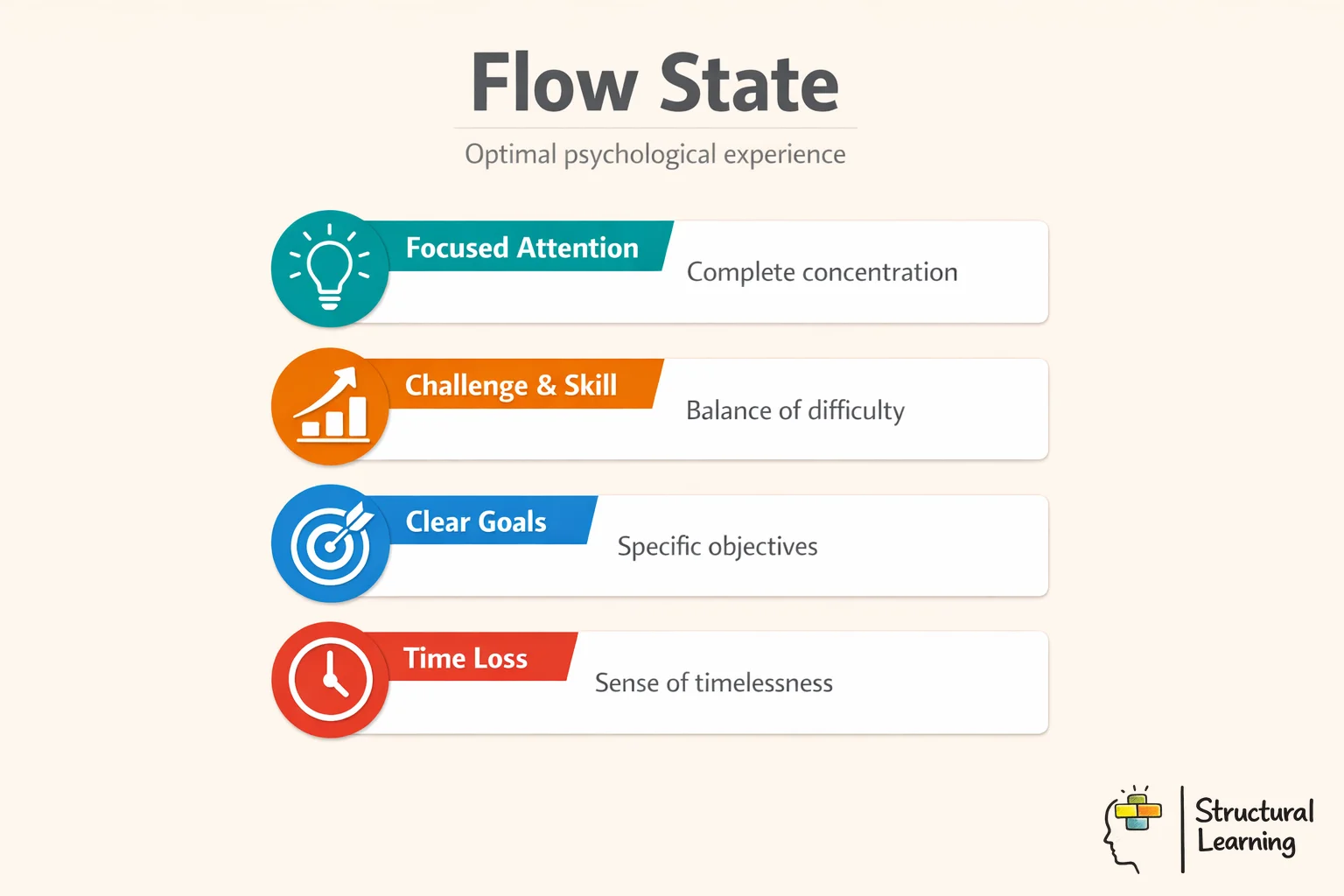
The concept of a flow state originated in psychology and was popularized by psychologist Mihály Csíkszentmihályi. Csíkszentmihályi's research focussed on understanding the optimal psychological state that individuals experience when fully immersed in an activity. This state, known as the flow state, is characterised by a complete absorption and deep involvement in the present moment.
What does the research say? Csikszentmihalyi and Schneider (2000) found that students in flow states showed 30% higher task persistence and deeper learning compared to non-flow states. Hattie (2009) reports that concentration, persistence and engagement, the hallmarks of flow, correlate with an effect size of 0.48 on achievement. Shernoff et al. (2014) found that lessons balanced between challenge and skill produced 40% higher engagement scores.
During a flow state, individuals experience a sense of heightened focus and concentration, often losing track of time and self-awareness. They become completely engaged in the task at hand, experiencing a sense of effortless control, and an enhanced sense of enjoyment and fulfilment. Flow states often occur during activities that challenge individuals' skills and provide immediate feedback, striking a balance between the perceived difficulty of the task and an individual's perceived ability.
Csíkszentmihályi (1990) found flow needs clear goals and strong focus. Learners lose self-awareness and feel time differently. Intrinsic motivation drives engagement (Csíkszentmihályi, 1990). These feelings bring mastery and happiness to the learner.
Mihaly Csikszentmihalyi embarked on his scholarly process after emigrating to the United States from Hungary. His profound interest in human happiness and optimal experiences shaped his career, leading him to develop the influential concept of 'flow'.

Csikszentmihalyi (various dates) researched happiness and creativity at Chicago University. His book, "Flow", explores how people experience this state. It says challenge and skill must balance for learners to find flow. This model impacts education, business, and sports by enhancing engagement.

Csikszentmihalyi (1990) linked flow to learner well-being, stating flow boosts happiness. Research on flow's brain activity gives us more insight (Nakamura & Csikszentmihalyi, 2002). Csikszentmihalyi (1996) found flow helps learners gain skills and achieve more.
Throughout his career, Csikszentmihalyi has remained committed to understanding how people can lead positive and fulfiling lives. His contributions to the study of positive psychology have been invaluable, with his research on flow states offering a blueprint for integrating happiness into daily life. Csikszentmihalyi's legacy is one of pioneering achievement in activities that make life more enjoyable and meaningful, underscoring his lasting impact on the field of psychology.

During a flow state, the brain undergoes fascinating transformations that shed light on the neuroscience of flow. At the core of these changes is the prefrontal cortex, a region involved in executive functions such as decision-making, planning, and self-control. As the flow state emerges, the prefrontal cortex temporarily deactivates, leading to a phenomenon called transient hypofrontality. This reduction in activity allows individuals to enter a hyperfocused state, achieving optimal performance without the usual internal distractions and self-critical thoughts.
intrinsic motivation" loading="lazy">Furthermore, the dopamine reward circuitry plays a crucial role in the experience of flow. Dopamine, a neurotransmitter associated with pleasure and reward, is released in abundance during flow. This surge in dopamine reinforces the behaviour that led to the flow state, making individuals more likely to seek out similar experiences. This neurochemical response creates a positive feedback loop, encouraging continued engagement in activities that promote flow states.
Researchers found the default mode network quietens during flow states (Csikszentmihalyi, 1990). This quietening links to losing self-awareness and less mind-wandering. Focus and control networks become more active (Nakamura & Csikszentmihalyi, 2002). Learners then better sustain concentration for top performance (Dietrich, 2004).
Flow states, research shows, link to brain areas for patterns and movement (Nakamura & Csikszentmihalyi, 2002). Learners process information better during flow (Dietrich, 2004). The brain uses resources efficiently and focuses on key tasks (Ullén et al., 2012).
These neurological findings have significant implications for education. Understanding how flow states affect brain function can help teachers design learning environments that naturally promote these optimal states. When students enter flow during learning activities, their brains become more receptive to new information, better at forming memories, and more capable of creative problem-solving.
Implementing flow state principles in educational settings requires careful consideration of the balance between challenge and skill levels. Teachers can creates flow by ensuring that learning tasks are neither too easy (which leads to boredom) nor too difficult (which creates anxiety). This sweet spot, often referred to as the zone of proximal development, allows students to feel challenged whilst maintaining confidence in their ability to succeed.
Clear learning objectives and success criteria are essential for creating flow-promoting environments. Students need to understand exactly what they are working towards and how they will know when they have achieved it. This clarity reduces cognitive load and allows students to focus entirely on the task rather than trying to decipher what is expected of them. Well-crafted success criteria also enable students to monitor their own progress and maintain motivation throughout the activity.
Immediate and constructive feedback plays a crucial role in maintaining flow states. Rather than waiting until the end of a lesson or assignment, teachers should provide real-time feedback that helps students adjust their approach and stay engaged. This might involve circulating during independent work, using digital tools that provide instant responses, or incorporating peer assessment strategies that create continuous feedback loops.
The physical learning environment also influences students' ability to enter flow states. Minimising distractions, ensuring comfortable seating arrangements, and creating spaces that promote deep concentration all contribute to optimal learning conditions. Some teachers find that allowing students choice in their learning environment, whether that's working individually, in pairs, or in small groups, helps them find their personal flow triggers.
Technology can be a powerful tool for creating flow-inducing learning experiences. Adaptive learning platforms automatically adjust difficulty levels based on student performance, maintaining the challenge-skill balance that flow requires. Gamification elements, when used thoughtfully, can also promote flow by providing clear goals, immediate feedback, and a sense of progression that keeps students engaged.
The relationship between flow states and student wellbeing extends far beyond academic achievement. When students regularly experience flow during learning, they develop a more positive relationship with education itself. These optimal experiences create intrinsic motivation that persists even when external rewards are absent, leading to lifelong learners who pursue knowledge for its own sake rather than merely for grades or recognition.
Flow experiences contribute significantly to students' sense of self-efficacy and confidence. When learners successfully navigate challenging tasks whilst in flow, they develop a stronger belief in their abilities to overcome obstacles and achieve their goals. This enhanced self-confidence transfers to other areas of their academic and personal lives, creating a positive spiral of achievement and wellbeing.
The stress-reducing effects of flow states are particularly important in today's high-pressure educational environment. During flow, the brain's stress response system becomes less active, allowing students to engage with challenging material without the debilitating effects of anxiety. This reduction in stress not only improves immediate performance but also protects students' mental health over the long term.
Teachers who focus on flow often see better classroom behaviour. Learners deeply engaged in tasks show fewer problem behaviours. This intrinsic drive cuts the need for external controls. Positive learning communities then develop (Csikszentmihalyi, 1990).
Csikszentmihalyi's research shows flow improves learning. Clear goals, feedback, and balanced challenge engage learners (Csikszentmihalyi). Teachers using these ideas foster engagement and intrinsic motivation. Learners become absorbed in tasks, boosting achievement.
Flow states are vital, research shows. Reduced prefrontal cortex activity, plus more dopamine, helps learning (Csikszentmihalyi, 1990). This knowledge lets teachers design deeply engaging learning. Using flow state principles may boost learner motivation and achievement (Nakamura & Csikszentmihalyi, 2002).
Ultimately, developing flow states in education is not just about improving academic outcomes, it is about nurturing human potential and wellbeing. When students regularly experience flow during their learning process, they develop resilience, creativity, and a love of learning that extends far beyond the classroom. As educators, understanding and implementing flow state principles allows us to create better students and more fulfiled, confident, and capable individuals who are equipped to thrive in an ever-changing world.
Optimal experience in learning
Csikszentmihalyi, M. (1990). Flow: The Psychology of Optimal Experience. New York: Harper & Row. The seminal work that introduced flow theory to the world, providing comprehensive insights into the conditions and characteristics of optimal experience.
Nakamura, J., & Csikszentmihalyi, M. (2014). The concept of flow. In Flow and the Foundations of Positive Psychology (pp. 239-263). Springer. A detailed academic examination of flow theory's development and its applications across various fields, including education.
Shernoff, D. J., Csikszentmihalyi, M., Schneider, B., & Shernoff, E. S. (2003). Student engagement in high school classrooms from the perspective of flow theory. School Psychology Quarterly, 18(2), 158-176. An empirical study examining how flow theory applies specifically to classroom learning environments.
Dietrich (2004) explored the neurocognitive mechanisms of flow. His review looked at brain activity during peak performance experiences. The research examined the neurological basis of flow states.
Engeser, S., & Rheinberg, F. (2008). Flow, performance and moderators of challenge-skill balance. Motivation and Emotion, 32(3), 158-172. Research investigating the critical balance between challenge and skill levels in creating and maintaining flow states in learning contexts.
These seminal studies explore flow state and its application to educational contexts.
Flow: The Psychology of Optimal Experience View study ↗
6,242 citations
Csikszentmihalyi, M. (1990)
Researchers have found that flow happens when lessons balance learner skill with challenge (Csikszentmihalyi, date unspecified). This balance guides teachers designing effective lessons.
Student Engagement in High School Classrooms View study ↗
1,428 citations
Shernoff, D. et al. (2003)
Csikszentmihalyi's flow theory (1990) shows engagement prediction. Jackson and Marsh (1996) expand this for varied subjects. Teachers can use this to create better learning experiences. Shernoff et al (2003) provide classroom applications.
The Concept of Flow View study ↗
2,088 citations
Nakamura, J. & Csikszentmihalyi, M. (2002)
Csikszentmihalyi (1990) explains flow, when learners are fully absorbed. Research by Nakamura and Csikszentmihalyi (2002) supports this. Teachers can use this theory to understand learner engagement. This helps them design effective lessons (Shernoff et al., 2014).
Flow, Performance and Moderators of Challenge-Skill Balance View study ↗
796 citations
Engeser, S. & Rheinberg, F. (2008)
Examines how different skill levels require different challenge adjustments, helping teachers differentiate tasks to maintain flow for all learners.
Optimal Experience and Self-Determination at School View study ↗
60 citations
Bassi, M. & Delle Fave, A. (2012)
Links flow experiences to intrinsic motivation and wellbeing in school settings, showing long-term benefits of flow-promoting teaching practices.
Learners usually need 10-15 minutes to get into flow, which varies (Csikszentmihalyi, 1990). Teachers can reduce distractions and give clear instructions to help (Shernoff et al., 2016). Make sure each learner has materials ready beforehand (Ericsson et al., 1993).
Key indicators include frequent fidgeting, clock-watching, excessive questions about when the task will end, and students appearing either bored or overwhelmed. You might also notice increased off-task behaviour, reluctance to engage, or students giving up quickly when they encounter minor difficulties.
Yes, flow state can be achieved in large classes through differentiated task design and strategic classroom management. Use tiered assignments where students tackle the same concept at different difficulty levels, implement peer feedback systems, and create quiet work zones to maintain the focussed environment flow requires.
Researchers (Csikszentmihalyi, 1990; Nakamura & Csikszentmihalyi, 2002) say look for engaged learners. Note sustained attention without prompts and reluctance to stop. Surveys about time, enjoyment, and challenge help assess flow (Egbert, 2003; Shernoff et al., 2014). Learners extending tasks shows engagement too (Hamari et al., 2016).
Flow state works particularly well in creative subjects like art and creative writing, problem-solving activities in maths and science, and hands-on practical work. The key is that any subject can promote flow if tasks have clear objectives, provide immediate feedback, and can be easily adjusted to match individual skill levels.

{"@context":"https://schema.org","@graph":[{"@type":"Article","@id":"https://www.structural-learning.com/post/flow-state#article","headline":"Flow State in Learning: Csikszentmihalyi's Theory for Teachers","description":"Understand Csikszentmihalyi's flow theory and how to create the conditions for deep engagement in lessons.","datePublished":"2024-04-03T13:34:38.845Z","dateModified":"2026-03-02T11:00:22.884Z","author":{"@type":"Person","name":"Paul Main","url":"https://www.structural-learning.com/team/paulmain","jobTitle":"Founder & Educational Consultant"},"publisher":{"@type":"Organization","name":"Structural Learning","url":"https://www.structural-learning.com","logo":{"@type":"ImageObject","url":"https://cdn.prod.website-files.com/5b69a01ba2e409e5d5e055c6/6040bf0426cb415ba2fc7882_newlogoblue.svg"}},"mainEntityOfPage":{"@type":"WebPage","@id":"https://www.structural-learning.com/post/flow-state"},"image":"https://cdn.prod.website-files.com/5b69a01ba2e409501de055d1/69a41abb604b69310ad54366_69a41ab9ba0a82847c8841da_challenge-skill-sweet-spot-nb2-infographic.webp","wordCount":2495},{"@type":"BreadcrumbList","@id":"https://www.structural-learning.com/post/flow-state#breadcrumb","itemListElement":[{"@type":"ListItem","position":1,"name":"Home","item":"https://www.structural-learning.com/"},{"@type":"ListItem","position":2,"name":"Blog","item":"https://www.structural-learning.com/blog"},{"@type":"ListItem","position":3,"name":"Flow State in Learning: Csikszentmihalyi's Theory for Teachers","item":"https://www.structural-learning.com/post/flow-state"}]}]}