Team Teaching

Updated on  

January 28, 2026

Team Teaching

|

May 13, 2022

How can schools embrace team teaching as part of a continued professional learning agenda?

Course Enquiry
Copy citation

Main, P (2022, May 13). Team Teaching. Retrieved from https://www.structural-learning.com/post/team-teaching

What is team teaching?

As the name suggests, team teaching indicates a group of educators, teaching in a team. It may be comprised of 2 to 5 teachers who will prepare individual lesson plans and teach a topic, using the same activities and resources to the same group of students. It is also called 'shared teaching' or 'co-teaching'. Team teaching is most beneficial when educators are collaborating effectively with one another, using dialogic approaches and share a common purpose.

Key Takeaways

  1. Beyond Solo Teaching: Discover why team teaching creates more objective observations and helps you understand student needs in ways individual practice cannot
  2. The Career Development Secret: Learn how pairing experienced teachers with early career staff reveals hidden competencies and accelerates professional growth through live modelling
  3. Nine Team Teaching Strategies: From parallel teaching to complementary skills: practical approaches that transform large classes into dynamic, differentiated learning environments
  4. The 15% Achievement Boost: Uncover the research-backed benefits and specific role shifts that make team teaching a powerful tool for improving student outcomes

Teaming an experienced teacher up with an early career member of staff certainly brings with it some distinct advantages such as being able to elaborate on the thought process when certain decisions are made, including demonstrating effective scaffolding approaches. This sort of modelling enables newly qualified teachers to get the inside picture of how an expert member of staff approaches certain tasks and monitors pupil progress. These sorts of competencies can remain hidden away from the rest of the education community.

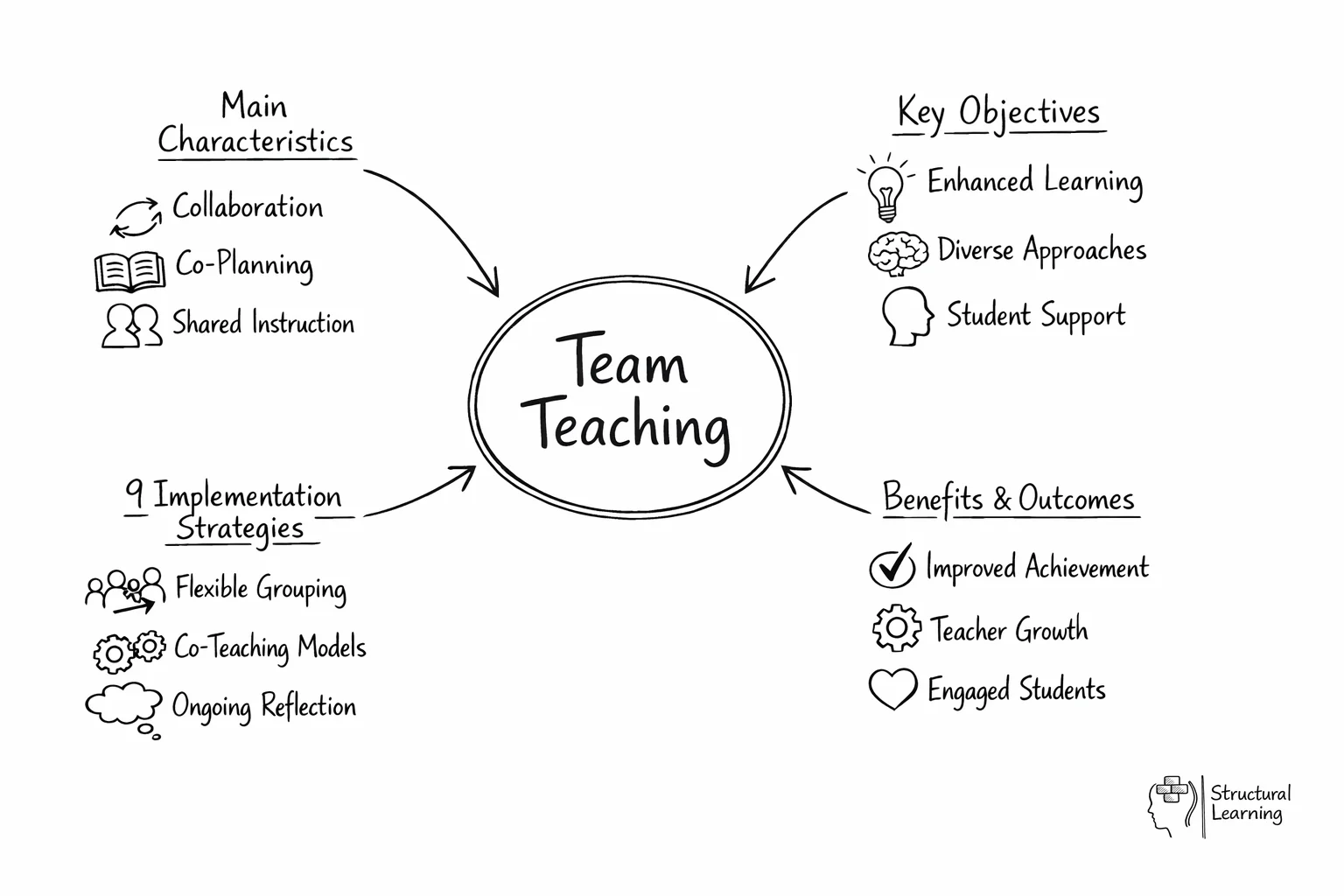
Hub-and-spoke diagram showing team teaching at center with four main components radiating outward
Hub-and-spoke diagram: Team Teaching Structure and Components

We have been utilising team teaching for creating inclusive classrooms that build students' cultural capital. When staffing timetables allow it, we are encouraging our partner schools to facilitate their action researchprojects in the presence of their colleagues. We have found that together, these teams develop much more objective observations.

Team teaching infographic showing definition, components, objectives and benefits of collaborative education
Team Teaching

This systems approach has helped our community of teachers who are utilising their new classroom resources to understand their student's needs in greater detail. This does however require more time, a luxury that many schools don't have but when they do, we think the benefits of facilitating together are really powerful. Many schools make the best use of their teaching assistants in this way. In this article, we will provide an outline of how schools can go about incorporating this type of instructional practice alongside other effective teaching strategies as part of a professional learning agenda.

What are the main objectives of team teaching?

There are many benefits of this approach to instructional practice. Classrooms can be lonely places for early career teachers. The following are some of the main objectives of team teaching:

1. To improve the quality of teaching;
2. To modify the classroom teaching according to the abilities and interests of the students;

3. To best utilize the teaching style, interests and expertise of teachers in the teacher's community.

What are the main characteristics of team teaching?

Below are the main characteristics of Team-Teaching:

  1. Team teaching involves two or more teachers participating in the process of teaching;
  2. The team-teaching activities are decided by the teachers themselves;
  3. The team-teaching plan is flexible;
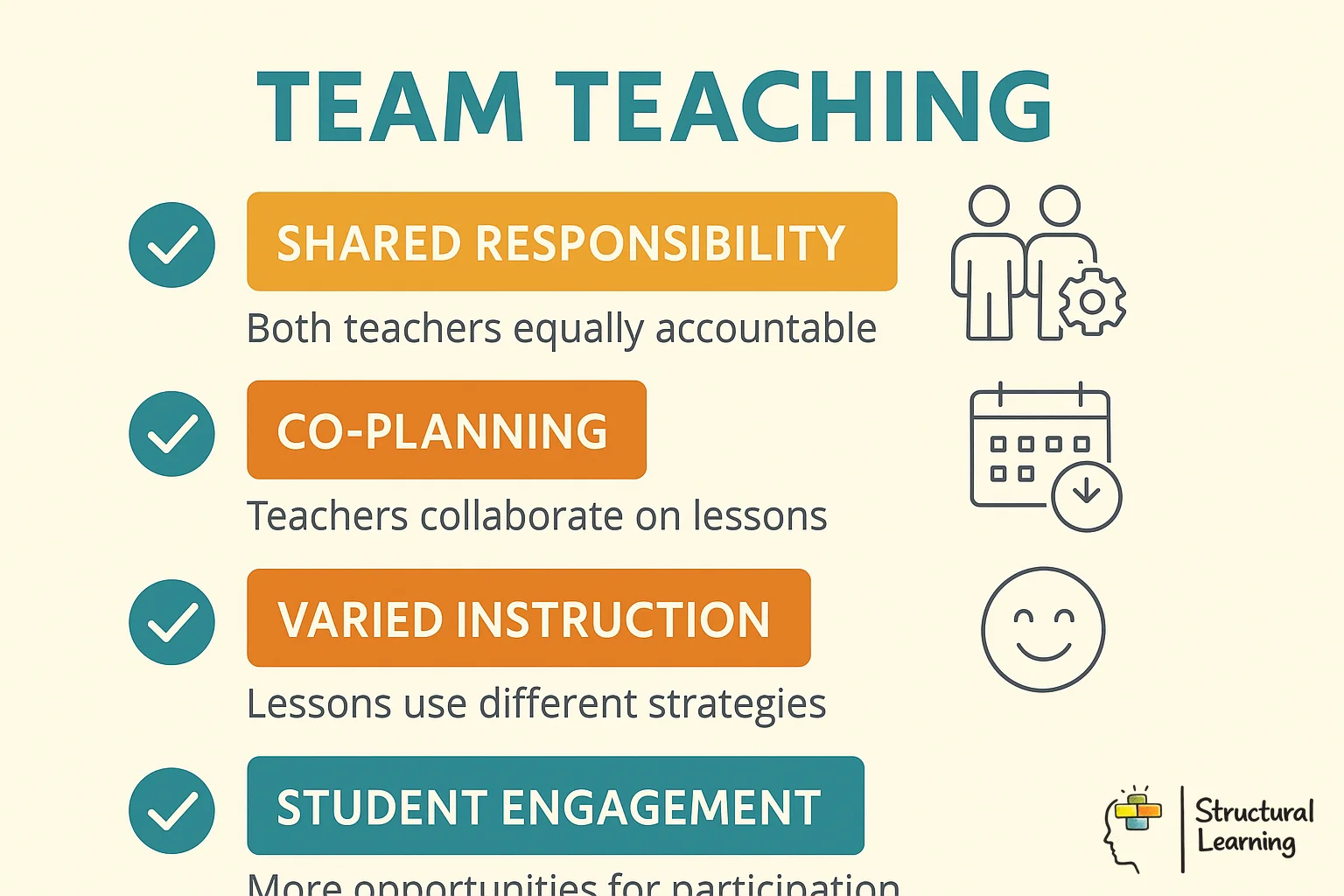
  4. The team teaching is based upon the collective responsibility of teaching given to a small group of teachers rather than giving the entire responsibility of teaching to one teacher only. The responsibility is shared by all the the members of staff.
  5. In the team- teaching different aspects of any topic are taught by an individual teacher turn by turn.
  6. In the process of team-teaching, the needs of the students, schools and currently used exciting variety of resources are considered.
  7. Every teacher involved in the team-teaching process teaches and executes the team teaching process cooperatively.
  8. Team-Teaching involves collaborative teaching and every teacher taking part in the team teaching applies his/her experiences, abilities and exciting variety of resources.
Two educators collaborating in classroom, observing students and taking notes during lesson
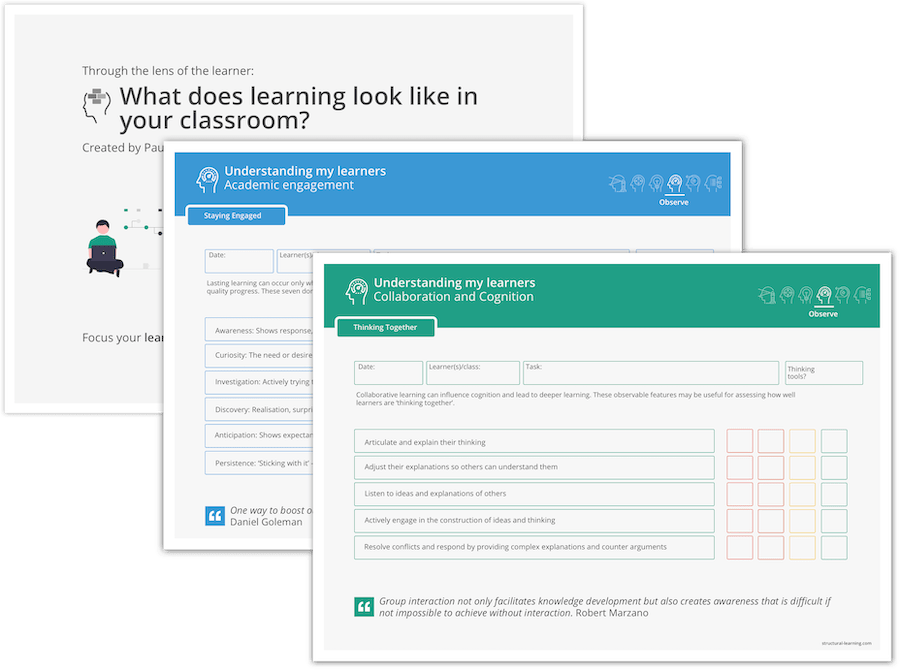
Make insightful observations during team teaching

9 Ways Your School Can Use Team Teaching

In the realm of education, team teaching is a powerful tool that can significantly enhance the learning environment. Here are nine creative ways that schools can leverage team teaching to advance teacher knowledge, improve outcomes, and develop new skills:

  1. Parallel Teaching: Two teachers simultaneously instruct different groups of students within the same classroom. This approach allows for more focused attention and targeted instruction based on student needs. Teachers can provide differentiation strategies more effectively when working with smaller groups.
  2. Station Teaching: Teachers set up different learning stations throughout the classroom, with each teacher responsible for specific stations. Students rotate between stations, experiencing varied teaching styles and approaches. This method promotes student engagement and allows for diverse learning experiences.
  3. Alternative Teaching: One teacher works with the majority of students while the other provides intensive support to a smaller group. This is particularly effective for supporting students with special educational needs or those requiring additional challenge.
  4. One Teach, One Observe: While one teacher leads the lesson, the other observes and collects data on student learning, behavior, or specific teaching strategies. This approach provides valuable feedback and helps teachers refine their practice.
  5. One Teach, One Assist: One teacher takes the lead while the other circulates, providing individual support and clarification. This ensures that all students receive personalized attention and support during instruction.
  6. Team Teaching for Writing: Collaborate to enhance writing instruction by having one teacher focus on content development while the other addresses technical skills and mechanics.
  7. Social-Emotional Learning Integration: Use team teaching to incorporate social-emotional learning components throughout academic instruction, with one teacher focusing on content and another on emotional regulation and social skills.
  8. Critical Thinking Development: Partner teachers can work together to develop students' critical thinking skills by presenting multiple perspectives and facilitating rich discussions.
  9. Assessment and Marking Collaboration: Teachers can work together on marking strategies and assessment design, ensuring consistency and comprehensive evaluation of student work while supporting self-regulation development.

Team teaching offers schools numerous opportunities to enhance learning experiences and maximise teaching expertise. One effective approach is subject integration, where teachers from different disciplines collaborate to create cross-curricular lessons that show students real-world connections between subjects. For example, an English and history teacher might work together on a unit exploring historical fiction, combining literary analysis with historical context.

Another powerful application is differentiated instruction support, where two teachers can simultaneously address varying student needs within the same classroom. One teacher might work with students requiring additional support whilst the other challenges advanced learners, ensuring all pupils receive appropriate instruction. Special educational needs integration also benefits significantly from team teaching, as subject specialists can work alongside SEN coordinators to create inclusive learning environments that support all students effectively.

Large group instruction presents another valuable opportunity, particularly for lectures, demonstrations, or special presentations where one teacher leads whilst another manages classroom dynamics and student engagement. Schools can also implement team teaching for teacher development purposes, pairing experienced educators with newer staff members to facilitate professional growth and knowledge transfer in authentic classroom settings.

What Is Team Teaching?

Team teaching is a collaborative instructional approach where two or more educators share responsibility for planning, delivering, and assessing learning experiences within the same classroom or learning environment. Unlike traditional models where teachers work in isolation, this methodology requires educators to combine their expertise, teaching styles, and subject knowledge to create richer, more diverse learning opportunities for students.

The approach encompasses various models, from co-teaching arrangements where educators simultaneously deliver content, to parallel teaching where groups rotate between different instructors, and station teaching where teachers specialise in particular aspects of the curriculum. Research by Marilyn Friend demonstrates that effective team teaching can significantly improve student engagement and achievement, particularly when educators complement each other's strengths and address individual learning needs more precisely.

In practice, successful team teaching requires careful coordination and shared educational philosophy. Teachers must establish clear roles, maintain consistent communication, and develop unified assessment strategies. This collaborative approach proves particularly valuable in inclusive classrooms, where specialist knowledge combined with general teaching expertise can better support diverse learners whilst maximising instructional time and resources.

Benefits of Team Teaching for Students and Teachers

Team teaching delivers substantial benefits for both students and educators by leveraging the complementary expertise of multiple instructors. Students experience enhanced learning outcomes through exposure to diverse teaching styles, perspectives, and subject matter expertise within a single classroom environment. Research by Cook and Friend demonstrates that collaborative instruction particularly benefits students with varying learning needs, as teachers can provide simultaneous support at different cognitive levels whilst maintaining whole-class engagement.

For educators, team teaching creates powerful opportunities for professional development and pedagogical growth. Teachers observe colleagues' classroom strategies in real-time, fostering continuous improvement through shared practice and reflection. Vygotsky's zone of proximal development applies equally to teacher learning, where collaborative instruction enables practitioners to develop skills beyond their individual capabilities through peer support and modelling.

The practical advantages extend to classroom management and differentiated instruction. With multiple educators present, teams can implement flexible grouping strategies, provide immediate intervention for struggling learners, and offer extension activities for advanced students simultaneously. This approach reduces cognitive load on individual teachers whilst increasing instructional responsiveness, creating more dynamic and inclusive learning environments that address diverse student needs effectively.

Types of Team Teaching Models

Team teaching encompasses several distinct models, each designed to address specific educational objectives and classroom dynamics. The most commonly implemented approaches include co-teaching, where two educators share responsibility for instruction simultaneously; parallel teaching, which involves dividing students into smaller groups taught by different instructors; and station teaching, where learners rotate between multiple learning centres managed by various team members.

Co-teaching proves particularly effective for inclusive classrooms, as research by Marilyn Friend demonstrates that this collaborative approach significantly improves outcomes for students with diverse learning needs. Parallel teaching reduces class sizes temporarily, allowing for more intensive instruction and increased student participation. Station teaching, meanwhile, enables educators to deliver specialised content whilst maintaining engagement through varied learning experiences.

When selecting an appropriate model, consider your students' specific needs, available resources, and curriculum demands. Begin with co-teaching to establish collaborative rhythms between team members, then gradually introduce parallel or station approaches as confidence and coordination develop. Successful implementation requires clear role definitions, shared planning time, and regular reflection on student progress to ensure the chosen model serves both learners and educators effectively.

Overcoming Team Teaching Challenges

Successful team teaching implementation requires careful attention to common pitfalls that can undermine collaborative instruction. Time constraints present the most significant challenge, as teachers need adequate planning periods to coordinate lessons, align assessment strategies, and maintain consistent communication. Schools must restructure timetables to provide protected planning time for teaching teams, whilst ensuring coverage arrangements don't compromise other educational activities.

Personality conflicts and differing teaching philosophies can derail even well-intentioned partnerships. Research by Cook and Friend emphasises the importance of establishing clear roles and responsibilities from the outset, preventing territorial disputes over curriculum content or classroom management approaches. Regular team meetings should include structured protocols for addressing disagreements constructively, focusing on student outcomes rather than individual preferences.

Administrative support proves crucial for overcoming resource allocation challenges. Headteachers must ensure teaching teams have access to appropriate physical spaces, shared planning resources, and professional development opportunities. Creating formal evaluation criteria specifically for team teaching initiatives helps demonstrate their educational value to governors and inspectors. Schools should also establish mentoring partnerships between experienced team teaching practitioners and newcomers, facilitating knowledge transfer and reducing implementation anxiety whilst building sustainable collaborative practices across the institution.

How to Plan Effective Team Teaching Lessons

Effective team teaching begins with structured collaborative planning that establishes clear roles, shared objectives, and coordinated instructional strategies. Unlike individual lesson planning, team teaching requires explicit discussion about how each educator will contribute to the learning experience, when they will take the lead, and how they will support their colleague's instruction. Research by Friend and Cook emphasises that successful collaborative instruction depends on teachers having dedicated time to align their teaching philosophies, discuss student needs, and plan complementary activities that maximise the strengths of both educators.

The planning process should address three critical elements: content delivery methods, classroom management protocols, and assessment strategies. Teachers must decide whether they will employ parallel teaching, station teaching, or alternative instructional models, and establish clear signals for transitions between activities. Villa, Thousand, and Nevin's research demonstrates that teams who explicitly plan their physical positioning, voice projection, and student interaction patterns create more seamless learning experiences that reduce confusion and maintain student engagement throughout the lesson.

Practical preparation involves creating shared documentation that outlines each teacher's responsibilities, required resources, and contingency plans for unexpected situations. This collaborative framework should include specific timings, differentiation strategies, and agreed-upon behaviour management approaches that both educators can implement consistently, ensuring students receive coherent instruction regardless of which teacher is leading at any given moment.

Loading audit...

What is team teaching?

As the name suggests, team teaching indicates a group of educators, teaching in a team. It may be comprised of 2 to 5 teachers who will prepare individual lesson plans and teach a topic, using the same activities and resources to the same group of students. It is also called 'shared teaching' or 'co-teaching'. Team teaching is most beneficial when educators are collaborating effectively with one another, using dialogic approaches and share a common purpose.

Key Takeaways

  1. Beyond Solo Teaching: Discover why team teaching creates more objective observations and helps you understand student needs in ways individual practice cannot
  2. The Career Development Secret: Learn how pairing experienced teachers with early career staff reveals hidden competencies and accelerates professional growth through live modelling
  3. Nine Team Teaching Strategies: From parallel teaching to complementary skills: practical approaches that transform large classes into dynamic, differentiated learning environments
  4. The 15% Achievement Boost: Uncover the research-backed benefits and specific role shifts that make team teaching a powerful tool for improving student outcomes

Teaming an experienced teacher up with an early career member of staff certainly brings with it some distinct advantages such as being able to elaborate on the thought process when certain decisions are made, including demonstrating effective scaffolding approaches. This sort of modelling enables newly qualified teachers to get the inside picture of how an expert member of staff approaches certain tasks and monitors pupil progress. These sorts of competencies can remain hidden away from the rest of the education community.

Hub-and-spoke diagram showing team teaching at center with four main components radiating outward
Hub-and-spoke diagram: Team Teaching Structure and Components

We have been utilising team teaching for creating inclusive classrooms that build students' cultural capital. When staffing timetables allow it, we are encouraging our partner schools to facilitate their action researchprojects in the presence of their colleagues. We have found that together, these teams develop much more objective observations.

Team teaching infographic showing definition, components, objectives and benefits of collaborative education
Team Teaching

This systems approach has helped our community of teachers who are utilising their new classroom resources to understand their student's needs in greater detail. This does however require more time, a luxury that many schools don't have but when they do, we think the benefits of facilitating together are really powerful. Many schools make the best use of their teaching assistants in this way. In this article, we will provide an outline of how schools can go about incorporating this type of instructional practice alongside other effective teaching strategies as part of a professional learning agenda.

What are the main objectives of team teaching?

There are many benefits of this approach to instructional practice. Classrooms can be lonely places for early career teachers. The following are some of the main objectives of team teaching:

1. To improve the quality of teaching;

2. To modify the classroom teaching according to the abilities and interests of the students;

3. To best utilize the teaching style, interests and expertise of teachers in the teacher's community.

What are the main characteristics of team teaching?

Below are the main characteristics of Team-Teaching:

  1. Team teaching involves two or more teachers participating in the process of teaching;
  2. The team-teaching activities are decided by the teachers themselves;
  3. The team-teaching plan is flexible;
  4. The team teaching is based upon the collective responsibility of teaching given to a small group of teachers rather than giving the entire responsibility of teaching to one teacher only. The responsibility is shared by all the the members of staff.
  5. In the team- teaching different aspects of any topic are taught by an individual teacher turn by turn.
  6. In the process of team-teaching, the needs of the students, schools and currently used exciting variety of resources are considered.
  7. Every teacher involved in the team-teaching process teaches and executes the team teaching process cooperatively.
  8. Team-Teaching involves collaborative teaching and every teacher taking part in the team teaching applies his/her experiences, abilities and exciting variety of resources.
Two educators collaborating in classroom, observing students and taking notes during lesson
Make insightful observations during team teaching

9 Ways Your School Can Use Team Teaching

In the realm of education, team teaching is a powerful tool that can significantly enhance the learning environment. Here are nine creative ways that schools can leverage team teaching to advance teacher knowledge, improve outcomes, and develop new skills:

  1. Parallel Teaching: Two teachers simultaneously instruct different groups of students within the same classroom. This approach allows for more focused attention and targeted instruction based on student needs. Teachers can provide differentiation strategies more effectively when working with smaller groups.
  2. Station Teaching: Teachers set up different learning stations throughout the classroom, with each teacher responsible for specific stations. Students rotate between stations, experiencing varied teaching styles and approaches. This method promotes student engagement and allows for diverse learning experiences.
  3. Alternative Teaching: One teacher works with the majority of students while the other provides intensive support to a smaller group. This is particularly effective for supporting students with special educational needs or those requiring additional challenge.
  4. One Teach, One Observe: While one teacher leads the lesson, the other observes and collects data on student learning, behavior, or specific teaching strategies. This approach provides valuable feedback and helps teachers refine their practice.
  5. One Teach, One Assist: One teacher takes the lead while the other circulates, providing individual support and clarification. This ensures that all students receive personalized attention and support during instruction.
  6. Team Teaching for Writing: Collaborate to enhance writing instruction by having one teacher focus on content development while the other addresses technical skills and mechanics.
  7. Social-Emotional Learning Integration: Use team teaching to incorporate social-emotional learning components throughout academic instruction, with one teacher focusing on content and another on emotional regulation and social skills.
  8. Critical Thinking Development: Partner teachers can work together to develop students' critical thinking skills by presenting multiple perspectives and facilitating rich discussions.
  9. Assessment and Marking Collaboration: Teachers can work together on marking strategies and assessment design, ensuring consistency and comprehensive evaluation of student work while supporting self-regulation development.

Team teaching offers schools numerous opportunities to enhance learning experiences and maximise teaching expertise. One effective approach is subject integration, where teachers from different disciplines collaborate to create cross-curricular lessons that show students real-world connections between subjects. For example, an English and history teacher might work together on a unit exploring historical fiction, combining literary analysis with historical context.

Another powerful application is differentiated instruction support, where two teachers can simultaneously address varying student needs within the same classroom. One teacher might work with students requiring additional support whilst the other challenges advanced learners, ensuring all pupils receive appropriate instruction. Special educational needs integration also benefits significantly from team teaching, as subject specialists can work alongside SEN coordinators to create inclusive learning environments that support all students effectively.

Large group instruction presents another valuable opportunity, particularly for lectures, demonstrations, or special presentations where one teacher leads whilst another manages classroom dynamics and student engagement. Schools can also implement team teaching for teacher development purposes, pairing experienced educators with newer staff members to facilitate professional growth and knowledge transfer in authentic classroom settings.

What Is Team Teaching?

Team teaching is a collaborative instructional approach where two or more educators share responsibility for planning, delivering, and assessing learning experiences within the same classroom or learning environment. Unlike traditional models where teachers work in isolation, this methodology requires educators to combine their expertise, teaching styles, and subject knowledge to create richer, more diverse learning opportunities for students.

The approach encompasses various models, from co-teaching arrangements where educators simultaneously deliver content, to parallel teaching where groups rotate between different instructors, and station teaching where teachers specialise in particular aspects of the curriculum. Research by Marilyn Friend demonstrates that effective team teaching can significantly improve student engagement and achievement, particularly when educators complement each other's strengths and address individual learning needs more precisely.

In practice, successful team teaching requires careful coordination and shared educational philosophy. Teachers must establish clear roles, maintain consistent communication, and develop unified assessment strategies. This collaborative approach proves particularly valuable in inclusive classrooms, where specialist knowledge combined with general teaching expertise can better support diverse learners whilst maximising instructional time and resources.

Benefits of Team Teaching for Students and Teachers

Team teaching delivers substantial benefits for both students and educators by leveraging the complementary expertise of multiple instructors. Students experience enhanced learning outcomes through exposure to diverse teaching styles, perspectives, and subject matter expertise within a single classroom environment. Research by Cook and Friend demonstrates that collaborative instruction particularly benefits students with varying learning needs, as teachers can provide simultaneous support at different cognitive levels whilst maintaining whole-class engagement.

For educators, team teaching creates powerful opportunities for professional development and pedagogical growth. Teachers observe colleagues' classroom strategies in real-time, fostering continuous improvement through shared practice and reflection. Vygotsky's zone of proximal development applies equally to teacher learning, where collaborative instruction enables practitioners to develop skills beyond their individual capabilities through peer support and modelling.

The practical advantages extend to classroom management and differentiated instruction. With multiple educators present, teams can implement flexible grouping strategies, provide immediate intervention for struggling learners, and offer extension activities for advanced students simultaneously. This approach reduces cognitive load on individual teachers whilst increasing instructional responsiveness, creating more dynamic and inclusive learning environments that address diverse student needs effectively.

Types of Team Teaching Models

Team teaching encompasses several distinct models, each designed to address specific educational objectives and classroom dynamics. The most commonly implemented approaches include co-teaching, where two educators share responsibility for instruction simultaneously; parallel teaching, which involves dividing students into smaller groups taught by different instructors; and station teaching, where learners rotate between multiple learning centres managed by various team members.

Co-teaching proves particularly effective for inclusive classrooms, as research by Marilyn Friend demonstrates that this collaborative approach significantly improves outcomes for students with diverse learning needs. Parallel teaching reduces class sizes temporarily, allowing for more intensive instruction and increased student participation. Station teaching, meanwhile, enables educators to deliver specialised content whilst maintaining engagement through varied learning experiences.

When selecting an appropriate model, consider your students' specific needs, available resources, and curriculum demands. Begin with co-teaching to establish collaborative rhythms between team members, then gradually introduce parallel or station approaches as confidence and coordination develop. Successful implementation requires clear role definitions, shared planning time, and regular reflection on student progress to ensure the chosen model serves both learners and educators effectively.

Overcoming Team Teaching Challenges

Successful team teaching implementation requires careful attention to common pitfalls that can undermine collaborative instruction. Time constraints present the most significant challenge, as teachers need adequate planning periods to coordinate lessons, align assessment strategies, and maintain consistent communication. Schools must restructure timetables to provide protected planning time for teaching teams, whilst ensuring coverage arrangements don't compromise other educational activities.

Personality conflicts and differing teaching philosophies can derail even well-intentioned partnerships. Research by Cook and Friend emphasises the importance of establishing clear roles and responsibilities from the outset, preventing territorial disputes over curriculum content or classroom management approaches. Regular team meetings should include structured protocols for addressing disagreements constructively, focusing on student outcomes rather than individual preferences.

Administrative support proves crucial for overcoming resource allocation challenges. Headteachers must ensure teaching teams have access to appropriate physical spaces, shared planning resources, and professional development opportunities. Creating formal evaluation criteria specifically for team teaching initiatives helps demonstrate their educational value to governors and inspectors. Schools should also establish mentoring partnerships between experienced team teaching practitioners and newcomers, facilitating knowledge transfer and reducing implementation anxiety whilst building sustainable collaborative practices across the institution.

How to Plan Effective Team Teaching Lessons

Effective team teaching begins with structured collaborative planning that establishes clear roles, shared objectives, and coordinated instructional strategies. Unlike individual lesson planning, team teaching requires explicit discussion about how each educator will contribute to the learning experience, when they will take the lead, and how they will support their colleague's instruction. Research by Friend and Cook emphasises that successful collaborative instruction depends on teachers having dedicated time to align their teaching philosophies, discuss student needs, and plan complementary activities that maximise the strengths of both educators.

The planning process should address three critical elements: content delivery methods, classroom management protocols, and assessment strategies. Teachers must decide whether they will employ parallel teaching, station teaching, or alternative instructional models, and establish clear signals for transitions between activities. Villa, Thousand, and Nevin's research demonstrates that teams who explicitly plan their physical positioning, voice projection, and student interaction patterns create more seamless learning experiences that reduce confusion and maintain student engagement throughout the lesson.

Practical preparation involves creating shared documentation that outlines each teacher's responsibilities, required resources, and contingency plans for unexpected situations. This collaborative framework should include specific timings, differentiation strategies, and agreed-upon behaviour management approaches that both educators can implement consistently, ensuring students receive coherent instruction regardless of which teacher is leading at any given moment.

Classroom Practice

Back to Blog

{"@context":"https://schema.org","@graph":[{"@type":"Article","@id":"https://www.structural-learning.com/post/team-teaching#article","headline":"Team Teaching","description":"How can schools embrace team teaching as part of a continued professional learning agenda?","datePublished":"2022-05-13T15:08:43.942Z","dateModified":"2026-01-26T10:09:32.212Z","author":{"@type":"Person","name":"Paul Main","url":"https://www.structural-learning.com/team/paulmain","jobTitle":"Founder & Educational Consultant"},"publisher":{"@type":"Organization","name":"Structural Learning","url":"https://www.structural-learning.com","logo":{"@type":"ImageObject","url":"https://cdn.prod.website-files.com/5b69a01ba2e409e5d5e055c6/6040bf0426cb415ba2fc7882_newlogoblue.svg"}},"mainEntityOfPage":{"@type":"WebPage","@id":"https://www.structural-learning.com/post/team-teaching"},"image":"https://cdn.prod.website-files.com/5b69a01ba2e409501de055d1/696a33300d2a1997614ff943_696a332b1b525298b711f688_team-teaching-illustration.webp","wordCount":2341},{"@type":"BreadcrumbList","@id":"https://www.structural-learning.com/post/team-teaching#breadcrumb","itemListElement":[{"@type":"ListItem","position":1,"name":"Home","item":"https://www.structural-learning.com/"},{"@type":"ListItem","position":2,"name":"Blog","item":"https://www.structural-learning.com/blog"},{"@type":"ListItem","position":3,"name":"Team Teaching","item":"https://www.structural-learning.com/post/team-teaching"}]},{"@type":"FAQPage","@id":"https://www.structural-learning.com/post/team-teaching#faq","mainEntity":[{"@type":"Question","name":"What exactly is team teaching and how does it differ from regular classroom instruction?","acceptedAnswer":{"@type":"Answer","text":"Team teaching involves 2 to 5 educators working collaboratively to prepare lesson plans and teach the same group of students using shared activities and resources. Unlike traditional solo teaching, it creates more objective observations and helps teachers understand student needs through collective "}},{"@type":"Question","name":"How can schools practically implement team teaching when they have limited time and resources?","acceptedAnswer":{"@type":"Answer","text":"Schools can start by pairing experienced teachers with early career staff during action research projects and making better use of teaching assistants in collaborative roles. When staffing timetables allow, schools should facilitate colleague observations and encourage flexible grouping approaches l"}},{"@type":"Question","name":"What are the main benefits of team teaching for both teachers and students?","acceptedAnswer":{"@type":"Answer","text":"Team teaching offers a 15% increase in student achievement scores according to research, whilst providing professional development opportunities for teachers through live modelling and shared expertise. It creates more engaging, interactive lessons and helps build inclusive classrooms that develop s"}},{"@type":"Question","name":"How does team teaching support early career teachers' professional development?","acceptedAnswer":{"@type":"Answer","text":"Team teaching allows newly qualified teachers to observe expert colleagues' thought processes and decision-making in real-time, including effective"}},{"@type":"Question","name":"What are some specific team teaching strategies that schools can use in their classrooms?","acceptedAnswer":{"@type":"Answer","text":"Schools can implement parallel teaching where two teachers simultaneously instruct different groups in the same classroom, or use complementary teaching skills where teachers with different expertise collaborate. Other approaches include flexible grouping based on learning objectives and shared resp"}}]}]}