Language Development in Children: Stages and Strategies
How children develop language from babbling to complex sentences. Key stages, milestones, and evidence-based teaching strategies for supporting language growth in school.


How children develop language from babbling to complex sentences. Key stages, milestones, and evidence-based teaching strategies for supporting language growth in school.
Language development in children is a foundational process through which they acquire the ability to understand and express themselves using speech. This complex process is supported by various child development theories that help educators understand how children progress through different stages of communication. It begins even before birth, with infants recognising the rhythm and pitch of their mother's voice, and continues throughout childhood as they progress from babbling and gestures to forming coherent words and sentences. This process is essential for developing the cognitive, emotional, and social skills necessary for effective communication.

Three key aspects of language development shape a child's growth: the progression from auditory recognition to verbal expression, the role of language in developing cognitive and emotional understanding, and its significance in laying the groundwork for literacy and interpersonal relationships. Children first learn to speak before mastering reading and writing, highlighting the critical link between oracy and language development and early oral language skills and later academic success. Language also facilitates problem-solving, co mprehension, and emotional expression, equipping children to understand their world and emotions. Moreover, strong language skills help children build connections, helping them to form and sustain meaningful relationships, a process closely linked to social learning theories of attachment.
Want to go deeper on Chomsky? This article covers all major language development theories. For a detailed exploration of universal grammar, the Language Acquisition Device and the nativist approach, see our dedicated guide to Chomsky's language theory.
What does the research say? Hart and Risley's (1995) landmark study found a 30-million-word gap between high and low socioeconomic households by age 3. The EEF's Communication and Language Approaches review reports +6 months of progress from targeted oral language interventions. Hoff (2003) showed that the quality of language input (not just quantity) predicts vocabulary growth, with child-directed speech explaining up to 22% of variance in language outcomes.
How language evolves, the principles of developing its development, and the strategies educators and caregivers can use to improve children's communication abilities.
From birth until age five, infants quickly develop telegraphic speech. The of language skills are universal. The age and rate at which a child passes each spoken language milestone varies considerably. Thus, a child's spoken language skills development must be compared to norms, not other children. Girls can acquire language more rapidly than boys.
Language development is a fundamental indication of cognitive growth and maturity. After age five, speech skills acquisition becomes more difficult for the majority of children and it indicates the language disorders among infants. Typically, receptive language development (the capacity to perceive speech) advances more rapidly than expressive (the ability to communicate).
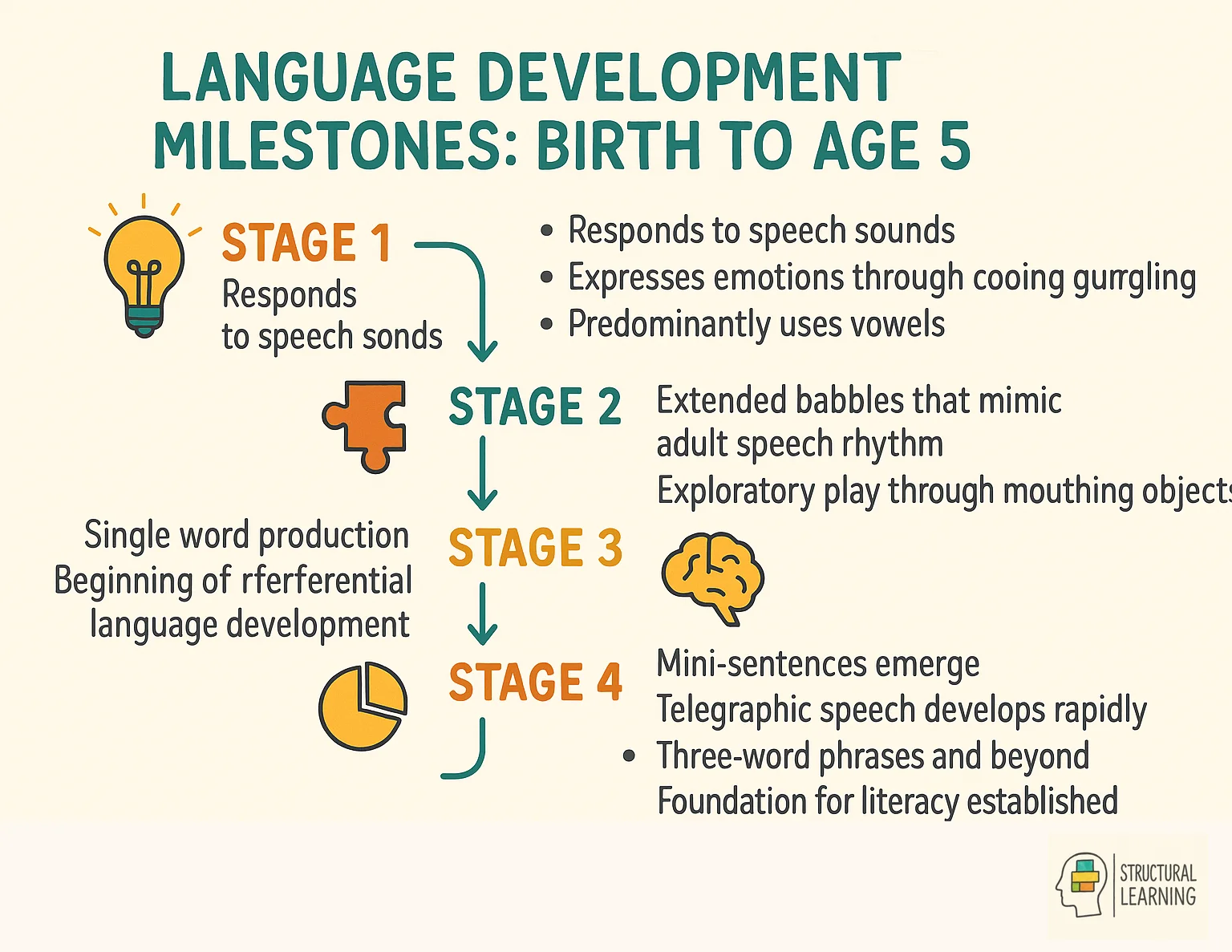
There are two known principles of spoken language development. In referential language development, children begin learning vocabulary by speaking single words before combining them into two-word mini, sentences and, subsequently, three-word phrases. In the early stages of expressive vocabulary development, children produce extended, incomprehensible babbles that imitate the cadence and rhythm of adult speech. The majority of children employ a mixture of these techniques and easily achieve phrasing outcomes.
In 1983, Jerome Bruner proposed that Noam Chomsky's Language Acquisition Device, the innate grammatical processor that Chomsky argued all children are born with, could not operate alone. Children needed, Bruner argued, a complementary structure in the social environment: the Language Acquisition Support System, or LASS. Where the LAD was internal and biological, the LASS was external and interactional. It consisted of the routines, games, shared reference, and scaffolded exchanges that caregivers provide long before a child produces a recognisable word (Bruner, 1983). The two systems, LAD and LASS, were not competing accounts of language acquisition; they were, in Bruner's view, two halves of the same mechanism.
Bruner drew heavily on Vygotsky's (1978) account of how higher cognitive functions originate in social interaction before they are internalised by the child. In the domain of language, this meant that the structure of conversations precedes the structure of grammar. Caregivers establish formats, recurring interactional routines with predictable roles, before the child can participate verbally. The peekaboo game is a classic example: it has a fixed structure (concealment, anticipation, reveal, reaction), it creates joint attention on a shared object of focus, and it provides a slot in which the child can produce a vocalisation that will be treated as a communicative act. Over hundreds of repetitions, the child learns that turn-taking, shared reference, and communicative intent are the scaffolding on which lexical items and, later, morphology can be hung.
Joint attention is the mechanism that makes the LASS work. When a caregiver and child attend to the same object at the same moment, the child can map a word onto its referent reliably. Tomasello and Farrar (1986) showed experimentally that vocabulary acquisition was substantially faster when caregivers followed the child's attentional lead rather than redirecting attention to a new object. Caregivers who labelled objects only when the child was already looking at them produced children with larger vocabularies at 18 months than caregivers who attempted to redirect attention. The implication for classroom practice is direct: in early years settings, language input is most effective when it follows the child's point of interest rather than imposing a predetermined topic.
For teachers, the LASS framework repositions the adult as an active architect of language opportunity rather than a passive source of input. In practice, this means structuring repeated routines with predictable linguistic slots, using the daily timetable as a series of LASS formats: register time, snack time, and carpet time each provide a recurring interactional structure in which children can anticipate what is coming, hear consistent vocabulary, and produce increasingly complex contributions. Ninio and Bruner (1978) demonstrated precisely this mechanism in their analysis of picture-book reading routines, showing that the four-phase cycle of attention, query, label, and feedback in joint book reading is one of the most powerful LASS formats available to caregivers and teachers alike.
Language development milestones are a significant tool for monitoring children's progress. While there is a vast range of 'normal' months of age, every child learns at their own speed, missing a milestone may be an early warning that your child is failing to hear, comprehend or utilise language skills. Infants, throughout language development, may face problems therefore, milestones are indicators of when a child is struggling in a certain area of speech development.
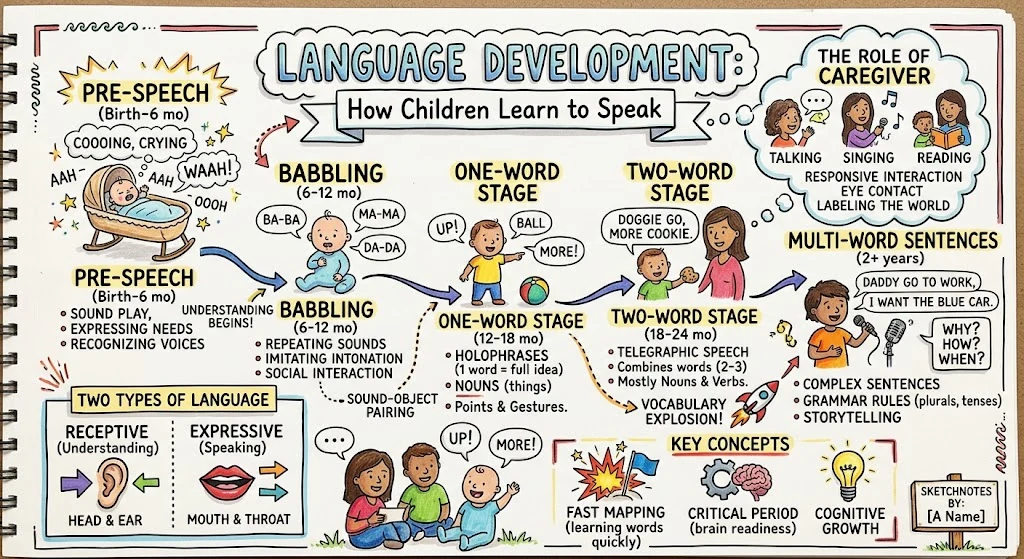
Milestones of language and child development for infants aged 0 to 2 years:
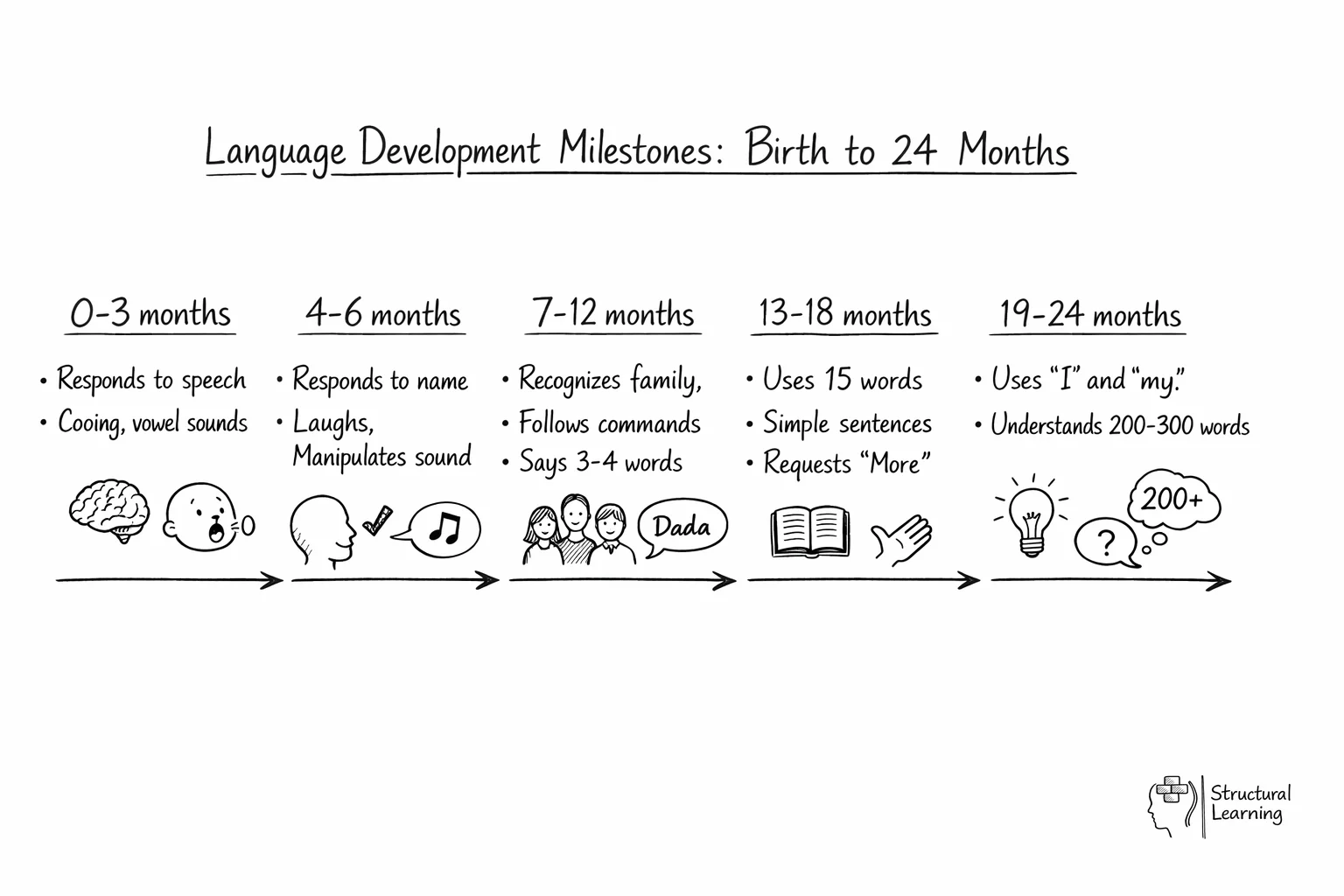
Each stage builds upon the previous one, creating a foundation for increasingly complex communication skills. During the babbling stage (6-12 months), children experiment with sounds and begin to understand the rhythm and patterns of their native language. Patricia Kuhl's research demonstrates that babies are remarkably attuned to the phonetic patterns of languages they hear regularly.
The one-word stage typically emerges around 12-18 months, when children begin using single words to communicate entire thoughts. A child saying 'milk' might mean 'I want milk', 'There's the milk', or 'I've finished my milk'. Teachers working with very young children should recognise that these single words represent sophisticated understanding and respond by expanding on the child's intended meaning, providing rich language models through child-directed speech.
The two-word stage (18-24 months) marks the beginning of grammar development. Children combine words following basic grammatical rules, producing phrases like 'more biscuit' or 'daddy gone'. This telegraphic speech demonstrates children's innate understanding of word order and meaning relationships. In the classroom, teachers can support this stage of development by modelling complete sentences whilst acknowledging children's attempts at communication, helping bridge the gap between their current abilities and more complex language structures.
Creating a language-rich classroom environment requires deliberate planning and consistent implementation of evidence-based strategies. Child-directed speech remains one of the most powerful tools teachers can employ, involving clear articulation, varied vocabulary, and responsive interaction patterns that mirror natural language acquisition processes. Research by Catherine Snow demonstrates that children benefit significantly from exposure to diverse linguistic structures and vocabulary beyond their current developmental stage, making teacher modelling crucial for advancing communication skills.
Effective classroom practices include incorporating wait time during conversations, allowing children adequate processing time before expecting responses. Teachers should actively expand on children's utterances, providing grammatically correct models whilst acknowledging their communicative intent. For example, when a child says "car go fast," responding with "Yes, the red car is going very fast down the hill" demonstrates proper syntax whilst validating their message.
Structured activities such as storytelling, role-play, and collaborative discussions provide natural contexts for language development across all stages. Teachers can implement scaffolded conversations by asking open-ended questions, encouraging peer interaction, and creating opportunities for children to explain their thinking. Regular observation and documentation of children's language use helps identify individual needs and informs targeted support strategies.
Teachers are uniquely positioned to identify language development difficulties, as they observe children's communication patterns across diverse classroom contexts daily. Unlike brief clinical assessments, classroom observations reveal how children navigate real-world communication challenges, from following multi-step instructions to participating in group discussions. Research by Dorothy Bishop emphasises that early identification significantly improves intervention outcomes, making teachers' observations invaluable for supporting children's language development.
Key indicators of potential difficulties include persistent challenges with vocabulary acquisition, difficulty understanding or following age-appropriate instructions, and limited participation in classroom conversations. Children may also demonstrate word-finding difficulties, frequently using vague terms like "thing" or "stuff" instead of specific vocabulary. Catherine Snow's research highlights that children struggling with narrative skills, such as retelling stories or describing events sequentially, often benefit from targeted support.
Effective identification involves systematic observation rather than isolated incidents. Create simple checklists noting whether children can engage in age-appropriate conversations, understand classroom instructions without visual cues, and express their needs clearly. Document specific examples of communication breakdowns and successful interactions, as these patterns provide valuable information for specialist referrals and inform your own classroom adaptations while supporting the child's ongoing development.
Language development varies dramatically between children, influenced by a complex interplay of biological, environmental, and social factors. Individual differences in cognitive processing speed, working memory capacity, and auditory processing abilities create natural variation in how quickly children acquire vocabulary, grammar, and communication skills. Research by Hart and Risley famously demonstrated that children from language-rich environments may hear up to 30 million more words by age four than their peers, creating significant disparities in linguistic exposure that teachers must recognise and address.
Environmental factors play an equally crucial role in shaping language trajectories. The quality and quantity of child-directed speech at home, opportunities for meaningful conversation, and exposure to varied vocabulary through books and experiences all contribute to developmental outcomes. Additionally, multilingual children may appear to develop more slowly in English whilst actually demonstrating sophisticated metalinguistic awareness across multiple language systems.
Understanding these factors enables teachers to differentiate their approach effectively. Rather than viewing slower development as deficit, educators can recognise it as variation requiring targeted support. Create language-rich classroom environments with varied vocabulary exposure, provide additional processing time for responses, and celebrate multilingual assets. Regular observation and documentation help identify individual patterns, allowing teachers to adjust expectations appropriately whilst maintaining high standards for all learners.
Eric Lenneberg's Biological Foundations of Language (1967) proposed that the capacity for first language acquisition is constrained by a biologically determined window that opens at around age two and closes at puberty. Lenneberg argued that during this period, the brain retains sufficient neural plasticity for language systems to become fully established. After puberty, lateralisation of language function to the left hemisphere is complete, and the window closes. Evidence from children recovering from left-hemisphere lesions supported this account: pre-pubertal children showed far greater language recovery than adults with equivalent damage, suggesting that neural plasticity, not instruction, was doing the work.
The most discussed case in the critical period literature is Genie, a child discovered in 1970 at age 13 after being deprived of language input from infancy. Curtiss (1977) documented Genie's subsequent language development in detail. Despite intensive teaching, Genie acquired a substantial vocabulary but never developed normal syntax. She produced noun-phrase combinations without the morphological and syntactic organisation seen even in young children at Brown's Stage III. Curtiss interpreted this as evidence that syntax, unlike vocabulary, requires exposure during the critical period to develop normally. The case is not without methodological complications: Genie's early deprivation was not limited to language, and her cognitive and emotional development were affected across multiple domains. Researchers have since preferred the term 'sensitive period' to signal that the developmental window is probabilistic rather than absolute, with attrition of plasticity rather than a sharp cut-off at puberty.
Newport (1990) provided some of the most controlled evidence for age-of-acquisition effects by studying deaf adults who had acquired American Sign Language at different ages: from birth, between ages 4 and 6, and after age 12. Those who had acquired ASL from birth showed native-like grammatical competence across all morphological and syntactic measures. Those who had acquired ASL after age 12 showed persistent gaps in morphology and complex syntax even after thirty years of use. Newport's data suggested that the critical period effect is strongest for grammatical morphology and weakest for vocabulary, a gradient that aligns with the clinical picture seen in late second language learners.
The implications for English as an Additional Language pupils are significant. A child who arrives in a British primary school at age five with no English is in a very different position from a pupil who arrives at age 11. The five-year-old has both implicit language learning mechanisms and the full LASS of classroom interaction working in her favour; research by Cummins (1984) suggests she will develop conversational English in 1 to 2 years and academic language proficiency in 5 to 7 years. The older arrival has greater metalinguistic awareness and stronger literacy in their first language, which transfer benefits identified by Cummins' Common Underlying Proficiency model, but will find phonological and morphological acquisition slower and less automatic. Practical implications follow: early years settings should prioritise rich oral language environments because neural plasticity is at its peak, while secondary teachers working with late-arriving EAL pupils should prioritise academic vocabulary and explicit grammar instruction, the routes that remain open after the sensitive period for implicit acquisition has narrowed.
Language development in children refers to the process through which they acquire the ability to understand and express themselves using speech. It begins before birth and continues throughout childhood, involving auditory recognition, verbal expression, and developing cognitive and emotional understanding.
To implement language development, educators can use child-directed speech, encourage storytelling, and incorporate interactive activities that promote listening, speaking, reading, and writing. Regularly engaging with children in conversations and providing a rich vocabulary environment are also effective strategies.
Language development is essential for cognitive, emotional, and social growth. It enables problem-solving, comprehension, emotional expression, and lays the foundation for literacy and meaningful interpersonal relationships.
Common mistakes include over-correcting children's speech, not providing enough opportunities for conversation, and failing to match the complexity of language to the child's developmental level. It's important to maintain a supportive environment that encourages exploration and communication.
Language development can be assessed by monitoring children's progress against age-appropriate milestones, such as responding to speech, using words correctly, and engaging in conversations. Regular observation and feedback from parents or caregivers can also provide insights into a child's language skills.
Understanding typical language development milestones enables teachers to identify children who may need additional support and celebrate progress effectively. Roger Brown's morpheme studies revealed predictable patterns: children typically use single words by 12 months, combine two words by 18-24 months, and demonstrate complex sentence structures by age four. However, variation is normal, with some children reaching milestones earlier or later whilst still developing within healthy parameters.
Effective classroom assessment focuses on functional communication rather than perfect grammar. Observe how children use language for different purposes: requesting help, sharing ideas, asking questions, and engaging socially with peers. Patricia Kuhl's research demonstrates that meaningful interaction drives language acquisition more effectively than passive exposure, making authentic classroom conversations valuable assessment opportunities.
Create simple observation checklists tracking key indicators: vocabulary growth, sentence complexity, comprehension skills, and willingness to communicate. Document children's language use during natural activities like story time, group work, and play. When concerns arise, collaborate with speech and language professionals early, as Catherine Snow's research shows that timely intervention significantly improves outcomes. Remember that multilingual learners may show different patterns, developing skills across languages simultaneously.
The relationship between oral language development and literacy acquisition forms a bidirectional pathway that strengthens throughout a child's educational process. Children who enter school with rich vocabularies and strong listening comprehension skills typically demonstrate greater success in learning to read, whilst the process of reading itself accelerates language development by exposing children to complex sentence structures and sophisticated vocabulary rarely encountered in everyday conversation.
Research by Catherine Snow demonstrates that the language skills children develop through meaningful conversations directly support their ability to decode text and comprehend written material. Phonological awareness, the understanding that spoken words are made up of individual sounds, emerges naturally from playful interactions with language and serves as a crucial foundation for reading success. Similarly, children's growing understanding of narrative structure through storytelling experiences enhances their ability to comprehend and produce both oral and written texts.
In the classroom, teachers can strengthen these connections by integrating rich discussions around texts, encouraging children to retell stories in their own words, and providing abundant opportunities for both listening to and creating narratives. Building vocabulary through shared reading experiences, whilst simultaneously encouraging children to use new words in their spoken language, creates powerful learning cycles that accelerate both literacy and oral language development.
Select the proficiency stage, first language group, and challenge area to receive tailored strategies, vocabulary targets, and progress milestones.
Download this free Attachment, Child Development & Emotional Wellbeing resource pack for your classroom and staff room. Includes printable posters, desk cards, and CPD materials.
These peer-reviewed studies provide the evidence base for language development strategies discussed in this guide.
The Relation Between First-Grade Grey Matter Volume and Second-Grade Math Competence View study ↗
425 citations
K. (2013)
This research demonstrates how early language development supports mathematical learning, showing that vocabulary and comprehension skills predict later numeracy success. Teachers can strengthen mathematical outcomes by building strong language foundations through rich classroom conversations and explicit vocabulary instruction across all subject areas.
Oral Language and Reading Comprehension Skills in the Early Primary Years: A Meta-Analysis View study ↗
C.J. et al. (2000)
This comprehensive meta-analysis demonstrates that children's oral language abilities directly predict their reading comprehension success, with vocabulary and listening skills showing particularly strong relationships. Teachers can improve literacy outcomes by prioritising rich verbal interactions, storytelling, and explicit vocabulary instruction before and alongside formal reading instruction.
Shared Book Reading Interventions for Young Children: A Meta-Analysis View study ↗
892 citations
S.E. et al. (2011)
This meta-analysis confirms that shared book reading significantly enhances children's vocabulary, comprehension, and expressive language skills, with the greatest benefits for children from language-poor backgrounds. Teachers should implement daily interactive read-alouds with open-ended questions, vocabulary discussions, and opportunities for children to retell stories in their own words.
Language Development From Birth to Three Years: The Essential Role of Social Interaction View study ↗
672 citations
E. (2006)
This research emphasises that quality conversational interactions, rather than passive language exposure, drive language development most effectively. Teachers working with young children should prioritise responsive conversations, following children's interests, expanding their utterances, and providing meaningful contexts for language use rather than relying solely on structured activities or passive listening.
The Development of Language Skills in Children: A Critical Review View study ↗
M. (2003)
This influential review demonstrates that language development emerges from children's attempts to understand others' communicative intentions within social contexts, not from innate grammatical knowledge alone. Teachers can support this natural process by creating meaningful communication opportunities, modelling clear language, and responding to children's communicative attempts with expansion and elaboration.
Language development in children is a foundational process through which they acquire the ability to understand and express themselves using speech. This complex process is supported by various child development theories that help educators understand how children progress through different stages of communication. It begins even before birth, with infants recognising the rhythm and pitch of their mother's voice, and continues throughout childhood as they progress from babbling and gestures to forming coherent words and sentences. This process is essential for developing the cognitive, emotional, and social skills necessary for effective communication.

Three key aspects of language development shape a child's growth: the progression from auditory recognition to verbal expression, the role of language in developing cognitive and emotional understanding, and its significance in laying the groundwork for literacy and interpersonal relationships. Children first learn to speak before mastering reading and writing, highlighting the critical link between oracy and language development and early oral language skills and later academic success. Language also facilitates problem-solving, co mprehension, and emotional expression, equipping children to understand their world and emotions. Moreover, strong language skills help children build connections, helping them to form and sustain meaningful relationships, a process closely linked to social learning theories of attachment.
Want to go deeper on Chomsky? This article covers all major language development theories. For a detailed exploration of universal grammar, the Language Acquisition Device and the nativist approach, see our dedicated guide to Chomsky's language theory.
What does the research say? Hart and Risley's (1995) landmark study found a 30-million-word gap between high and low socioeconomic households by age 3. The EEF's Communication and Language Approaches review reports +6 months of progress from targeted oral language interventions. Hoff (2003) showed that the quality of language input (not just quantity) predicts vocabulary growth, with child-directed speech explaining up to 22% of variance in language outcomes.
How language evolves, the principles of developing its development, and the strategies educators and caregivers can use to improve children's communication abilities.
From birth until age five, infants quickly develop telegraphic speech. The of language skills are universal. The age and rate at which a child passes each spoken language milestone varies considerably. Thus, a child's spoken language skills development must be compared to norms, not other children. Girls can acquire language more rapidly than boys.
Language development is a fundamental indication of cognitive growth and maturity. After age five, speech skills acquisition becomes more difficult for the majority of children and it indicates the language disorders among infants. Typically, receptive language development (the capacity to perceive speech) advances more rapidly than expressive (the ability to communicate).
There are two known principles of spoken language development. In referential language development, children begin learning vocabulary by speaking single words before combining them into two-word mini, sentences and, subsequently, three-word phrases. In the early stages of expressive vocabulary development, children produce extended, incomprehensible babbles that imitate the cadence and rhythm of adult speech. The majority of children employ a mixture of these techniques and easily achieve phrasing outcomes.
In 1983, Jerome Bruner proposed that Noam Chomsky's Language Acquisition Device, the innate grammatical processor that Chomsky argued all children are born with, could not operate alone. Children needed, Bruner argued, a complementary structure in the social environment: the Language Acquisition Support System, or LASS. Where the LAD was internal and biological, the LASS was external and interactional. It consisted of the routines, games, shared reference, and scaffolded exchanges that caregivers provide long before a child produces a recognisable word (Bruner, 1983). The two systems, LAD and LASS, were not competing accounts of language acquisition; they were, in Bruner's view, two halves of the same mechanism.
Bruner drew heavily on Vygotsky's (1978) account of how higher cognitive functions originate in social interaction before they are internalised by the child. In the domain of language, this meant that the structure of conversations precedes the structure of grammar. Caregivers establish formats, recurring interactional routines with predictable roles, before the child can participate verbally. The peekaboo game is a classic example: it has a fixed structure (concealment, anticipation, reveal, reaction), it creates joint attention on a shared object of focus, and it provides a slot in which the child can produce a vocalisation that will be treated as a communicative act. Over hundreds of repetitions, the child learns that turn-taking, shared reference, and communicative intent are the scaffolding on which lexical items and, later, morphology can be hung.
Joint attention is the mechanism that makes the LASS work. When a caregiver and child attend to the same object at the same moment, the child can map a word onto its referent reliably. Tomasello and Farrar (1986) showed experimentally that vocabulary acquisition was substantially faster when caregivers followed the child's attentional lead rather than redirecting attention to a new object. Caregivers who labelled objects only when the child was already looking at them produced children with larger vocabularies at 18 months than caregivers who attempted to redirect attention. The implication for classroom practice is direct: in early years settings, language input is most effective when it follows the child's point of interest rather than imposing a predetermined topic.
For teachers, the LASS framework repositions the adult as an active architect of language opportunity rather than a passive source of input. In practice, this means structuring repeated routines with predictable linguistic slots, using the daily timetable as a series of LASS formats: register time, snack time, and carpet time each provide a recurring interactional structure in which children can anticipate what is coming, hear consistent vocabulary, and produce increasingly complex contributions. Ninio and Bruner (1978) demonstrated precisely this mechanism in their analysis of picture-book reading routines, showing that the four-phase cycle of attention, query, label, and feedback in joint book reading is one of the most powerful LASS formats available to caregivers and teachers alike.
Language development milestones are a significant tool for monitoring children's progress. While there is a vast range of 'normal' months of age, every child learns at their own speed, missing a milestone may be an early warning that your child is failing to hear, comprehend or utilise language skills. Infants, throughout language development, may face problems therefore, milestones are indicators of when a child is struggling in a certain area of speech development.
Milestones of language and child development for infants aged 0 to 2 years:

Each stage builds upon the previous one, creating a foundation for increasingly complex communication skills. During the babbling stage (6-12 months), children experiment with sounds and begin to understand the rhythm and patterns of their native language. Patricia Kuhl's research demonstrates that babies are remarkably attuned to the phonetic patterns of languages they hear regularly.
The one-word stage typically emerges around 12-18 months, when children begin using single words to communicate entire thoughts. A child saying 'milk' might mean 'I want milk', 'There's the milk', or 'I've finished my milk'. Teachers working with very young children should recognise that these single words represent sophisticated understanding and respond by expanding on the child's intended meaning, providing rich language models through child-directed speech.
The two-word stage (18-24 months) marks the beginning of grammar development. Children combine words following basic grammatical rules, producing phrases like 'more biscuit' or 'daddy gone'. This telegraphic speech demonstrates children's innate understanding of word order and meaning relationships. In the classroom, teachers can support this stage of development by modelling complete sentences whilst acknowledging children's attempts at communication, helping bridge the gap between their current abilities and more complex language structures.
Creating a language-rich classroom environment requires deliberate planning and consistent implementation of evidence-based strategies. Child-directed speech remains one of the most powerful tools teachers can employ, involving clear articulation, varied vocabulary, and responsive interaction patterns that mirror natural language acquisition processes. Research by Catherine Snow demonstrates that children benefit significantly from exposure to diverse linguistic structures and vocabulary beyond their current developmental stage, making teacher modelling crucial for advancing communication skills.
Effective classroom practices include incorporating wait time during conversations, allowing children adequate processing time before expecting responses. Teachers should actively expand on children's utterances, providing grammatically correct models whilst acknowledging their communicative intent. For example, when a child says "car go fast," responding with "Yes, the red car is going very fast down the hill" demonstrates proper syntax whilst validating their message.
Structured activities such as storytelling, role-play, and collaborative discussions provide natural contexts for language development across all stages. Teachers can implement scaffolded conversations by asking open-ended questions, encouraging peer interaction, and creating opportunities for children to explain their thinking. Regular observation and documentation of children's language use helps identify individual needs and informs targeted support strategies.
Teachers are uniquely positioned to identify language development difficulties, as they observe children's communication patterns across diverse classroom contexts daily. Unlike brief clinical assessments, classroom observations reveal how children navigate real-world communication challenges, from following multi-step instructions to participating in group discussions. Research by Dorothy Bishop emphasises that early identification significantly improves intervention outcomes, making teachers' observations invaluable for supporting children's language development.
Key indicators of potential difficulties include persistent challenges with vocabulary acquisition, difficulty understanding or following age-appropriate instructions, and limited participation in classroom conversations. Children may also demonstrate word-finding difficulties, frequently using vague terms like "thing" or "stuff" instead of specific vocabulary. Catherine Snow's research highlights that children struggling with narrative skills, such as retelling stories or describing events sequentially, often benefit from targeted support.
Effective identification involves systematic observation rather than isolated incidents. Create simple checklists noting whether children can engage in age-appropriate conversations, understand classroom instructions without visual cues, and express their needs clearly. Document specific examples of communication breakdowns and successful interactions, as these patterns provide valuable information for specialist referrals and inform your own classroom adaptations while supporting the child's ongoing development.
Language development varies dramatically between children, influenced by a complex interplay of biological, environmental, and social factors. Individual differences in cognitive processing speed, working memory capacity, and auditory processing abilities create natural variation in how quickly children acquire vocabulary, grammar, and communication skills. Research by Hart and Risley famously demonstrated that children from language-rich environments may hear up to 30 million more words by age four than their peers, creating significant disparities in linguistic exposure that teachers must recognise and address.
Environmental factors play an equally crucial role in shaping language trajectories. The quality and quantity of child-directed speech at home, opportunities for meaningful conversation, and exposure to varied vocabulary through books and experiences all contribute to developmental outcomes. Additionally, multilingual children may appear to develop more slowly in English whilst actually demonstrating sophisticated metalinguistic awareness across multiple language systems.
Understanding these factors enables teachers to differentiate their approach effectively. Rather than viewing slower development as deficit, educators can recognise it as variation requiring targeted support. Create language-rich classroom environments with varied vocabulary exposure, provide additional processing time for responses, and celebrate multilingual assets. Regular observation and documentation help identify individual patterns, allowing teachers to adjust expectations appropriately whilst maintaining high standards for all learners.
Eric Lenneberg's Biological Foundations of Language (1967) proposed that the capacity for first language acquisition is constrained by a biologically determined window that opens at around age two and closes at puberty. Lenneberg argued that during this period, the brain retains sufficient neural plasticity for language systems to become fully established. After puberty, lateralisation of language function to the left hemisphere is complete, and the window closes. Evidence from children recovering from left-hemisphere lesions supported this account: pre-pubertal children showed far greater language recovery than adults with equivalent damage, suggesting that neural plasticity, not instruction, was doing the work.
The most discussed case in the critical period literature is Genie, a child discovered in 1970 at age 13 after being deprived of language input from infancy. Curtiss (1977) documented Genie's subsequent language development in detail. Despite intensive teaching, Genie acquired a substantial vocabulary but never developed normal syntax. She produced noun-phrase combinations without the morphological and syntactic organisation seen even in young children at Brown's Stage III. Curtiss interpreted this as evidence that syntax, unlike vocabulary, requires exposure during the critical period to develop normally. The case is not without methodological complications: Genie's early deprivation was not limited to language, and her cognitive and emotional development were affected across multiple domains. Researchers have since preferred the term 'sensitive period' to signal that the developmental window is probabilistic rather than absolute, with attrition of plasticity rather than a sharp cut-off at puberty.
Newport (1990) provided some of the most controlled evidence for age-of-acquisition effects by studying deaf adults who had acquired American Sign Language at different ages: from birth, between ages 4 and 6, and after age 12. Those who had acquired ASL from birth showed native-like grammatical competence across all morphological and syntactic measures. Those who had acquired ASL after age 12 showed persistent gaps in morphology and complex syntax even after thirty years of use. Newport's data suggested that the critical period effect is strongest for grammatical morphology and weakest for vocabulary, a gradient that aligns with the clinical picture seen in late second language learners.
The implications for English as an Additional Language pupils are significant. A child who arrives in a British primary school at age five with no English is in a very different position from a pupil who arrives at age 11. The five-year-old has both implicit language learning mechanisms and the full LASS of classroom interaction working in her favour; research by Cummins (1984) suggests she will develop conversational English in 1 to 2 years and academic language proficiency in 5 to 7 years. The older arrival has greater metalinguistic awareness and stronger literacy in their first language, which transfer benefits identified by Cummins' Common Underlying Proficiency model, but will find phonological and morphological acquisition slower and less automatic. Practical implications follow: early years settings should prioritise rich oral language environments because neural plasticity is at its peak, while secondary teachers working with late-arriving EAL pupils should prioritise academic vocabulary and explicit grammar instruction, the routes that remain open after the sensitive period for implicit acquisition has narrowed.
Language development in children refers to the process through which they acquire the ability to understand and express themselves using speech. It begins before birth and continues throughout childhood, involving auditory recognition, verbal expression, and developing cognitive and emotional understanding.
To implement language development, educators can use child-directed speech, encourage storytelling, and incorporate interactive activities that promote listening, speaking, reading, and writing. Regularly engaging with children in conversations and providing a rich vocabulary environment are also effective strategies.
Language development is essential for cognitive, emotional, and social growth. It enables problem-solving, comprehension, emotional expression, and lays the foundation for literacy and meaningful interpersonal relationships.
Common mistakes include over-correcting children's speech, not providing enough opportunities for conversation, and failing to match the complexity of language to the child's developmental level. It's important to maintain a supportive environment that encourages exploration and communication.
Language development can be assessed by monitoring children's progress against age-appropriate milestones, such as responding to speech, using words correctly, and engaging in conversations. Regular observation and feedback from parents or caregivers can also provide insights into a child's language skills.
Understanding typical language development milestones enables teachers to identify children who may need additional support and celebrate progress effectively. Roger Brown's morpheme studies revealed predictable patterns: children typically use single words by 12 months, combine two words by 18-24 months, and demonstrate complex sentence structures by age four. However, variation is normal, with some children reaching milestones earlier or later whilst still developing within healthy parameters.
Effective classroom assessment focuses on functional communication rather than perfect grammar. Observe how children use language for different purposes: requesting help, sharing ideas, asking questions, and engaging socially with peers. Patricia Kuhl's research demonstrates that meaningful interaction drives language acquisition more effectively than passive exposure, making authentic classroom conversations valuable assessment opportunities.
Create simple observation checklists tracking key indicators: vocabulary growth, sentence complexity, comprehension skills, and willingness to communicate. Document children's language use during natural activities like story time, group work, and play. When concerns arise, collaborate with speech and language professionals early, as Catherine Snow's research shows that timely intervention significantly improves outcomes. Remember that multilingual learners may show different patterns, developing skills across languages simultaneously.
The relationship between oral language development and literacy acquisition forms a bidirectional pathway that strengthens throughout a child's educational process. Children who enter school with rich vocabularies and strong listening comprehension skills typically demonstrate greater success in learning to read, whilst the process of reading itself accelerates language development by exposing children to complex sentence structures and sophisticated vocabulary rarely encountered in everyday conversation.
Research by Catherine Snow demonstrates that the language skills children develop through meaningful conversations directly support their ability to decode text and comprehend written material. Phonological awareness, the understanding that spoken words are made up of individual sounds, emerges naturally from playful interactions with language and serves as a crucial foundation for reading success. Similarly, children's growing understanding of narrative structure through storytelling experiences enhances their ability to comprehend and produce both oral and written texts.
In the classroom, teachers can strengthen these connections by integrating rich discussions around texts, encouraging children to retell stories in their own words, and providing abundant opportunities for both listening to and creating narratives. Building vocabulary through shared reading experiences, whilst simultaneously encouraging children to use new words in their spoken language, creates powerful learning cycles that accelerate both literacy and oral language development.
Select the proficiency stage, first language group, and challenge area to receive tailored strategies, vocabulary targets, and progress milestones.
Download this free Attachment, Child Development & Emotional Wellbeing resource pack for your classroom and staff room. Includes printable posters, desk cards, and CPD materials.
These peer-reviewed studies provide the evidence base for language development strategies discussed in this guide.
The Relation Between First-Grade Grey Matter Volume and Second-Grade Math Competence View study ↗
425 citations
K. (2013)
This research demonstrates how early language development supports mathematical learning, showing that vocabulary and comprehension skills predict later numeracy success. Teachers can strengthen mathematical outcomes by building strong language foundations through rich classroom conversations and explicit vocabulary instruction across all subject areas.
Oral Language and Reading Comprehension Skills in the Early Primary Years: A Meta-Analysis View study ↗
C.J. et al. (2000)
This comprehensive meta-analysis demonstrates that children's oral language abilities directly predict their reading comprehension success, with vocabulary and listening skills showing particularly strong relationships. Teachers can improve literacy outcomes by prioritising rich verbal interactions, storytelling, and explicit vocabulary instruction before and alongside formal reading instruction.
Shared Book Reading Interventions for Young Children: A Meta-Analysis View study ↗
892 citations
S.E. et al. (2011)
This meta-analysis confirms that shared book reading significantly enhances children's vocabulary, comprehension, and expressive language skills, with the greatest benefits for children from language-poor backgrounds. Teachers should implement daily interactive read-alouds with open-ended questions, vocabulary discussions, and opportunities for children to retell stories in their own words.
Language Development From Birth to Three Years: The Essential Role of Social Interaction View study ↗
672 citations
E. (2006)
This research emphasises that quality conversational interactions, rather than passive language exposure, drive language development most effectively. Teachers working with young children should prioritise responsive conversations, following children's interests, expanding their utterances, and providing meaningful contexts for language use rather than relying solely on structured activities or passive listening.
The Development of Language Skills in Children: A Critical Review View study ↗
M. (2003)
This influential review demonstrates that language development emerges from children's attempts to understand others' communicative intentions within social contexts, not from innate grammatical knowledge alone. Teachers can support this natural process by creating meaningful communication opportunities, modelling clear language, and responding to children's communicative attempts with expansion and elaboration.
{"@context":"https://schema.org","@graph":[{"@type":"Article","@id":"https://www.structural-learning.com/post/language-development#article","headline":"Language Development in Children: Stages and Teaching Strategies","description":"Children develop language from babbling through to fluent speech in predictable stages. Covers Chomsky, Piaget, Vygotsky and Bruner with age-by-age...","datePublished":"2022-10-20T15:58:49.936Z","dateModified":"2026-03-02T11:01:16.827Z","author":{"@type":"Person","name":"Paul Main","url":"https://www.structural-learning.com/team/paulmain","jobTitle":"Founder & Educational Consultant"},"publisher":{"@type":"Organization","name":"Structural Learning","url":"https://www.structural-learning.com","logo":{"@type":"ImageObject","url":"https://cdn.prod.website-files.com/5b69a01ba2e409e5d5e055c6/6040bf0426cb415ba2fc7882_newlogoblue.svg"}},"mainEntityOfPage":{"@type":"WebPage","@id":"https://www.structural-learning.com/post/language-development"},"image":"https://cdn.prod.website-files.com/5b69a01ba2e409501de055d1/695267b7cb656249ee1f6166_695267b5e33217ec941db454_language-development-infographic.webp","wordCount":2739},{"@type":"BreadcrumbList","@id":"https://www.structural-learning.com/post/language-development#breadcrumb","itemListElement":[{"@type":"ListItem","position":1,"name":"Home","item":"https://www.structural-learning.com/"},{"@type":"ListItem","position":2,"name":"Blog","item":"https://www.structural-learning.com/blog"},{"@type":"ListItem","position":3,"name":"Language Development in Children: Stages and Teaching Strategies","item":"https://www.structural-learning.com/post/language-development"}]}]}