Updated on
September 24, 2026
Chomsky's Theory of Language: Universal Grammar Explained
Chomsky's theory of language proposes innate grammar. Learn how Universal Grammar, the LAD and poverty of the stimulus explain language acquisition.


Updated on
September 24, 2026
Chomsky's theory of language proposes innate grammar. Learn how Universal Grammar, the LAD and poverty of the stimulus explain language acquisition.
What is Chomsky’s theory of language acquisition?
Chomsky's theory of language acquisition is a nativist account: children are born biologically prepared to detect grammatical patterns in the speech around them, rather than learning language only through imitation and reward. In the classroom it suggests rich language exposure matters more than drilling, since learners actively infer the underlying rules.
Noam Chomsky's theory of language is the claim that humans are born with a built-in capacity for grammar. He called this shared blueprint Universal Grammar. He argued it explains how a four-year-old builds the rules of any language from patchy talk, and why they say "I goed" when no adult does.
It is a nativist theory: nature supplies the frame and experience fills in the detail. That sets it against Skinner's behaviourism, and it sits among the major learning theories every teacher meets. For how it compares with other views of talk, see our guide to language development theories. This guide explains Universal Grammar, the Language Acquisition Device and the poverty of the stimulus. Then it weighs the evidence and turns it into classroom moves for EYFS, KS1, EAL and MFL.
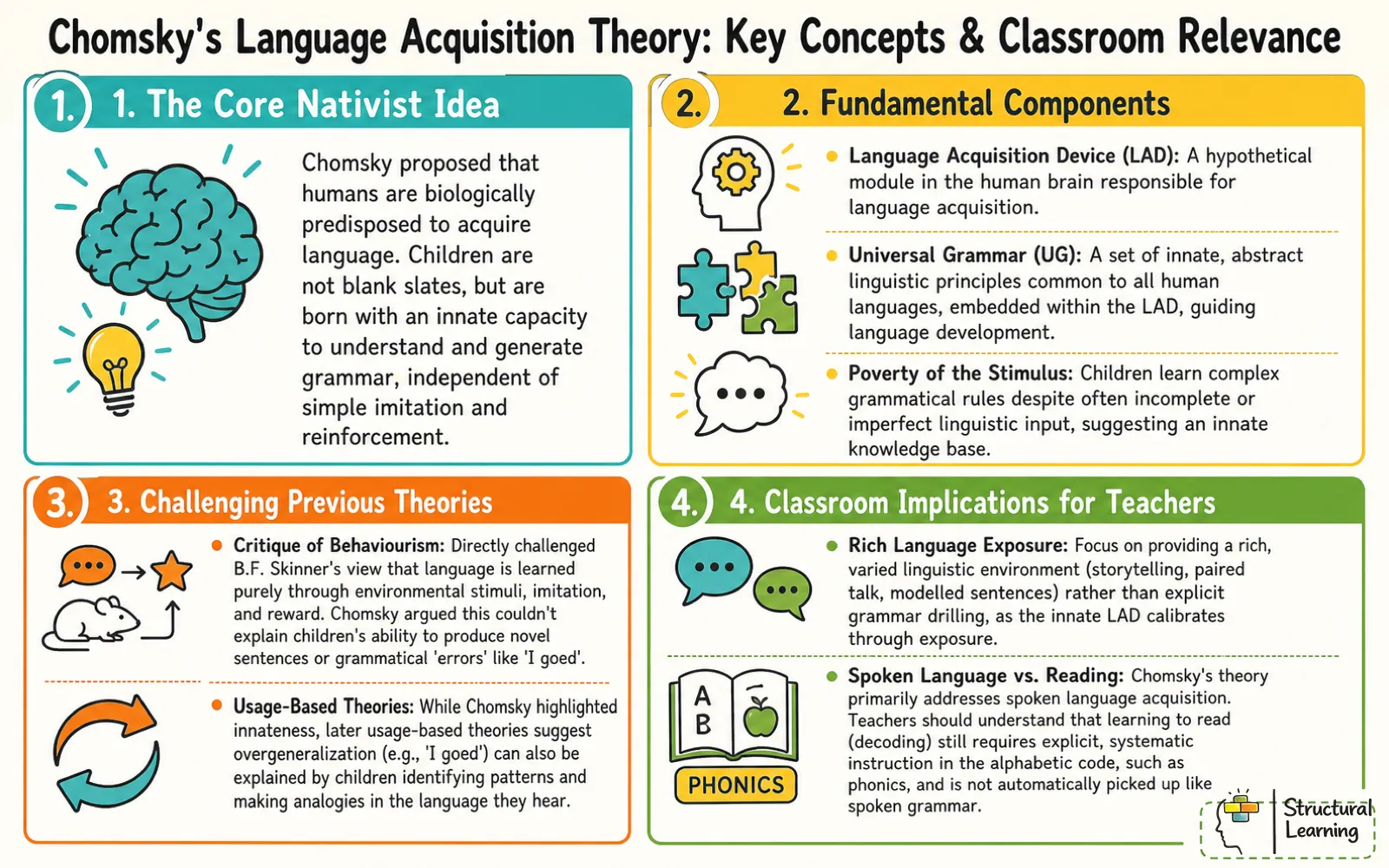
The most important classroom point comes first: Chomsky wrote about spoken language, not reading. Children acquire the grammar of their home language without lessons, but they do not acquire reading in the same way, and Castles, Rastle and Nation (2018) show that reading requires explicit teaching of how letters correspond to sounds. The theory should therefore never be used to argue that learners will learn to read simply by being surrounded by books.
Chomsky's theory of language, often called his theory of language acquisition, makes three linked claims. First, all human languages share deep structural rules. Second, children are born knowing the outline of those rules. Third, that inborn knowledge is why children learn language so fast from so little. He set out the first version in Syntactic Structures (Chomsky, 1957) and the claims about children in Aspects of the Theory of Syntax (Chomsky, 1965).
Before Chomsky, the dominant view came from behaviourism: B. F. Skinner (1957) treated language as behaviour, acquired through imitation and shaped by reinforcement. Chomsky's (1959) review of Skinner's book argued that this explanation could not work, because children say sentences they have never heard, make errors that no adult makes, and reach a working grammar at roughly the same age in very different homes.
Chomsky compared language to a biological organ, such as the visual system, which develops in each child when it meets the right input. The input matters, because a child in Leeds acquires English and a child in Lahore acquires Urdu, but on this view experience triggers development rather than building the grammar from scratch. His work helped launch the shift in psychology towards studying the mind, the same movement that later produced working memory research.
Chomsky's ideas changed a great deal over sixty years, so it helps to know which version a source means. The 1960s theory talked about deep structure and surface structure. The 1980s version, called principles and parameters, is the one most teacher guides describe (Chomsky, 1986). Since the 1990s, Chomsky's minimalist approach has stripped Universal Grammar back to very little. It may be a single operation called Merge, which joins two items into one (Berwick and Chomsky, 2016).
Universal Grammar is the set of grammatical principles that Chomsky believed every human is born with and that all languages share. It is not the grammar of English or French but a set of constraints on what any possible human grammar can look like, so a child's task, on this view, is to discover which options their own language has selected.
Chomsky's best-known illustration concerns how English forms yes-or-no questions. Starting from "The boy is happy", you move "is" to the front to produce "Is the boy happy?", so a child could easily infer a simple rule: move the first "is" to the front.
Now try a longer sentence: "The boy who is tall is happy." The simple rule gives "Is the boy who tall is happy?", which no English speaker says. The correct question moves the "is" from the main part of the sentence: "Is the boy who is tall happy?" The rule depends on the structure of the sentence, not on the order of the words.
Crain and Nakayama (1987) asked children aged three to five to form questions like these, and the children did not make the "move the first is" error. Chomsky argued that children rarely hear the sentences that would teach them the correct rule, so the preference for structure must be innate. This reasoning is the core of the poverty of the stimulus argument, which is discussed in more detail below.
In the 1980s version, Universal Grammar has two parts. Principles hold for every language, such as the rule about structure above. Parameters are settings that vary between languages, a bit like switches (Chomsky, 1986).
Word order is the classic example of a parameter. English places the verb before its object ("eat the cake"), whereas Japanese places it after ("keeki o taberu", literally "cake eat"). According to this view, children do not learn word order from scratch; they hear enough of their language to set the parameter, and a cluster of related patterns follows automatically.
For teachers of learners who are new to English, this is a useful perspective even if you doubt the full theory. A learner whose home language places the verb last is not starting from zero, because they already possess a complete working grammar; what they need is extensive English input and targeted practice wherever the two languages differ.
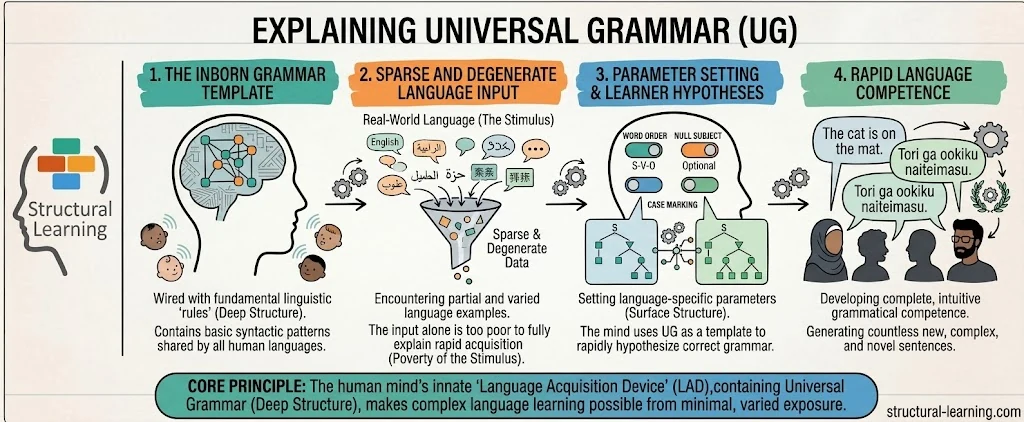
The sketchnote summarises the theory as Chomsky presented it: an inborn grammatical template, sparse and varied input, parameters set by experience, and finally fluent, original speech. Treat it as a diagram of the claim rather than as proof, because the evidence section below shows where each step is well supported and where researchers still disagree.
The Language Acquisition Device, or LAD, is Chomsky's name for the inborn mental ability that lets a child turn the speech they hear into a grammar. He described it in the 1960s, most fully in Aspects of the Theory of Syntax (Chomsky, 1965). Speech goes in, the LAD checks it against Universal Grammar, and a grammar of the child's own language comes out.
The LAD is not a structure you could identify on a brain scan; it is an abstract description of what the mind must be able to do. Brain regions such as Broca's area certainly process language, but they are not the LAD, and they contribute to other functions as well. In later work, Chomsky largely abandoned the term and referred instead to the "language faculty".
In 2002, Chomsky and two colleagues narrowed the claim sharply. They suggested that the only part of the language faculty unique to humans may be recursion (Hauser, Chomsky and Fitch, 2002). Recursion is the ability to put one structure inside another without limit. "The dog that chased the cat that ate the rat" is recursion at work. Many summaries of the LAD still describe the older, much bigger version.
Jerome Bruner accepted that children arrive ready for language, but his point was that readiness is not enough. A child also needs a Language Acquisition Support System, or LASS: the shared routines, games and patient adults that make talk meaningful (Bruner, 1983). Peekaboo, story time and "What's that?" at snack time are the LASS in action.
Chomsky's theory is called nativist because it holds that key knowledge is native, or inborn, rather than learned. The opposite view is empiricist: the mind starts with general learning abilities and builds knowledge from experience. Nativists do not say experience is unimportant. They say experience alone could not produce what every child ends up knowing.
The central argument for nativism is the poverty of the stimulus. "Stimulus" refers to the speech a child hears, and "poverty" means that it is too limited to explain the result: adult conversation is full of half-sentences and false starts, and children are rarely corrected on grammar, often ignoring the corrections they do receive. Nevertheless, by school age they can produce and judge sentences they have never heard.
Jean Berko Gleason demonstrated this with a famous experiment (Berko, 1958). She showed young children a picture of an invented creature, called it a "wug", then showed two of them and asked the children to complete the sentence "There are two...". Children as young as four answered "wugs", even though they could never have heard the word before, which means they were applying a general rule for plurals rather than copying something they had heard.
Other evidence comes from children who build language with little help. Deaf children in Nicaragua first came together in new schools in the late 1970s and created a new sign language. Younger children who joined later made it more regular than the signing they learned from older ones (Senghas and Coppola, 2001). Nativists see this as the language faculty filling gaps in the input.
Critics accept that children go beyond what they hear, but they question whether that needs inborn grammar. Pullum and Scholz (2002) searched real collections of speech and writing and found that the key example sentences are rare, but not absent. Simple computer learners have also picked up some classic "unlearnable" patterns from ordinary input (Regier and Gahl, 2004).
Infants are also far better learners than the 1960s assumed. Eight-month-olds can track which sounds tend to follow which after two minutes of listening (Saffran, Aslin and Newport, 1996). Children who can find patterns in sounds may find patterns in grammar too. So the debate is no longer whether children have inborn abilities. It is whether those abilities are specific to grammar.
The quickest way to understand Chomsky is to see whose ideas he was opposing and which researchers have since argued back. The diagram below sets out four accounts of where a child's grammar comes from, together with what each account suggests a teacher should do when a learner says "I goed".
Skinner's account is the one Chomsky took apart for grammar, but it still has a place. Praise, modelling and practice do shape routines, vocabulary and talk habits. Read more in our guide to Skinner's operant conditioning. Where Skinner struggles is the creative part of grammar: the new sentences nobody has modelled.
Piaget and Chomsky debated face to face at Royaumont Abbey, near Paris, in 1975 (Piattelli-Palmarini, 1980). Piaget argued that language grows out of general thinking, so a child must grasp an idea before they can talk about it. Chomsky argued that language has its own timetable. Piaget's stages of cognitive development remain useful for planning. On grammar, though, most linguists sided with Chomsky: language is not just a by-product of thinking.
Vygotsky started from the social side: for him, language first exists between people and only later becomes an instrument of individual thought (Vygotsky, 1978). His zone of proximal development describes what a learner can achieve with conversation and support that they cannot yet manage alone. Bruner's LASS and the concept of scaffolding learners' talk developed from the same tradition (Wood, Bruner and Ross, 1976).
Tomasello (2003) offers the strongest contemporary alternative. In his usage-based account, children first learn whole phrases such as "Where's the..." or "I want...", and only gradually notice which slots in those phrases can vary. Studies of early speech find that most of it is organised around particular words in exactly this way (Tomasello, 2000), so on this view grammar is constructed from use rather than switched on.
Which account should a teacher believe? You do not need to choose one in order to teach well, because although the nativist and usage-based camps disagree about the origin of grammar, they agree that children need a great deal of rich, meaningful talk and that errors are evidence of learning.
Here is the evidence most often used for Universal Grammar, what supporters say it shows, and how critics answer. Read across each row. The last column is our summary of where the debate stands today.
| Evidence | Supporters say | Critics reply | Where it stands |
|---|---|---|---|
| Errors such as "I goed" and "wugs" (Berko, 1958) | Children use rules they were never taught. | Hearing many regular verbs predicts the same errors through pattern-finding. | Shows rule use. Does not settle where rules come from. |
| Questions depend on sentence structure (Crain and Nakayama, 1987) | Children never try the simple word-order rule. | The key sentences do occur in real speech (Pullum and Scholz, 2002). | The strongest nativist argument, still defended (Berwick et al., 2011). |
| Speed and similar milestones | Children everywhere reach a working grammar by about age five. | Children differ a lot in pace. Back-and-forth talk at home predicts language skills (Romeo et al., 2018). | Readiness is real. How much is grammar-specific is open. |
| New languages made by children (Senghas and Coppola, 2001) | Children add grammar that the input lacked. | Children tidy up messy input, which general learning can also do. | Strong evidence that children shape language, not just copy it. |
| A critical period (Johnson and Newport, 1989) | Grammar is learned best early, as a maturing faculty predicts. | Age effects are gradual, not a sharp cut-off. | Age matters, most for accent and fine grammar. |
| Shared features across languages | All languages share deep properties. | Languages differ far more than expected, with few true universals (Evans and Levinson, 2009). | The weakest pillar today. |
Weighed as a whole, the evidence supports a strong inborn readiness for language. It is much less clear that this readiness contains grammar itself. Dąbrowska (2015) reviews each argument and concludes that general learning abilities may explain the facts better. Supporters reply that statistical learning needs a built-in set of options to work within (Yang, 2004; Lidz and Gagliardi, 2015).
The summary above draws on nine studies representing both sides of the debate; it is a map of the argument rather than a vote. For teachers, the practical point is that both positions predict the same good practice: rich, responsive talk and frequent opportunities for learners to use new patterns.
Chomsky's theory is still influential, but it is no longer the default view of how children acquire language. Inside theoretical linguistics it remains central, now in its minimalist form. In child development research, many researchers favour usage-based or statistical learning accounts (Tomasello, 2003). Few researchers on either side still defend a large, detailed grammar module present at birth.
So when a source says "Chomsky proved that grammar is innate", treat it with care. He made a powerful argument that transformed the field, and his 1959 review ended behaviourism as a complete theory of language. But the content of Universal Grammar has shrunk with each version, and critics say it now predicts little that can be tested (Dąbrowska, 2015).
Critics raise five recurring limitations. First, Universal Grammar is difficult to test, because each revision of the theory has changed what it predicts. Second, genuine universals shared by every language turn out to be rare (Evans and Levinson, 2009). Third, children hear richer input than the poverty of the stimulus argument assumed (Pullum and Scholz, 2002).
Fourth, the theory concentrates on grammatical structure and says little about how children learn to use language socially, to take turns, persuade or explain, which Bruner (1983) and Vygotsky (1978) placed at the centre. Fifth, it describes an idealised adult speaker rather than real variation between learners, so it offers teachers no direct guidance on reading, writing or learners who need extra support.
Chatbots have given the debate a new twist. Large language models learn to write fluent English from text alone, with no built-in grammar, which looks like a victory for learning from input. However, they need many thousands of times more words than any child hears (Frank, 2023), and that gap suggests children bring something powerful to the task, whatever it eventually turns out to be.
The classroom lesson is straightforward: fluent output is not the same as understanding. A learner who says "I goed" is reasoning about grammatical rules, so asking a class why "goed" sounds logical but "went" is correct becomes a genuine lesson in how English grammar works.
Lenneberg (1967) proposed a critical period: a biological window, closing around puberty, when language is learned most easily. Chomsky's theory fits this idea, since a maturing ability would be most open early on. The evidence is real, but the window closes gradually rather than slamming shut.
Johnson and Newport (1989) tested adults who had moved to the United States at different ages. Those who arrived before about age seven reached native-like grammar, and scores declined steadily with later arrival. The case of Genie, a girl kept in isolation until she was thirteen, points in the same direction, although a single case of severe neglect cannot tell us much on its own (Curtiss, 1977).
Two points matter for EAL and MFL teachers. First, older learners are not failing, since they bring strengths that young children lack: they can use deliberate strategies, read, and compare the new language with their first. Second, the hardest aspects for late starters are pronunciation and fine points of grammar, so rich conversation should be combined with explicit teaching of the patterns that differ from the home language. Our guide to teaching modern foreign languages covers the practical side.
The next section translates all of this into classroom practice. The strategies work whether you lean towards Chomsky or towards his critics, because both camps agree on the conditions that help children talk more, and talk better.
Chomsky never proposed a teaching method, and he explicitly warned against deriving one from his linguistics. Nevertheless, his theory and its critics agree on more classroom practice than you might expect, as the phase-by-phase summary below shows.
| Phase | What you might hear | What to do | Why |
|---|---|---|---|
| EYFS (Nursery and Reception) | "Me want juice." "Two sheeps." | Name, expand and recast in play: "You want juice? Here's your juice." Share rhymes and stories every day. | Children build grammar from lots of meaningful talk. A recast gives the right model without stopping the chat. |
| KS1 | "I goed to the park." "He runned." | Recast, then ask a question that needs the form: "You went? Where did you go?" Use story retells with sentence stems. | Errors show rule use. A follow-up question gets the learner to try the form. |
| EAL, any age | "He go school yesterday." "Why you are sad?" | Value the home language. Pre-teach key phrases. Practise the patterns that differ from the first language. | Learners already have a full grammar. They need English input and targeted practice. |
| KS3 MFL | Learned phrases that fall apart in new sentences | Teach high-frequency patterns explicitly, then recycle them in speaking tasks that change one slot at a time. | Older learners gain from explicit teaching. Usage-based work shows grammar grows by varying known patterns. |
| Reading, all phases | Fluent talkers who cannot decode new words | Teach phonics explicitly and systematically. | Speech comes naturally. Reading does not (Castles, Rastle and Nation, 2018). |
In a Year 1 class, a learner shares weekend news: "At the weekend I goed to my nan's and we eated cake." Rather than stopping the learner or saying that the words are wrong, the teacher replies, "You went to your nan's and ate cake? Lucky you! What did you do when you went there?", and the learner answers, "We went to the shop."
That brief exchange achieved three things: it kept the conversation going, it modelled the irregular forms "went" and "ate", and its question invited the learner to use "went" independently, which they did. Lyster and Ranta (1997) found that recasts on their own frequently pass learners by, whereas prompts that ask learners to reformulate their answer led to considerably more uptake. The recast coach below combines both steps for six common errors.
Keep recasts light and frequent, because they work best inside real conversation rather than as a correction routine. If a learner's speech is well behind their peers across many settings and over months, record examples and talk to your SENCo. That is a question for a specialist, not for grammar practice.
Teachers on social media rarely mention Chomsky by name. When his ideas surface, it is usually as a half-remembered claim that learners will simply pick grammar up, and many teachers report being told exactly that during training before deciding to push back. A single teacher's account is not research, but these posts reveal where the theory is being misapplied.
Teachers on social media are not planning lessons around Universal Grammar. They are arguing about one idea that grew out of it: that learners will absorb grammar, spelling and reading without being taught. Here is what they describe doing, and what the research says.
| Routine, as teachers describe it | What you would notice | What the evidence says |
|---|---|---|
| Putting short grammar teaching back into English lessons | ||
I was told throughout my teacher training that teaching grammar is a waste of time because kids just naturally pick it up. |
Learners who talk fluently but lose control of tense and agreement when they write. | Children acquire spoken grammar without lessons, but writing is a different task. Brief, explicit teaching tied to real writing has a place. |
| Teaching English learners verb forms, without the labels | ||
Yes, don’t teach the words noun, verb, etc. But they must know how to conjugate verbs! |
Learners who understand well but still say "He go" or "Yesterday I eat". | Recasts alone are often missed. Prompts that ask the learner to try the form again lead to more uptake (Lyster and Ranta, 1997). |
| Building up phrases in a new language before naming the rules | ||
I don’t do a lot of direct grammar instruction until students have enough background knowledge |
Learners who use whole chunks such as "Where is...?" correctly before they can explain them. | Early grammar is largely built around particular words and phrases, then generalised (Tomasello, 2000). |
| Teaching learners to sound out words, not wait for reading to arrive | ||
I’d get 4th graders who didn’t know how to sound words out. |
Confident talkers who guess words from pictures or first letters. | Speech develops through exposure; reading needs explicit phonics teaching (Castles, Rastle and Nation, 2018). |
Notice the pattern across these accounts: none of these teachers rejects rich talk. What they reject is the jump from "children learn to speak without lessons" to "so nothing needs teaching". That jump is not in Chomsky's work, and the evidence on reading and on second languages does not support it.
Four accounts from teachers on social media: three on being told that learners absorb language without teaching, and one on explicit teaching done badly.
They were told its not a priority anymore and that kids will learn it on their own
I was a FRENCH teacher. NO, they do not “just pick it up.”
Learning a new language from scratch & not immersed in it (as in bilingualism) involves some explicit learning of a different grammar, to talk, read & write.
I have seen terrible bits of MFL writing when people have ticklists of features to include.
The common thread is timing and balance. Talk comes first and matters most in the early years, and explicit teaching then joins it for reading, writing and additional languages. The three mistakes below are the ones these teachers repeatedly encounter.
Do not use Chomsky to argue against teaching grammar. Children acquire the grammar of their first language without lessons, but naming grammatical features, controlling them in writing and learning an additional language are different tasks, so brief, explicit grammar teaching linked to real reading and writing has a clear place. Our guide to building better sentences shows how.
Do not treat reading as natural, which is the most costly misreading of Chomsky. Speech develops through exposure, but reading is a cultural invention. It needs explicit teaching of the code (Castles, Rastle and Nation, 2018). Our guide to theories of reading, from phonics to whole language explains why.
Do not interpret errors as failure. Forms such as "I goed", "two mouses" and "Why you are sad?" are evidence of a learner constructing a system, so acknowledge the reasoning and then model the conventional form. For a broader view of classroom talk, see our guide to oracy and language development.
Use the quiz above as a quick check after reading, or as a ten-minute starter for a staff meeting on language development. Each answer explains the thinking behind it, so wrong answers become talking points.
Chomsky's theory says children are born with a built-in sense of how grammar works, called Universal Grammar. The speech they hear sets the details for their own language. That, he argued, is why young children learn complex grammar quickly and make logical errors like "I goed".
The classic example is that grammar rules follow sentence structure, not word order. Children form "Is the boy who is tall happy?" and never "Is the boy who tall is happy?", even though a simple "move the first is" rule would give the second. Chomsky argued that this preference is built in.
No. The LAD is better understood as a job description than as a body part, because it names what a child's mind must accomplish to learn grammar from speech. Brain imaging shows language processing distributed across a network of areas, and none of them functions as the single device Chomsky described.
Chomsky developed the idea in the early 1960s and set it out most fully in Aspects of the Theory of Syntax in 1965. His 1959 review of Skinner's Verbal Behavior laid the ground by arguing that behaviourism could not explain how children learn grammar.
Its strengths are that it explains how fast children learn, why they make rule-based errors and why they can say new sentences. Its weaknesses are that Universal Grammar is hard to test, true universals are rare, children hear richer input than first assumed, and it says little about the social use of language.
Partly. His case against behaviourism is widely accepted, and his work still shapes linguistics. But many child development researchers now favour usage-based accounts, where grammar is built from the patterns children hear. Most agree that children bring some inborn readiness; they disagree about whether it includes grammar.
Teachers use it to give learners rich, responsive talk rather than grammar drills, to treat errors as signs of learning, and to recast errors while keeping the conversation going. It also reminds EAL teachers that new arrivals already have a full grammar. It does not apply to reading, which needs explicit phonics teaching.
Try one thing tomorrow: pick a learner whose grammar errors you notice, and answer each one with a recast plus a question that asks them to use the form. Then read our overview of the key learning theories for teachers to see where Chomsky sits beside Piaget, Vygotsky and Skinner.
Berko, J. (1958). The child's learning of English morphology. Word, 14(2-3), 150-177.
Berwick, R. C., & Chomsky, N. (2016). Why only us: Language and evolution. MIT Press.
Berwick, R. C., Pietroski, P., Yankama, B., & Chomsky, N. (2011). Poverty of the stimulus revisited. Cognitive Science, 35(7), 1207-1242.
Bruner, J. (1983). Child's talk: Learning to use language. W. W. Norton.
Castles, A., Rastle, K., & Nation, K. (2018). Ending the reading wars: Reading acquisition from novice to expert. Psychological Science in the Public Interest, 19(1), 5-51.
Chomsky, N. (1957). Syntactic structures. Mouton.
Chomsky, N. (1959). A review of B. F. Skinner's Verbal Behavior. Language, 35(1), 26-58.
Chomsky, N. (1965). Aspects of the theory of syntax. MIT Press.
Chomsky, N. (1986). Knowledge of language: Its nature, origin, and use. Praeger.
Crain, S., & Nakayama, M. (1987). Structure dependence in grammar formation. Language, 63(3), 522-543.
Curtiss, S. (1977). Genie: A psycholinguistic study of a modern-day "wild child". Academic Press.
Dąbrowska, E. (2015). What exactly is Universal Grammar, and has anyone seen it? Frontiers in Psychology, 6, 852.
Evans, N., & Levinson, S. C. (2009). The myth of language universals: Language diversity and its importance for cognitive science. Behavioral and Brain Sciences, 32(5), 429-448.
Frank, M. C. (2023). Bridging the data gap between children and large language models. Trends in Cognitive Sciences, 27(11), 990-992.
Hauser, M. D., Chomsky, N., & Fitch, W. T. (2002). The faculty of language: What is it, who has it, and how did it evolve? Science, 298(5598), 1569-1579.
Johnson, J. S., & Newport, E. L. (1989). Critical period effects in second language learning: The influence of maturational state on the acquisition of English as a second language. Cognitive Psychology, 21(1), 60-99.
Lenneberg, E. H. (1967). Biological foundations of language. John Wiley and Sons.
Lidz, J., & Gagliardi, A. (2015). How nature meets nurture: Universal Grammar and statistical learning. Annual Review of Linguistics, 1, 333-353.
Lyster, R., & Ranta, L. (1997). Corrective feedback and learner uptake: Negotiation of form in communicative classrooms. Studies in Second Language Acquisition, 19(1), 37-66.
Piattelli-Palmarini, M. (Ed.). (1980). Language and learning: The debate between Jean Piaget and Noam Chomsky. Harvard University Press.
Pullum, G. K., & Scholz, B. C. (2002). Empirical assessment of stimulus poverty arguments. The Linguistic Review, 19(1-2), 9-50.
Regier, T., & Gahl, S. (2004). Learning the unlearnable: The role of missing evidence. Cognition, 93(2), 147-155.
Romeo, R. R., Leonard, J. A., Robinson, S. T., West, M. R., Mackey, A. P., Rowe, M. L., & Gabrieli, J. D. E. (2018). Beyond the 30-million-word gap: Children's conversational exposure is associated with language-related brain function. Psychological Science, 29(5), 700-710.
Saffran, J. R., Aslin, R. N., & Newport, E. L. (1996). Statistical learning by 8-month-old infants. Science, 274(5294), 1926-1928.
Senghas, A., & Coppola, M. (2001). Children creating language: How Nicaraguan Sign Language acquired a spatial grammar. Psychological Science, 12(4), 323-328.
Skinner, B. F. (1957). Verbal behavior. Appleton-Century-Crofts.
Tomasello, M. (2000). The item-based nature of children's early syntactic development. Trends in Cognitive Sciences, 4(4), 156-163.
Tomasello, M. (2003). Constructing a language: A usage-based theory of language acquisition. Harvard University Press.
Vygotsky, L. S. (1978). Mind in society: The development of higher psychological processes. Harvard University Press.
Wood, D., Bruner, J. S., & Ross, G. (1976). The role of tutoring in problem solving. Journal of Child Psychology and Psychiatry, 17(2), 89-100.
Yang, C. D. (2004). Universal Grammar, statistics or both? Trends in Cognitive Sciences, 8(10), 451-456.